

Published on: November 9, 2024 / Updated on: November 9, 2024 – Author: Konrad Wolfenstein
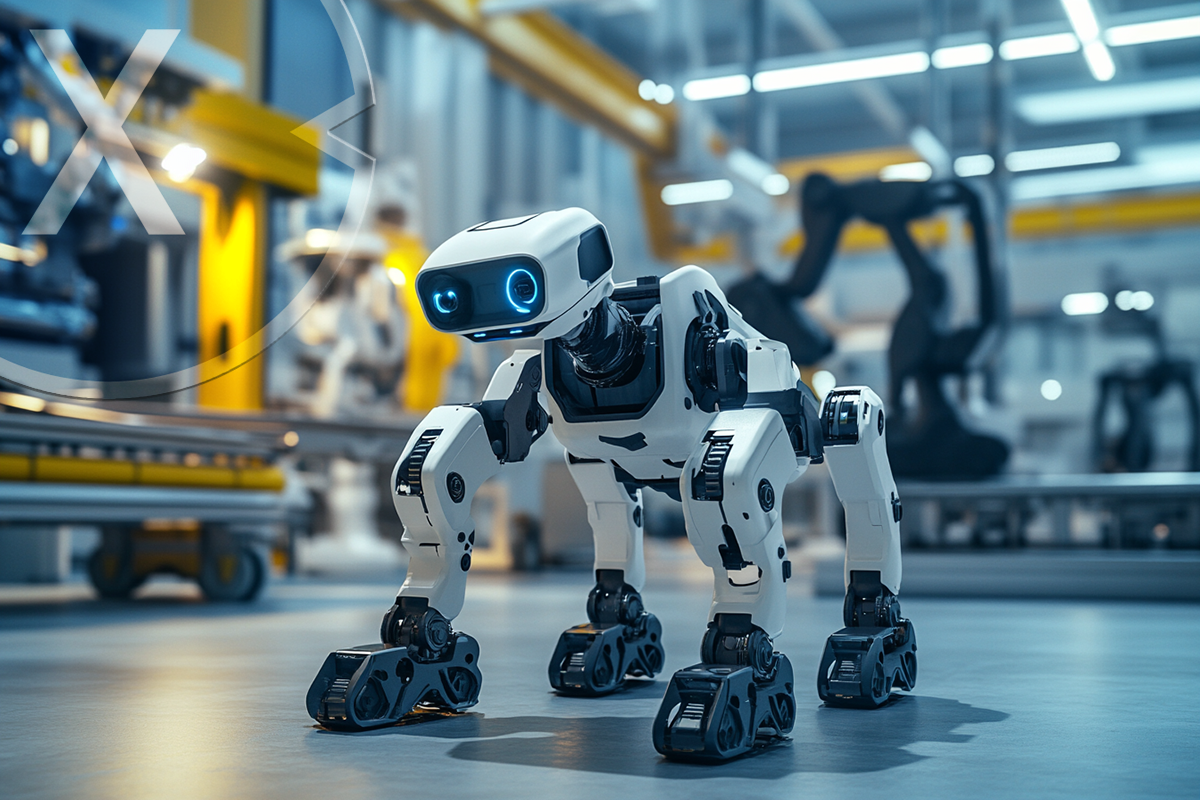
Quadrupedal robotics in cities and factories? – Image: Xpert.Digital
Quadruped Pioneers: Automation in Cities and Factories on Four Legs
🐶 Learning from four-legged friends: Efficient city and factory automation
The vision of the future is increasingly shaped by modern technologies and automation, with quadruped robots playing a crucial role. These four-legged machines, often modeled after animals like dogs, are not only fascinating developments in robotics, but they will also significantly shape our cities and factories of the future. Their versatility and ability to operate on rough terrain open up entirely new possibilities for creating a smarter, more efficient, and safer environment. This article will explore how these robots are influencing the future of smart cities and smart factories, and what challenges and opportunities this presents.
The basics of quadruped robotics and how it works
Quadruped robots, or four-legged robots, are based on complex motion algorithms and advanced sensor systems, giving them high mobility and adaptability. Compared to traditional two-wheeled or tracked robots, quadruped robots offer increased stability and can move effortlessly across a wide variety of terrain. Their sensory equipment typically includes cameras, lidar (laser rangefinders), and accelerometers, allowing them to precisely analyze their surroundings and adapt accordingly. This agility and precision in movement is crucial for successful operation in challenging environments, whether on a construction site, in a disaster area, or in a production hall.
A key aspect of quadruped robotics is the ability to move autonomously or remotely. The advanced motion control algorithms are often based on machine learning and artificial intelligence (AI), enabling the robots to independently avoid obstacles and calculate the most efficient routes. This allows them to autonomously perform even complex tasks such as inspections or transporting materials.
Potential applications in the Smart City: Efficiency and security
In the smart city, a city designed to simplify and make people's everyday lives more sustainable through digitalization and networking, quadruped robots could play a crucial role. Significant potential lies in the area of public safety and surveillance. Thanks to their ability to reach even difficult-to-access locations, they could assist in monitoring construction projects, infrastructure, or emergency situations. One example would be the use of quadruped robots in inspecting bridges or tunnels, where worker safety is at stake. Such robots could contribute to verifying structural integrity, thus identifying and reporting potential hazards early on.
Furthermore, quadruped robots could serve as rapid support in emergency response. In disasters such as earthquakes, floods, or fires, they could assist emergency services in locating victims and potentially delivering medical supplies. Their ability to navigate rough terrain and overcome obstacles is particularly valuable in such situations. They could, for example, utilize thermal imaging cameras and pollutant sensors to identify hazardous areas without endangering human lives.
Beyond security aspects, there are also numerous applications in the area of infrastructure maintenance. Smart cities rely on automation and networking to utilize resources more efficiently, and quadruped robots can be used, for example, to inspect utility lines and sewers. Because these robots can operate autonomously or semi-autonomously, they reduce the need for time-consuming and costly manual inspections and maintenance. Furthermore, they can be deployed around the clock, allowing problems to be quickly identified and resolved before they lead to major outages.
Further development in the Smart Factory: Flexibility and precision
Quadruped robots are also finding increasingly widespread use in industrial production, particularly in so-called "smart factories" that operate in a fully networked and automated manner. Here, flexibility and precision are paramount, as these robots are capable of moving safely and efficiently even in complex, dynamic environments. One advantage over traditional, stationary robots is the mobility of quadrupeds, which allows them to react flexibly to changes in the production line or even to transport materials independently from one place to another.
Another area of application in smart factories is the inspection and monitoring of machines and equipment. While traditional monitoring methods often rely on permanently installed sensors and cameras, quadruped robots can navigate autonomously through production halls and perform various measurements. For example, they could monitor the temperature and condition of machines, detect faults, and thus help minimize production downtime. The flexibility of these robots also allows them to be adapted quickly to changing production requirements, making them ideal assistants in an increasingly dynamic and variable manufacturing environment.
Quadruped robots could also contribute to increased employee safety. In hazardous or inaccessible work areas, they could take over inspection tasks where people would otherwise be exposed to potential hazards. Furthermore, they can help measure and report toxic gases or extreme temperatures, thereby reducing the risk to human workers.
Artificial intelligence and machine learning as key drivers
A key factor in the further development and performance of quadruped robots is the integration of artificial intelligence and machine learning. These technologies enable the robots to learn from their experiences and continuously improve their efficiency. They are able to recognize patterns, optimize routes, and even react to previously unknown situations. Through machine learning, quadruped robots can, for example, learn to overcome complex obstacles or react more quickly to unexpected situations, which significantly increases their usability in dynamic and unpredictable environments.
The integration of AI also allows robots to be improved beyond purely mechanical functions. This enables robots not only to recognize objects, but also to make decisions and perform tasks that were previously the sole domain of humans. In a smart factory, for example, quadruped robots could not only check the condition of a machine, but also predictively analyze when maintenance is required, thus taking preventative action.
Challenges and ethical questions
Despite the many advantages that quadruped robots offer, there are also a number of challenges and ethical questions that need to be considered. The use of such robots raises questions about data protection and privacy, especially in public areas like smart cities. Robot surveillance could be perceived as an invasion of privacy, which is why clear guidelines and laws are needed to ensure responsible use.
The question of security also plays a role. As quadruped robots increasingly operate autonomously and make complex decisions, it is important that their systems are protected against hacking and misuse. This requires continuous monitoring and improvement of security protocols.
Another aspect concerns the world of work and its potential impact on jobs. The automation of inspection and maintenance tasks by robots could lead to a decline in the human workforce in some sectors. At the same time, however, new fields of work are opening up, for example in the development, maintenance, and monitoring of these robots. It is therefore important that society and policymakers work together to take measures to guide the transition to an increasingly automated working world and ensure that no social inequalities arise.
Shaping the future with quadruped robots
Quadruped robots have the potential to significantly influence the development of smart cities and smart factories. Their mobility, adaptability, and ability to perform complex tasks offer a multitude of opportunities to make cities and factories more efficient, safer, and more sustainable. At the same time, however, the challenges and ethical questions must be addressed to ensure the responsible and sustainable use of this technology.
With the increasing integration of artificial intelligence and machine learning, the potential of quadruped robots will continue to grow, and they will become present in more and more areas of daily life. From providing support in disaster situations to optimizing industrial production, they could become valuable helpers that enrich everyday life and improve quality of life.
Suitable for: