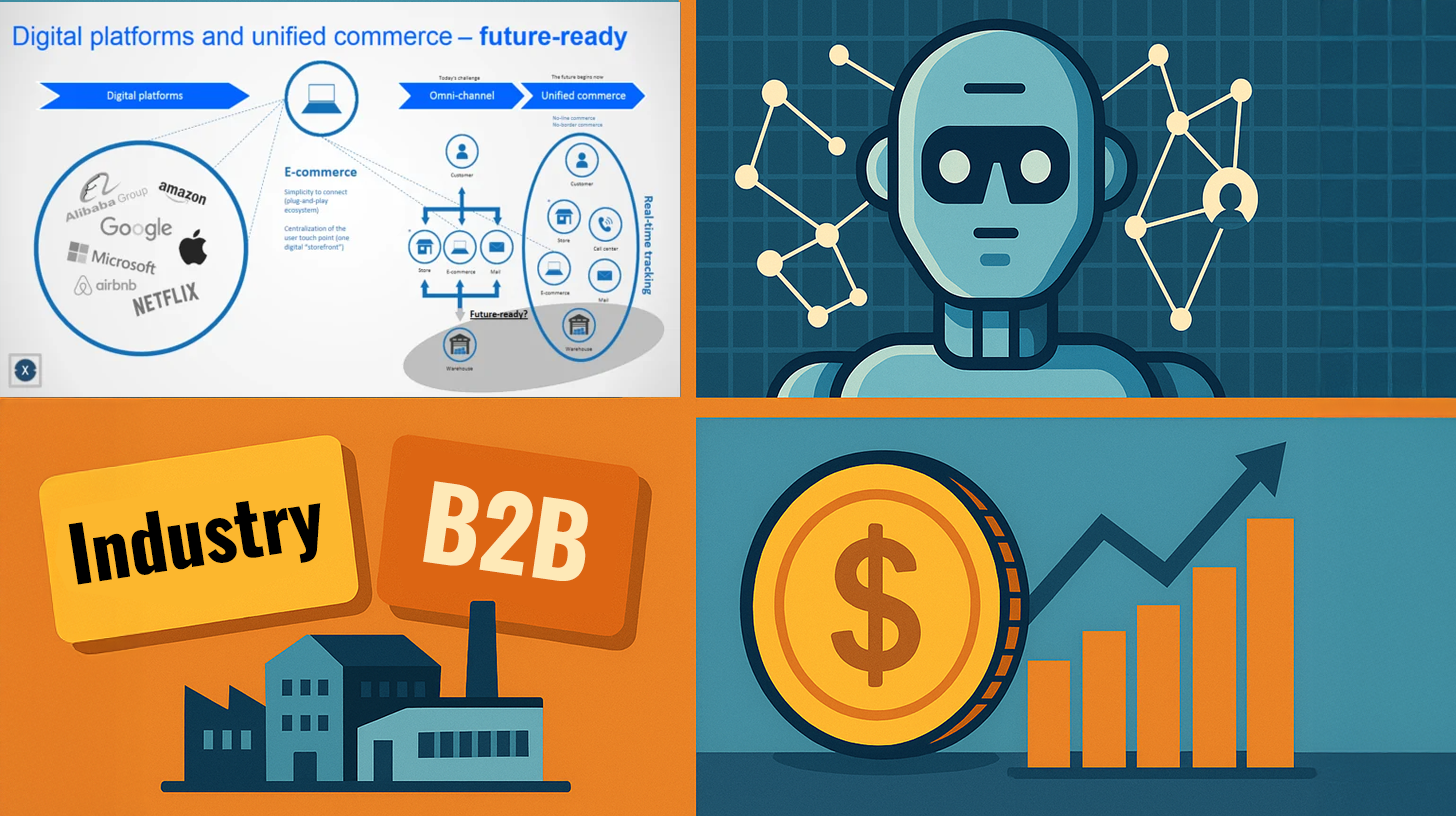
Platform economy in transition: Developments from September 2018 to September 2025 – Image: Xpert.Digital
Europe and Africa continue to play no significant role in the platform world
### Germany's Digital Paradox: From "New Territory" to Laggard – with a Surprising Forecast ### The Silent Revolution: How AI Has Completely Transformed the Platform Giants Since 2018 ### More Than Just Amazon: Why New Players Like Temu and B2B Are Now Completely Changing the Rules of the Game ### $40 Trillion Market: Who Are the Winners and Losers of the New Platform Era?
Forget 2018: This is why everything is different today in the platform world, from AI to regulation
What can happen in seven years? In the world of digital platforms, it's nothing short of a revolution. A market already valued at a remarkable $7 trillion in 2018 has grown into a $40 trillion behemoth by 2025—a truly unimaginable explosion of digital capital. Back then, in 2018, we analyzed the emerging platform economy as a model in which digital marketplaces like Amazon, Uber, and app stores were reorganizing the economy. The prediction was: They will fundamentally transform markets. Today we know: That prediction was an understatement.
A current look at the landscape, however, reveals more than just exponential growth. The rules of the game have fundamentally changed, and the balance of power has shifted dramatically. While US and Asian tech giants are breaking valuation records, Europe and Africa risk becoming digital colonies with a marginal share of this future market. At the same time, a technology that barely featured in the analysis in 2018 has changed everything: Artificial intelligence has become the new engine of the platform world, redefining efficiency, personalization, and entire business models. This transformation is accompanied by a growing concentration of market power, the rise of new, aggressive players like Temu, and attempts by policymakers to end the digital Wild West phase with regulations such as the DMA and DSA. The following analysis delves deeply into these developments, revealing who the winners and losers of this new era are and why, despite progress, Germany risks falling behind completely.
Related to this:

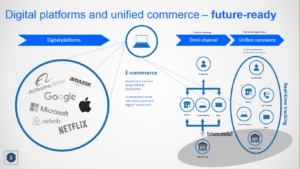
From 7 to 40 trillion: How the tech world exploded – and Europe lost its connection
In September 2018, we analyzed the emerging field of platform economics. Platform economics refers to an economic model in which digital platforms act as intermediaries between suppliers and consumers. Instead of producing products or services themselves, platforms create a digital marketplace where different actors can interact with each other.
Examples:
- Amazon, eBay → connect sellers and buyers.
- Uber, Airbnb → connect service providers (drivers, landlords) and customers.
- App Stores → connect developers and users.
Mark:
- Network effects: The more participants, the more attractive the platform becomes.
- Data as a key asset: Platforms gain advantages through user data.
- Low transaction costs: Brokerage is carried out digitally and efficiently.
In short: The platform economy creates markets without necessarily being a producer or supplier itself, but rather through the organization and management of interactions.
A comparison with today's situation reveals dramatic changes in almost all areas analyzed.
Market growth and valuations
2018
In 2018, approximately 500 existing digital platforms were documented, with annual growth rates exceeding 20 percent. The 60 most valuable platforms were valued at $7 trillion, while all platform companies combined reached $8.5 billion.
2025
The development has accelerated exponentially. The 100 most valuable companies worldwide reached the $40 trillion mark for the first time on March 31, 2025, with a combined market capitalization of $42.6 trillion. The tech giants alone show impressive growth rates: Apple leads with a market capitalization of $3.3 trillion, followed by Microsoft ($2.8 trillion), Nvidia ($2.6 trillion), and Amazon (over $2 trillion).
Europe's position in the platform economy
2018
Europe was already lagging dramatically behind with only a 3 percent share of the global platform value, while the US controlled 67 percent and Asia 30 percent.
2025
The situation has hardly improved. Europe and Africa continue to play a negligible role in the platform world – Europe's share remains unchanged at just 2 percent. Despite the Digital Markets Act (DMA) and the Digital Services Act (DSA), Europe has fallen dangerously behind. The digital economy's share of GDP is almost 10 percent in the US, while in Europe it is only around 6 percent.
B2B procurement: Supply chains, trade, marketplaces & AI-powered sourcing

B2B procurement: Supply chains, trade, marketplaces & AI-powered sourcing with ACCIO.com - Image: Xpert.Digital
More information here:
Using AI agents for strategic purchasing: Opportunities for SMEs and large companies
Germany: From uncharted territory to digital backwardness
2018
The website cited a shocking Bitkom study: 54 percent of the German companies surveyed had never heard of the term "digital platform".
2025
Although Germany has improved, it still ranks only 14th in the EU-wide digitalization comparison. In the digital economy segment, Germany ranks 8th EU-wide, 9th in network quality, and only 15th in digital skills. At the same time, according to Forrester, Germany is projected to be the "most digitally advanced market in Europe" by 2029, with e-commerce growth of 50 percent to 146 billion euros.
B2B platforms: From niche segment to mainstream
2018
B2B platforms were still an underrepresented segment, although China was already considered an innovation driver in this area.
2025
B2B marketplaces in Germany are experiencing annual growth of 17.5 percent – significantly more than the overall e-commerce market, which is growing at 11 percent. In 2018, 30 percent of industrial companies used transaction platforms, and by 2025, another 15 percent plan to use such systems. Despite overall economic challenges, B2B e-commerce is growing steadily at 8.1 percent.
Artificial intelligence as a game changer
2018
AI did not play an explicit role in platform business models in the original analysis.
2025
AI has revolutionized the platform economy. Digital platforms are increasingly integrating artificial intelligence to improve intermediary processes and achieve a significant increase in both efficiency and quality. 92 percent of brands use AI for personalized product suggestions and chatbots. By 2025, AI integration platforms will have become indispensable tools in modern IT.
Mobility and logistics: New dimensions
2018
Uber was cited as an example with a market capitalization of over 70 billion US dollars, while Europcar was under 3 billion.
2025
Uber is currently trading at around $79 per share. Logistics platforms have continued to evolve – Amazon AWS is experiencing growth rates of 19 percent and could reach approximately $130 billion in revenue from AWS alone by 2025.
Marketplaces and e-commerce: Concentration is increasing
2018
Amazon and other marketplaces already dominated, but the concentration was less pronounced.
2025
Marketplaces have reached a 55 percent revenue share of German e-commerce. Amazon and eBay continue to dominate, while new players like Temu, with 60-100 percent annual growth in the EU, are having a disruptive effect. Online marketplaces remain the growth driver, with projected growth of 4.7 percent to around €44 billion.
Related to this:
Regulation and Governance
2018
Regulatory aspects played a subordinate role in the original analysis.
2025
The implementation of the Digital Markets Act (DMA) and Digital Services Act (DSA) in Europe has had a global impact, leading to significant adjustments in business models and technical architectures. Regulatory complexity is not only a challenge but also a source of innovation.
Accelerated change with persistent problems
While the quantitative dimensions of the platform economy have multiplied since 2018 – from a total valuation of $7 trillion to over $40 trillion – structural problems persist. Europe's marginal position has barely improved despite regulatory efforts. Although Germany has made progress, it still lags behind in international comparison.
The integration of AI, expansion into B2B markets, and increasing regulation are shaping the new phase of the platform economy. At the same time, market concentration is intensifying, while new Asian players like Temu are challenging the established order. The 2018 prediction that platforms would "fundamentally transform" the economy has proven accurate – with all the opportunities and risks that this transformation entails.
A new dimension of digital transformation with 'Managed AI' (Artificial Intelligence) - Platform & B2B solution | Xpert Consulting

A new dimension of digital transformation with 'Managed AI' (Artificial Intelligence) – Platform & B2B solution | Xpert Consulting - Image: Xpert.Digital
Here you will learn how your company can implement customized AI solutions quickly, securely and without high entry barriers.
A managed AI platform is your all-inclusive, worry-free solution for artificial intelligence. Instead of dealing with complex technology, expensive infrastructure, and lengthy development processes, you receive a ready-made solution tailored to your needs from a specialized partner – often within just a few days.
The key advantages at a glance:
⚡ Rapid implementation: From idea to ready-to-use application in days, not months. We deliver practical solutions that create immediate added value.
🔒 Maximum data security: Your sensitive data stays with you. We guarantee secure and compliant processing without sharing data with third parties.
💸 No financial risk: You only pay for results. High upfront investments in hardware, software, or personnel are completely eliminated.
🎯 Focus on your core business: Concentrate on what you do best. We take care of the entire technical implementation, operation, and maintenance of your AI solution.
📈 Future-proof & scalable: Your AI grows with you. We ensure continuous optimization and scalability, and flexibly adapt the models to new requirements.
More information here:
We are here for you - Consulting - Planning - Implementation - Project Management
☑️ SME support in strategy, consulting, planning and implementation
☑️ Creation or realignment of the AI strategy
☑️ Pioneer Business Development

Konrad Wolfenstein
I would be happy to serve as your personal advisor.
You can contact me by filling out the contact form below or simply call me on +49 7348 4088 965 .
I'm looking forward to our joint project.
Write to me


Xpert.Digital - Konrad Wolfenstein
Xpert.Digital is a hub for industry focusing on digitalization, mechanical engineering, logistics/intralogistics and photovoltaics.
With our 360° Business Development solution, we support renowned companies from new business to after-sales.
Market intelligence, smarketing, marketing automation, content development, PR, mail campaigns, personalized social media and lead nurturing are part of our digital tools.
You can find more information at: www.xpert.digital - www.xpert.solar - www.xpert.plus
Keep in touch