
Large-scale photovoltaic project “Utah Solar 1” with 300 MW: Los Angeles invests in Utah's solar energy – A business with a future – Creative image on the topic, with AI: Xpert.Digital
Utah Solar 1: Hub for renewable energy and regional development – energy supply in the American West
Large-scale photovoltaic project “Utah Solar 1” with 300 MW: Los Angeles invests in Utah's solar energy – A business with a future
Utah Solar 1: Hub for renewable energy and regional development – energy supply in the American West
Long-term contracts are key to financing solar projects
The challenges and opportunities of Utah's solar power plant for Los Angeles
Utah Solar 1 is a pioneering photovoltaic project that will not only sustainably transform the region's energy supply but also serve as an example of the complexity and opportunities of the modern energy transition. With a planned capacity of 394 megawatts of direct current and 300 megawatts of alternating current, the project represents a significant step toward a clean energy future. It impressively demonstrates how long-term power purchase agreements, existing transmission infrastructure, and tax incentives can create an economically viable model for renewable energy.
The project, developed by EDF Power Solutions North America in Millard County, Utah, symbolizes the interplay of various stakeholders – from developers and public institutions to international banks. The electricity generated here flows into the energy-intensive greater Los Angeles area, where the demand for clean energy is constantly growing. Utah Solar 1 illustrates that the energy transition is not just a technical challenge, but also a matter of economic and institutional frameworks that must work together to succeed. The coming years will show whether and how this model can serve as a blueprint for future solar projects in the American West and beyond.
Los Angeles is buying Utah's sunshine – demonstrating that the energy transition is primarily a business involving contracts, grids, and taxpayers' money
Utah Solar 1 is more than just another large photovoltaic project in a sun-drenched region of the United States. The plant exemplifies a new phase in the energy transition, where success is no longer solely determined by falling module prices and ambitious climate targets. Rather, the crucial factor is whether developers, electricity consumers, banks, grid operators, and public institutions can create an economically viable overall model. This is precisely where the project's significance lies: a variable and weather-dependent energy source, on paper, is transformed into a comparatively predictable infrastructure investment through a long-term power purchase agreement, existing transmission infrastructure, tax incentives, and international bank financing.
EDF Power Solutions North America is developing Utah Solar 1 in Millard County, Utah. The planned plant will have a capacity of 394 megawatts of direct current (DC) and 300 megawatts of alternating current (AC). Following financial close, the project will enter the full construction phase. Electricity deliveries are scheduled to begin in mid-2027. Annual generation of approximately 766,000 megawatt-hours is expected. The electricity will be purchased under a 30-year power purchase agreement with the Southern California Public Power Authority, acting on behalf of customers of the Los Angeles Department of Water and Power.
What makes this project economically interesting is the connection between different regions and interests. The added value is generated in a rural region of Utah, but the electricity flows to the greater Los Angeles area. Financing comes from international banks, while a significant portion of the project's profitability is tied to the US system of transferable production tax credits. Utah Solar 1 is therefore not just a power plant, but a hub connecting regional development, local energy policy, the capital market, federal funding, and supra-regional grid expansion.
A major project with an unusually long economic reach
The technical specifications illustrate the scale of the system. The difference between 394 megawatts of DC power and 300 megawatts of AC power is not a contradiction, but rather reflects the typical oversizing of the solar generator relative to the inverter and grid connection capacity. The ratio is approximately 1.31. This design allows the system to achieve its 300 megawatts of feed-in power for more hours, as sufficient DC power is available even during periods of lower solar irradiance. While some of the theoretically possible module power may be reduced above the inverter's limit during particularly sunny hours, this design generally improves grid connection utilization and reduces the cost per megawatt-hour delivered over the course of the year.
With an annual production of 766,000 megawatt-hours and an AC output of 300 megawatts, the calculated capacity factor is approximately 29.1 percent. For a photovoltaic project, this is a high value, but plausible for a good location in the American Southwest. Put another way, the expected annual production corresponds to about 2,553 full-load hours. The plant thus generates the same amount of electricity over the course of the year that it would produce in just over 106 days at continuous nominal output. This metric is economically important because the value of a solar project depends not only on the installed capacity, but also on the actual amount of energy sold, the generation profile over time, and the availability of transmission lines.
The 30-year contract term extends well beyond typical economic cycles and political terms of office. It binds the project and the buyer well into the second half of the 2050s. This reduces short-term price risks but simultaneously creates long-term obligations. For EDF, such a contract improves its creditworthiness because future revenues can be predicted more accurately. For the public electricity buyer, it provides long-term protection against fuel price risks and a portion of the fluctuations in the wholesale market. At the same time, it assumes the risk that the contractually agreed-upon energy might, in retrospect, be temporarily more expensive than alternative procurement options.
The electricity price makes the investment comprehensible
The contract price for the supplied energy was set at US$46.50 per megawatt-hour. Based on the expected annual production of 766,000 megawatt-hours, this results in a calculated annual revenue of approximately US$35.6 million before accounting for deviations, test energy, surplus quantities, availability provisions, tax credits, and other contract components. Over 30 years, the nominal volume of regular electricity deliveries would amount to approximately US$1.07 billion. This simple calculation is not a profit forecast but illustrates the long-term magnitude of the central revenue stream.
The contract includes differentiated pricing. Energy during start-up and testing phases is priced at US$15.58 per megawatt-hour. Excess energy is compensated at only a portion of the regular contract price; 40 percent for certain excess quantities and 25 percent for quantities exceeding a broader threshold. This ensures the developer is economically focused on reliably meeting the agreed delivery volume without designing the plant solely for the highest possible, potentially systemically valuable, surplus production.
The price of $46.50 per megawatt-hour falls within the range in which large new US solar plants can generally be competitive. However, a direct comparison with general levelized cost of electricity (LCOE) remains limited. A power purchase agreement (PPA) price can reflect grid usage, delivery point, environmental attributes, development risks, and contractual safeguards differently than a standardized LCOE calculation. Furthermore, solar power has varying values at different times of day. A megawatt-hour at midday, especially in a solar-rich market, may be less valuable than energy in the early evening. Therefore, the contract price should be viewed less as an isolated metric and more as part of a package that includes energy, long-term price stability, certificates of origin, and strategic access to renewable generation.
A purchase agreement becomes the foundation of the financing
The long-term power purchase agreement (PPA) is the key link between the technical facility and the capital market. Project financing typically relies on lenders primarily accessing the project's future cash flows and assets. The better the revenues are contractually secured and the more creditworthy the purchaser, the more likely banks are to provide substantial amounts of debt capital over longer periods and at more favorable terms.
Utah Solar 1 benefits from a public purchase agreement and a municipal utility with long-term procurement needs. This significantly reduces the traditional sales risk. The developer doesn't have to hope year after year that it can sell its entire production at profitable spot market prices. Instead, the power purchase agreement (PPA) provides a reliable basis for financial models, debt servicing, and return calculations. This reliability is particularly valuable in a period of higher interest rates, because even small changes in financing costs and risk premiums can significantly impact the profitability of capital-intensive projects.
This doesn't mean all risks disappear. Construction costs, delays, technical performance, grid availability, regulatory changes, and actual solar irradiance remain relevant. Furthermore, there are potential discrepancies between the amount of electricity generated and the amount delivered at the agreed-upon point. However, a long-term contract distributes these risks more clearly. It transforms an open market risk into a set of defined obligations, guarantees, and compensation mechanisms. This very translation of uncertainty into contractually measurable risks is a core function of modern infrastructure financing.
The contract structure also includes safeguards and financial penalties. A guarantee of US$30 million was stipulated for the development phase, increasing to US$45 million after the start of commercial operations. In case of delays, daily payments of US$163,043 may be incurred. The guaranteed output corresponds to 85 percent of the expected annual production. Such provisions protect the buyer from a project that delivers late or significantly under budget, while simultaneously providing strong incentives for EDF to manage construction, commissioning, and operation professionally.
Five banks distribute risk and capital requirements
The financing is provided by Crédit Agricole CIB, MUFG Bank, National Bank of Canada, Société Générale, and Standard Chartered Bank. MUFG acts as the administrative agent. Crédit Agricole CIB serves as the initial coordinating lead arranger, while several institutions act as coordinating arrangers and original lenders. This division of roles is typical for large project financings where the capital requirements, due diligence, and risk are not to be borne by a single bank.
The international consortium signals two things. First, large-scale photovoltaics with long-term power purchase agreements (PPAs) are still considered a financially viable infrastructure class. Second, the financing is complex enough to require specialized institutions with experience in energy projects, tax structures, security packages, and cross-border transactions. The banks are not only evaluating EDF as the sponsor, but also examining construction contracts, supply chains, insurance, yield assessments, grid connection, permits, tax requirements, and the creditworthiness of the contractual cash flows.
For the developer, a consortium offers the advantage of being able to mobilize larger loan volumes and spread individual risks more broadly. At the same time, coordination efforts and documentation requirements increase. Any significant deviation from the financial model can trigger approval requirements. However, this effort is the price for long-term access to debt financing. Since solar power plants incur a large portion of their costs before commissioning but only generate revenue over decades, a sustainable capital structure is almost as important as the technical quality of the power plant.
Tax credits become tradable financing capital
Particularly revealing is the production tax credit, which is integrated into the capital structure via bridge financing. Crédit Agricole CIB is designated as the sole purchaser of the production tax credits generated by the project. This ensures that a government subsidy claim is not only realized gradually as a tax advantage, but is translated into readily available liquidity at an early stage. The bridge facility covers the period between construction expenditures, commissioning, and the actual creation or transfer of the tax credits.
Economically, this model fulfills a similar function to the monetization of future receivables. The project receives capital earlier, thereby reducing the need for equity capital or other, more expensive interim financing. In return, the buyer of the tax credits receives a tax-deductible asset. For this mechanism to work, construction progress, commissioning date, eligible production, and regulatory requirements must be carefully documented. The tax structure is therefore not merely an add-on, but an integral component of bankability.
Choosing production-based funding simultaneously creates a performance incentive. The economic benefit only arises if the plant actually generates electricity. This distinguishes the production tax credit from purely investment-related funding, which is primarily linked to eligible construction costs. For a high-yield location with a high capacity factor, the production-based option can be particularly attractive. However, it increases the importance of reliable yield forecasts and technical availability.
Politically, the transaction demonstrates the extent to which the American energy transition is organized through tax law. Subsidy policies, the banking market, and electricity contracts are intertwined. This accelerates investment but also creates dependencies on complex regulations. Changes in eligibility for subsidies, supply chain requirements, or the treatment of foreign companies can affect calculations. Utah Solar 1 mitigates some of this risk by already securing financing and involving a specific buyer for the tax credits. However, regulatory risk is never completely eliminated.
Utah produces, Los Angeles consumes
The geographic core of the project is the spatial separation between generation and consumption. Utah offers large areas, high solar irradiance, and a long-standing energy-economic connection to Southern California. Los Angeles, on the other hand, has enormous electricity demand, ambitious decarbonization goals, and more limited opportunities to build large-scale generation facilities within its densely populated urban area. Utah Solar 1 combines these complementary conditions.
The electricity will be delivered to the Los Angeles Department of Water and Power's balancing area via existing transmission infrastructure. The planned delivery point is located at the Intermountain Power Project substation. An approximately 2.5-mile-long, 345-kilovolt connection line links the solar power plant to this infrastructure. From there, a high-capacity high-voltage direct current (HVDC) system provides a connection to Southern California. This eliminates the need to construct a completely new transmission line between Utah and Los Angeles for each new power generation facility.
This use of existing grids is a crucial competitive advantage. In the United States, numerous energy projects fail or are delayed not because of modules or capital, but because of grid connections, waiting lists, permits, and a lack of transmission capacity. A good solar site without a secure transmission route can be economically less valuable than a slightly less suitable site with a reliable grid connection. Utah Solar 1 therefore illustrates that in the next phase of the energy transition, grid rights and transmission infrastructure will become scarce strategic assets.
Old energy axes are given a new function
Millard County is no stranger to the energy sector. The Intermountain Power Project has been associated with coal-based power generation and supplying western markets for decades. The region therefore possesses land, lines, substations, energy expertise, and institutional relationships with Southern California consumers. The expansion of photovoltaics does not completely replace this infrastructure, but rather leverages and transforms it.
This contains an important lesson for industrial policy. Energy transitions are more efficient when existing infrastructure can be reused. A former or transforming fossil fuel energy hub often possesses valuable grid connections, transport routes, skilled workers, and local expertise. If only the generation technology is replaced while part of the rest of the system remains intact, transformation costs decrease. At the same time, regions whose existing business model is under pressure can develop new sources of revenue.
The new function, however, is not identical to the old one. A large coal-fired power plant provides predictable output and performs many ongoing operational tasks. A solar power plant generates energy depending on the weather and requires comparatively little personnel once completed. It can therefore maintain tax revenue and energy production, but it does not automatically replace all existing jobs or system services. Realistic regional policy must acknowledge this difference instead of portraying every renewable investment as a complete replacement for fossil fuel-based value creation.
New: Patent from the USA – install solar parks up to 30% cheaper and 40% faster and easier – with explanatory videos!

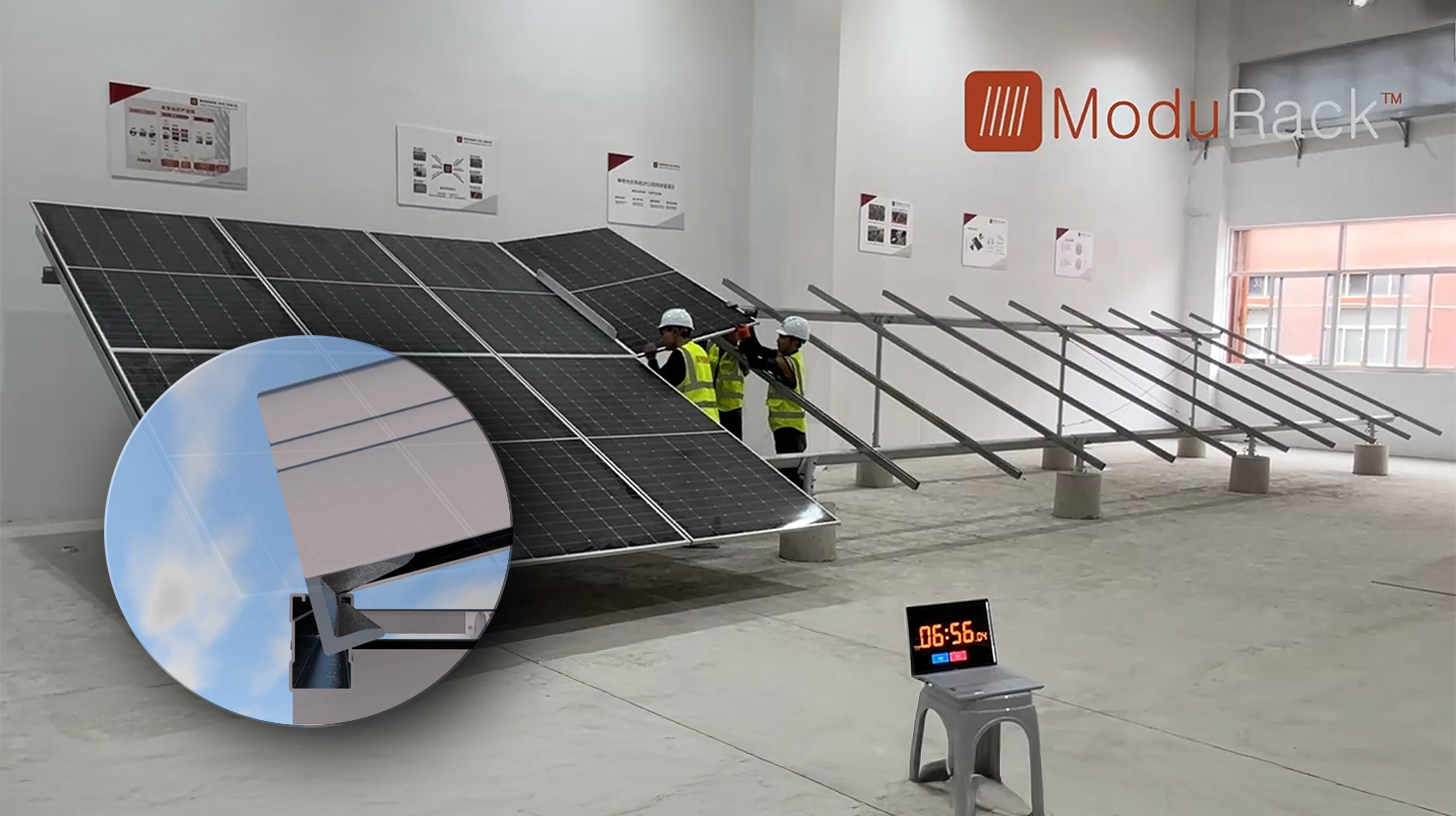
New: Patent from the USA – Install solar parks up to 30% cheaper and 40% faster and easier – with explanatory videos! - Image: Xpert.Digital
The core of this technological advancement is the deliberate departure from conventional clamp mounting, which has been the standard for decades. The new, more time- and cost-effective mounting system addresses this with a fundamentally different, more intelligent concept. Instead of clamping the modules at specific points, they are inserted into a continuous, specially shaped support rail and held securely in place. This design ensures that all forces – whether static loads from snow or dynamic loads from wind – are distributed evenly across the entire length of the module frame.
More information here:
Financing solar projects: The key to Utah Solar 1
The local return consists primarily of taxes and rents
Millard County is expected to generate more than $40 million in local tax revenue over the multi-year project period. In addition, the Utah Trust Lands Administration, on whose state-owned land the project is being built, anticipates approximately $27 million in lease revenue. This totals at least $67 million in public or publicly affiliated revenue. These sums will be spread over decades and should therefore not be mistaken for a one-time economic stimulus.
In purely mathematical terms, an investment of $40 million over 30 years equates to an average of roughly $1.3 million in local tax revenue per year, assuming the sum is distributed evenly for simplicity. Actual payments can vary significantly due to valuation methods, depreciation, and contract details. Nevertheless, for a county with only about 13,500 residents, this magnitude is still relevant. Municipal budgets can use such an investment to finance infrastructure, schools, emergency services, or other public services without the investment generating a comparable level of ongoing demand for local services as a large residential or commercial development.
Lease payments serve a different function. They monetize state-managed land and can support public services. At the same time, they ensure that a portion of the economic value of the land use does not remain solely with the project developer and electricity consumer. The combination of lease payments and taxes is attractive for sparsely populated regions because it combines revenue with a relatively low additional burden on the population.
Nevertheless, opportunity costs must be considered. Large solar installations can restrict alternative uses, alter landscapes, and incur decommissioning costs after the end of their operational life. Therefore, sound contracts must address decommissioning, land restoration, liability, and financial safeguards. Local benefits are greatest when revenues are not only consumed but also invested in long-term location quality, education, transportation infrastructure, and economic diversification.
Four hundred construction jobs are significant, but not permanent
At the peak of construction, approximately 400 workers are expected to be employed. For a small regional job market, this represents a significant temporary boost. By comparison, the number of employed residents in Millard County is just over 6,000. Even if a large portion of the project workers commute from outside the area, hotels, restaurants, retail stores, fuel providers, landlords, and local service providers can benefit from the increased demand.
The employment impact, however, is concentrated in construction and commissioning. Once completed, photovoltaic systems require only relatively small operation and maintenance teams. Therefore, it would be misleading to portray 400 construction jobs as permanent employment. The sustainable regional effect arises more from tax revenues, leases, contracts for maintenance and vegetation management, and the strengthening of the region as an energy and infrastructure hub.
The origin of the added value is also crucial. If modules, inverters, transformers, and specialized construction services are sourced from outside the region, only a portion of the investment remains local. The better regional companies are integrated into earthworks, electrical installation, safety, logistics, and ongoing services, the greater the multiplier effect. For Millard County, it would therefore be beneficial to use the construction phase for training and developing transferable skills that can later be applied to grids, storage facilities, data centers, or other energy projects.
The project strengthens Los Angeles, but does not solve its evening problem
Los Angeles aims to convert its electricity supply entirely to clean energy by 2035. Utah Solar 1 will contribute a significant amount of renewable energy and environmental benefits to this goal. Based on the expected 766,000 megawatt-hours, the plant can make a measurable contribution to the municipal utility's electricity portfolio. The long-term contract also protects against fuel price increases, as solar energy does not incur ongoing fuel costs.
However, the strategic impact should not be confused with readily available power. Solar power is primarily generated during the day. California already has high photovoltaic capacity, which is why midday hours are sometimes characterized by low or negative wholesale prices and curtailment. In the evening, solar production drops rapidly, while consumption can remain high. An additional solar installation therefore increases the amount of renewable energy, but without storage, flexible demand, dispatchable power plants, or complementary generation profiles, it does not automatically solve the problem of guaranteed evening power.
Utah Solar 1 is described in the published key data as a solar power plant without its own large-scale storage. This means the system's value remains heavily dependent on the delivery profile, the grid situation, and the LADWP's ability to integrate production into a broader portfolio. Batteries in California or Utah, pumped storage, demand-side management, geothermal energy, wind power, and flexible power plant capacities can bridge the time gap. The project's economic value increases when inexpensive daytime energy displaces fossil fuel generation, charges storage, or supplies new flexible consumers.
High yield does not guarantee high system value
The expected 766,000 megawatt-hours are a key planning figure. Some documents mention a higher production of more than 823,000 megawatt-hours for the first year of operation. Such discrepancies can arise from assumptions regarding degradation, availability, feed-in restrictions, the start date, or different model configurations. For a conservative economic analysis, the contractually communicated expected value of approximately 766,000 megawatt-hours provides a more robust basis.
At 766,000 megawatt-hours and a price of US$46.50 per megawatt-hour, the aforementioned base revenue of approximately US$35.6 million per year is generated. If production decreases by ten percent, this figure is reduced by approximately US$3.6 million before any further balancing mechanisms are taken into account. Therefore, good technical availability, low pollution, efficient inverters, and professional operational management have direct financial implications.
Even more important is the question of whether the electricity can actually be consumed and transmitted. Grid bottlenecks, maintenance, or system-related curtailments can reduce the usable yield. The crucial question then becomes who bears the risk and how lost quantities are contractually addressed. A project can technically enable high production but perform worse economically if some of the energy is generated at inconvenient times or cannot be transported. The advantage of Utah Solar 1 lies in the fact that the delivery point, transmission route, and consumer have already been integrated into a cohesive procurement model.
The real innovation is institutional, not technical
Photovoltaic modules, inverters, and high-voltage power lines are established technologies. The unique achievement of Utah Solar 1 therefore lies less in a revolutionary technical innovation than in its institutional combination. A developer pools land, permits, construction expertise, and operation. A public purchaser secures sales for three decades. International banks provide debt financing. A bank buys future production tax credits. Public land management and local authorities receive leases and taxes. Existing transmission lines connect the generation and consumption regions.
This division of labor makes the project scalable. Each participant assumes risks appropriate to their role. EDF bears development, construction, and operational risks. The electricity consumer undertakes long-term procurement obligations and integrates the energy into its portfolio. Banks bear credit risks but require collateral, due diligence, and contractual oversight. The government promotes production through taxation. The region provides the site and infrastructure and receives revenue in return.
At the same time, a complex interdependence arises. If one component fails, the entire structure can come under pressure. Delays jeopardize delivery dates and eligibility for funding. Supply chain problems increase construction costs. Changes in tax law affect financing. Network bottlenecks reduce the value of production. A long-term PPA stabilizes the model, but also makes it less flexible. The strength of such projects therefore lies not in the absence of risks, but in their precise allocation.
Political support accelerates the market and distorts it at the same time
The integration of production tax credits improves economic viability and is expected to lower the price that electricity consumers must accept for renewable energy. This will enable the realization of projects that would otherwise be built later, on a smaller scale, or not at all. From a macroeconomic perspective, this can be justified if climate damage, air pollution, technological learning curves, and security of supply are not fully reflected in the market price of fossil fuels.
However, subsidies are not free. The government forgoes tax revenue, and this fiscal burden must be weighed against the public benefit. Furthermore, generous subsidy regulations can steer investments toward projects whose location or feed-in profile is not optimal from a systemic perspective. If additional midday production is frequently curtailed, the societal benefit of another solar power plant may be less than the benefit of storage, grids, or guaranteed low-carbon power.
Utah Solar 1 has advantages over isolated projects in this respect. It combines a high-yield site with an identified consumer and existing long-distance transmission infrastructure. Nevertheless, the fundamental question remains: how can future subsidy policies be more strongly aligned with system value rather than solely with the amount of energy generated? Incentives for time-of-use feed-in, storage integration, grid support, flexible consumers, and regional diversification are all conceivable. Purely production-based subsidies reward each eligible megawatt-hour similarly, even though their value to the overall system can vary considerably.
Supply chains and trade policy remain a cost risk
Large US solar projects operate in an environment where modules, cells, inverters, transformers, and other components are influenced by trade regulations, rules of origin, and industrial policy requirements. The United States aims to rapidly build new capacity while simultaneously establishing domestic production and reducing dependence on Chinese-dominated supply chains. These objectives could conflict in the short term.
Tariffs and stricter origin requirements potentially increase procurement costs and documentation efforts. At the same time, they promote investment in American manufacturing and can improve security of supply in the long term. For a project with an already secured financing package, it is crucial to determine the extent to which supply contracts have been finalized, price increases hedged, and funding requirements verified. Banks typically demand robust documentation because an incorrect origin classification can not only lead to additional costs but also result in the loss of tax benefits.
Transformers and grid components deserve special attention. While solar modules are produced in large quantities worldwide, high-voltage components can have long delivery times. A delayed transformer can prevent a nearly completed system from being connected to the grid. Therefore, schedule risks are not necessarily concentrated on the most visible components. The size of contractual late payment payments demonstrates that the schedule is being taken seriously from a business perspective.
Water, area, and public acceptance are all part of the return on investment calculation
Photovoltaic power plants require significantly less water during operation than thermal power plants; however, a large project in an arid region is not entirely water-neutral. Water is needed during construction for dust control and, if necessary, cleaning. During operation, water consumption depends on pollution levels, cleaning methods, and local regulations. In a region with scarce water resources, this aspect should be planned transparently.
Land use also requires a sober assessment. Large solar parks alter landscapes, habitats, and existing land uses. Good planning can reduce these impacts, for example, by selecting already disturbed areas, protecting sensitive regions, providing wildlife corridors, and implementing appropriate vegetation management. State-managed land offers clear ownership and lease structures, but this does not absolve the project from ecological and social responsibilities.
Acceptance often depends on whether the benefits and burdens appear fairly distributed. Los Angeles receives renewable energy, while Millard County bears the burden of land use, construction traffic, and landscape changes. Taxes, leases, and local contracts are therefore not merely byproducts, but an integral part of the social balance. The more transparently the revenues are used and the more consistently local businesses are involved, the more stable public support can be over the long operating period.
The greatest risks lie between the building plans and the power system
The construction schedule remains ambitious until the planned delivery in mid-2027. Large projects can be delayed by weather, material shortages, a lack of skilled workers, network work, or permitting requirements. The guaranteed commercial delivery date is later than the target date, providing a limited buffer. Nevertheless, daily delay payments create significant financial pressure. A delay of just 100 days would theoretically amount to more than US$16 million, assuming the relevant clause is fully applied.
After commissioning, the risk profile shifts. Then, yield, availability, degradation, operating costs, and grid restrictions become crucial. Solar modules typically lose some of their power over the years. This development must be factored into the financial model, as must the replacement of inverters and other components. A 30-year contract therefore requires not only successful construction but also decades of technical discipline.
The portfolio risk lies with the consumer. Los Angeles must combine solar energy with demand, storage, dispatchable systems, and other renewable sources. If electricity demand increases due to electric vehicles, heat pumps, data centers, and industrial electrification, additional daytime energy can become very valuable. If flexible demand lags behind the expansion, midday surpluses and curtailment could increase. The project's success therefore also depends on developments outside its immediate vicinity.
Why a purchase option after 15 years is strategically important
The contract structure gives the Southern California Public Power Authority the option to purchase the plant after 15 years and again at the end of the contract term. Such a purchase option provides strategic flexibility. The public purchaser can initially benefit from a privately developed and financed project without bearing the full construction and development risk from the outset. Later, it can decide whether ownership makes economic and energy policy sense.
After 15 years of operation, a significant portion of the initial financing is typically recouped, while the plant can still generate electricity for many more years. Its value then depends on its technical condition, remaining contractual rights, expected operating costs, module degradation, and future electricity prices. For the seller, the purchase option offers a potential exit strategy; for the buyer, it provides the opportunity to benefit more from lower marginal costs in the long term.
However, the right is not automatically a bargain. The purchase price and the valuation method are crucial. Furthermore, the new owner assumes the risks associated with technical aging and future investments. Strategically, the option is nevertheless valuable because it prevents the public user from remaining merely a spectator after 15 years. It creates a decision point at which market conditions and system requirements can be reassessed.
Utah Solar 1 shows the next phase of the solar market
The first major growth phase of photovoltaics was driven by falling technology costs and political expansion targets. The next phase will be more strongly determined by financing, grids, supply chains, and system value over time. Utah Solar 1 fits precisely into this pattern. The modules are important, but the decisive competitive advantages lie in the 30-year power purchase agreement (PPA), access to the Intermountain transmission system, tax monetization, and the ability to convince an international banking consortium.
For other developers, the lesson is that sheer project size is not enough. A large project without grid connection, guaranteed customers, or reliable funding remains speculative. For electricity providers, it is becoming clear that long-term contracts create price stability but must be supplemented by storage and flexible resources. For regions like Millard County, there is an opportunity to transform existing energy infrastructure into a new economic phase. However, the long-term local benefits depend on whether taxes and lease payments are translated into productive site development.
For American energy policy, the project demonstrates that government funding can mobilize significant private capital. Five international banks are providing financing not solely for climate protection reasons, but because contractually secured payment flows, an experienced developer, tax advantages, and existing infrastructure create an investable risk profile. While the public sector does not assume full responsibility for the project, it significantly influences its economic viability through tax law, land management, municipal procurement, and grid infrastructure.
The sun is free, the energy system is not
The provocative point of Utah Solar 1 is this: The raw material, the sun, costs nothing, yet almost everything that makes it economically viable is capital-intensive and institutionally demanding. Modules must be procured, land secured, grids connected, risks insured, tax breaks monetized, and electricity volumes sold over decades. The success of renewable energies therefore depends not only on natural resources and technology, but also on efficient markets and institutions.
Under these conditions, Utah Solar 1 appears to be a plausibly structured project. The expected production is high, the contract is long-term, the customer is strategically motivated, and the transmission infrastructure is already in place. The local region receives substantial taxes and lease payments, while Los Angeles moves closer to its goal of clean energy. The international financing consortium and the included tax credit demonstrate that the project has also been modeled viably from the perspective of professional investors.
At the same time, it would be wrong to portray the project as a simple success story devoid of conflicting objectives. The 400 construction jobs are mostly temporary. Solar power does not replace guaranteed evening power generation. Subsidies burden public budgets and can create perverse incentives. Land use, supply chains, grid bottlenecks, and regulatory uncertainty remain real risks. It is precisely these limitations that make the project economically attractive: it demonstrates not that the energy transition is easy, but that it becomes financially viable when technology, contracts, grids, and policy are precisely coordinated.
Ultimately, Utah Solar 1 is less a symbol of cheap solar energy than of the growing professionalism of the renewable energy market. The plant combines rural advantages with urban demand, a history of fossil fuel infrastructure with a renewable future, and government subsidies with private capital. In doing so, it provides a model for the American West: electricity is generated where land and resources are available, transported via existing energy corridors, and transformed into predictable economic value through long-term contracts. Whether this model proves successful in the long run depends not solely on the number of megawatts installed, but on how reliably, grid-supporting, and cost-efficiently these megawatts actually operate over three decades.
Your partner for business development in the fields of photovoltaics and construction
From industrial rooftop PV to solar parks and larger solar parking lots
☑️ Our business language is English or German
☑️ NEW: Correspondence in your native language!

Konrad Wolfenstein
I and my team are happy to be available to you as your personal advisor.
You can contact me by filling out the contact form here wolfenstein@xpert.digital:or simply call me at +49 7348 4088 965. My email address is
I'm looking forward to our joint project.