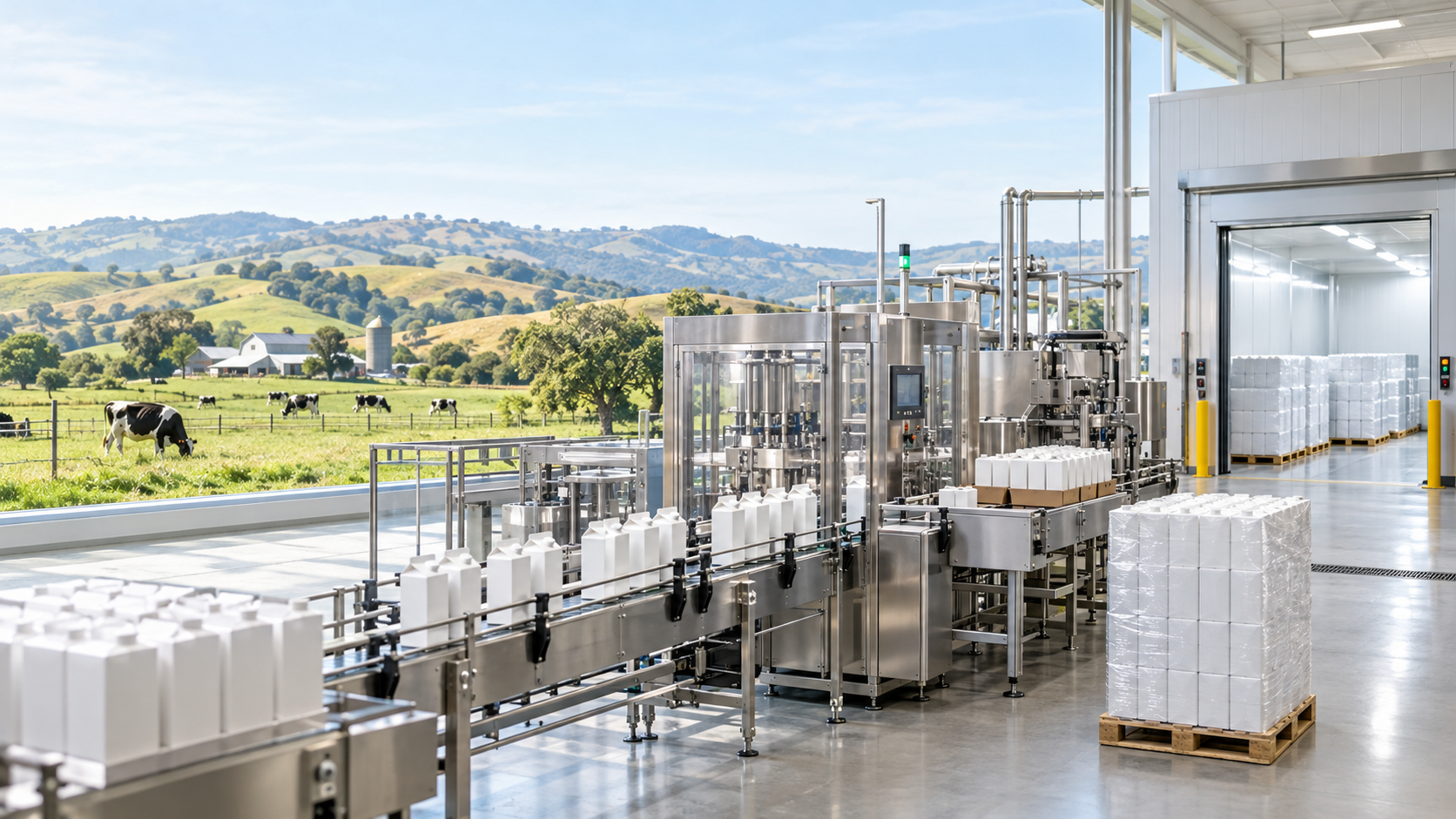
Clover Sonoma invests $30 million in refrigeration and intralogistics: Petaluma becomes the dairy's logistics hub – creative image on the topic, with AI: Xpert.Digital
Clover Sonoma is banking on California: Can the expansion save the farms?
More dairy products, fewer farmers: What dilem does Clover Sonoma face?
Growing dairy, shrinking milk supply: The calculation behind Clover's expansion
Clover Sonoma is investing $30 million in expanding its Petaluma facility. New bottling and packaging lines, along with a larger cold storage facility, are intended to make processing and distribution more efficient. But while the dairy is increasing its capacity, the agricultural milk base in Northern California's North Bay is shrinking. This is the central point of contention for the project: More processing capacity alone won't save farms. The crucial question is whether Clover can produce enough profitable products—and whether the milk suppliers are financially stable enough to continue production and investment.
Following previous expansion plans, the company is now focusing its strategy more strongly on the Californian market. At the same time, a broader product range, including fermented and protein-rich products, is intended to create additional value. However, the viability of this approach depends not only on new machinery. Milk prices, production costs, raw material availability, cold chains, consumer prices, and cooperation with farmers also play a role. Therefore, this investment is neither simply a success story about a modern facility nor an obvious expansion in a shrinking market. It is an attempt to rebalance a regional value chain under challenging conditions.
Clover Sonoma: $30 million to combat farm closures: Increased bottling capacity won't save farms
Clover Sonoma is investing $30 million in Petaluma, opting for an economically ambitious form of growth: increasing value creation at the existing site rather than expanding distribution as much as possible. The two-year expansion aims to strengthen milk processing, packaging, and cold chain logistics. At the same time, the agricultural raw material base in Northern California's North Bay is shrinking. This is precisely where the economic significance of the project lies. A more efficient dairy can stabilize regional agriculture, but only if enough farms survive economically and utilize the additional capacity with profitable products.
The investment program is therefore neither merely a local success story nor an obviously contradictory expansion in a shrinking market. It is an attempt to rebalance a threatened regional value chain through higher productivity, greater market penetration, and a broader product range. The crucial bottleneck does not lie solely in the factory. It arises from the interplay of milk prices, agricultural costs, raw material availability, cold chains, and consumers' willingness to pay.
The return to economic reason
Clover Sonoma's historical roots stretch back to 1916. The current processing facility in Petaluma was opened in 1991. The company thus combines over a century of regional tradition with an industrial infrastructure that must be continuously adapted to new demands. This combination is economically valuable, but not automatically sustainable in the long term. A well-known brand is no substitute for modern processes or sufficient profitability from its suppliers.
In 2021, the Colombian food company Alpina Productos Alimenticios acquired a 70% stake in Clover. This investment was intended to expand Clover's reach beyond California. However, five years later, only about 1% of sales come from other US states. Under John Coletta, who took over as CEO in 2024, the strategy has therefore refocused more strongly on the Californian home market. The decisive factor is the greater profitability of this business compared to the originally planned nationwide expansion.
This does not fundamentally contradict the involvement of an international owner. A multinational investor does not necessarily have to roll out a regional brand nationally to derive economic benefit from it. They can equally profit from deepening its regional competitive position. What matters is not how many states a product is available in, but rather what additional revenue actually remains after procurement, production, distribution, refrigeration, and capital investment.
Why distance eats up the profit margin
For chilled dairy products, a new distribution region not only expands the reachable customer base. It can also create additional transportation stages, inventory levels, and coordination challenges. Furthermore, there are costs associated with market launch, promotional activities, and brand building. A regional brand often has to explain outside its core territory why customers should pay a higher price. The story of Northern California family farms may carry less immediate weight there than in their home market.
Expansion becomes particularly problematic when initial sales volumes remain small. Underutilized transport connections or low sales density per point of sale spread logistics costs across fewer products. Simultaneously, every additional day between production and purchase reduces the remaining sales period. For perishable goods, write-offs and returns can therefore quickly erode seemingly attractive additional revenue. These mechanisms explain the economic plausibility of the strategic adjustment, without replacing Clover's detailed cost calculations, which are not publicly available.
Furthermore, focusing on California is not synonymous with retreating to the immediate vicinity. Clover now also supplies Southern California. The company thus differentiates between regionally rooted production and broader marketing within the state. This approach can be sensible as long as transport density, sales speed, and achievable prices are aligned. However, even a Californian market demands a sober calculation of distances. A political boundary does not automatically make a long delivery route short.
Where the 30 million will start
The investment program encompasses several successive phases of the operation. Two filling machines, two automatic carton packers, and a palletizer have already been added. Simultaneously, the cold storage facility is being expanded. In addition, Clover is searching for a site in the Petaluma area for a potential facility for the development of fermented dairy products. This component, intended as a cultural and innovation hub, is therefore distinct from the already installed equipment and the ongoing warehouse expansion.
This distinction is crucial for a reliable assessment. The announced 30 million US dollars represents an investment framework over two years, not proof that all projects have been completed or all funds have been spent. Similarly, sufficiently detailed information regarding the allocation between machinery, buildings, warehouse technology, and development is not publicly available. Therefore, neither a concrete increase in capacity nor a reliable return on investment can be derived from the total sum.
The industrial logic is evident, however. Faster filling is of little use if packaging can't keep up. Additional packaged goods create new problems if palletizing, refrigeration, or loading are overloaded. Clover expands multiple links in the same process chain. This can reduce the likelihood that a single modernized machine will simply exacerbate the next bottleneck. Whether this succeeds depends on the actual coordination of the systems and material flows.
Cold chain logistics as a silent value creator
A larger cold storage facility is more than just additional storage space. It can better coordinate production rhythms and deliveries. Milk is delivered continuously, while retail orders fluctuate. Suitable intermediate storage can help organize shifts more predictably, consolidate orders, and absorb short-term demand peaks. This decoupling of production and shipping becomes particularly important with a broader product range.
However, economic benefits do not arise from maximizing inventory levels. Refrigerated finished goods tie up capital, require energy, and lose their remaining shelf life as they age. Therefore, the warehouse must be managed according to the principle that goods with the nearest expiration date are shipped first. Crucial factors are not only the number of pallet spaces occupied, but also inventory turnover, temperature stability, order picking accuracy, and the remaining shelf life at the customer's site.
Furthermore, a distinction must be made between refrigerated and frozen logistics. Expanding facilities for chilled milk or yogurt does not automatically create suitable capacity for ice cream. The different temperature ranges require appropriate technical systems and supply chains. Therefore, for the overall economic viability analysis, it is crucial to determine which product groups can actually utilize the existing infrastructure and what additional investments a new product range would entail.
Automation still needs people
As part of the expansion, 21 jobs have already been created in milk production and warehousing. This refutes the simplistic notion that automation necessarily leads to fewer jobs. With increased processing capacity or additional shifts, modern equipment and new positions can be created simultaneously. Machines take over certain repetitive tasks, while operation, maintenance, quality control, and material supply still require human resources.
Conversely, 21 additional positions do not yet demonstrate a comprehensive regional employment effect. For that, information would be needed on factors such as the overall workforce development, potential changes in other areas of the business, and the long-term viability of the new jobs. Calculating investment costs per job would also be misleading. The 30 million US dollars are not solely for job creation, but also for modernization, site stabilization, and potential future product development.
For Petaluma, a key benefit lies in keeping industrial food processing local. Mayor Kevin McDonnell views the investment as a positive economic signal for the city and agriculture in southern Sonoma County. This perspective is understandable: A dairy combines agricultural production with technical and logistical jobs. However, the true value of this combination depends on the location not only investing but also maintaining long-term competitiveness.
Sonoma County Agriculture Commissioner Andrew Smith also links the expansion of processing and cold storage facilities to the long-term viability of the region's dairy industry. Organic and conventional production exist side-by-side. From an economic perspective, this assessment underscores the importance of processing infrastructure: without it, farms lose a significant portion of their marketing opportunities. Maintaining this infrastructure is therefore a necessary, but not sufficient, condition for stable farm incomes.
The raw material base is becoming dangerously narrow
While processing capacity is expanding, regional milk production has declined sharply. For Sonoma and Marin combined, approximately 32 million US gallons are projected for 2025, compared to roughly 86 million in 2020. This represents a decrease of about 62%. Given these rounded figures, the percentage should not be interpreted as a mathematically precise rate of change. Nevertheless, the magnitude is clear: within just a few years, well over half of the previous volume has been lost.
For German readers, 32 million US gallons are roughly equivalent to 121 million liters, while 86 million gallons yield approximately 326 million liters. These figures refer to the production of the two counties, not to Clover's sales or total raw material throughput. A direct comparison would overlook the role of other processors and additional sourcing areas. Similarly, regional figures do not allow for conclusions to be drawn about the overall performance of the California dairy industry.
The decline nevertheless increases the strategic risk. A dairy can acquire a bottling line relatively easily, whereas a disused agricultural supply structure cannot be rebuilt in the short term. Herds, barns, pastures, expertise, and family succession form an interconnected production system. If several of these prerequisites break down simultaneously, a subsequent price incentive may not be sufficient to regain the previous milk volume.
The past year shows counter-movements
A closer look reveals a distinction between the multi-year downward trend and the most recent annual development. In Sonoma County, the reported milk volume in 2025 increased from approximately 1.82 million to 2.01 million US hundredweight compared to the adjusted figure for the previous year. One US hundredweight is equivalent to 100 US pounds, or about 45.36 kilograms. Within this defined area, the recorded volume thus increased by approximately 10.8%.
The recovery was driven by organic milk. Its production increased from around 1.46 to 1.74 million hundredweight, representing a rise of approximately 18.9%. Conventional milk production, on the other hand, fell from roughly 357,600 to 278,100 hundredweight. Long-term decline and short-term growth are therefore not mutually exclusive. The data point to a structurally weakened sector, in which individual segments and years can certainly show a rebound.
The picture is different for Marin. There, the production value of organic milk reached approximately US$21.4 million in 2025, roughly 1% lower than the previous year. Furthermore, six organic dairy farms in the Point Reyes National Seashore closed in 2026 following a settlement agreement. The full impact of these closures is not yet reflected in the 2025 figures. Therefore, the supply outlook should not be based solely on the recently improved Sonoma statistics.
Rising figures are no all-clear signal
The production value of milk in Sonoma County increased from approximately $60.9 million to $71 million in 2025, representing a rise of about 17%. It is important to note the geographical distinction: the $71 million figure refers to Sonoma County and should not be interpreted as the combined production value of Sonoma and Marin. Furthermore, this figure represents the gross agricultural value, not dairy sales, retail sales, or farmer profits.
The value of organic milk in Sonoma increased by approximately 24% to about US$65.2 million. This was due to both higher volume and an improved average price. The reported price rose from US$36.02 to US$37.54 per hundredweight, an increase of roughly 4.2%. This increase in value, therefore, cannot simply be equated with a price jump of the same magnitude. A significant portion was attributable to the increased recorded production volume.
At the same time, the value of conventional milk fell from around $8.3 million to $5.9 million, a decline of approximately 29%. This contrasting trend illustrates why a single overall figure is insufficient to describe the situation. Even with rising revenues, individual farms can remain under pressure if feed, personnel, financing, or maintenance become more significant expenses. Higher gross values demonstrate economic activity, but not a sufficient return on all production factors.
Organic farming offers both an opportunity and a cost-saving promise
Approximately 87% of the milk produced in Sonoma and Marin in 2025 was organic. In Sonoma, 47 out of 56 registered dairy farms were already certified organic in 2018. For 2026, 47 dairy farms are projected there, of which more than 80% will operate organically. However, farm share and volume share are different indicators. A high percentage of certified farms does not automatically reflect their share of total milk production.
Organic farming generally allows for differentiation from purely price-driven competition. In Sonoma, the reported average organic milk price in 2025, at US$37.54 per hundredweight, was significantly higher than the US$21.09 for conventional milk. The calculated difference was approximately 78%. However, this does not represent a profit margin. Organic production entails its own requirements and costs; furthermore, farm structure and marketing can differ between the two groups.
US organic standards require, among other things, that ruminants have at least 120 grazing days per year and that, on average over the grazing season, at least 30% of their dry matter intake comes from pasture. Converting a non-organic dairy operation to organic farming is, under the relevant conditions, a process that typically takes several months, generally twelve; longer transition periods may apply to land. Therefore, a short-term increase in demand cannot be immediately met by producing additional certified regional milk. Supply reacts with a time lag.
Your intralogistics experts

Consulting, planning and implementation of complete solutions for high-bay warehouses and automated storage systems - Image: Xpert.Digital
More information here:
The organic milk boom needs a restriction
The organic milk boom needs a restriction
The strong position of organic milk in the North Bay should not be confused with a uniform volume boom across the entire US market. In August 2026, estimated nationwide sales of organic drinking milk products were 242 million pounds, 2.4% higher than in the same month of the previous year. However, for the period from January to August combined, sales totaled 1.981 billion pounds, 0.3% lower than in the same period of the previous year.
Within the segment, organic whole milk performed significantly better. Sales increased by 4.8% year-on-year through August, while various reduced-fat categories declined. This suggests a shift within the market, not an unchecked expansion of all organic categories. Local supply bottlenecks may still occur, however, because supply and demand may not align geographically, seasonally, or according to product characteristics.
This presents Clover with a challenging task. The company must differentiate whether growth stems from additional customers, changing preferences within the category, higher prices, or the displacement of other brands. Each of these factors requires a different production and distribution plan. Those who lump all developments together under the umbrella term "organic" risk overcapacity in the wrong product or underestimate a genuinely attractive market segment.
Small farms are under pressure to scale
The economic pressure on smaller dairy farms is not a phenomenon unique to Northern California. Nationwide studies show significant average cost advantages for larger farms. For 2021, the estimated total economic cost of production for herds with fewer than 50 cows was approximately $42.70 per 100 pounds of milk. For farms with at least 2,000 cows, it was about $19.14. These nationwide figures are not a direct cost calculation for Sonoma, but they illustrate the importance of farm size.
Part of the difference arises from the fact that buildings, machinery, management, and certain technologies are spread across a larger milk production. Nevertheless, size and profitability are not identical. Farm management, location, production system, and achieved prices can significantly alter the results. Smaller farms can also be economically successful. However, their business model must offset higher unit costs through appropriate revenues, exceptional quality, more favorable operating conditions, or additional income streams.
The distinction between current solvency and long-term viability is particularly important. A family farm may still be able to pay its bills even though its own labor, the land it has invested, and future replacement investments are not adequately compensated. Such farms don't necessarily disappear immediately. They initially invest less, postpone repairs, or fail to find a successor. The subsequent loss of production is then the visible end of a longer-term economic erosion process.
Farmers need more than confidence
For Beretta Family Dairy in Santa Rosa, Clover is an important business partner. Jennifer Beretta represents a family whose connection to the brand dates back to 2010. The processor's investment at the site improves the prospects for continued purchase from the perspective of such suppliers. This expectation can facilitate investment decisions because it reduces the risk of a sudden loss of regional processing.
A modern dairy, however, does not replace a viable milk supply contract. Transparent pricing, sufficiently long planning horizons, and a distribution of cost risks that allows for agricultural investment remain crucial. Multi-year agreements, clearly defined quality premiums, or support during organic conversion are all conceivable options. Whether Clover will utilize such instruments to any significant extent remains to be seen. They merely describe the economic levers that would be appropriate for the announced regional commitment.
There are dependencies on both sides. Farmers need reliable buyers, while Clover relies on suitable producers for its regional positioning. A short-term, aggressive purchasing policy could weaken this raw material base. Conversely, the dairy must cover its own costs and remain competitive with retailers and consumers. Sustainable cooperation therefore does not arise from one-sided price maximization, but from a distribution of added value that keeps both sides capable of renewal.
Regionality doesn't end at the factory gate
The focus on local agriculture coincides with an already established regional sourcing strategy. Depending on the month, less than 10% of the milk used by Clover comes from other US states. Additionally, within California, sourcing from outside the immediate North Bay area, including the San Joaquin Valley, plays a role. Milk is therefore not produced exclusively where the brand has its historical roots. This is a significant economic reality, not a minor logistical exception.
Three levels must be distinguished: the processing location, the origin of the raw material, and the sales territory. A product can be processed in Petaluma, made with milk from other Californian regions, and sold in Southern California. This can make sense from a business perspective. However, for a particularly local brand positioning, explanation is needed if consumers associate the product with a more specific origin.
A credible regional claim should therefore be described in a verifiable manner. This includes clearly defined regions of origin, traceable proportions, and a differentiation between individual product lines. Supplementary sourcing can secure supply and fill seasonal gaps. However, it should not be presented as if it were identical to a completely closed local supply chain. Transparency here protects not only consumers but also the economic value of the brand.
Conventional milk remains strategically important
Although the region is heavily influenced by organic farming, Clover uses conventional milk for almost half of its products. This statement doesn't automatically represent half of the purchased quantity or revenue. Nevertheless, it's important for assessing the product range: the company doesn't operate a purely organic business model. It has to manage diverse raw material flows, quality requirements, and price positioning simultaneously.
According to company management, Clover also pays above-market prices for conventional milk. Such a premium can be economically justifiable as compensation for special requirements or as a contribution to securing suitable suppliers. However, without published contract details, it is impossible to assess the amount of these additional payments and what costs or services they represent. This statement alone does not imply either above-average returns for farmers or a lack of purchasing discipline.
The conventional component is also not insignificant for the regional system. If this segment shrinks, procurement alternatives and the utilization of certain product lines could become more limited. A strategy that exclusively promotes additional organic conversions would therefore have to consider the remaining demand for conventional quantities. The appropriate raw material structure depends on the actual product range, not solely on the most publicly visible category.
Protein alters the utilization
Around 80% of Clover's revenue still comes from milk. Coletta wants to increase the share of other products, particularly protein-rich foods like Greek yogurt. This shifts the strategic focus: the goal is not simply to sell more milk, but to create a more attractive and diverse product mix from the available raw material. The potential innovation center for fermented products is part of this strategy and should not be seen as a general cultural center.
The market provides some clues. US production of natural and fruit yogurt rose from around 4.87 billion pounds to 5.29 billion pounds in 2025, an increase of 8.5%. This figure includes yogurt overall, not just Greek yogurt, and measures production rather than retail demand. It supports the assessment of a dynamic product segment, but proves neither Clover's future market share nor the profitability of any specific new product launch.
In addition to fermented products, Clover has also reintroduced premium-positioned ice cream into its product range. This business follows a different demand and cost logic than high-protein yogurt: enjoyment, taste, and brand profile are more important, while a separate cold chain is required. Diversification, therefore, does not mean that all new product lines will benefit from the same consumer trend. Each category requires its own independent profitability analysis.
Higher selling prices for processed products do not necessarily equate to higher profits. Fermentation, concentration, recipe development, additional packaging, and marketing all incur costs. Drained Greek yogurt produces sour whey, the utilization or treatment of which must be factored into planning. Therefore, the crucial factor is the additional contribution margin after all variable costs and necessary investments. A new product category only creates value if it generates more revenue than its added complexity costs.
Product diversity requires industrial discipline
Greater utilization of various milk components can improve added value, but requires integrated planning. Fat, protein, and other components cannot be managed independently of the composition of the purchased milk. Those who want to produce more protein-rich products must consider the other material flows involved and how these can be marketed or further processed. The economic analysis doesn't end with a successful yogurt cup.
Furthermore, a broader product range can put a strain on the factory. Frequent product changes, smaller batch sizes, and different packaging formats increase the need for coordination. Additional variants require storage space, master data, and sales forecasts. A company can therefore simultaneously increase revenue while simultaneously reducing its operational efficiency. New filling and packaging lines are particularly valuable when they are compatible with the planned product range and allow for changeovers with reasonable effort.
A phased approach is advisable for entering further categories. Limited market tests, reliable repurchase rates, and clearly defined revenue targets can prevent a general food trend from being prematurely translated into permanent capacity. This is a viable business option, not a confirmed practice for Clover. Especially when raw material availability is uncertain, the ability to adjust development steps has intrinsic strategic value.
Trust must remain verifiable
Regional positioning depends on more than just transport distances. Animal husbandry, access to pasture, soil management, and supplier control also influence whether consumers accept a quality premium. Clover faces public accusations from animal welfare and agricultural activists regarding individual sourcing farms and animal husbandry conditions. Such accusations do not constitute conclusive evidence of violations. The company, for its part, points to annual independent animal welfare audits and its own internal controls.
Economically, the verifiability of the respective claims is crucial. Organic certification, animal welfare monitoring, regional origin, and regenerative farming are distinct attributes. Proof of one does not automatically prove the others. Similarly, the size of a herd alone is insufficient evidence of good or bad farming practices. What matters are the standards actually applied, their scope, and the verifiable results on the farms.
Clover also supports activities related to soil testing and improved land management. Such measures can be beneficial for farmers if they provide knowledge and facilitate operational decisions. However, without site-specific measurements, no specific cost savings or climate impact can be derived from them. For a premium brand, this restraint is economically sound: exaggerated claims may generate short-term attention, but in the long run, they damage precisely the trust upon which the price premium depends.
Climate efficiency requires clean metrics
Clover participates in the Dairy Methane Action Alliance and aims to reduce methane emission intensity by 10% over three years. This is a target, not a proven result. Furthermore, intensity describes emissions per defined production unit. It is not the same as an equally large reduction in absolute emissions. With increasing production, these two metrics can diverge.
The same logic applies to site expansion. New technology can reduce energy consumption per liter processed, while overall consumption increases due to higher volumes. A larger cold storage facility can improve delivery and prevent spoilage, but it also requires energy. A reliable assessment would therefore have to consider several factors together: raw material production, processing, refrigeration, transport, losses, and the respective reference unit.
Regional sourcing can enable short transport routes, but it doesn't automatically guarantee the smallest ecological footprint. Production methods, feed origin, vehicle utilization, and operational efficiency also play a role. The strongest economic link between environmental performance and competitiveness arises where demonstrably fewer resources are wasted or credibly better products are produced. A mere claim of origin is not enough.
The trade decides with
Even a high-performing dairy often reaches end customers through retailers. Additional capacity only improves a company's negotiating position if products sell reliably and offer a clear benefit. High delivery capacity alone does not prevent price pressure. Retailers assess factors such as sales density, profit per shelf space, promotional potential, and delivery reliability. A strong regional brand can have an advantage here, but must continually prove it.
The expansion into Southern California should therefore be viewed as a separate economic test. Greater sales opportunities meet longer transport routes and potentially different competitive conditions. What matters is not just the initial order, but whether recurring demand generates sufficient transport volumes and stable revenues. The new cold storage facility can support such supply chains, but it cannot permanently compensate for weak sales velocity.
Added to this is the price sensitivity of customers. Organic quality, animal welfare, and origin can justify a willingness to pay, but they don't require an unlimited household budget. A compelling product range therefore needs clear distinctions between price points and products. For Clover, it will likely be particularly important to make the quality premium understandable without devaluing conventional offerings or simultaneously imposing a high premium price on all new products.
Three paths for Petaluma's future
A favorable outcome would be achieved if the modernized facilities operate efficiently, additional cooling capacity improves deliveries, and the Californian market accepts the planned product mix. At the same time, suppliers would need to earn enough to continue production and make necessary investments. In this scenario, industrial productivity and agricultural stability could reinforce each other. A portion of the additional value creation would then secure the conditions for further regional supply.
A moderate trajectory would be less spectacular, but equally economically relevant. Modernization could initially offset rising costs, maintain existing supply relationships, and secure the plant's competitiveness without triggering a major surge in sales. An investment program doesn't necessarily have to usher in a new era of growth to be worthwhile. In a structurally challenging environment, stabilizing a high-performing site can already be of considerable value.
Problems would arise if the regional supply continued to shrink, new products fell short of expectations, and additional long-distance sourcing became necessary. In that case, higher capital costs would coincide with insufficient capacity utilization and a more difficult-to-deliver regional message. These scenarios are qualitative, not probability forecasts. Without published company data on capacity, margins, financing, and sales planning, a reliable numerical return on investment or amortization calculation would be impossible.
How success is demonstrated
For a proper evaluation, a few verifiable metrics are therefore more important than general growth promises. At the plant level, these include capacity utilization, scrap, downtime, energy consumption, and total cost per saleable unit. In logistics, delivery reliability, inventory holding periods, transport capacity utilization, and shelf life upon arrival are crucial. An isolated increase in production volume, on the other hand, would be of little significance if inventory losses or price concessions were to increase simultaneously.
On the agricultural side, it would need to be determined whether suitable suppliers remain, what quantities are contractually available, and whether necessary replacement investments are made. For the brand, verifiable origin information, consistent repeat purchases, and a reasonable price difference compared to similar products would be relevant. For new products, sales revenue alone should not be the sole criterion; rather, their contribution to profit after accounting for additional production, distribution, and capital expenditures should be considered.
The clearly reasoned perspective on Clover's investment is therefore this: Returning to its Californian focus is more economically plausible than national expansion for its own sake. However, its viability does not depend on the size of the cold storage facility or the speed of the bottling machines. It hinges on whether Clover can generate sufficiently credible, differentiated value from a scarcer regional supply of raw materials and distribute this value in such a way that its agricultural base also has a future. Increased processing capacity is one tool for this, but not yet a solution.
Your global marketing and business development partner
☑️ Our business language is English or German
☑️ NEW: Correspondence in your native language!

Konrad Wolfenstein
I and my team are happy to be available to you as your personal advisor.
You can contact me by filling out the contact form here wolfenstein@xpert.digital:or simply call me at +49 7348 4088 965. My email address is
I'm looking forward to our joint project.