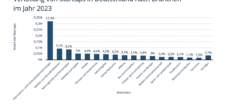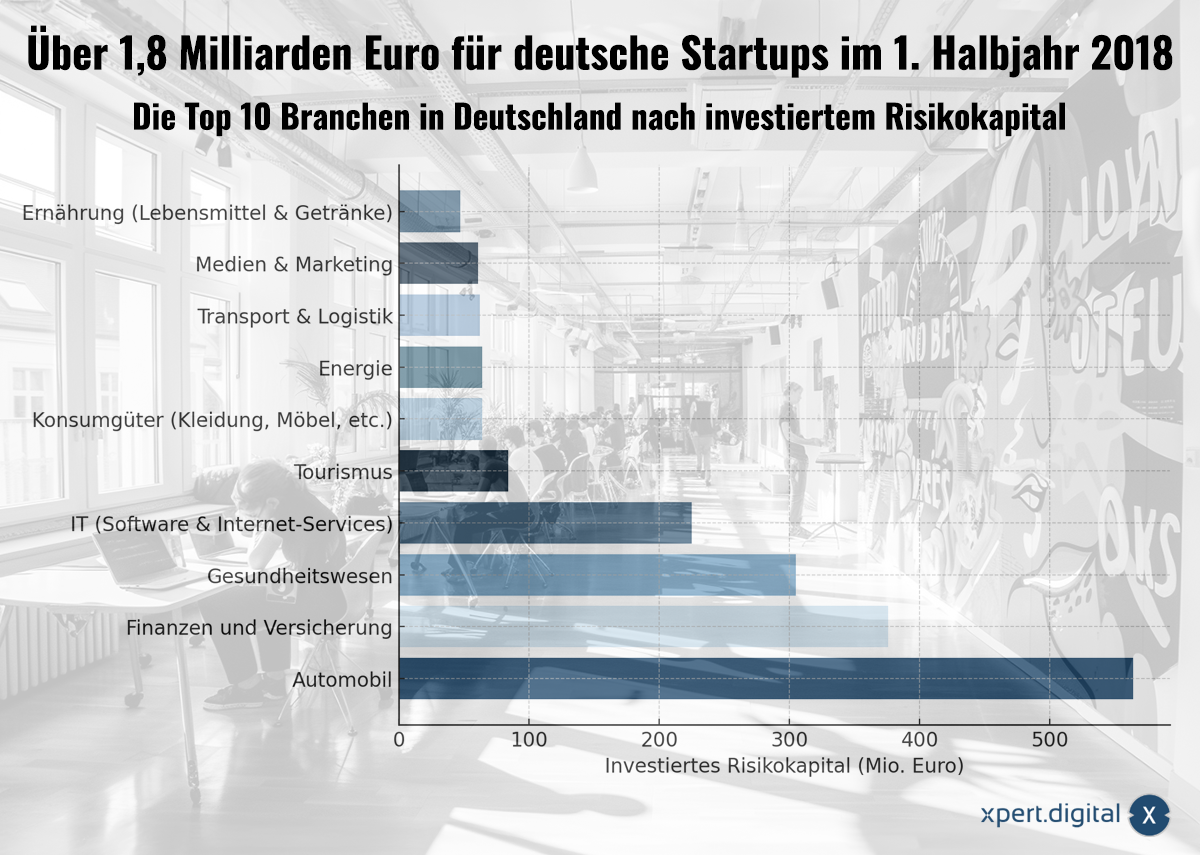
Over €1.8 billion for German startups – Top 10 sectors in Germany for venture capital investments 2018 – Image: Xpert.Digital
📈 Investor confidence: 1.8 billion euros for German startups
💶🌟 From founders to winners: The growth of German startups
German startups have experienced impressive growth for years, driven largely by the increasing number of venture capital investments. In the first half of 2018 alone, over €1.8 billion was invested in German startups. This trend is not only a testament to the innovative strength of German founders, but also a clear indication of the confidence investors place in the local ecosystem.
🚀 Berlin as a center of the startup scene
Berlin has established itself as the undisputed center of the German startup scene in recent years. The city attracts around two-thirds of all investments and offers the perfect breeding ground for innovative ideas and disruptive business models. The advantages Berlin offers startups are manifold: an international and open atmosphere, a large network of founders, experienced entrepreneurs, and investors, as well as comparatively low living costs compared to other major cities like London or Paris.
Furthermore, the city is a magnet for talent from all over the world. This is due not only to its cultural diversity and attractiveness, but also to the opportunity to work in a rapidly growing and dynamic environment. Large incubators and accelerator programs such as the Berlin Startup Academy or Factory Berlin support young companies and offer valuable assistance in their early stages.
📊 Key industries and growth areas
The automotive industry leads the list of the best-funded sectors with €564 million in invested venture capital. This is hardly surprising given the long-standing and strong presence of the German automotive industry. However, while large companies like Volkswagen, BMW, and Mercedes-Benz are known worldwide, a new generation of companies is emerging, aiming to shape the future of mobility with innovative technologies. Startups in the fields of electromobility, autonomous driving, and mobility services are increasingly receiving capital, as they are considered the driving forces of the coming industrial revolution.
The financial and insurance sector follows in second place, attracting a total of €376 million in investments in 2018. The digitalization of banking and insurance, also known as FinTech and InsurTech, has developed rapidly in recent years. New business models based on blockchain technology, artificial intelligence, and data-driven solutions are particularly in demand in this sector. FinTech startups in Germany, in particular, offer innovative solutions for traditional banking, payment services, and asset management, shaking up the market.
Healthcare ranks third with €305 million and represents another exciting growth sector. Digital health startups have emerged as a response to the increasing pressure on healthcare systems worldwide. From telemedicine platforms and wearables that track health data in real time to AI-powered diagnostic tools, the health technology sector is attracting ever-increasing capital. The COVID-19 pandemic has further highlighted the importance of digital health solutions, which is likely to strengthen this sector even more in the coming years.
💼 The role of venture capital in the growth of startups
Venture capital is typically the most important source of external funding for startups. Unlike traditional financing methods such as bank loans, which involve fixed interest payments, venture capitalists benefit from the company's development through equity investments. This investment often provides founders not only with financial flexibility but also with access to a broad network of industry experts, mentors, and potential partners.
The risks investors take are high – especially since a large proportion of startups fail within the first five years. Nevertheless, investors accept this risk because the potential returns can also be enormous. Particularly in sectors with high innovation potential, such as IT, biotechnology, or FinTech, the chances of above-average returns are greater.
🚀 Challenges and opportunities for German startups
Despite their considerable successes, German startups still face challenges. While access to capital has become easier in recent years, there is still a lack of large venture capital funds capable of investing substantial sums in later stages. Many startups that have successfully completed the proof of concept and are entering the scaling phase often have to turn to international investors to secure further funding.
Another problem is the high level of regulation, particularly in the finance and healthcare sectors. Innovative business models in these sectors often have to overcome complex regulatory hurdles, which delays market entry and poses significant challenges for startups. This can lead to a competitive disadvantage, especially in highly regulated markets like Germany.
At the same time, however, many opportunities also exist. Germany has established itself as an innovation hub, not only because of its highly developed industry, but also thanks to its strong research landscape. Universities and research institutes work closely with startups to develop new technologies and bring them to market. This is evident, for example, in the growing number of deep-tech startups specializing in artificial intelligence, robotics, and the Internet of Things.
📊 International comparison: Where does Germany stand?
In international comparison, Germany is an important player in the European startup scene, but it lags behind countries like the USA, China, and the United Kingdom. Access to large sums of venture capital and the internationalization of startups, in particular, are more advanced in these countries. Silicon Valley is still considered the mecca for founders worldwide, while Berlin has established itself as a leading location in Europe.
Nevertheless, there are significant differences in mindset and risk appetite between the US and Germany. While failure is often seen as a valuable experience in the US, German founders tend to be more risk-averse and focus more on sustainable and stable business models. This is also reflected in the types of sectors they invest in: while the US has a high concentration of software and internet startups, Germany places greater emphasis on more traditional sectors such as automotive and manufacturing.
💼 Where are we going?
The German startup scene is developing promisingly, and it is expected that further record sums of venture capital will flow in the coming years. Technological change and advancing digitalization offer enormous opportunities, especially for startups, to tap into new markets and revolutionize existing industries.
To remain competitive in the long term, however, it is crucial that Germany continues to invest in building a comprehensive venture capital landscape and reduces regulatory hurdles to avoid hindering innovation. Furthermore, international collaborations should be promoted to facilitate knowledge transfer between different startup hubs and enable founders to access new markets.
The German startup scene is at a turning point, and with the right strategic decisions, it could develop into one of the world's leading innovation hubs in the coming years. It will be exciting to see how investments evolve and which new technologies and business models will come to the fore.
📊💶 Venture capital investments in German startups: Detailed analysis for the first half of 2018
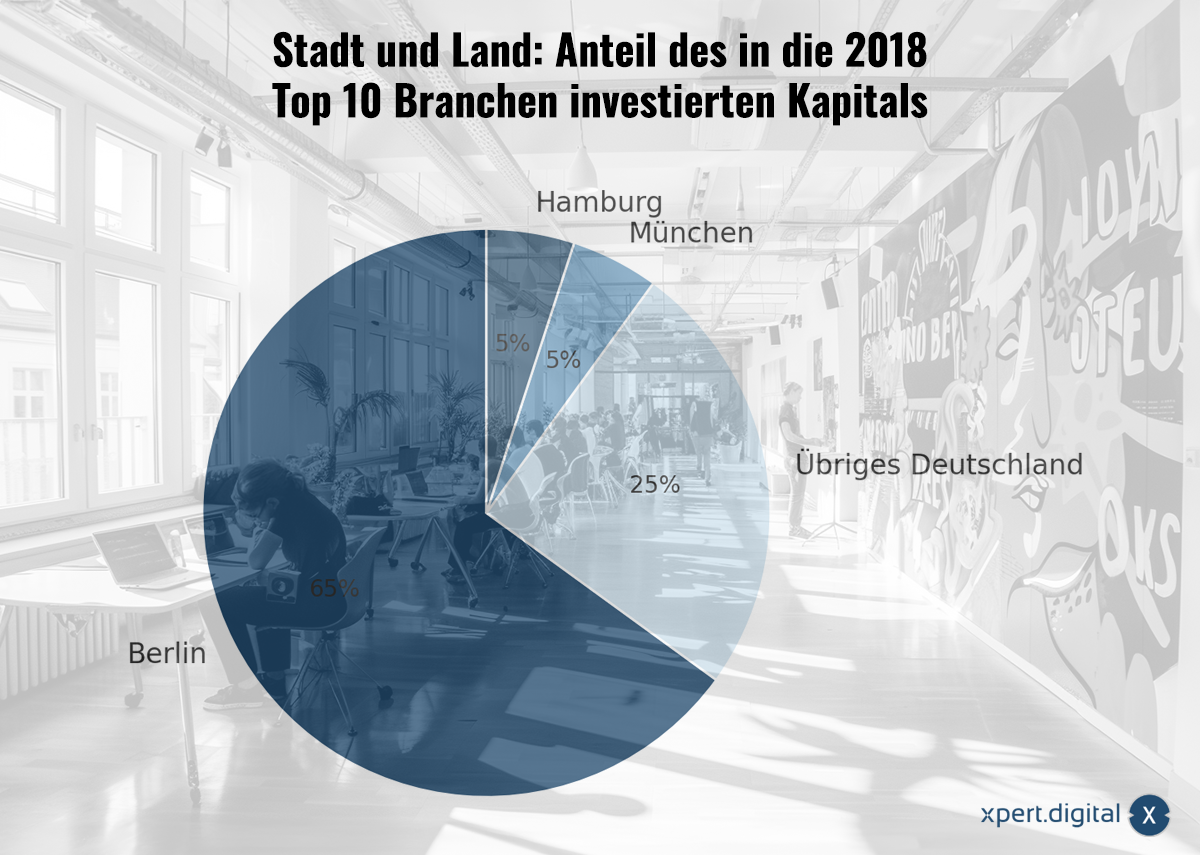
Urban and rural areas: Share of capital invested in the top 10 industries in 2018 – Image: Xpert.Digital
🎨📊 A total of over €1.8 billion was invested, spread across various sectors. The top 10 sectors account for 95 percent of the total venture capital. Let's take a closer look at the figures and analyze what they mean for the respective sectors and the German startup ecosystem.
🚗 1. Automobile: 564 million euros
The automotive industry received by far the most venture capital investments in the first half of 2018 – a total of €564 million. This reflects the enormous importance of the automotive industry in Germany. Germany is known for its leading car manufacturers such as Volkswagen, BMW, and Daimler. However, alongside these established players, a growing number of new startups are emerging, focusing on electromobility, autonomous driving, and new mobility solutions. These startups are key players in the transformation of the automotive industry towards more environmentally friendly and efficient transportation concepts.
The areas of e-mobility and connected cars, in particular, have attracted investor interest. Startups specializing in the development of battery technologies, charging infrastructure, or software for autonomous driving are benefiting from these funding rounds. The high investment volume indicates that the transformation of the automotive industry is well underway and that many more disruptive innovations are to be expected.
📈💵 2. Finance and Insurance: 376 million euros
The financial and insurance sector raised €376 million in venture capital during the same period. This figure illustrates the significant growth in interest in FinTech and InsurTech startups. Digital financial service providers and insurance technologies have experienced a veritable boom in recent years. Many of these companies offer innovative solutions that challenge traditional banks and insurance companies, whether through simplified online banking services, peer-to-peer lending platforms, or machine learning-based insurance platforms.
In Germany, FinTech startups like N26 and Raisin are among the pioneers of this movement. The high level of investment in this sector demonstrates that Germany is one of the leading FinTech locations in Europe. At the same time, the sum of €376 million signals that further disruptive developments are to be expected in the future, which could fundamentally change both the banking and insurance sectors.
🏥💊 3. Healthcare: 305 million euros
With €305 million, the healthcare sector was one of the industries that attracted a particularly large amount of venture capital in 2018. This demonstrates that investors see great potential in the field of digital healthcare. Startups focusing on topics such as telemedicine, digital health platforms, wearables, and personalized medicine are especially in demand.
The German healthcare sector is increasingly being transformed by technological innovations. Startups are gaining importance, particularly in the areas of preventive healthcare, AI-supported diagnostics, and remote patient monitoring. These developments are of great significance not only for the healthcare industry but also for society as a whole, as they can contribute to improving overall healthcare provision.
💻🌐 4. IT (Software & Internet Services): 276 million euros
The IT sector, including software and internet services startups, attracted €276 million in venture capital. These investments highlight the role that digitalization plays in almost all areas of life. Startups in this sector are developing solutions ranging from cloud-based services and cybersecurity to data-driven applications.
What's particularly interesting is that many of these startups are developing platform-based business models that allow them to offer scalable solutions for various industries. The level of investment suggests that Germany is an attractive location for software and internet service companies offering digital solutions for both the B2C and B2B sectors.
🏖️✈️ 5. Tourism: 265 million euros
With €265 million in venture capital, tourism is another high-growth sector. Digital platforms revolutionizing the travel market are increasingly attracting investment. Startups offering innovative concepts for travel bookings, mobility, and accommodation have challenged traditional market players.
The growing importance of travel tech startups like GetYourGuide, which allow users to book travel experiences easily and digitally, demonstrates that tourism is a significant growth sector in Germany as well. The substantial amount invested in this area signals that the transformation of the travel industry is far from over.
👗🛋️ 6. Consumer goods (clothing, furniture, etc.): 228 million euros
The consumer goods industry, particularly clothing and furniture, has received €228 million in investments. This demonstrates that the e-commerce sector remains a strong growth market. Startups specializing in the online sale of consumer goods have developed enormously in recent years. In addition to fashion startups like Zalando or About You, there is a growing number of companies offering furniture and household goods online.
These startups are benefiting from changing consumer behavior, with more and more people shopping online. The digitalization of retail and the development of innovative business models such as subscription services or sustainable production have made this sector an attractive investment target.
🔋🌍 7. Energy: 222 million euros
In the energy sector, €222 million in venture capital was invested. The energy transition and the trend towards sustainable energy production and use have made this sector a popular investment area. Startups focusing on renewable energies, energy storage solutions, and energy efficiency have benefited significantly from these investments.
In Germany, there are numerous initiatives to promote cleantech companies that develop technologies to reduce the carbon footprint and make energy production more efficient. These startups make a significant contribution to achieving climate goals and simultaneously offer investors attractive growth opportunities.
🚛📦 8. Transport & Logistics: 193 million euros
With €193 million in investment, the transport and logistics sector ranks in the middle range. Startups in this field are developing innovative solutions for freight transport, logistics optimization, and delivery. Logistics startups are gaining increasing importance, particularly in the context of the growing e-commerce market.
The development of autonomous delivery vehicles, drones for parcel delivery, and platforms for optimizing supply chains are just a few examples of the innovative concepts being driven forward in this sector. Investors recognize the potential of these technologies, which could fundamentally transform the transportation sector.
📺📈 9. Media & Marketing: 153 million euros
The media and marketing sector has received €153 million in investments. Startups offering data-driven marketing solutions or new media formats are particularly attractive to investors. Digital advertising platforms, influencer marketing, and personalized content strategies are just some of the areas where startups are growing.
The development of AI-powered tools for automating marketing processes and data-driven analysis of consumer behavior is attracting increasing investor interest. These solutions offer companies the opportunity to optimize their marketing strategies and respond more effectively to the needs of their target groups.
🍽️🥤 10. Nutrition (Food & Beverages): 139 million euros
The food industry has raised €139 million in venture capital. Startups focusing on sustainable foods, plant-based alternatives, or innovative delivery models like meal kits are particularly in demand. The trend toward healthier and more sustainable consumption has fueled strong growth in this sector.
In Germany, there are numerous FoodTech startups trying to revolutionize the food system. From the production of alternative proteins to delivery services for fresh food and innovative packaging solutions – the food industry offers diverse investment opportunities
📊📈 Digitalization is shaping the business of German start-ups
🌐✨ Digitalization plays a crucial role in today's business world and has a profound impact on almost every industry. Start-ups, in particular, often considered pioneers of new technologies, have used digitalization not only as a tool to optimize internal processes but also to develop entirely new business models. In this article, we examine how digitalization is shaping the business of German start-ups, which markets it is influencing, and what strategic opportunities arise from this development.
📊📱 The importance of digitalization for business models
Start-ups are often characterized by their ability to react flexibly to market changes. This is particularly evident in how they integrate digitalization into their business models. Digitalization not only influences the efficiency of processes but also enables entirely new business areas and services that would not have been feasible before.
Significant impact on business models
A significant proportion of German startups report (source: KPMG) that digitalization has a "very large" or "large" impact on their business model. This illustrates that digitalization is not merely seen as a technological development, but as a central foundation for their entire business understanding. These companies utilize digital technologies to tap into new markets, automate business processes, and develop innovative products or services.
🚀💡 Opportunities through digitalization
The opportunities offered by digitalization are manifold. Several key areas deserve particular mention:
1. Automation and efficiency improvement
Digital technologies enable companies to automate their internal processes, thereby not only reducing costs but also increasing efficiency. Tasks that were previously manual and time-consuming can now be automated through software solutions, freeing up employees for more creative and strategic tasks.
2. Expansion of target markets
Digital technologies enable startups to offer their services and products across geographical boundaries. Through online platforms and digital marketing strategies, companies can operate globally and reach new customer groups. This is particularly important for young companies that want to scale quickly and expand their market presence.
3. Innovative business models
Digitalization is giving rise to new, innovative business models. Companies can use data analysis and artificial intelligence (AI) to develop products that create personalized customer experiences. For example, a digital fashion startup could offer a platform that suggests individually tailored clothing items based on AI-driven recommendations.
💻⚠️ Challenges of Digitalization
However, alongside the opportunities, digitalization also brings challenges. Start-ups must overcome these in order to survive in an increasingly competitive environment.
1. Data and IT security
With increasing digitalization, the risks of cyberattacks also rise. Start-ups, which often operate with limited financial and human resources, must ensure that their IT infrastructure is adequately protected. Data leaks or security vulnerabilities can have serious consequences, both for customer trust and for the company's reputation.
2. Rapid technological change
Technologies are evolving rapidly, and startups must be able to adapt quickly to these changes. Those who react too slowly to new trends risk falling behind the competition. Flexibility and a strong culture of innovation are crucial here.
3. Skilled worker shortage
There is a noticeable shortage of skilled workers, particularly in the IT and technology sectors. Start-ups have to compete not only with other companies but also with large corporations for the best talent. To survive in this competition, many young companies are relying on creative solutions, such as flexible working models and attractive company values, to attract the best minds.
🌍📶 International Markets and Their Importance
Globalization and digitalization go hand in hand, especially for startups, which benefit from the opportunities of global networking. Digital technologies enable young companies to expand their reach beyond the national market and serve international markets.
Germany as the main market
Despite the international focus of many startups, Germany remains the most important market for many young companies. This is due to several reasons: On the one hand, Germany offers a strong infrastructure and a business-friendly environment for new ventures. On the other hand, the needs and preferences of German consumers are well understood, which reduces business risk.
EU and non-EU countries
Many startups are also expanding into neighboring EU countries, as these are more easily accessible due to shared regulatory frameworks. Non-EU countries in Europe also play a role, albeit to a lesser extent. North America is also an attractive market for German startups, especially for technology companies that want to benefit from the innovative strength of the USA.
📈🌐 Digital Business Strategies
For startups, developing a clear digital strategy is crucial. This should encompass not only the technological infrastructure but also how digital channels are used to engage with customers and optimize business processes.
1. Omnichannel strategy
An omnichannel strategy enables companies to interact with their customers across various digital and physical channels. For example, e-commerce companies can offer their products not only through their website, but also via social media and online marketplaces.
2. Personalization through data analysis
Thanks to modern analytics tools, startups can use customer data to create personalized offers and experiences. This personalization leads to greater customer loyalty and increases customer satisfaction.
3. Cloud-based solutions
Using cloud solutions allows startups to design their IT infrastructure flexibly. Cloud services offer a scalable platform for running digital applications and can be expanded or reduced as needed. This gives young companies the necessary flexibility to react quickly to market changes.
💼🔍 The role of investors
Investors play a crucial role in promoting digitalization in startups. They offer not only financial support but also valuable strategic advice, particularly regarding the scaling and expansion of business models.
Venture capital for technological innovations
Many venture capitalists are particularly interested in startups that drive technological innovation. They see great potential in digital business models, as these are often rapidly scalable and promise high profitability. Startups that utilize innovative technologies such as artificial intelligence, blockchain, or the Internet of Things (IoT) therefore frequently have a good chance of securing funding.
🔮📊 The future of digitalization in start-ups
Digitalization offers startups enormous opportunities, but also presents challenges. Companies that are able to react flexibly to technological changes and integrate digital innovations into their business model will be successful in the long run. In particular, the ability to tap into international markets and effectively utilize digital technologies will determine which startups prevail in the market and which do not.
The coming years will reveal the role that new technological trends, such as the metaverse or the further development of artificial intelligence, will play. However, one thing is certain: digitalization will remain an indispensable tool for startups to survive in a globalized and technologically advanced world.
💼 Start-up revenue distribution by market 2018
1. 🇩🇪 Germany – 78.7% revenue share
By far the largest share of revenue for German startups comes from the domestic market. Almost 80% of total revenue is generated in Germany. This suggests that while German startups think globally, they are strongly focused on the national market. This can be due to several reasons:
familiar market environment
Start-ups understand the preferences and behavior of their local customers. The German market, due to its size and economic strength, offers a solid foundation for young companies.
Regulatory advantages
In Germany, the legal framework for start-ups is familiar, which facilitates the market launch of new products and services.
However, this focus on the domestic market could also reflect a certain reluctance towards internationalization. This could be due to the challenges associated with expanding into foreign markets, such as cultural differences or regulatory hurdles.
2. 🔗 EU countries – 11.0% revenue share
Another important market for German startups is the EU, which accounts for 11% of their revenue. The European Union offers numerous advantages, including:
Common Internal Market
The European single market allows companies to operate within the EU without major trade barriers. This means less bureaucracy and simpler trading conditions.
Common currency (Euro)
Many EU countries benefit from a common currency, which simplifies business transactions and pricing.
Despite these advantages, the revenue share in the EU is comparatively small compared to the German market. This could indicate that while German startups are aiming for expansion into Europe, this tends to occur in the early stages of internationalization.
3. 🌍 Europe (non-EU) – 2.3% revenue share
Countries in Europe that are not part of the EU contribute only 2.3% to total revenue. This shows that these markets currently play a less significant role for German startups. Possible reasons for this include:
Regulatory differences
Countries outside the EU are subject to different regulations and legal frameworks, which can make market entry more difficult.
Economic differences
Markets outside the EU may appear less economically stable or less attractive, which discourages German start-ups from expanding there.
However, this could present opportunities for start-ups in the future, as some non-EU countries in Europe, such as Switzerland or Norway, represent economically strong and technologically advanced markets.
4. 📈 North America – 4.4% revenue share
The North American market (particularly the USA and Canada) accounts for 4.4% of revenue. This is a remarkably small share considering that North America is one of the world's largest and most important technology markets. Possible reasons for this relatively small share could be:
Highly competitive market
The US market is particularly competitive, as it is home to many leading tech companies. It can be difficult for startups to gain a foothold in this environment.
Cultural and regulatory differences
The US and Canada have different legal requirements and cultural expectations that could make expansion more difficult.
High market entry costs
Entering the North American market involves high costs, especially in the areas of marketing and customer acquisition.
Nevertheless, North America offers enormous potential for German startups, especially in the tech sector. The market is large, technologically advanced, and offers access to important investors and networks.
5. 📊 Other countries – 3.6% revenue share
Markets outside Europe and North America contribute 3.6% to total revenue. These markets are very diverse and include regions such as Asia, Africa, Latin America, and Australia. This small share suggests that German startups have so far only focused to a limited extent on global markets outside the established economic blocs. However, future growth opportunities may lie in these areas
Emerging markets
Countries like China, India, and Brazil offer significant growth opportunities, especially for tech startups. These markets have a growing middle class and increasing demand for digital services.
New technologies and infrastructure
In some emerging economies, massive investments are being made in digital infrastructures, creating new opportunities for technology and service sector startups.
🌐 Impact of digitalization on business models
The influence of digitalization on the business models of German start-ups provides detailed insights into how strongly this influence is perceived.
1. 🚀 Very large influence – 61.1%
Over 60% of the surveyed startups stated that digitalization has a very significant impact on their business model. This means that the majority of German startups see digitalization not just as a tool, but as a central foundation of their business strategy. This significant impact indicates companies that focus on digital products and services or have fully digitized their internal processes.
2. 💡 Significant influence – 18.2%
18.2% of startups report that digitalization has a "significant" impact. This also shows that digital technologies play a significant role, but may not shape the business model to the same extent as in the startups with a "very significant" impact. These companies might, for example, digitally optimize existing analog business models without completely switching to digitalization.
3. ⚖️ Medium influence – 10.3%
Around 10% of startups report a moderate impact from digitalization. In these cases, digitalization is likely used to improve or supplement existing processes, but is not seen as the primary driver of business development.
4. 🔍 Little influence – 6.5%
6.5% of startups report that digitalization has only a minor impact on their business model. These startups likely operate in sectors that are less technology-dependent or rely on traditional business models that do not benefit significantly from digital technologies.
5. 🚫 No impact – 3.9%
A small minority of 3.9% state that digitalization has no impact on their business model. These could be startups in very specific niche markets that have so far been barely affected by digitalization, or companies that deliberately rely on analog models.
📊 Opportunities and challenges for German start-ups
The figures clearly demonstrate that digitalization plays a key role for German startups, both in terms of developing their business models and expanding into new markets. While the German market remains the most important revenue driver, enormous opportunities exist in further internationalization, particularly in Europe and North America. However, to fully exploit the potential of digitalization, startups must overcome the challenges it presents, such as IT security, skills shortages, and rapid technological change. Companies that successfully address these challenges will be able to thrive in a globalized and digitalized world in the long term.
We are here for you - Consulting - Planning - Implementation - Project Management
☑️ Start-up and industry expert, here with its own Xpert.Digital industry hub featuring over 2,500 specialist articles

Konrad Wolfenstein
I would be happy to serve as your personal advisor.
You can contact me by filling out the contact form below or simply call me on +49 7348 4088 965 .
I'm looking forward to our joint project.
Write to me


Xpert.Digital - Konrad Wolfenstein
Xpert.Digital is a hub for industry focusing on digitalization, mechanical engineering, logistics/intralogistics and photovoltaics.
With our 360° Business Development solution, we support renowned companies from new business to after-sales.
Market intelligence, smarketing, marketing automation, content development, PR, mail campaigns, personalized social media and lead nurturing are part of our digital tools.
You can find more information at: www.xpert.digital - www.xpert.solar - www.xpert.plus
Keep in touch