
Outsourced marketing department: SME advertising agencies as workhorses of the Mittelstand – creative image on the topic, with AI: Xpert.Digital
No budget for 5 specialists? When a full-service agency really pays off for your SME
Staff shortage in marketing: Why SME agencies are the true workhorses
The illusion of the creative agency: What medium-sized businesses need today instead
Those responsible for marketing in small and medium-sized enterprises (SMEs) today often face a significant resource problem. Digital channels are fragmenting, technological demands are growing rapidly, and target audience expectations are constantly rising – yet internal budgets and staffing levels rarely keep pace. In this situation, it's not enough for SMEs to simply bring on board a traditional creative agency that produces a brilliant campaign once a year. What's needed are reliable generalists who can handle day-to-day operations, fill gaps in staffing, and maintain a strategic overview. This is precisely where specialized SME agencies come into their own. They don't just provide ideas, but act as outsourced marketing departments and indispensable workhorses for SMEs. But what exactly distinguishes them from traditional advertising and campaign agencies? And what should decision-makers really consider when choosing their agency partner? This article examines the various agency models, analyzes pricing structures, and demonstrates why a full-service approach is often the only economically viable solution for SMEs.
Who will get the cart out of the mud when there's a lack of budget and personnel?
Creativity or hard work? Which advertising agency is truly right for your company?
A glance at the German agency landscape today reveals a colorful mix of advertising agencies, communications agencies, creative agencies, and highly specialized campaign firms. However, a closer look reveals a clear division of labor, closely tied to the size and resources of the clients. For small and medium-sized enterprises (SMEs), the agency they work with is rarely a glamorous creative partner like a large campaign agency, but rather a workhorse that steps in where internal resources are lacking. This analysis examines how SME agencies differ from pure campaign agencies and creative boutiques, what range of services is actually expected of them, and whether they focus on specific core areas or simply fill gaps for missing internal resources.
Two agency worlds, two business models
The fundamental difference between a typical SME agency and a traditional campaign agency lies not primarily in the talent of its employees, but in the business model underlying the collaboration. Campaign agencies and pure creative firms are generally geared towards projects that are time-limited but highly focused in terms of content, such as developing a brand relaunch, a major advertising campaign, or a sensational creative concept for a single product. They work on a campaign-based model with time horizons ranging from a few weeks to several months and concentrate on awareness, reach, and sales promotion. Their success is usually measured in creative awards, reach, and short-term impact.
SME agencies, on the other hand, are almost always geared towards long-term support. They manage all of a client's communication channels simultaneously and ensure a consistent marketing presence over an extended period, often for years and well beyond the initial contract. This pattern explains why retainer models, i.e., fixed monthly fee agreements, are significantly more common in the SME sector than project-based, one-off contracts. Monthly flat fees for comprehensive support in Germany typically range between €2,000 and €10,000, while one-off, larger projects, such as a website relaunch, often start at €8,000. According to market research, smaller engagements with a reduced scope of services start at around €800 to €1,200 per month, which covers one or two channels and basic reporting.
Why small businesses need generalists instead of specialists
The crucial question of whether SME agencies need to cover more ground or focus on specific areas can be clearly answered by looking at the structure of their clients: They need to be more broadly positioned because their clients rarely have their own marketing departments with specialists for every single channel. While a large corporation can commission separate internal teams or several specialized external partners simultaneously for SEO, social media, content production, media planning, and brand management, a medium-sized manufacturing company or an owner-managed service provider often has only a single point of contact for all marketing, if any at all. This is precisely where the so-called full-service agency comes in, bundling all relevant digital and traditional services under one roof and enabling coordinated strategies, instead of sending clients back and forth between several specialized service providers.
The typical range of services offered by such an agency extends from strategic consulting, target group analysis, and competitor monitoring to the development of a brand identity and a suitable corporate design. This is complemented by concrete implementation in the form of web design and web development, search engine optimization (SEO) and search engine advertising (SEA), social media management, content creation in text, image, and video formats, traditional print advertising, and increasingly, optimization for AI-based search engines, known in technical jargon as Generative Engine Optimization (GEO). Such a broad range of services is not accidental, but rather stems from the simple business logic that a small company cannot afford, nor wants, five or six different specialized service providers, each with their own invoices, contact persons, and briefing processes.
The agency as an outsourced marketing department
The comparison with the concept of marketing outsourcing is particularly insightful, as it precisely describes the role of SME agencies. Outsourcing in marketing means no longer handling individual or all marketing tasks with in-house staff, but rather engaging experienced external specialists. This represents a very practical solution for many medium-sized companies facing limited personnel and rapidly changing requirements. It is by no means an all-or-nothing principle, but rather a spectrum with many intermediate levels: With partial outsourcing, the client retains strategic control and only relinquishes specific disciplines such as search engine optimization or graphic design. With complete outsourcing, the external partner jointly assumes strategy and implementation, effectively acting as an in-house, but outsourced, marketing department.
This observation directly answers the third initial question: SME agencies, in a significant portion of their projects, step in precisely where the company itself lacks resources, be it in the form of expertise, time, technical infrastructure, or simply personnel. They are therefore less mere idea generators and more structural gap fillers, taking over continuous operational work that would be handled by permanent marketing staff in larger organizations. The comparison to a workhorse is apt because a large part of the agency's day-to-day work doesn't consist of spectacular creative ideas, but rather the reliable, recurring maintenance of websites, search engine rankings, social media channels, and advertising campaigns.
🎯🎯🎯 Data-driven B2B industry hub as a quasi-in-house solution

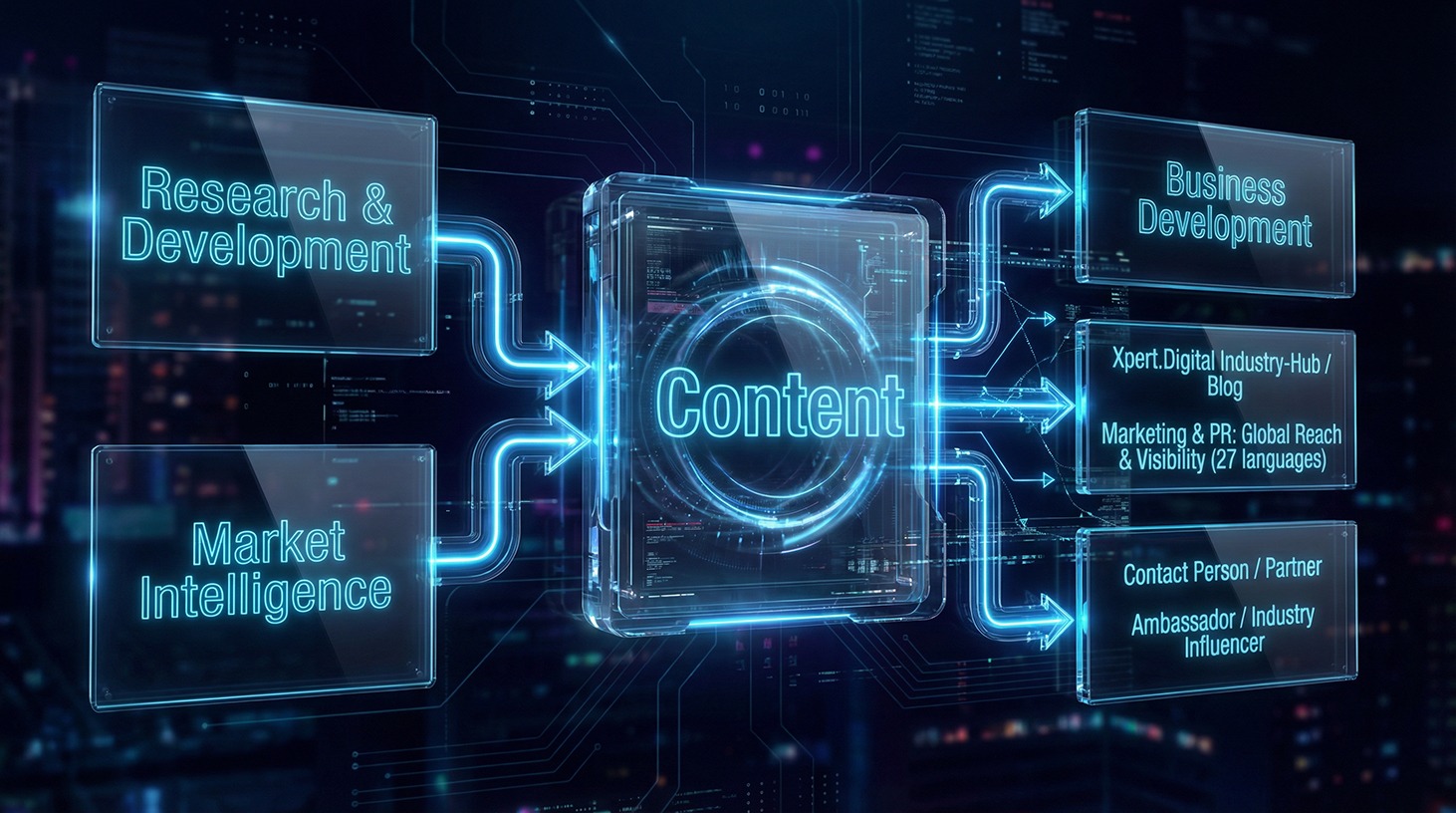
The quasi-in-house solution: How Xpert.Digital closes operational gaps in B2B marketing and sales – Smart Content-Driven Business - Image: Xpert.Digital
Xpert.Digital is a data-driven B2B industry hub led by Konrad Wolfenstein . The company acts as an external, quasi-in-house solution for industrial partners, closing operational gaps in marketing, content, and sales – without requiring additional resources on the client side.
More information here:
The agency gap in medium-sized businesses: Why operational support is more important than pure creativity
Where creative agencies begin and where they end
Creative agencies, in the narrower sense, pursue a significantly narrower but more profound approach. Their core business is the development of exceptional concepts, attention-grabbing campaign ideas, and distinctive designs, while operational tasks such as ongoing community management, website maintenance, or traditional search engine marketing are often not part of their services or are deliberately outsourced. Furthermore, the term "creative agency" is the most imprecise of all agency designations, because virtually every agency describes itself as creative, regardless of the breadth or narrowness of its actual service offerings.
Communication agencies, in turn, traditionally think even more broadly than pure advertising agencies, as they handle all aspects of corporate communication, including public relations, internal communications, and crisis communications, with the strategic goal of strengthening reputation and stakeholder relationships in the long term. Advertising agencies in the classic sense focus more on the creative development and implementation of specific advertising measures such as campaigns, advertisements, commercials, and brand appearances, aiming for immediate attention and sales promotion. In practice, however, these boundaries are becoming increasingly blurred for smaller agencies, because economic necessity forces them to combine elements from all three areas in order to simultaneously meet all relevant needs for a single medium-sized client.
Performance comparison between agency types
The following overview summarizes the key structural differences between typical SME agencies, classic campaign agencies and pure creative agencies, and clarifies why SME agencies in particular must necessarily act as generalists.
| feature | SME agency (full service) | Campaign agency | Creative agency |
|---|---|---|---|
| Time horizon | Long-term, often years | Campaign-based, weeks to months | Project-based, concept-focused |
| Performance range | Very broad: Strategy, Web, SEO, Social Media, Content, Print | Eng: Creative concept, media planning, production of a campaign | Eng: Idea development, design, conception |
| Compensation model | Mostly retainers, monthly flat fees | Predominantly project-based with high individual budgets | Mostly project-based |
| Typical customer | SMEs without their own marketing department | Larger brands with a defined campaign budget | Companies with clearly defined creative needs |
| Performance measurement | Ongoing operational KPIs, visibility, leads | Reach, attention, short-term sales | Creative impact, awards |
| role towards the customer | Outsourced marketing department | External impetus for an individual project | Idea generator for special tasks |
Price structures as a reflection of the division of labor
The different business models are directly reflected in the market's pricing structures. Hourly rates for agencies in Germany range from approximately €60 to €300, with small agencies and experienced freelancers often charging between €80 and €130 per hour. Communication agencies tend to charge between €120 and €250 per hour, while advertising agencies calculate their rates even more broadly, from €100 to €300, because campaign projects may also involve production costs and media budgets. In Switzerland, comparable hourly rates are naturally higher, ranging from CHF 160 to CHF 280, with monthly mandates for SMEs often starting at a fixed price of CHF 2,500.
It is also interesting to note that retainer models are significantly more common at communications agencies (60 to 70 percent) than at traditional advertising agencies (only 30 to 40 percent), which underscores the stronger project orientation of pure campaign providers. For SME agencies with their holistic, full-service approach, the retainer rate is likely even higher, as the continuous management of all a client's channels naturally requires a long-term contractual basis and cannot be meaningfully broken down into individual, clearly defined projects.
Digitalization exacerbates the resource shortage in medium-sized businesses
A key driver behind the growing importance of SME agencies as resource-filling solutions lies in the rapidly increasing complexity of digital marketing disciplines. Where just a few years ago a website and perhaps an advertisement in a trade journal sufficed, medium-sized companies today must simultaneously manage search engine optimization, search engine advertising, multiple social media channels, email marketing, content production in text, image, and video formats, and now also visibility in AI-powered search systems. This fragmentation of channels, coupled with limited personnel budgets, explains why many SMEs consciously opt for a broadly positioned, full-service agency rather than hiring a separate specialist for each individual discipline and acting as a coordinator between multiple external partners themselves.
Smaller businesses, especially those with only one or two marketing staff members, are increasingly faced with the fundamental decision of either hiring an agency or using modern, all-in-one marketing software that automates many tasks and is offered at significantly lower monthly costs, ranging from €50 to €400. In practice, many companies are adopting a hybrid model where software supports ongoing operational campaigns, while an agency is brought in several times a year for strategic sprints, major relaunches, or more complex market entries. This pattern confirms once again that agencies are primarily in demand among medium-sized businesses where strategic thinking, concept development, and coordination are required, while purely execution-related tasks are increasingly being supplemented or replaced by technology.
The gray area between conception and ongoing support
A frequently overlooked aspect concerns tasks that fall neither clearly under the umbrella of strategic communications consulting nor traditional advertising production, such as the creation of complex corporate presentations, technical white papers, or multilingual specialist content for international target groups. Such formats often fall into a gap between pure communications agencies, which tend to view them as strategic documents, and advertising agencies, which primarily see them as creative design tasks. For medium-sized companies with international operations, for example in the industrial, logistics, or technology-driven B2B service sectors, this means in practice that a suitable agency must possess both a substantive and strategic understanding of complex specialist topics and the necessary design and technical implementation skills, further intensifying the already high expectations placed on the versatility of SME agencies.
This observation also explains why niche providers are increasingly establishing themselves within the full-service segment. These providers offer a broad range of services but still pursue a recognizable industry specialization, such as in B2B communication, technical industrial companies, or specific international markets. This combination of horizontal service breadth and vertical industry specialization allows such agencies to act simultaneously as generalist workhorses and as technically skilled sparring partners for complex issues—something rarely found in the world of pure campaign or creative agencies.
Structural limitations of full-service logic
Despite the obvious advantages of holistic support, the full-service model also reaches its limits in practice. An agency that offers everything is not automatically one that masters everything at the highest level, because the depth of expertise in individual disciplines such as highly complex technical SEO, data-driven performance marketing, or elaborate video production cannot naturally reach the same level of maturity in a small generalist team as in a highly specialized boutique agency that focuses exclusively on a single area. Therefore, what is crucial for the actual added value of an SME agency is not so much the sheer number of services offered, but rather the ability to consistently consider strategy and implementation from a single source, so that, for example, the person who develops the corporate design also understands how it must be implemented correctly on the website.
Many larger full-service agencies address this tension by building internal specialist teams for individual disciplines, which are nevertheless coordinated under a common strategic umbrella, or by collaborating selectively with external specialist partners for particularly demanding sub-tasks without relinquishing overall control. For medium-sized clients, this means in practice that choosing the right agency is less a question of the largest service portfolio and more a question of how well an agency truly understands the client's internal processes, resource gaps, and strategic goals, and can translate these into a coherent, practical overall concept.
The practice of medium-sized companies
In summary, SME agencies differ from pure campaign agencies and creative agencies primarily through their significantly broader, generalist service approach and their long-term, retainer-based client relationships. They must necessarily be able to cover more ground than specialized campaign firms because their medium-sized clients typically have no or only very small in-house marketing departments and therefore rely on an external, holistically minded entity. At the same time, this confirms the assumption that these agencies step in to a considerable extent where the company simply lacks the resources—be it expertise, time, or technical infrastructure—and thus effectively take over the function of an outsourced marketing department. For decision-makers in medium-sized businesses, this means that the choice of the right agency should ultimately depend less on the breadth of the service offering than on the demonstrable ability to combine strategic thinking and operational implementation power in a single, reliable partner.
📈🚀 From visibility to trust 👀🤝 Your scalable path with Xpert.Digital

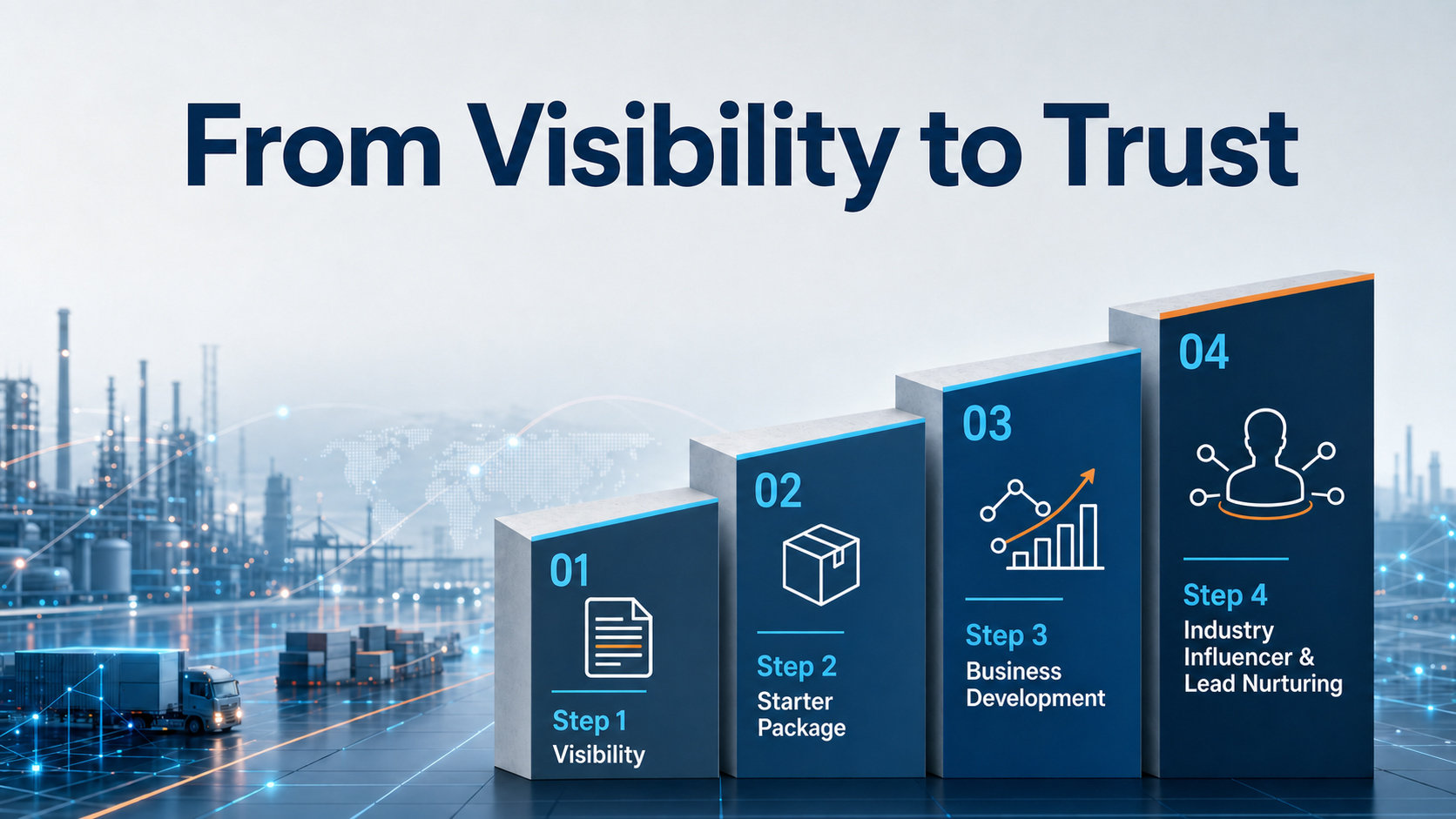
From visibility to trust: Your scalable path with Xpert.Digital - Image: Xpert.Digital
In industrial B2B, sustainable business relationships rarely emerge overnight. They develop step by step – through visibility, professional relevance, recurring touchpoints, and growing trust. Xpert.Digital's 4-stage model addresses precisely this: It offers a structured path that begins with a manageable entry point and can evolve into deeper collaboration in business development if needed.
Instead of relying on loud marketing promises, this model puts the relationship at the forefront. Companies start with clearly defined, easily calculable measures and then decide, based on their own experience, how far they want to expand the collaboration. A key factor for this undisturbed trust-building process: The platform completely avoids annoying advertising ads, so the editorial focus remains solely on the companies' expertise.
More information here:
Your global marketing and business development partner
☑️ Our business language is English or German
☑️ NEW: Correspondence in your native language!

Konrad Wolfenstein
I and my team are happy to be available to you as your personal advisor.
You can contact me by filling out the contact form here wolfenstein@xpert.digital:or simply call me at +49 7348 4088 965. My email address is
I'm looking forward to our joint project.