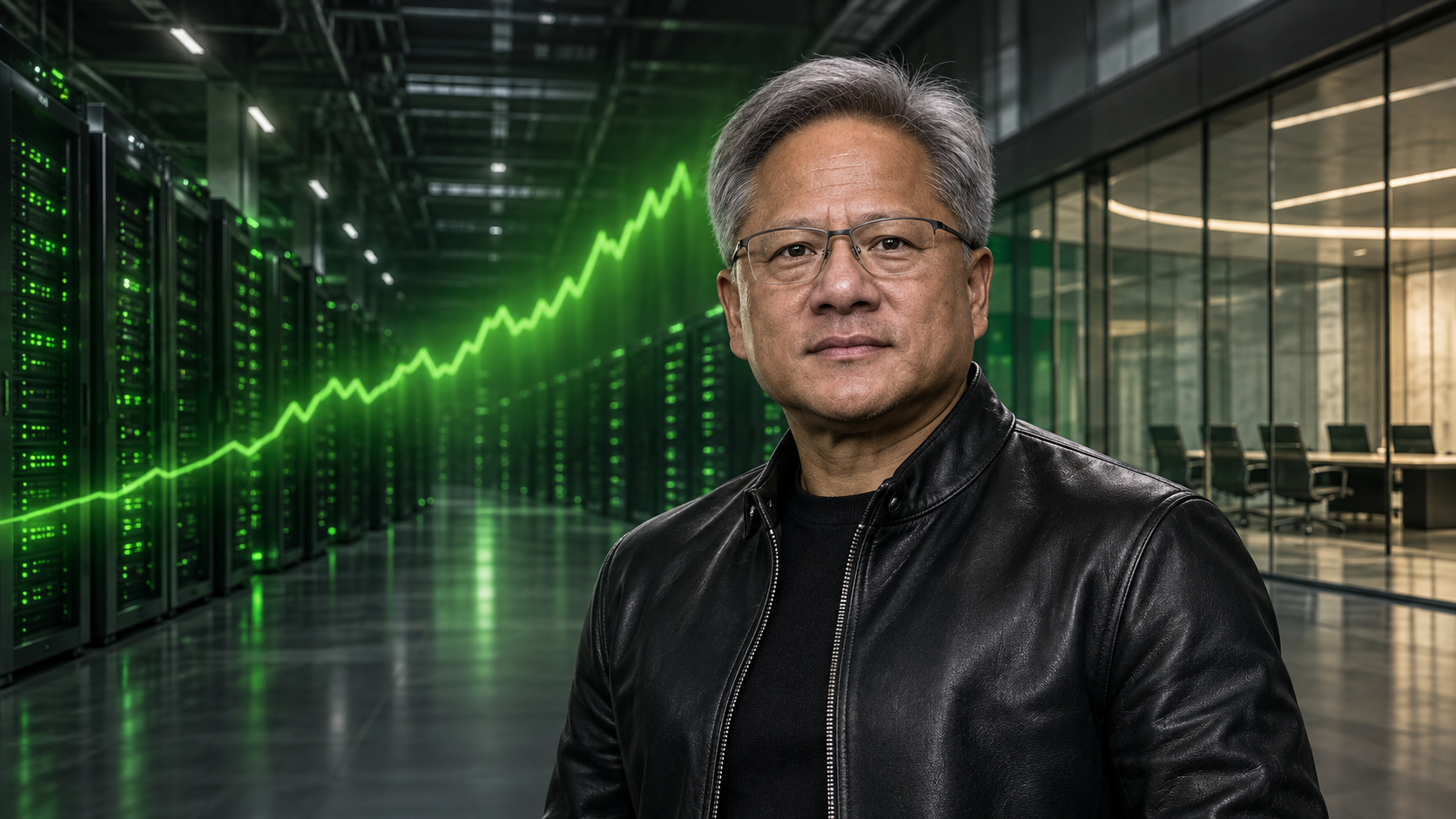
Nvidia brings back Jensen Huang: Why the stock market is betting on a single manager – Creative image on the topic, with AI: Xpert.Digital
Jensen Huang's comeback triggers a rally – but the biggest questions remain unanswered
One manager, billions in market capitalization, and open investigations: The Nvidia case
Nvidia between AI boom and security issues: What Huang's comeback means
Nvidia is once again relying on its co-founder Jensen Huang: Following his resignation in connection with an alleged espionage scandal, the board of directors has reappointed him as president and CEO. The stock market reacted with a sharp rise in the share price – a sign of how strongly investors pin the future of the AI company on a single leader. But Huang's return is not a complete exoneration: The internal investigation continues, and government agencies are also looking into the case. This presents Nvidia with a dual challenge: The company must ensure strategic continuity while simultaneously demonstrating that its control mechanisms function independently and effectively. This overview reveals what the market reaction tells us about AI capitalism, why high profits do not protect against valuation risks, and how the success of the comeback can truly be measured.
Too important to fail – and apparently too valuable for a permanent resignation
Jensen Huang's return to the top of Nvidia is far more than a spectacular personnel decision. It reveals just how closely intertwined economic power, technological leadership, political interests, and the trust of the capital markets have become. The board of directors reinstated the co-founder as president and CEO on November 23, 2026, with immediate effect. This followed his resignation in connection with an alleged espionage scandal and a brief interim period under CFO Colette Kress. The internal investigation continues despite his reinstatement.
The decision was initially received as a significant relief on the stock market. Nvidia shares experienced an extraordinary price surge, while other technology stocks also benefited from the renewed confidence. However, the speed of this reaction is not the only economically decisive factor. More significant is what it reveals about the company's valuation: a considerable portion of the expected future success is apparently linked not only to products, patents, and data centers, but also to the personal agency of a single manager.
This creates a paradoxical situation. Huang's return can reduce uncertainty in the short term, reassure customers, and establish strategic continuity. At the same time, the strength of the market reaction exposes a structural weakness. A company whose valuation is so sensitive to its founder's status possesses exceptional leadership capital but also carries a significant personnel concentration risk.
The economically compelling perspective, therefore, lies neither in an unreserved celebration of the comeback nor in a hasty condemnation. The crucial question is whether Nvidia combines the return of its key strategic figure with a credible strengthening of institutional control. Without this connection, the stock rally would primarily be a bet on the long-term viability of personal indispensability as a business model.
A comeback with reservations instead of a final discharge
The board of directors justified the reinstatement with discussions and reviews that convinced them of Huang's openness and his ability to lead the company. Assessments from high-level US government officials also factored into the decision. Based on this, the board sees no risk to national security from his return. Harvey Jones remains chairman of the board; Huang will therefore not assume the chairmanship. Colette Kress, after her temporary role as CEO, will refocus on her financial responsibilities.
This institutional classification is important because the return does not automatically grant comprehensive legal or factual exoneration. The decision initially answers the question of who should lead the company. It does not definitively answer what happened in connection with the investigated events, what information may have been affected, or whether organizational weaknesses existed.
Nvidia is allowing a committee of independent board members to continue the investigation. This committee is supported by independent legal counsel. Huang has pledged his support and cooperation. Additionally, there are ongoing government investigations and inquiries with which the company intends to continue cooperating.
Economically, this constitutes a decision made with incomplete information. The board of directors apparently had to weigh two risk groups against each other: the potential consequences of returning before all reviews were completed and the potential damage of a prolonged leadership crisis.
Both risks can be significant. A premature comeback could exacerbate future losses of trust should new, damaging information emerge. Conversely, a permanent separation could negatively impact strategic alignment, employee retention, customer relationships, and capital market confidence. The fact that the board of directors currently appears to place greater emphasis on the second risk is a business assessment. Its validity will only be measured by whether the underlying assumptions hold up.
What the price surge reveals – and what it doesn't prove
The immediate market reaction was exceptionally strong. In the initial phase, a rise of approximately 17 percent was reported within minutes; subsequent price levels were nearly 30 percent above the previous Friday's closing price. Later, gains of around 31 percent, or about a third, were also reported. Such figures are not necessarily contradictory. In highly volatile trading, they can reflect different points in time and comparison bases.
For economic interpretation, however, a clear distinction must be made. A price gain of 17 percent during a short period should not automatically be added to a daily gain of 30 percent. Likewise, an interim high does not necessarily represent the final daily result.
In principle, a stock can rise because investors expect higher future profits. However, it can also rise because they consider the same profits less risky and therefore accept a higher price for them. In Nvidia's case, the second explanation is particularly plausible: The personnel decision doesn't directly change the number of chips shipped or the already installed computing power. It initially alters the assessment of how reliably the company can realize its economic potential.
Furthermore, there are potential technical factors at play. Investors who previously bet on falling prices might have to close their positions. Other market participants could re-enter the market after a sharp decline as soon as a key downward pressure appears to ease. However, without reliable position data, the respective contribution of these effects cannot be quantified.
The price surge is therefore a strong sign of confidence, but not proof that the matter has been fully clarified. Financial markets evaluate expectations. They do not replace an investigation or a security review.
Why a strong recovery is not yet full restitution
The stock market euphoria takes on a different meaning when viewed in the context of the preceding price movement. Before Huang's return, the stock had temporarily lost more than 40 percent during the month. This significantly lowered the starting point for the recovery.
Percentage losses and gains have an asymmetrical effect. For example, if a price falls from 100 to 60, this corresponds to a decline of 40 percent. If it then rises by 30 percent, it only reaches 78. Despite the impressive increase, it is still 22 percent below the original level. To fully offset a 40 percent loss, a subsequent gain of approximately 66.7 percent would be necessary.
This simple calculation protects against a common misinterpretation. A spectacular daily rally can reflect a significant increase in confidence and yet only recover a portion of the previously destroyed market value.
Equally important is the distinction between market capitalization and available financing. If the market capitalization increases, the company does not automatically receive the same amount of money in its bank account. First, the market price of existing shares changes.
Indirectly, a higher valuation can still create significant economic advantages. Share-based compensation becomes more attractive, potential acquisitions using company shares are easier to finance, and the confidence of business partners can stabilize. Conversely, sharp share price declines can negatively impact employee retention and complicate strategic decision-making.
The stock market thus reflects more than just a company's future expectations. Through compensation, financing, and trust, it can also influence its actual ability to act. This is precisely why an extreme dependence on the personal status of a CEO is more than just a communication problem.
Behind the leadership drama lies an extraordinary winning machine
The full economic impact of the personnel decision only becomes clear when considering the company's financial figures. Nvidia reported revenue of $115.8 billion for the third quarter of fiscal year 2027, which ended on October 25, 2026. This represented a 103 percent increase compared to the same quarter of the previous year and a 20 percent increase compared to the previous quarter. Operating profit reached $77.5 billion, and net income was $65.3 billion.
These rounded figures result in an operating margin of approximately 67 percent and a net margin of around 56 percent. The reported gross margin was 74.8 percent. Such figures explain why uncertainty regarding leadership is not being treated as an isolated personnel matter. At stake is the management of a business that is already generating exceptionally high earnings on a quarterly basis.
However, these figures don't allow for arbitrary extrapolation. If one were to multiply the quarterly revenue by four, purely mathematically, the result would be an annual figure of approximately 463 billion US dollars. This would be an annualized snapshot, not a company forecast. It assumes that the current revenue level is maintained over four quarters and takes neither further growth impulses nor potential slowdowns into account.
This distinction is particularly important when growth rates are very high. A company can perform exceptionally well operationally and still have an overly optimistic stock market valuation if the share price already anticipates even stronger results.
Huang's return therefore doesn't come to a demonstrably collapsed core business. She arrives at an extremely profitable company whose future viability was suddenly in question. This explains why a reduction in personnel could trigger such a significant reassessment.
The data center is both a growth engine and a concentration risk
Of the quarterly revenue, $107.6 billion came from the data center business. This segment grew by 110 percent year-over-year and contributed approximately 93 percent to total group revenue.
This structure clearly demonstrates how little Nvidia can now be described as a mere graphics chip provider. Its economic value hinges significantly on the infrastructure for accelerated computing and artificial intelligence. The company thus benefits from investment decisions that extend far beyond simply replacing individual computer components.
At the same time, a form of concentration emerges that remains relevant despite a large customer base. If various customers increase their spending based on the same fundamental conviction—namely, the expectation of rapidly growing AI usage—their investment decisions are economically interconnected. Many customers then do not automatically translate into many independent sources of demand.
Should the monetization of AI applications progress more slowly than expected, several large investors could become more cautious simultaneously. Conversely, persistently high demand can trigger a self-reinforcing expansion: More available computing capacity enables additional applications, the use of which in turn justifies further infrastructure.
The question of leadership is important for this dynamic, but not the sole determining factor. Even an excellently managed company cannot completely escape its customers' investment cycle.
The key test, therefore, remains whether the buyers of the infrastructure will derive sufficient long-term economic benefits from its use. On the other side of the business relationship, Nvidia's revenue is initially an investment expenditure. In the long term, this must translate into productivity gains, new revenue streams, or strategically justifiable advantages.
The economic value of a founder cannot be reduced to their salary
A CEO can create value for a technology company that extends far beyond formal responsibilities. They combine technical understanding, strategic decision-making, personal relationships, and the ability to credibly communicate long-term development.
In a founder-led company, this knowledge can be particularly strongly tied to specific individuals. Decision-making routines developed over decades, the understanding of internal teams, and direct contacts with key partners cannot be fully documented or transferred quickly.
This can create a founder's premium. Investors then pay more for a company because they believe its leadership possesses an above-average ability to transform technological opportunities into profitable markets. The value lies not solely in the individual, but in their impact on the entire organizational network.
The downside is the risk associated with key personnel. The more decisions, trust, and public image are tied to a single individual, the greater the potential consequences of their sudden absence. This applies not only to resignations but also, fundamentally, to illness, conflicts, or inadequate long-term succession planning.
However, the strong stock market reaction does not reveal Huang's exact monetary value. The price is reacting simultaneously to several pieces of information: his return, the assessment of the security situation, the reduced likelihood of a prolonged leadership crisis, and political support.
The correct conclusion, therefore, is not that a single manager created a certain amount of billions within a few minutes. It is that the market reassessed a bundle of risks, with this manager at its center.
🎯🎯🎯 Data-driven B2B industry hub as a quasi-in-house solution


The quasi-in-house solution: How Xpert.Digital closes operational gaps in B2B marketing and sales – Smart Content-Driven Business - Image: Xpert.Digital
Xpert.Digital is a data-driven B2B industry hub led by Konrad Wolfenstein . The company acts as an external, quasi-in-house solution for industrial partners, closing operational gaps in marketing, content, and sales – without requiring additional resources on the client side.
More information here:
The impact of Huang's return on the AI market
Colette Kress represents the often underestimated achievement of continuity
Huang's return should not lead to the erroneous conclusion that the interim leadership under Colette Kress was economically insignificant. She temporarily assumed the company's management during a period of considerable public uncertainty while simultaneously continuing her financial responsibilities. Following Huang's reinstatement, she remains CFO.
Crisis management often consists of preventing an operational disruption altogether. Customers must continue to be supplied, cash flows managed, investments coordinated, and employees informed. If these tasks are accomplished successfully, the success is less visible than a major strategic announcement.
This difference is crucial for evaluating leadership. Charismatic founders can excel at opening up new markets and shaping industrial development. Financially oriented leaders, on the other hand, often create the conditions necessary to ensure that growth remains financially manageable.
Both functions are complementary. Without strategic ambition, a company can miss opportunities. Without financial discipline, it can fail due to too many simultaneous commitments, flawed capital allocation, or inadequate risk management.
That's another reason why it would be wrong to interpret the share price increase as a judgment on the interim CEO's professional competence. The stock market doesn't evaluate an isolated ranking of executives. It evaluates a changed overall situation.
In the long term, Nvidia's institutional strength would be evident precisely in the fact that the company can both benefit from Huang's special skills and function reliably without the founder's daily personal intervention.
Government support reduces uncertainty, but does not replace control
The political dimension of the comeback is economically significant. US President Donald Trump publicly welcomed Huang's return. Elon Musk had also championed him and viewed the decision as correcting a mistake. At the same time, the board of directors explicitly stated that assessments from high levels of government had been incorporated into its evaluation of the national security risk.
Such signals can reduce uncertainty. If investors fear that a personnel issue could lead to a fundamental conflict with the government, public support initially provides relief. It can lower the likelihood of certain negative scenarios from the market's perspective.
However, this does not guarantee lasting political certainty. Governments can change their priorities, receive new information, or make different decisions under altered foreign policy conditions. Likewise, public approval is not synonymous with a completed administrative process.
Furthermore, there is an institutional tension. A board of directors must justify its decisions in the interest of the company and its owners. Political assessments can provide relevant information, but they must not replace independent review.
The most economically advantageous situation, therefore, does not consist of the closest possible proximity between company executives and the government. It consists of predictable rules, clearly defined responsibilities, and transparent control procedures.
For Nvidia, political connections are valuable. Even more valuable in the long run, however, is the ability to remain operational under changing governments, stricter regulations, and differing geopolitical constellations. Personal relationships can open doors; institutional reliability is essential to safeguard the business model.
National security is becoming a core business function
These events demonstrate that security issues are no longer a peripheral concern for strategically important technology companies. When products, technical information, or business relationships have security policy implications, personal contacts and internal access rights can have significant economic consequences.
A distinction must be made between allegations, risks, and proven violations. The investigation addresses, among other things, the question of whether Huang was the target of foreign intelligence interference. This does not automatically mean that he himself acted unlawfully or that all publicly discussed assumptions are true.
For corporate governance, however, the mere possibility of such a risk is sufficient to prompt a review of controls. These include rules for sensitive information, the disclosure of potential conflicts of interest, and clear responsibilities for unusual business situations.
Nvidia has also established a National Security and Export Control Committee comprised exclusively of independent board members. Furthermore, the company is seeking a Chief Compliance Officer to oversee compliance across the entire organization and report to the relevant board committee.
Economically, such measures are not merely additional administrative costs. They can be seen as an investment in preventing very large losses. Even a small probability of severe sanctions, damaged customer relationships, or significant information losses can justify considerable preventative expenditures, given the size of the company.
Practical effectiveness remains crucial. A committee alone cannot create security if it lacks information. A new leadership position is of little use if it is not authorized to escalate conflicts independently. Credible oversight begins where rules can be enforced, even against the most economically important individuals.
The real leadership problem lies in the potentially exceptional nature of the founder
The return of an exceptionally successful company founder can be objectively justified. It would become problematic, however, if it tacitly resulted in a special status that overrides ordinary control mechanisms.
This presents a classic incentive problem. The more an organization's economic success is attributed to a single individual, the higher the perceived cost of confronting that person. Employees might withhold critical information, managers might downplay doubts, and supervisory boards might overestimate risks.
Such behavior does not need to be proven in a specific case to be relevant as a structural risk. It arises from the distribution of power and dependency.
The board of directors therefore faces a dual challenge. It must leverage Huang's abilities for the benefit of the company while simultaneously demonstrating that its own oversight function is not dependent on his popularity or stock market performance.
Continuing the independent investigation is a necessary prerequisite. In addition, reliable reporting channels, adequately equipped oversight functions, and clear consequences for any new findings are essential.
The separation of roles between the CEO and the chairman of the supervisory board is also significant in this context. It can facilitate independent oversight, but it does not automatically guarantee it. The crucial factor is whether the board actually possesses the necessary information, expertise, and willingness to act independently in the event of a conflict.
The quality of corporate management is ultimately not measured by whether it brings back a successful founder. It is measured by whether it can enable him to lead effectively without relinquishing his control.
Why the relief extends far beyond Nvidia
The fact that other technology stocks also reacted positively to Huang's return points to Nvidia's role as a benchmark for the entire AI investment landscape. The news was not interpreted solely as an improvement in the situation of a single company, but rather as a boost for a broader economic outlook.
This is supported by several communication channels. Customers could make strategic decisions more easily if the management of a central supplier is clearly defined again. Partners could plan with greater certainty. Investors could assess the risk of declining momentum in infrastructure development as lower.
However, a broad market reaction does not necessarily prove additional real-world order intake. Several steps lie between improved sentiment, binding investment decisions, and infrastructure actually being used productively.
For suppliers, data center operators, and industrial users, the reliability of concrete commitments is therefore less important than the daily exchange rate. These include delivery dates, product availability, technical support, and long-term investment plans.
Uncertainty can be costly, especially in large infrastructure projects. If decisions are postponed, financing costs can continue to accrue while the facilities or buildings are not yet generating revenue. Stabilized management can reduce such inefficiencies.
Conversely, it would be an oversimplification to attribute all movements on the US stock markets solely to Huang's return. Markets as a whole react simultaneously to interest rates, economic expectations, corporate earnings reports, and political developments. The personnel decision was a significant catalyst, but not automatically the sole cause of every observed price movement.
High margins do not protect against a demanding valuation
Nvidia's exceptional profitability provides financial flexibility. It enables high investments, the financing of additional control structures, and the management of short-term pressures. However, strong earnings should not be confused with the absence of valuation risk.
A stock can be expensive even if the underlying company is performing exceptionally well. The crucial factor is what kind of performance the current price already anticipates. If investors expect consistently very high growth rates and margins, even a moderate normalization can lead to significant price declines.
This is especially true after a strong recovery. As fears of a crisis subside, share prices can rise faster than the actual expected future profits. Then, some of the relief is offset by a more demanding valuation.
The reported gross margin of 74.8 percent and the more than doubled quarterly sales demonstrate the current economic strength. However, they do not definitively answer how long this balance of growth and profitability can be maintained.
In the long term, this depends, among other things, on how customers monetize their investments, how technological alternatives develop, and what political restrictions exist. Huang's leadership can influence these factors, but not completely control them.
A dispassionate analysis therefore distinguishes three levels: the quality of the company, the reliability of its management, and the share price. The founder's return can improve the second level. However, this does not automatically mean that every valuation at the third level is justified.
Three development paths between normalization and a new crisis of confidence
A favorable development path would be an institutionally secured normalization. Huang establishes strategic continuity, the investigation is completed independently, and the additional control functions gain practical authority. In this case, Nvidia could permanently reduce some of the previously incurred risk discount.
A moderate development path would involve continuing operations amidst persistent political and legal uncertainty. The business could continue to grow strongly, while unresolved issues could cause additional costs, limitations, or recurring price fluctuations. A return to normal operations would then be economically beneficial, but not a complete solution.
An unfavorable development path would arise if new findings called into question the basis for the reinstatement. In that case, the credibility of the board of directors could be damaged more severely than by the original resignation. The problem would no longer be just the investigated matter, but also the question of why the supervisory board had previously considered a return justifiable.
Without further reliable information, it is not possible to assign any reliable probabilities to these scenarios. However, they do help to highlight the relevant differences.
The asymmetric effect of new information is particularly important. Positive operational figures can gradually strengthen confidence. Conversely, a serious new finding regarding security or leadership could very quickly jeopardize a large part of the recovery.
The economic evaluation must therefore take two timelines into account simultaneously: the long-term expansion of the AI business and the short-term sensitive process of restoring institutional credibility.
How the economic success of the comeback can actually be measured
The first day of trading has generated attention, but not yet any reliable proof of success. A more telling indicator will be whether Nvidia can continue its operational development without overshadowing the outstanding control issues.
On the business side, revenue quality, profitability, and the economic viability of customer demand are crucial. High growth rates are particularly valuable if they are not achieved through a disproportionate increase in risk. Equally important is whether customer investments translate into productive use, thereby creating a foundation for further demand.
At the management level, clear lines of responsibility are crucial. The collaboration between Huang, Kress, the rest of the management team, and the board of directors must enable both swift decisions and effective dissent.
On the oversight side, it will be crucial whether the independent investigation is actually completed and whether any comprehensible organizational consequences arise from it. Not every sensitive detail needs to be made public. However, the capital market does need a credible basis to ensure that uncertainty is not merely masked by communication.
Finally, the question of succession remains. A company of this size should have a plan not only for the return of its founder, but also for his future absence. A robust management structure would not diminish Huang's economic value. It would prevent that value from simultaneously becoming a permanent vulnerability.
Sustainable value only arises when leadership and control come together
Huang's return could be economically sound. The company's figures show exceptionally strong business, the strategic management of which is of considerable importance. The market reaction signals that investors had previously assessed the risk of a prolonged leadership crisis as high, but now consider this risk significantly lower.
Nevertheless, it would be an oversimplification to conclude from the rally that all decisions have been fully validated. The capital market initially welcomes a change in expectations. Whether these expectations are justified will only be determined by further business developments and how the outstanding questions under investigation are addressed.
The central lesson extends beyond Nvidia. The more important technology companies become for economic growth and national interests, the less they can rely on informal trust in exceptional individuals. In particular, outstanding economic success increases the demands for independent oversight.
The most compelling perspective, therefore, lies in a combination, not an either-or decision: Nvidia needs the strategic power of its founder and at the same time structures that can also set limits for him.
A truly successful outcome would be achieved if, after this crisis, the company were not only able to resume operations but also more institutionally resilient. Then Huang's return would have accomplished more than just a spectacular stock price recovery. It would have been the starting point for a leadership model in which personal strength is no longer confused with organizational dependence.
📈🚀 From visibility to trust 👀🤝 Your scalable path with Xpert.Digital


From visibility to trust: Your scalable path with Xpert.Digital - Image: Xpert.Digital
In industrial B2B, sustainable business relationships rarely emerge overnight. They develop step by step – through visibility, professional relevance, recurring touchpoints, and growing trust. Xpert.Digital's 4-stage model addresses precisely this: It offers a structured path that begins with a manageable entry point and can evolve into deeper collaboration in business development if needed.
Instead of relying on loud marketing promises, this model puts the relationship at the forefront. Companies start with clearly defined, easily calculable measures and then decide, based on their own experience, how far they want to expand the collaboration. A key factor for this undisturbed trust-building process: The platform completely avoids annoying advertising ads, so the editorial focus remains solely on the companies' expertise.
More information here:
Your global marketing and business development partner
☑️ Our business language is English or German
☑️ NEW: Correspondence in your native language!

Konrad Wolfenstein
I and my team are happy to be available to you as your personal advisor.
You can contact me by filling out the contact form here wolfenstein@xpert.digital:or simply call me at +49 7348 4088 965. My email address is
I'm looking forward to our joint project.