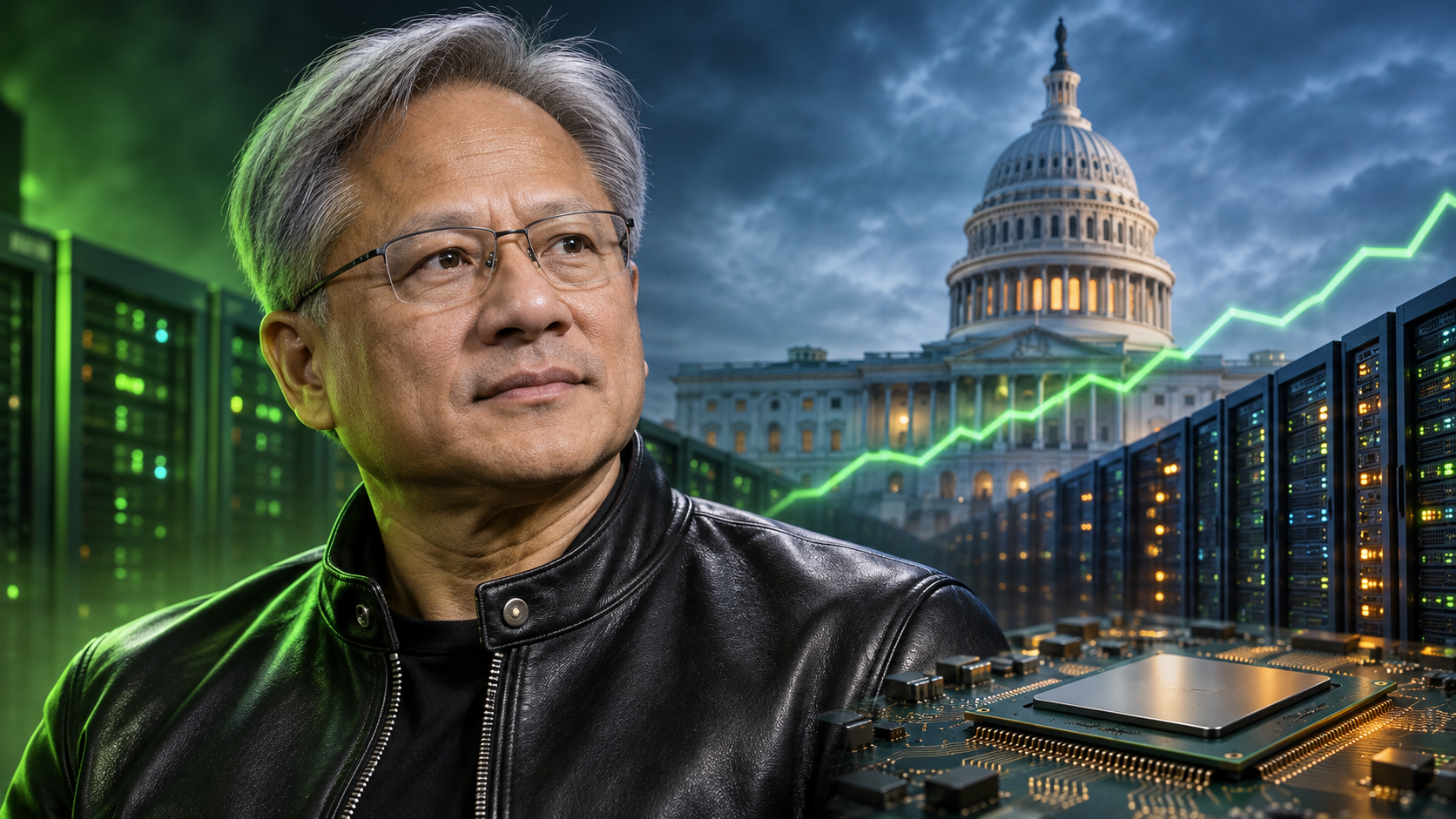
Best AI soap opera: No risk to national security? Nvidia stock rises by double digits! Anthropic stock continues to fall! – Creative image on the topic, with AI: Xpert.Digital
Jensen Huang returns to Nvidia: A breakthrough or a new test of endurance?
AI boom under pressure: Nvidia rises, Anthropic falls – and the doubts remain
Nvidia stock soars after Huang's comeback – but security concerns remain
Nvidia's stock rose sharply following the surprise return of co-founder Jensen Huang to the company's helm. Investors welcomed the restored leadership continuity – but the price surge is no proof that all outstanding issues have been resolved. The investigation into potential foreign interference continues, the handling of export controls remains politically contentious, and the company's dependence on its influential founder raises questions about its corporate governance.
At the same time, the stock of AI company Anthropic is falling, even though both companies are benefiting from the artificial intelligence boom. This differing reaction illustrates how differently investors assess the risks along the value chain: Nvidia sells the infrastructure on which many AI applications are built; Anthropic has to prove that its models can be marketed profitably in the long term. What's behind these price movements – and why Huang's comeback doesn't answer the security and oversight questions.
Huang's comeback is driving the stock price up – but the political risks remain: The stock market celebrates the savior, while Washington prepares the bill
Jensen Huang's return to the helm of Nvidia is far more than a spectacular personnel decision. It exposes a fundamental contradiction of the current AI boom: Financial markets demand stability, predictable investment plans, and a convincing leader. At the same time, policymakers and regulatory bodies must determine whether this very concentration of power has created significant risks. What investors may see as a liberating move in the short term could become the starting point for a protracted dispute for the company's management regarding responsibility, export controls, and national security.
On November 23, 2026, Nvidia reinstated its co-founder, Huang Huang, as CEO, president, and board member with immediate effect. The decision was unanimous. The board justified its decision by citing discussions about Huang's openness and leadership skills, as well as assessments from high-level US government officials. At the same time, the company stated that the independent investigation into potential foreign intelligence interference was ongoing. Thus, two statements stand side by side, the relationship between which remains crucial: The board considers Huang's return justifiable, even though the investigation into the underlying risks is not yet complete.
The economically sound perspective is therefore this: Huang's comeback can immediately remove the leadership discount from the stock. However, it eliminates neither the open control issues nor the uncertainty surrounding the China business, and certainly not the question of whether the massive investments in artificial intelligence will generate sufficient returns in the long term. A rising share price is a market signal, not an investigative report.
The price surge measures relief, not the solution to all problems
The aforementioned price levels initially illustrate the speed of the revaluation. An increase from approximately $124 to more than $146 represents a movement of almost 18 percent. Such rapid jumps can hardly be explained by an equally sudden improvement in operations. New production capacities, additional power connections for data centers, or entirely new customer budgets don't appear in a matter of minutes.
The most significant change has been in investors' assessment of the likelihood of a prolonged leadership crisis, strategic delays, and disruptions to key business relationships. Later market reports from the same day even described temporary price gains of around one-third. These figures do not necessarily contradict a previously observed increase of approximately 17 percent. They may reflect different points in time and comparison criteria. However, without identical trading venues, timestamps, and reference prices, the figures should not be conflated to form a single price trend.
Economically, this initially represents a partial reversal of a risk discount. If market participants previously feared that Nvidia would permanently lose its key strategic coordinator, his return could trigger significant valuation effects. Long-term earnings expectations don't even need to increase for this to happen. It's enough that investors assume a lower probability of particularly adverse developments.
Added to this is the mechanics of a tense market. Investors who had bet on further price declines may be forced to buy back shares after a surprising piece of news. Other investors who had prudently reduced their positions are buying out of fear of missing a recovery. Such movements can amplify the fundamental revaluation. Therefore, the magnitude of the price increase alone does not reveal the proportion attributable to actual business prospects and the proportion to short-term positioning.
Why Nvidia is bringing back more than one CEO
The unusual market reaction becomes more understandable when one doesn't view Huang solely as a replaceable manager. His significance lies in the combination of several functions: He represents technical product decisions, the long-term architecture of the company, relationships with major customers, and the political mediation of a business model that is increasingly treated as strategic infrastructure.
Nvidia doesn't simply sell individual chips. Its economic value arises from the interplay of computing power, software, development tools, network technology, and integration into the investment plans of major customers. At the top of such a system is the ability to credibly combine technical capabilities, production limitations, and commercial commitments. Huang's influence on product planning, customer relationships, and Washington is one of the main reasons why his temporary absence caused uncertainty far beyond Nvidia.
For investors, his return could therefore mean that existing agreements appear more reliable again. Customers need to be able to assess which systems will be available and when. Suppliers require robust planning. Investors want to know whether major investment projects complement each other or whether a strategic realignment will cause them to diverge.
However, therein lies the downside. The more a company's value depends on a single individual, the greater the key person risk. A corporation can be a technological leader and extremely successful financially, yet still possess an institutional weakness: it functions better under its influential founder than without him, but hasn't adequately secured his importance through robust structures. The market then celebrates the return of a person whose perceived indispensability is itself part of the problem.
The abrupt about-face damages the credibility of the supervisory authority
The timing of the decision is particularly puzzling. Just the week before, the company's top management had ruled out Huang's return. A few days later, his reinstatement was unanimously approved. Simultaneously, President Donald Trump had publicly advocated for his return and subsequently welcomed the decision. This sequence of events does not prove undue influence, but it does raise the bar for a plausible explanation.
A board of directors must be able to change decisions when new information becomes available. Especially in a crisis, rigidly adhering to an inaccurate assessment would be detrimental. However, what is crucial is what has actually changed. New, reliable findings are something different from economic pressure, public campaigns, or the fear of further share price declines.
This distinction is relevant for company valuation. Investors assess not only the CEO's abilities but also the quality of their oversight. If a supervisory board switches from categorical rejection to full support within a few days, an additional uncertainty arises: How reliable were the initial assessment and the subsequent revision?
The board of directors cannot close this gap simply through demonstrative unity. Unanimity shows that a decision is supported collectively. It says little about what evidence was presented, what counterarguments were examined, and what conditions are attached to the return. What would be most economically valuable is a process that remains credible even if later investigations yield unfavorable results.
National security is not a matter of stock market value
The claim that Huang's return poses no risk to national security has met with bipartisan skepticism. Republican Senator John Cornyn is demanding a verifiable basis for this assessment. Democratic Senator Elizabeth Warren is calling for answers regarding compliance with export controls and the government's role. Don Bacon, Raja Krishnamoorthi, and Kirsten Gillibrand are also among the politicians demanding further clarification or an interview with Huang; Gillibrand is calling for a sworn statement. Thus, the conflict cannot be convincingly reduced to mere partisan politics.
Several questions need to be addressed separately in this matter. First, it must be determined whether foreign influence was attempted. Second, whether this actually resulted in a leak of information or other threats. Third, it must be examined whether personal circumstances could have impaired the independence of decision-making. Fourth, the effectiveness of internal company safeguards must be assessed.
None of these questions are answered by a rising share price. Likewise, a suspicion does not automatically imply a proven violation. Especially with intelligence allegations, careful differentiation is essential. The board of directors can arrive at a preliminary risk assessment without thereby clarifying all historical events.
This creates a communication problem for Nvidia: A very broad all-clear may provide short-term reassurance, but in the long run it creates additional vulnerabilities. Should a more nuanced assessment become necessary later, the company would not only have to explain the initial events, but also the reliability of its interim statements.
A code of conduct must prove itself, especially at the top of the company
The sharp criticism of Nvidia's code of conduct addresses a central question of good corporate governance: Do rules still apply when their application becomes economically inconvenient? A code of conduct has no intrinsic value simply because it is comprehensively formulated and publicly accessible. Its usefulness arises only from verifiable responsibilities, effective controls, and comprehensible consequences.
It would be premature to conclude, solely from Huang's return, that all rules have become meaningless. Without a completed investigation and a thorough understanding of the relevant findings, such a judgment is not tenable. Equally problematic, however, would be the opposite assumption: that economic success can resolve issues of conflicts of interest or security risks.
The real test is the equal treatment of comparable situations. If employees face significant consequences, while management primarily focuses on the economic impact of their actions, a set of rules loses its internal credibility. This can create risks that are not immediately apparent in any short-term profit forecast: employees report problems later, managers interpret boundaries more liberally, and control functions lose authority.
A company must therefore pursue two goals simultaneously. It must neither pass final judgments on mere suspicion nor accept economic necessity as a substitute for clarification. A convincing return would not involve suspending the rules in favor of an exceptional manager, but rather a decision within a demonstrably functioning control system.
New oversight bodies are a start, but not yet proof of effectiveness
Nvidia has announced several organizational measures. A committee comprised exclusively of independent board members is investigating potential foreign interference. In addition, a committee for national security and export controls has been established. Furthermore, the company is seeking a Chief Compliance Officer to oversee compliance across the entire group and report to the relevant board committee. Cooperation with ongoing regulatory investigations will continue.
These steps address identifiable weaknesses. An independent reporting line can prevent critical information from being filtered solely through the operational hierarchy. Expert external advice can help identify risks that are not fully captured by standard corporate legal counsel.
However, the establishment of a committee does not equate to its effectiveness. Crucial factors are access to information, staffing, technical review expertise, and the ability to actually halt or amend decisions. A control body that is only informed after the fact is different from an authority with binding approval powers.
The position of the future compliance officer will also be important. They must be able to act independently vis-à-vis an exceptionally influential management team. This includes protected escalation channels and the assurance that unpleasant findings will not be treated as damaging disloyalty.
From an economic perspective, such structures initially incur costs and can slow down processes. Their benefit lies in limiting rare but potentially very expensive missteps. A company with significant geopolitical importance, in particular, cannot rely on informal personal relationships to provide sufficient protection in the long term.
In business dealings with China, permits, deliveries, and political intentions must be kept separate
The discussion about chip sales to China often suffers from conflating different factors. An export application is not the same as an approval. An approval is not the same as a delivery. Conversely, a delivery does not automatically prove a regulatory violation or the long-term political acceptability of the transaction.
The figures, which became public in November, involve considerable numbers. Nvidia and AMD together received approvals for 879,868 AI chips with Chinese ties by May 11, 2026. Applications had been submitted for over 3.4 million chips. These figures refer to several companies and cannot be attributed entirely to Nvidia. Nor do they indicate how many of the approved semiconductors were actually shipped.
For Nvidia itself, a different figure is more economically significant: In the quarter ending October 25, sales of approved Hopper-generation products for China amounted to $2.4 billion. At the same time, the interim management at the time stated that further shipments of this type had been discontinued and were not included in the forecast. This implies that the political approval of certain business transactions and their actual continuation can diverge.
The timing is also important. The approval details that became public in November do not mean that the underlying China regulation was only established this week. Some of the political decisions were made significantly earlier. Anyone who infers a direct connection between a single personnel decision and a supposedly new chip deal from the close timing of several news items is going beyond the available information.
🎯🎯🎯 Data-driven B2B industry hub as a quasi-in-house solution


The quasi-in-house solution: How Xpert.Digital closes operational gaps in B2B marketing and sales – Smart Content-Driven Business - Image: Xpert.Digital
Xpert.Digital is a data-driven B2B industry hub led by Konrad Wolfenstein . The company acts as an external, quasi-in-house solution for industrial partners, closing operational gaps in marketing, content, and sales – without requiring additional resources on the client side.
More information here:
The importance of transparency and compliance in corporate governance
The Chinese market is simultaneously an opportunity, a dependency, and a strategic dilemma
China is economically attractive for Nvidia because large companies there require significant computing power. Revenue from this market can spread development costs more broadly and strengthen the use of its own technical platform. From a company perspective, there are therefore many reasons to secure legally permissible sales opportunities.
From a security policy perspective, this analysis is insufficient. Powerful AI infrastructure can be used for civilian applications, but at the same time, it can support capabilities that states consider strategically sensitive. The line is not simply drawn between a harmless older chip and a fundamentally dangerous new one. Crucial factors also include the number of chips deployed, networking capabilities, software, intended use, and actual access rights.
Conversely, strict export restrictions also come at a cost. If Chinese customers cannot expect reliable access to US products in the long term, their incentive to develop alternative supply chains and their own technological solutions increases. From the perspective of an American supplier, this can lead to a loss of market share and technological influence in the long run.
The economic assessment, therefore, is not about whether exports are exclusively good or exclusively bad. It concerns the question of which short-term revenues are associated with which long-term security and competitive consequences. Controlled access could maintain influence but foster undesirable capabilities. Extensive exclusion could limit risks but simultaneously accelerate the emergence of independent competitors.
This dilemma is particularly difficult for Nvidia because the company does not set the political conditions itself. It can adapt its products and choose its customers, but remains dependent on approvals, enforcement practices, and international countermeasures.
Government participation in profits does not replace a robust security logic
The China regulation also includes a fiscal component. A procedure has been established for certain chips whereby they are processed by the United States before being shipped to China and subject to a 25 percent duty. This gives the government a financial share of transactions whose legality is controversial from a security policy perspective.
This does not automatically mean that security decisions have become for sale. However, it does create a clear conflict of objectives. A government can generate revenue while simultaneously being obligated to limit certain exports for strategic reasons. These two interests must be kept strictly separate within the institutional framework.
For companies, such a structure creates additional planning uncertainty. A deal may be politically desirable under one government and require justification again under a later majority. Even if the deliveries were properly approved at the time, their terms may become subject to parliamentary criticism.
A system whose predictability depends on personal agreements would be particularly problematic from an economic perspective. Companies need transparent rules to plan production volumes, contracts, and investments. The more market access appears to be an isolated political decision, the more difficult it is to evaluate sustainably.
Therefore, transparency is not merely a communication issue. It can have economic value: Clear criteria reduce the risk that customers, suppliers, and investors will question the sustainability of a regulation with every political shift.
Parliamentary investigations can be expensive even without a conviction
The demands for hearings and sworn testimony introduce a second dimension of risk alongside day-to-day operations. Companies can face significant burdens, even if no criminal offense is ultimately established. Legal counsel, internal investigations, document preservation, and executive training tie up capital and management resources.
Particularly significant are potential contradictions between earlier statements, internal documents, and later explanations. In a publicly conducted crisis, the investigation doesn't just focus on what happened. It also examines who had what information at what time and how the company handled it.
Parliamentary oversight, government investigations, and private lawsuits must be considered separately. A congressional committee has different responsibilities than a law enforcement agency. Furthermore, a shareholder lawsuit can focus on alleged breaches of disclosure obligations without being subject to the same legal standards as a criminal trial.
The initial claim that Nvidia will inevitably face an existential crisis after a certain year cannot be supported by this. There is no reliable basis for it. However, a long political and legal repercussions are a plausible risk.
A fair assessment lies somewhere between downplaying the risks and predicting doom: A strong market position does not protect against high follow-up costs. Conversely, an investigation does not automatically render a company economically unsustainable. Crucial factors are the findings, any potential requirements imposed, and the ability to reliably continue operations during the investigation.
Why 2027 and 2029 are risk horizons, but not fateful years
The focus on upcoming political deadlines is understandable. New majorities can change the focus of investigations, request additional documents, and reassess previous decisions. Companies must therefore expect that agreements made today will remain subject to review for longer than the term of office of their political backers.
However, this does not allow for a reliable prediction of who will receive which summons or what sanction will be imposed, and when. Such statements would confuse political expectations with established facts. Even a change of government in 2029 would not automatically render previous permits retroactively unlawful.
These annual figures are still relevant for economic analysis, but only as planning horizons. Investments in AI infrastructure are amortized and financed over several years. If their profitability depends on rules that could change significantly after a short time, the requirements for safety margins and contract design increase.
Nvidia must therefore not only master the current legal situation. The company must be able to document that decisions were made according to transparent procedures. In this environment, robust documentation is a strategic asset.
The real long-term risk lies less in a predetermined political tribunal than in permanently restricted freedom of action. Recurring regulations, lengthy review processes, and damaged trust can slow growth without creating a single dramatic turning point.
Anthronic's share price decline tells a different story than Nvidia's relief rally
The fact that Anthropic is trading in the red despite a recovery in the technology sector is not necessarily a contradiction. The two companies are located at different points in the AI value chain and are therefore valued according to different expectations.
The quoted price of €80.44, representing a daily loss of 2.35 percent, initially describes a specific snapshot in time. Interim levels around €78.30 and earlier daily prices above €86 indicate significant fluctuations. Without clear information about the trading venue and the time, however, these euro prices should not be directly compared to dollar prices on the Nasdaq. Exchange rates, trading hours, and liquidity can influence the data.
Added to this is the unique situation immediately following the IPO. Anthropic began trading on the Nasdaq on November 19, 2026, under the ticker symbol ANT. The issue price was $83. After the over-allotment option was fully exercised, the IPO comprised 1.127 billion shares and a gross proceeds of approximately $93.5 billion. Of this, roughly $91.6 billion went to the company itself; the remainder went to selling existing shareholders.
A newly listed company undergoes intense price discovery. Differing ideas about growth, costs, and appropriate valuation clash for the first time in real-world trading. Positive news from Nvidia can influence these questions, but it doesn't answer them. In particular, the return of a key infrastructure manager says little about what price investors should be willing to pay for the future profits of a model developer.
A large amount of fresh capital is not proof of a viable business model
In addition to its IPO, Anthropic completed a private placement of approximately $26 billion. Buyers included AMD, Broadcom, Google, Micron, Microsoft, Nvidia, and TSMC Partners. Together, the IPO and the accompanying placement raised a gross volume of approximately $119.5 billion. However, this figure also includes sales by existing shareholders and therefore does not represent the total funds raised by Anthropic.
The scale of the company initially improves its financial flexibility. A company with substantial liquid assets can finance research, secure computing power, and survive longer investment phases. However, the amount of capital raised is not sufficient for valuation purposes.
The crucial question is what economic returns will result. Will the additional expenditure attract customers who generate sustained, profitable revenue? Or will usage increase primarily because high computing costs are offset by low prices and fresh capital? Without reliable answers, a major funding success remains, initially, a leap of faith.
The involvement of strategic partners is also ambiguous. It can deepen technological cooperation and create planning certainty. At the same time, investors must distinguish whether they primarily expect an attractive financial return or also want to secure their own supply relationships and platform interests.
This does not mean that such investments are economically unsound. It simply means that the involvement of prominent technology companies does not constitute an independent guarantee of a fair stock market valuation.
The crucial question of profit lies between the chip supplier and the model developer
Nvidia and Anthropic are part of the same investment cycle, but have different economic starting positions. The infrastructure provider can profit from increased spending if customers require additional systems. The model developer must then convert this computing power into services for which users are willing to pay a sufficient price.
The central distribution question is therefore: At which point in the value chain do the profits remain? High demand for AI does not automatically mean that all participating companies will achieve consistently high returns. A significant portion of the economic benefits can accrue to users, while providers put each other under price pressure.
For model developers, the ratio of usage revenue to ongoing provision costs is particularly important. Increased inquiries are only entirely positive if they contribute sufficiently after deducting variable costs. Lower computation costs can help, but they can also intensify competition and enable lower sales prices.
For Nvidia, the crucial factor is whether customers can finance their investments through viable business models. An equipment supplier can experience strong growth for a while, even if its customers aren't yet generating sufficient returns. However, this gap cannot be widened indefinitely indefinitely.
The opposing share price development can therefore express a rational differentiation: Investors view the restored leadership continuity at Nvidia positively, while they continue to see a high price for Anthropic's profitability, which has yet to be proven.
The interconnectedness of the AI ecosystem increases both opportunities and contagion risks
The capital relationships between chip manufacturers, cloud providers, and AI developers make the investment boom powerful, but also more difficult to understand. When companies are simultaneously suppliers, customers, partners, and shareholders, common interests and potential dependencies arise.
An equity stake can enable a young company to build capacity more quickly. A long-term supply contract can provide infrastructure manufacturers with planning security. A technical partnership can accelerate development. Such connections are not automatically problematic.
The analysis becomes more challenging when the same financial flows are repeatedly interpreted as signs of independent demand. If a supplier provides capital and the recipient uses it to purchase services from that supplier, a financially viable transaction can occur. However, it must be verified whether there are ultimately enough end customers willing to pay.
The crucial question is not whether large sums of money are moved within the ecosystem. It is whether a sustainable economic benefit is generated outside this cycle that justifies the investments.
Huang's return can strengthen confidence in the continuation of existing relationships. However, it does not eliminate the need to assess their economic quality individually. The more tightly interwoven the network, the more a disruption at one central company can spread to other participants. The fact that Nvidia is perceived as an anchor of stability is therefore both an expression of its strength and an indication of a concentration of risks.
Multi-billion dollar AI investments must be measured by productivity
Beyond the personnel drama, the sustainability of the AI boom hinges on a sober question: Does the additional computing power generate sufficient productive benefit? For companies, what matters is not how impressive an application appears, but whether it reduces costs, improves quality, enables revenue, or eliminates bottlenecks.
However, there are several stages between technical performance and economic success. Applications must be integrated into processes. Data must be of sufficient quality. Employees must be able to verify results. Data protection, security, and responsibilities must be clearly defined. Therefore, a convincing demonstration in isolation does not constitute a viable business case.
Infrastructure costs also arise. In addition to chips, electricity, cooling, buildings, network technology, and qualified personnel are required. The return on investment for a data center depends on the entire cost structure, not just the purchase price of the accelerators.
Added to this is the speed of technological progress. New systems can be more powerful or efficient, thus putting older investments under economic pressure. Conversely, not every older system is immediately worthless; its profitability depends on its application, utilization, and operating costs.
The same basic principle applies to the valuation of Nvidia and Anthropic, albeit on different levels: growth must translate into reliable cash flows. The return of a charismatic leader can stabilize expectations, but it cannot replace sound business calculations.
Three development paths instead of a premature doomsday prediction
A favorable outcome would be possible if the investigations uncover no serious violations, the new control structures become effective, and Nvidia continues its technical and commercial planning without major disruptions. In that case, Huang's return could be seen as a successfully managed leadership crisis. Part of the previously established risk discount would then indeed have been excessive.
A moderate trajectory also seems plausible. Nvidia could remain operationally strong, while simultaneously having to cope with hearings, additional controls, and restricted access to China for years. This wouldn't be an existential catastrophe, but it could increase costs and limit valuation. Economic strength and political vulnerability are not mutually exclusive.
An unfavorable outcome would require serious new findings: for example, proven significant rule violations, serious control deficiencies, or misleading information with corresponding legal consequences. In such cases, in addition to direct burdens, customer confidence, financing conditions, and strategic flexibility could also suffer.
It is currently impossible to reliably predict with a precise probability which path will unfold. Likewise, a specific year cannot be considered an inevitable crisis point. The value of these scenarios lies in making the relevant conditions visible.
For an objective analysis, this is more meaningful than the alternative between unbridled euphoria and certain catastrophe. Nvidia can simultaneously be an exceptionally high-performing company and a company with insufficiently clarified management risks.
The real test begins after the comeback
The AI soap opera has a real economic core. Huang's return reduces acute uncertainty because Nvidia regains a key strategic player. The strong market reaction is therefore not merely irrational personality cult. It demonstrates the value investors place on continuity at the helm of a tightly integrated technology company.
At the same time, this very reaction exposes a structural weakness. A corporation of this importance should not have to regain its stability solely by having the same person, whose role and environment are still under investigation, take over the leadership again. Building lasting trust requires more than a successful personnel return.
Nvidia must provide three distinct pieces of evidence: The company must deliver economically, transparently control its export business, and demonstrate that oversight remains effective even with respect to its influential founder. None of these pieces of evidence can be substituted for the other two. Good products do not excuse regulatory violations; effective controls do not guarantee a high valuation; and political support does not replace profitable demand.
Anthropic's simultaneous share price weakness serves as a reminder that the AI market is not a uniform success story. Infrastructure, models, and applications are subject to different cost structures and valuation risks. In the long run, capital will be allocated according to where technological capabilities actually generate reliable returns.
The crucial contrast, therefore, is not between a celebrated Nvidia and a punished Anthropic. It lies between quickly restored trust and long-term proven resilience. The stock market can answer the first question within minutes. The second requires verifiable results.
📈🚀 From visibility to trust 👀🤝 Your scalable path with Xpert.Digital


From visibility to trust: Your scalable path with Xpert.Digital - Image: Xpert.Digital
In industrial B2B, sustainable business relationships rarely emerge overnight. They develop step by step – through visibility, professional relevance, recurring touchpoints, and growing trust. Xpert.Digital's 4-stage model addresses precisely this: It offers a structured path that begins with a manageable entry point and can evolve into deeper collaboration in business development if needed.
Instead of relying on loud marketing promises, this model puts the relationship at the forefront. Companies start with clearly defined, easily calculable measures and then decide, based on their own experience, how far they want to expand the collaboration. A key factor for this undisturbed trust-building process: The platform completely avoids annoying advertising ads, so the editorial focus remains solely on the companies' expertise.
More information here:
Your global marketing and business development partner
☑️ Our business language is English or German
☑️ NEW: Correspondence in your native language!

Konrad Wolfenstein
I and my team are happy to be available to you as your personal advisor.
You can contact me by filling out the contact form here wolfenstein@xpert.digital:or simply call me at +49 7348 4088 965. My email address is
I'm looking forward to our joint project.