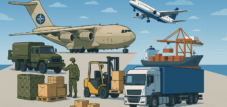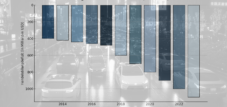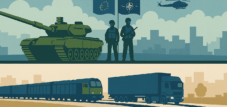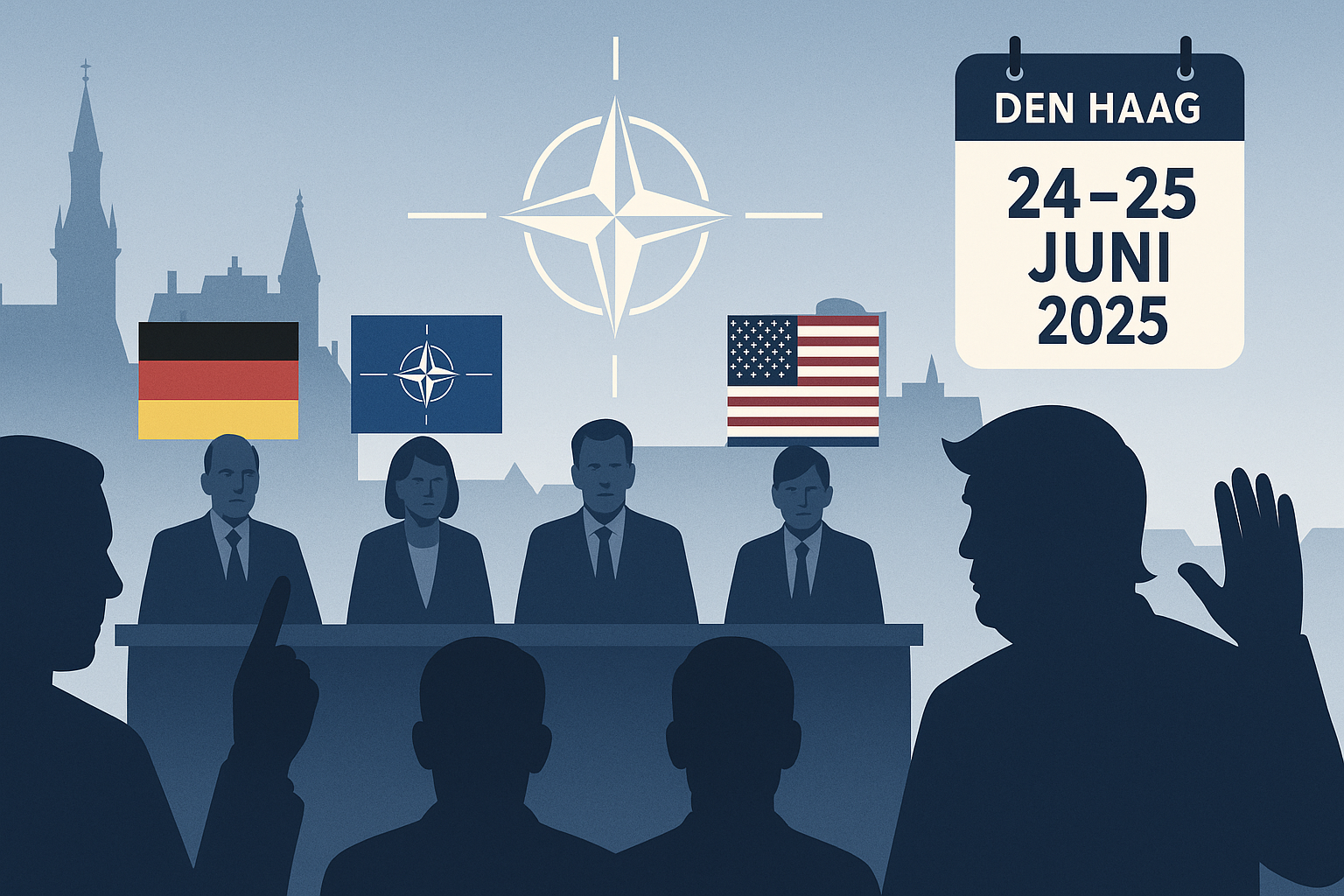
NATO summit in The Hague on June 24 and 25, 2025: Tensions over defense spending and Trump fears – Image: Xpert.Digital
NATO Crisis 2025: Defense spending and the US president divide the alliance
Defense spending dispute overshadows NATO meeting in The Hague
The upcoming NATO summit in The Hague on June 24 and 25, 2025, is fraught with considerable political tension. Two key areas of conflict threaten the unity of the alliance: the controversial demand for a drastic increase in defense spending to five percent of gross domestic product and the uncertainty surrounding the participation of US President Donald Trump.
Related to this:

Trump's five percent demand is splitting the alliance
US President Donald Trump has reiterated his demand, first made in January, that all NATO member states should spend five percent of their gross domestic product on defense. This would more than double the current two percent target, which was only recently fully met by all NATO states for the first time.
Rutte's diplomatic compromise proposal
NATO Secretary General Mark Rutte, the former Dutch Prime Minister, has developed a strategic plan to meet Trump's demands while keeping European allies on board. His proposal stipulates that the 32 member states should allocate a total of five percent of their GDP to security-related expenditures by 2032 at the latest: 3.5 percent for traditional defense spending such as troops and weapons, and 1.5 percent for defense-related infrastructure such as militarily usable ports, roads, and bridges.
The Netherlands was the first country to agree to this plan and decided to gradually increase its defense spending to five percent, with the Dutch calculation also including aid for Ukraine.
Spain is leading the resistance
Spanish Prime Minister Pedro Sánchez has become the first head of government to openly announce his opposition to the five percent target. In a letter to NATO Secretary General Rutte, he described increasing defense spending to five percent of GDP as "not only unreasonable, but even counterproductive." Spain announced that it would "not be able to commit to a specific spending target" at the NATO summit.
Spain's Defense Minister Margarita Robles even described the NATO plans as a "major mistake," arguing that capabilities must first be determined before a percentage is set. With military spending of around 1.3 percent of GDP, Spain is among the biggest laggards in the alliance, but aims to reach the two percent target by 2025.
Secret resistance from other allies
Besides Spain's official opposition, there is also covert resistance from other important NATO partners. At the G7 finance ministers' summit, the finance ministers from France, Italy, Great Britain, and Canada made it clear off the record that they could not afford an increase to five percent from their budgets.
Summit shortened to two and a half hours – fears of a Trump debacle
Fearing another early departure by Trump, the NATO summit, originally planned for two days, was reduced to a single two-and-a-half-hour session, according to the Financial Times. This drastic shortening came after Trump recently left the G7 summit in Canada prematurely.
Claudia Major, Senior Vice President at the German Marshall Fund, commented on this development: “It was reduced from two days to a two-hour session… so that should be doable, and my hope is that it works.” At the same time, she admitted: “But I have given up trying to predict Trump.”.
Division in the German Federal Government
Even within the German federal government, there is disagreement about defense spending. Chancellor Friedrich Merz (CDU) and Foreign Minister Johann Wadephul (CDU) publicly support the five percent target. Wadephul argues that Trump's demands are "entirely in our interest" and that Europe must abandon the illusion "that security costs nothing or can be obtained cheaply.".
Finance Minister Lars Klingbeil (SPD), on the other hand, is only willing to increase spending to 3.5 percent. He explained: "If it ends up being three percent, then we'll do three percent; if it's 3.5 percent, then we'll do 3.5 percent," but he objected to a "purely numbers-based debate.".
SPD peace circles warn against arms race
Tensions within the SPD are being exacerbated by a "manifesto" signed by over 100 individuals close to the party, published shortly before the party conference at the end of June. Prominent signatories such as former parliamentary group leader Rolf Mützenich, foreign policy expert Ralf Stegner, and former party chairman Norbert Walter-Borjans are calling for a departure from the arms buildup policy and direct diplomatic talks with Russia.
The document describes the planned increase in defense spending as "irrational" because there is "no security policy justification" for it. Stegner called the five percent increase, or 225 billion euros annually, "sheer madness" and "an insane sum.".
Defense Minister Boris Pistorius reacted sharply to the manifesto, calling it a "denial of reality".
Outlook on the critical summit
The NATO summit in The Hague will be the first under the leadership of Mark Rutte as the new Secretary General. Key topics include increasing defense spending, strengthening NATO's deterrence and defense capabilities, and further support for Ukraine.
The drastic reduction of the summit to two and a half hours demonstrates how eager NATO partners are to include Trump, even if this might come at the expense of a comprehensive discussion of complex security policy challenges. The summit thus becomes a critical test for the future of the transatlantic alliance at a time of growing geopolitical tensions.
Related to this:
From 34% to 1%: The gap in global military budgets
The share of military spending in gross domestic product (GDP) is a key indicator of a country's security policy priorities. A comparison of the data for 2024 and 2025 reveals a world of extremes, ranging from war-related peaks to comparatively moderate levels.
Ukraine and Russia: The extremes in the arms race
At the top of this comparison is Ukraine: In 2024, the country spent around 34% of its GDP on the military. This globally highest figure is a direct consequence of the enormous strain caused by Russia's war of aggression. According to the World Bank, this figure already reached 36.65% in 2023. While the Ukrainian government plans a reduction for 2025, it still budgets a massive 26.3% of GDP for defense and security.
Russia is also massively restructuring its economy for war: Military spending rose to around 7.05% of GDP in 2024. This marks the highest level since the collapse of the Soviet Union and illustrates the country's comprehensive mobilization for military purposes.
The midfield: Regional tensions as a driving force
A group of countries with significant, but considerably lower, military spending follows in the middle. This includes Pakistan, whose share is estimated at around 3.5% based on historical data. South Korea is also investing heavily in light of the tense regional security situation, spending approximately 2.6% of its GDP on defense in 2023.
Economic giants below the 2% mark
Numerous economically strong nations, however, remain significantly below the 2% mark, often considered a NATO target. India's defense budget for 2024/25 is 1.9% of GDP. Japan (1.6% in 2024) plans to increase it to 2% by 2027 in response to geopolitical changes. China has deliberately kept its share stable at around 1.5% for years. Despite the absolute increase in spending, this percentage is offset by the country's strong economic growth. Brazil brings up the rear in this comparison with a share of approximately 1.1% (as of 2023).
The figures paint a clear picture: While the war in Europe dominates the budgets of Ukraine and Russia, forcing them to maintain extremely high military spending levels, other states are acting much more cautiously. In particular, populous and economically powerful countries like China, India, and Brazil prioritize their military expenditures far less in relation to their economic strength. The comparison thus highlights not only differing budgets but, above all, fundamentally different strategic and political orientations on the world stage.
Related to this:
Hub for Security and Defense - Advice and Information

Hub for Security and Defense - Image: Xpert.Digital
The Security and Defence Hub offers expert advice and up-to-date information to effectively support companies and organizations in strengthening their role in European security and defence policy. Working closely with the SME Connect Defence Working Group, it particularly promotes small and medium-sized enterprises (SMEs) that wish to further develop their innovative capacity and competitiveness in the defence sector. As a central point of contact, the Hub thus creates a crucial bridge between SMEs and European defence strategy.
Related to this: