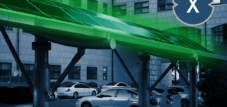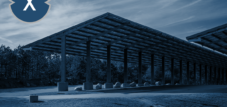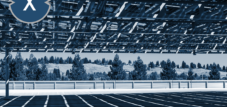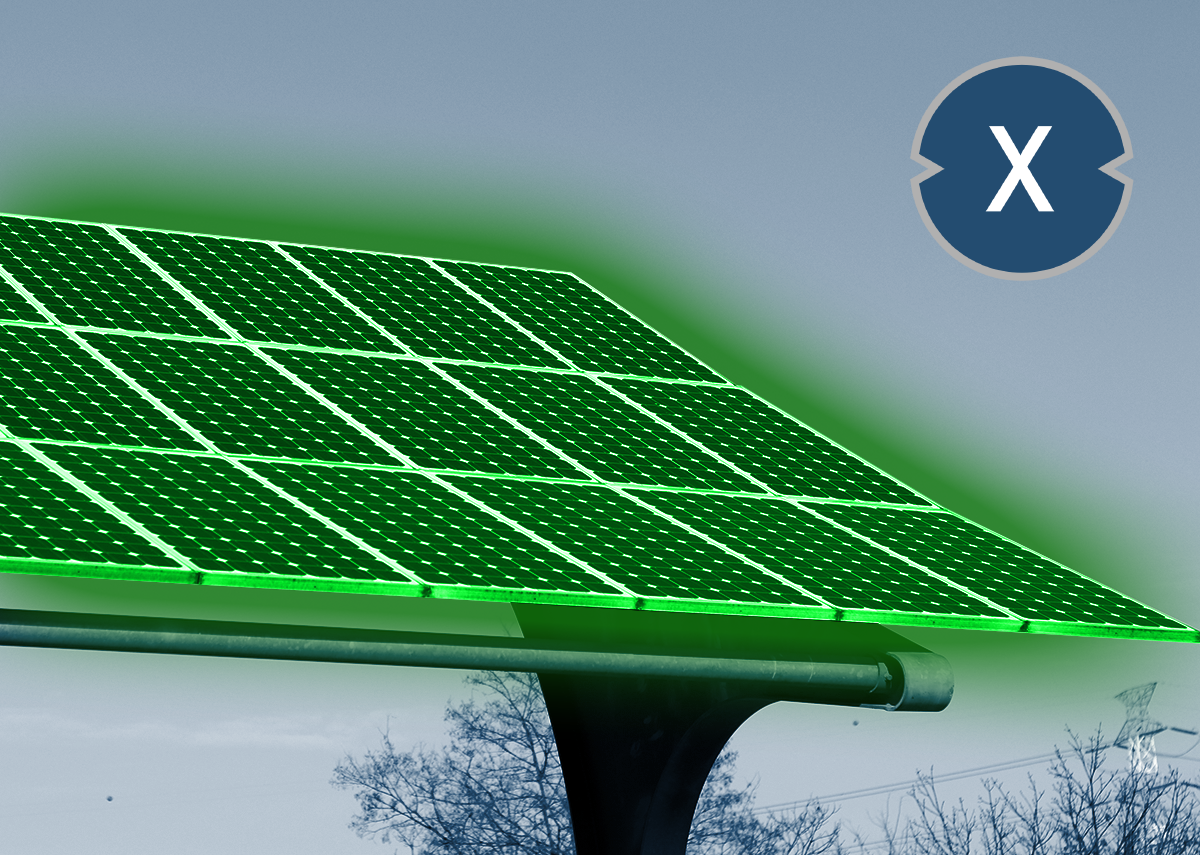
Solar carport solutions for diverse applications – Image: Xpert.Digital / Hyejin Kang|Shutterstock.com
Individual solutions for your solar roofing of sealed and open parking areas with solar carports
Three German states have already introduced mandatory solar carports. These include North Rhine-Westphalia, Baden-Württemberg, and Rhineland-Palatinate.
In Baden-Württemberg, the requirement applies to open parking spaces with 75 or more spaces. In North Rhine-Westphalia, it applies to open and commercial parking areas with 35 or more spaces, and in Rhineland-Palatinate, to parking areas with 50 or more spaces.
The mandatory solar carport requirement is intended to be the starting signal for the end of a "concrete monoculture" of sealed parking areas towards a multifunctional and modular variety of parking spaces.
The electricity generation is also intended to create an incentive to utilize the necessary solar roofing for parking areas, thereby also providing the added benefit of weather protection. Optionally, this can be combined with electricity storage and charging facilities for potential refueling and charging customers. These solar carports create a decentralized business model for and with refueling customers who previously relied on the monopoly of centralized gas stations. With the government-mandated shift from combustion engine vehicles to electric vehicles, anyone who provides suitable parking spaces can participate in the "refueling station" business model in the future, whether it's a shopping center or a discount supermarket.
This includes further customer loyalty opportunities, such as introducing discounts for regular customers. "Shop while you shop" is the principle that is coming and is already being practiced in some places.
But company parking spaces for customers and employees also open up new opportunities and potential for customer retention and, above all, cost reduction in the vehicle fleet.
Our photovoltaic solutions for roofing open parking areas are modular and scalable:
- Quick and easy assembly
- Stable strip foundation as impact protection
- Customizable design (color, materials, surface, size, etc.)
- Installation of charging stations and inverters is possible at any time
- Scalable & modular: Available as a single, double or infinitely scalable row carport
- Even in its standard version, it can be used for very high wind and snow loads (sk= 2.2 kN/m²).
- Extra-large and wide parking spaces and very easy parking thanks to W-shaped supports
- High-quality design for demanding and long-lasting requirements: Hot-dip galvanized steel construction (DIN EN 10346, DIN EN 1461)
📣 Open parking areas: Photovoltaic solutions for industry, retail and municipalities
Everything from a single source, specifically designed for solar solutions for large parking areas. Refinance or offset your future costs with your own electricity generation.
🎯 For solar installers, plumbers, electricians and roofers
Consultation and planning including a non-binding cost estimate. We connect you with strong partners in photovoltaics.
👨🏻 👩🏻 👴🏻 👵🏻 For private households
We have a regional presence throughout the German-speaking world. We have reliable partners who will advise you and implement your wishes.
With over 1,000 articles published, we cannot present all topics here. Therefore, you will find a small selection of our work here, and we would be delighted if we have sparked your interest in learning more about us:
Our Solar PDF Library

Photovoltaic Library (PDF) – Image: Xpert.Digital / Benvenuto Cellini|Shutterstock.com
Large PDF library: Market monitoring and market intelligence on the topic of photovoltaics.
Data is reviewed and its relevance assessed at regular intervals. This usually yields a number of interesting pieces of information and documentation, which we summarize in a PDF presentation: our own data analyses and marketing intelligence, as well as external market observations.
More information here:
How many new electric car registrations are there worldwide, by model?
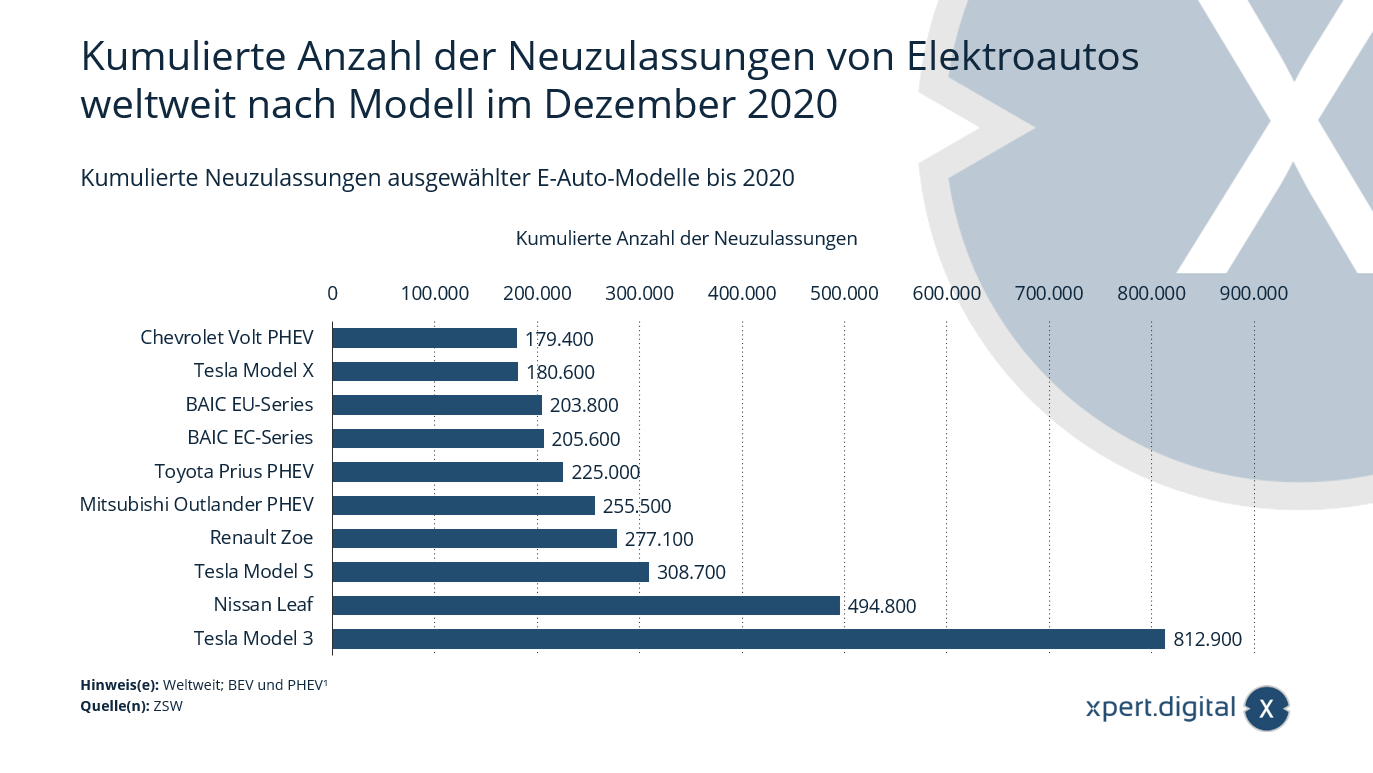
Cumulative new registrations of selected electric car models – Image: Xpert.Digital
Tesla's Model 3 is the world's best-selling electric car – as of December 2020, approximately 813,000 Model 3s had been sold worldwide. The Nissan Leaf follows in second place with approximately 494,800 units.
Cumulative new registrations of selected electric car models
- 812,900 Tesla Model 3
- 494,800 Nissan Leaf
- 308,700 Tesla Model S
- 277,100 Renault Zoe
- 255,500 Mitsubishi Outlander PHEV
- 225,000 Toyota Prius PHEV
- 205,600 BAIC EC-Series
- 203,800 BAIC EU-Series
- 180,600 Tesla Model X
- 179,400 Chevrolet Volt PHEV
What is the share of gasoline and diesel vehicles in new passenger car registrations?
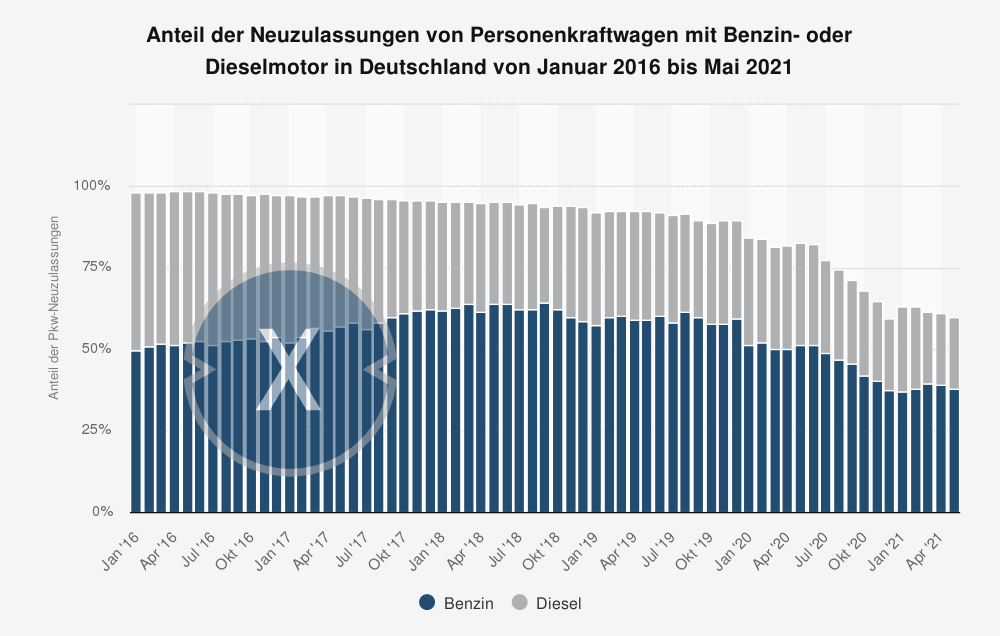
New car registrations (petrol and diesel) in Germany – Image: Xpert.Digital
Share of new passenger car registrations with petrol or diesel engines in Germany from January 2016 to May 2021: In May 2021, approximately 37.7 percent of newly registered passenger cars were equipped with a petrol engine. This corresponds to a total of around 86,900 vehicles and an increase of 1.1 percent compared to the same month of the previous year.
New registration: Initial registration of a brand-new vehicle with a license plate in Germany. Vehicles previously registered in Germany or abroad are not included. The figures for previous months were taken from the corresponding earlier publications.
Who is planning to modernize or purchase a new photovoltaic system?
People in Germany planning to modernize or purchase a new solar system (photovoltaic system) by housing situation compared to the population
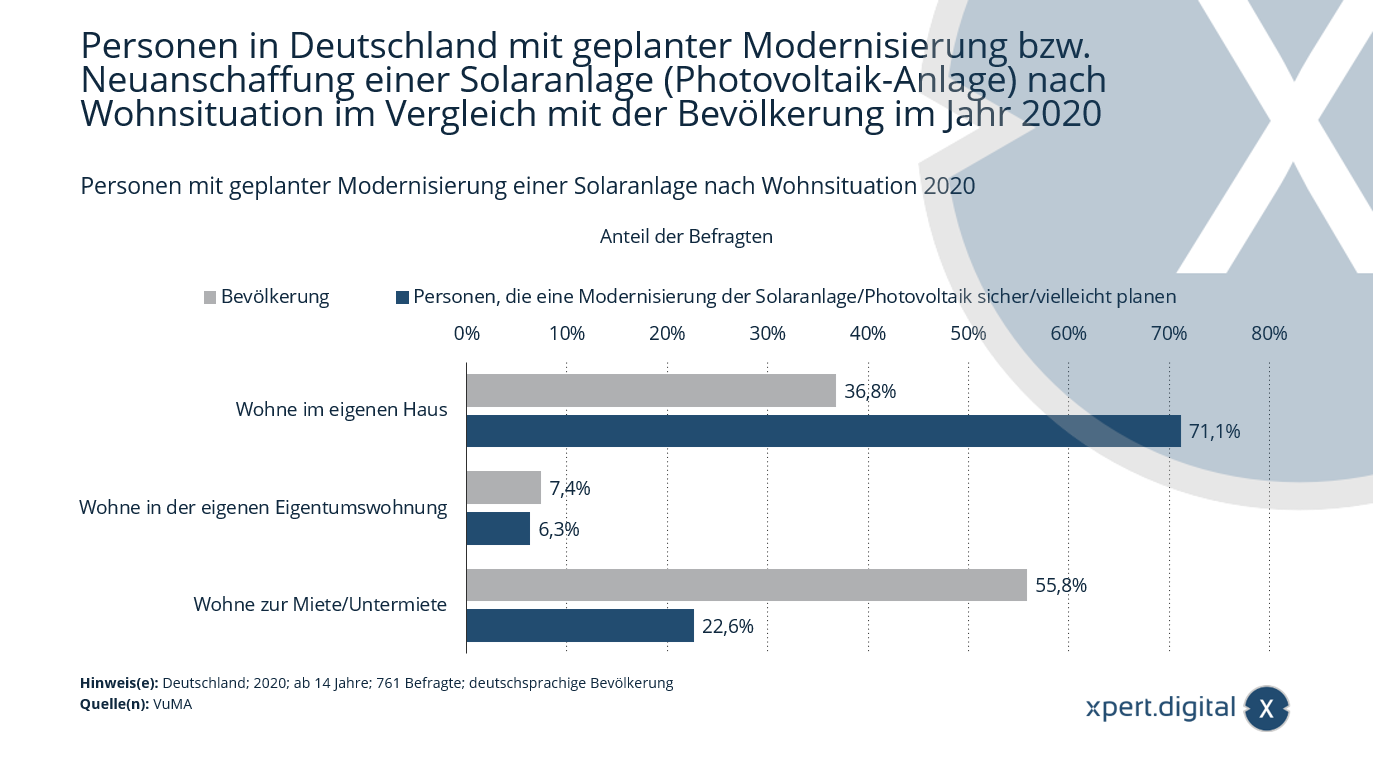
People planning to upgrade their solar power system, categorized by their living situation – Image: Xpert.Digital
According to projections, around 3.31 million people in Germany were definitely or possibly planning to modernize or purchase a new solar/photovoltaic system in 2020. Approximately 71.1 percent of this group lived in their own home. Meanwhile, about 36.8 percent of the general population lived in their own home.
People planning to modernize a solar system, according to their living situation
Population
- 36.8% – Live in your own house
- 7.4% – Live in your own condominium
- 55.8% – Live in rented/sublet accommodation
People who are definitely/maybe planning to modernize their solar/photovoltaic system
- 71.1% – Live in their own house
- 6.3% – Live in your own condominium
- 22.6% – Live in rented/sublet accommodation
How is the business with daylight going?
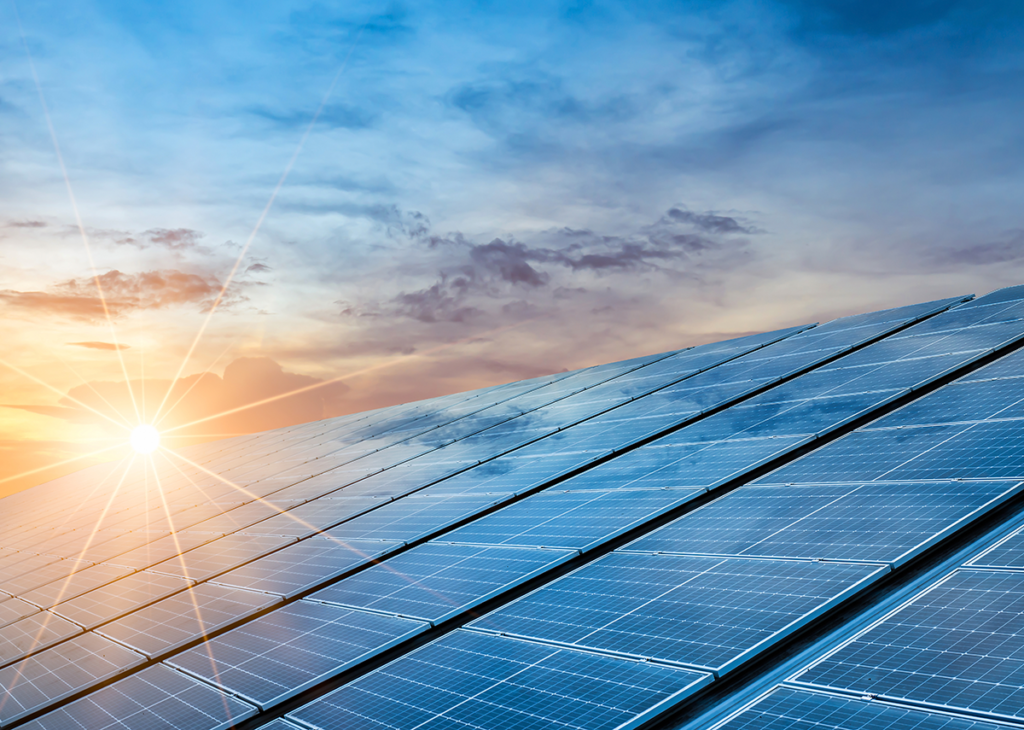
Generating electricity from daylight – Image: Fit Ztudio|Shutterstock.com
The Chinese company Jinko Solar generated approximately US$4.3 billion in revenue in 2019 from the sale of photovoltaic systems and grid-connected energy systems. Canadian Solar, JA Solar, and Yingli, three other companies with at least partial Chinese ownership, are also among the world's highest-grossing solar corporations, as the Statista graphic shows. The German company SMA Solar Technology also achieved revenues exceeding US$1 billion in 2019.
The share of solar energy in total electricity generation from renewable energy sources is increasing annually. Unlike wind energy, for example, photovoltaic systems do not require extensive construction work, as they can simply be installed on the roofs of existing or new buildings. This is also the plan of Bavaria's Minister-President Markus Söder – he has decided that photovoltaic systems should be installed on every new building in Bavaria starting in 2021. These regulations initially apply only to commercial buildings; from 2022, this will also be mandatory for private construction projects.
More information here:
Was 2020 a record year for sunshine hours, resulting in high electricity feed-in from photovoltaics?

Record number of sunshine hours in spring 2020 – @shutterstock | maradon 333
Weather records for Germany show more sunshine in the months of March, April, and May in spring 2020 than ever before – according to the German Weather Service, it was the sunniest spring since records began in 1951. April, in particular, boasted an abundance of sunshine with approximately 294 hours, resulting in record levels for the share of photovoltaics in Germany's electricity feed-in. As reported by the Federal Statistical Office (Destatis), this share reached 17.2% in April 2020, representing, along with wind power (24.2%), the largest portion of renewable energy feed-in to the grid. Overall, 55.6% of the total electricity generated was supplied by renewable energy sources.
When sunlight is converted into electricity, it is called photovoltaics. The Fraunhofer Institute for Solar Energy Systems calculated that in 2019, photovoltaics, with an electricity generation of 46.5 terawatt-hours, covered 8.2% of Germany's gross electricity consumption, while renewable energies as a whole accounted for 43%. In addition to professional photovoltaic operators, private households or individuals who jointly operate photovoltaic systems (so-called community solar power plants) can also feed solar energy into the grid and benefit from it.
More information here:
Are there solar mounting systems for pitched roofs that do not penetrate the roof membrane and do not damage it?
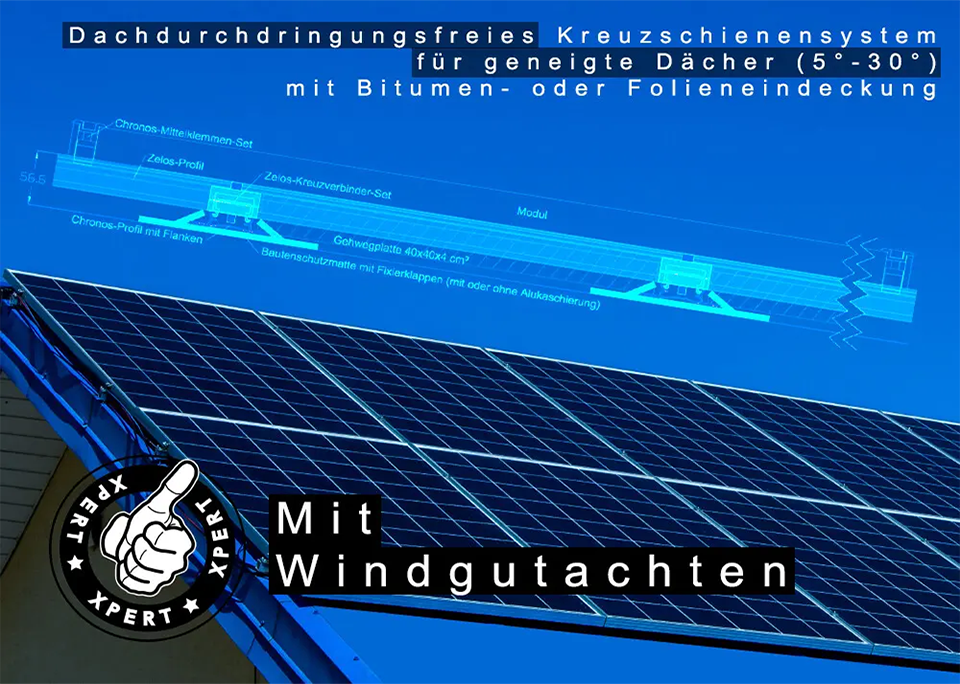
Roof penetration-free cross-rail system – @Xpert
Pitched gable and shed roofs with bitumen or membrane coverings were previously difficult or very complex to install without roof penetrations. With the new METIS mounting system from T.Werk, PV projects can now be easily implemented on these roofs. The modules are installed parallel to the roof in a cross-rail configuration with ballast. Roof penetrations are not required. The modules only need to be additionally secured against slippage (downslope) at the ridge or eaves.
The following options are available:
- With an east/west orientation of the roof surfaces, the module arrays on each side of the roof lift each other. Action equals reaction. The downward forces then balance each other. Construction using flat aluminum stock or perforated aluminum strips.
- Mounting to an attic. For example, by using an aluminum rail with screw anchors, threaded rods, or dowels. The module array is then secured to this rail with flat aluminum stock or perforated aluminum strips.
- Attachment to the ridge or ridge beam. Similar to the attachment for the parapet, except here we need threaded rods or solar panel fasteners and must then seal them accordingly. This requires roof penetrations at a few points.
- Specific special solutions that can only be identified after reviewing the project.
As a partner of T.Werk, we are happy to support you in the planning and design of the system.
More information here:
Can online software help municipalities advance energy transition projects?

Online software for the energy transition – @shutterstock | Robert Kneschke
TRAILstarter software is designed for municipalities with fewer than 10,000 inhabitants – the online tool can be used free of charge at www.trail-energie.de – TRAILplus with additional options will be released at the end of June.
- TRAIL helps smaller Thuringian communities to determine their energy needs and initiate energy transition projects
- The TRAILstarter software is designed for municipalities with fewer than 10,000 inhabitants
- The online tool can be used free of charge at www.trail-energie.de
- TRAILplus with additional options will be released at the end of June
The Thuringian Energy Agency (ThEGA), together with partners from Thuringian science and industry, has released "TRAILstarter." The free online software is available at www.trail-energie.de and is primarily designed to help municipalities with fewer than 10,000 inhabitants optimize their energy supply and reduce energy costs. In rural areas, the potential for heat supply based on renewable energies such as solar thermal energy or biomass is often particularly high. "However, smaller municipalities, some of which rely on volunteer representatives, often lack the time, expertise, and budget to implement the energy-efficient renovation of public buildings or complex processes such as the development or expansion of the local heating network," says ThEGA Managing Director Professor Dieter Sell. "TRAILstarter is a practical planning tool for municipal administrations. It allows energy transition projects to be launched without the need for time-consuming data collection on the current situation or the involvement of external expertise." The Federal Ministry for Economic Affairs and Energy and the Thuringian Ministry for the Environment, Nature Conservation, Energy and Nuclear Safety (TMUEN) funded the project.
More information here:
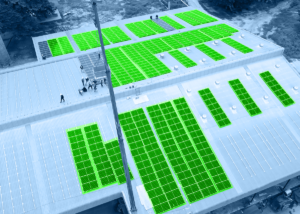
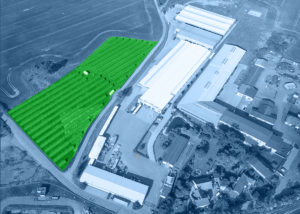
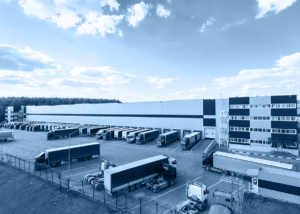
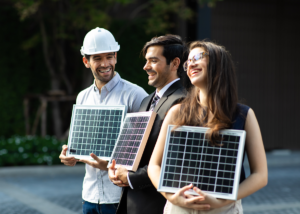
- Planning photovoltaics on warehouses, commercial buildings and industrial buildings
- Industrial plant: Planning a photovoltaic open-field system or open-area system
- Planning solar power systems with photovoltaic solutions for freight forwarding companies and contract logistics
- B2B Solar Systems and Photovoltaic Solutions & Consulting
Solar solutions: Xpert.Solar for planning and consulting in the area of solar carports, rooftop solar systems and photovoltaic systems in general for Mülheim, Leverkusen, Solingen and Herne

Konrad Wolfenstein
I would be happy to serve as your personal advisor.
You can contact me by filling out the contact form below or simply call me on +49 7348 4088 965 .
I'm looking forward to our joint project.
Write to me


Xpert.Digital – Konrad Wolfenstein
Xpert.Digital is a hub for industry focusing on digitalization, mechanical engineering, logistics/intralogistics and photovoltaics.
With our 360° Business Development solution, we support renowned companies from new business to after-sales.
Market intelligence, smarketing, marketing automation, content development, PR, mail campaigns, personalized social media and lead nurturing are part of our digital tools.
You can find more information at: www.xpert.digital – www.xpert.solar – www.xpert.plus
Keep in touch