“Simply pathetic”: Former military officers dissect Angela Merkel’s historical legacy after controversial EU honor – Image: Xpert.Digital
Strasbourg controversy: Why Merkel's highest EU award reopens old wounds
Worse than Schröder? The secret files behind the unprecedented controversy surrounding Angela Merkel
The high price of diplomacy: What the newly awarded EU order reveals about Merkel's Russia policy
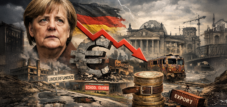
Angela Merkel was awarded the European Union's highest new order of merit – alongside Ukrainian President Volodymyr Zelenskyy. But what was intended as a glittering tribute to a historic chancellorship has, within days, escalated into a political conflagration. While Western Europe celebrates institutional cohesion, security experts and former military personnel from Scandinavia and the Baltic states are leveling serious accusations. They see the honoring of Merkel as a fatal signal: a glossing over of those security policy miscalculations and ignored warnings that paved the way for Vladimir Putin's war of aggression. Explosive documents from the Chancellor's Office further fuel suspicions that dependence on Russian gas was knowingly accepted. A look at a deeply fractured political legacy that is proving more costly for Europe today than ever before.
Merkel's legacy between honor and indictment: When an award reopens the wounds left behind by a political career
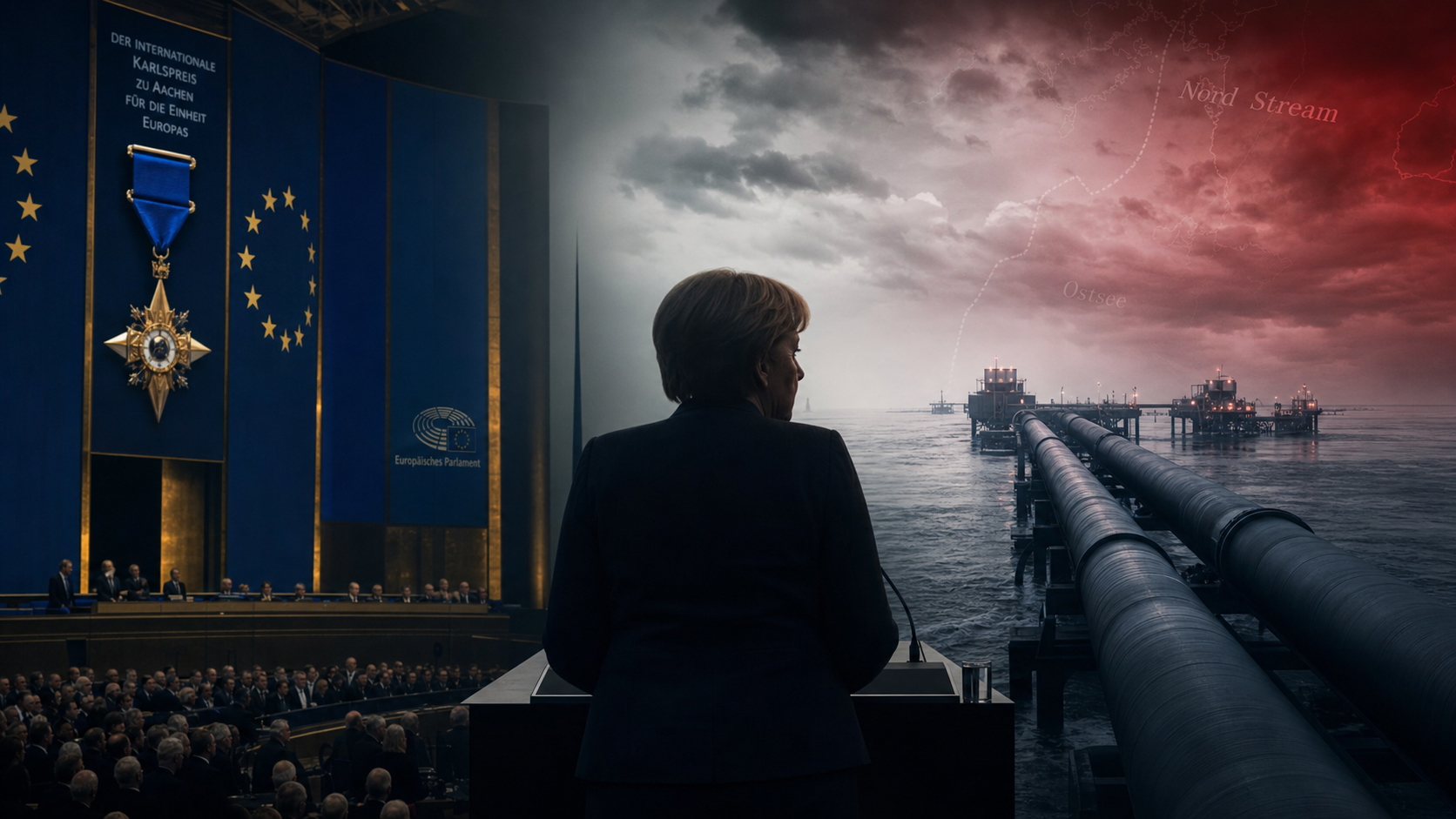
On May 19, the European Parliament in Strasbourg awarded the newly created European Order of Merit for the first time. Three individuals were honored in the highest category – as Meritorious Members: Ukrainian President Volodymyr Zelenskyy, former Polish President and Solidarity founder Lech Wałęsa, and former German Chancellor Angela Merkel. The order was established by the European Parliament in 2025 to mark the 75th anniversary of the Schuman Declaration, to recognize individuals who have made significant contributions to European integration and European values. However, Merkel's award, just a few days prior, continues to spark heated controversy – not due to partisan politics, but from the perspectives of experienced military and security experts from countries that have personally experienced Russia's expansionist ambitions.
An order that raises the question of historical judgment
The European Order of Merit is divided into three tiers: Members of the Order (lowest tier), Honorary Members, and Meritorious Members, the highest distinction. The jury comprises Parliament President Roberta Metsola, Vice-Presidents Ewa Kopacz and Sophie Wilmès, and prominent European figures Michel Barnier, José Manuel Barroso, Josep Borrell, and Enrico Letta. In addition to Merkel, Zelenskyy, and Wałęsa, recipients in the middle tier included former ECB President Jean-Claude Trichet, Moldovan President Maia Sandu, former Irish President Mary Robinson, and former Austrian Chancellor Wolfgang Schüssel. Those in the lowest tier included members of the band U2, NBA star Giannis Antetokounmpo, and human rights lawyer Oleksandra Matviychuk.
This broad circle of recipients has drawn criticism from observers. Harald Vilimsky, head of the Freedom Party delegation in the European Parliament, described the award as a sign of the "EU elites' loss of touch with reality" and complained that the Parliament was dealing with the distribution of the order in an "assembly-line" process while Europe was confronted with war, economic downturns, and migration issues. However politically motivated this criticism may be, it touches a nerve: What standards does a relatively new order apply when, in its first round of awards, it honors figures whose actions remain fundamentally controversial to this day?
From a promise of peace to a security policy miscalculation
For Pekka Toveri, the former head of Finnish military intelligence and now a member of the EPP group in the European Parliament, the awarding of the Order of Merit to Merkel sends the wrong signal about the EU's security policy thinking. He argues that Merkel was one of the key European politicians whose policies contributed to the conditions that ultimately led to the war in Ukraine. This criticism carries significant weight because it is not based on a Western European party perspective, but rather on the view of a man who spent years analyzing intelligence reports on Russian military activities – and whose country, Finland, only joined NATO in 2023, after decades of Finnish neutrality had finally become obsolete on February 24, 2022.
Toveri was particularly critical of Merkel's remarks in a Hungarian media outlet, in which the former chancellor stated that she had proposed EU-Russia talks with France in the summer of 2021, which failed due to resistance from Poland and the Baltic states, whereupon she resigned and Putin's aggression began. Toveri's assessment is devastating: This narrative is reminiscent of familiar Kremlin propaganda claiming that NATO's eastward expansion caused the war in Ukraine. Both are completely misguided interpretations and expressions of pure victimhood in a situation where self-criticism is actually needed. Putin's aggression is the result of an exaggerated belief in the omnipotence of diplomacy – not of a missed summit.
The Baltic states raise their voices – and draw a devastating comparison
Riho Terras, the former Estonian commander-in-chief and current MEP, also a member of the EPP group, puts it even more bluntly. He describes Merkel's attempt to blame the Baltic states for the failure of diplomatic processes as "simply pathetic" and damaging to EU unity. The Estonian goes even further, drawing a comparison that is likely to cause an uproar in Western European political discourse: some circles in Estonia – and these were not conspiracy theorists – had speculated that Putin had found a kind of new Schröder in Merkel, someone whose friendship and favors could, in a sense, be bought.
This comparison with Gerhard Schröder, the former chancellor who immediately entered the service of Russian energy companies after leaving office and publicly warned against demonizing Russia even after the invasion of Ukraine, is politically explosive. Terras is not saying that Merkel was bribed – he is describing a perceived systemic issue: a chancellor of a major Western European power who regularly prioritized Russian economic interests over the security concerns of her immediate eastern neighbors. Whether this perception is justified is debatable. That it exists, and not among irrational conspiracy theorists, but among former military leaders and elected parliamentarians, is a political reality that is difficult to ignore.
Nord Stream 2: The most expensive symbol of a failed foreign policy doctrine
Terras' criticism of Nord Stream 2 hits the strategic nerve: the pipeline has become the clearest symbol of how strongly Europe believed it could change Russia's thinking and behavior through economic relations and dialogue – despite repeated warnings after the annexation of Crimea in 2014. This assessment is reflected in the academic and political analysis of the so-called doctrine of "change through trade," which shaped not only Russia but also, in parallel, China.
The Nord Stream 2 project was initiated in 2015 – a year after the annexation of Crimea – by Gazprom and five European corporations. The pipeline was intended to transport up to 55 billion cubic meters of gas per year from Russia to Germany. The strategic dilemma was obvious from the outset: What Germany primarily considered an economic and energy policy project was viewed by its Eastern European and Baltic partners, as well as the USA, as a highly political instrument that would give Russia leverage over Ukraine and the entire eastern part of the continent. Analyses by the Konrad Adenauer Foundation had already pointed out in 2021 that the project remained fraught with high political risks and that German energy policy needed to become more strategic and European in its approach.
Particularly explosive are internal documents from the Federal Chancellery, the publication of which the Süddeutsche Zeitung obtained through legal action in 2025. These documents reveal that Merkel was informed in writing on September 2, 2015, about the asset swap between BASF/Wintershall and Gazprom, in which Gazprom was to acquire a stake in the German gas market. The Chancellery clearly recognized the risks at the time: the takeover would make Gazprom the direct supplier to municipal utilities, regional gas suppliers, companies, and power plants in Germany. Nevertheless, no veto was lodged. Economics Minister Sigmar Gabriel (SPD) had signaled to BASF that there were no energy policy concerns regarding the swap. This event, which took place a year after the annexation of Crimea, when Russia's revisionist nature had already been openly demonstrated, documents a political decision that is difficult to defend in retrospect.
The economic calculation: What dependency cost Germany
The economic consequences of this dependence, built up over decades, are measurable. Following the Russian attack on Ukraine on February 24, 2022, and the resulting end to Russian gas supplies, Germany lost approximately five percent of its gross domestic product, according to calculations by economist Sebastian Dullien of the Hans Böckler Foundation. Converted to per capita figures, this translates to an average annual loss of around €2,600 – compared to the EU average of €880, the Swedish figure of €1,700, or the Italian figure of just €230. Germany thus bears a structural premium for its particular vulnerability, which results directly from its one-sided reliance on Russian pipeline gas for its energy supply.
Between January and June 2022, between 1,350 and 1,700 gigawatt-hours of Russian gas flowed daily from Russia to Germany – a flow that dried up completely within a few months. The restructuring of the gas supply cost enormous sums: According to calculations by WirtschaftsWoche, the leased LNG platforms alone consumed around one million euros daily in the summer of 2024. Added to this were massive price increases on the energy markets: The average wholesale price for electricity in Germany climbed to around 235 euros per megawatt-hour in 2022 before stabilizing at about 80 euros by 2024 – meaning that, according to the Bruegel think tank, Europe was still paying industrial electricity tariffs in 2023 that were 158 percent higher than those in the USA.
The consequences for German industry are severe and long-lasting. According to a survey by the German Chambers of Industry and Commerce, 21 percent of industrial companies were considering production cutbacks or relocations in 2022 – this figure rose to 32 percent in 2023 and further to 37 percent in 2024. Among energy-intensive companies, the proportion considering relocations was already at 45 percent. PwC described the situation in 2024 as critical, warned of deindustrialization in the critical industrial core, and noted that Germany lagged far behind in global energy cost comparisons – behind the USA, China, the Middle East, and the rest of Europe. In 2022 and 2023, European industrial customers also paid five to six times more for gas than their US competitors.
However, it would be too simplistic to blame this development solely on Merkel. The structural problems of Germany's industrial base—excessive bureaucracy, a shortage of skilled workers, and chronic underinvestment in infrastructure—already existed before the energy crisis. University researcher Moritz Schularick from the University of Bonn pointed out in 2023 that the German economy ultimately withstood the end of Russian gas imports, which mitigated the predicted GDP declines of up to three percent. Nevertheless, the adjustment process was costly and painful, and could largely have been avoided if earlier warning signs had been taken more seriously.
Our EU and German expertise in business development, sales and marketing

Our EU and German expertise in business development, sales and marketing - Image: Xpert.Digital
Industry focus areas: B2B, digitalization (from AI to XR), mechanical engineering, logistics, renewable energies and industry
More information here:
A thematic hub offering insights and expertise:
- Knowledge platform covering global and regional economies, innovation and industry-specific trends
- A collection of analyses, insights, and background information from our key areas of focus
- A place for expertise and information on current developments in business and technology
- A hub for companies seeking information on markets, digitalization, and industry innovations
Merkel's legacy under attack: How internal documents demystify her Russia policy
The Minsk Agreement: Instrument of peace or strategic time-buying policy?
Alongside energy policy, a second controversy has damaged Merkel's foreign policy legacy: her own characterization of the Minsk agreements. In late 2022, the former chancellor stated in interviews with Die Zeit and Der Spiegel that the 2014 Minsk agreements were an attempt to give Ukraine time – time which Ukraine had used to become stronger. Merkel's ally François Hollande confirmed this interpretation to the Kyiv Independent.
These statements sparked a heated debate. Critics accused Merkel of retrospectively admitting that the agreement was not, in reality, a genuine peace project, but rather a diplomatic tool to buy time for Ukraine's military buildup. Supporters of the Chancellor countered that in Minsk, they had extracted the best possible outcome from a weak negotiating position: the Ukrainian army was on the verge of collapse at the time, and a frozen conflict was the only available compromise. Both interpretations have their own internal logic. What remains, however, is the observation that such a retrospective admission—if understood as an admission of strategic deception—undermines confidence in the West's overall diplomatic reliability.
For Toveri, the connection between this mindset and the subsequent failure is clear: the exaggerated belief in the transformative power of diplomacy and economic interdependence gave Russia the time and space to prepare its military attack. This perspective explains why many small and medium-sized Eastern European states, which have consistently pointed to the Russian threat since 1991, view the Western European response pattern of the years 2008 to 2022 as a kind of structural failure—not as malicious intent, but as a dangerous mix of naiveté, economic interests, and the desire to preserve the comfort zone of normalization for their own populations.
The doctrine of change through trade: idea, application, and failure
The concept of "change through trade" has deep roots in German foreign policy. It builds on Willy Brandt's social-democratic Ostpolitik, which demonstrably achieved success in reducing tensions during the Cold War. In the Merkel era, this principle was elevated to a kind of meta-political doctrine, applied equally to Russia and China: through deep economic integration, authoritarian systems were to be gradually persuaded to open up and implement reforms based on the rule of law.
What had worked in part for Cold War Germany proved to be a fallacy under fundamentally different geopolitical conditions. Russia used economic interdependence not as an incentive for political moderation, but as leverage. Energy dependence became—as political scientist Andreas Heinemann-Grüder of the Bonn International Centre for Conflict Studies describes—a structural weakness of the Western alliance. China drew similar conclusions: There, too, intensified economic relations over the past two decades have led neither to democratization nor to moderation in foreign policy. A DW commentator aptly called the "change through trade" approach for China a "fundamental lie of German foreign policy.".
That this doctrine would fail was not necessarily predictable – and was defended as a plausible option by reputable economists and political scientists well into the 2010s. This does not make the failure any less consequential, but it does demand a nuanced assessment: Merkel operated within a consensus shared by many of her European and German contemporaries. The question that remains is not whether, but when and with what weight the opposing signals should have been taken seriously – and whether, as the now-published Chancellor's Office documents suggest, she actually acted against her better judgment.
What the Chancellor's Office documents reveal: The knowledge of the risks
The publication of internal Chancellor's Office documents by the Süddeutsche Zeitung in 2025 represents the most compelling argument to date for a critical reassessment of the Merkel era. The documents prove that the Federal Chancellery clearly identified internally the risks of Gazprom's expansion in Germany, the gas storage deal, and the associated energy dependency – and the Chancellor was informed. Nevertheless, the sale of the gas storage facilities was neither prevented, nor was the Nord Stream 2 project halted despite the annexation of Crimea, nor was it even fundamentally questioned.
Michael Kellner, former Parliamentary State Secretary in the Economics Ministry of the coalition government, put it bluntly to the Süddeutsche Zeitung: Merkel was aware of the risks and deliberately avoided them. In doing so, she failed to live up to her oath of office to protect the German people from harm. The Green Party parliamentary group called for a parliamentary inquiry in May 2025. This demand met with resistance from the CDU/CSU, who are keen to protect the legacy of the long-serving Chancellor – thus crossing the line between historical analysis and active partisan politics, and consequently threatening to diminish its analytical precision.
Nevertheless, the documented facts remain: it was not merely a tragic misjudgment, but a political decision made against explicit internal warnings. The distinction between error and negligence—in both legal and political-ethical terms—is of considerable importance for the historical judgment.
The Order in contradiction: What Europe expresses through its honorary practices
In light of these facts, the question arises as to what the European Order of Merit signifies with its inaugural award. It is permissible to acknowledge Merkel's contributions to European integration: she was indeed a stabilizing force for European cohesion during key crises – the Eurozone crisis of 2010–2012, the refugee crisis of 2015, and the COVID pandemic. Her 16-year term in office did not tear apart the EU's institutional structure, but rather held it together through difficult negotiations. According to its own statements, the European Parliament is thus honoring individuals who have rendered outstanding service to the EU and its values.
At the same time, the controversy demonstrates that a one-sided award without contextualizing the failures sends a politically problematic signal – especially to those member states that, based on their own historical experiences, have always held a different view of Russia. Toveri succinctly captures this contradiction: An award that elevates someone to the highest category without addressing that person's security policy misjudgments implicitly reproduces the flawed assumptions that led to those decisions. European values, one could argue, also include the capacity for honest self-criticism – and the willingness to listen to the smaller partners who recognized uncomfortable truths earlier.
The pattern behind the failure: Structural causes of a flawed policy
It would be analytically insufficient to attribute the failure of German policy towards Russia solely to a single decision-maker. The political system of the Federal Republic, the economic lobbies of the energy and chemical industries, the interests of the SPD-affiliated trade union movement, the Eastern demand for cheap industrial gas, and the structural inertia of established energy partnerships – all of these formed a web of interests that pushed for continuity and marginalized political resistance to Nord Stream 2. The Chancellor's Office consistently described the project itself as a commercial undertaking, not a geopolitical issue – a framework that conceptually devalued political criticism from the outset.
Furthermore, intellectual honesty dictates acknowledging that the alternative – a complete break with Russia after 2014 – would have entailed considerable economic and social costs, which the political class of the time deemed unacceptable for its population. The question is not whether these costs would have been bearable – subsequent developments have shown that the costs of inaction were far higher – but rather how it was possible for the risk assessment to be so systematically skewed against the security outlook.
A nuanced assessment: acknowledging merits, naming failures
The historical classification of Angela Merkel as a stateswoman requires a distinction between at least three dimensions of her legacy. First, her achievements as a crisis manager of institutional Europe are real and documented. Second, her Russia policy was not an idiosyncratic project, but rather represented the prevailing Western European consensus of her time—a consensus, however, against which the eastern NATO partners protested constantly and unsuccessfully. Third, the now accessible documents suggest that decisions were made against better judgment, shifting the assessment from an honest error toward political negligence.
An order can and should recognize merit without taking a comprehensive view of past achievements. But the reactions from Finland and the Baltic states make it clear that Europe as a community has not yet found a common language for dealing with this chapter of its history. This is no longer just Merkel's personal problem – it is a problem of European remembrance culture and of the continent's ability to learn from structural policy errors before the next test arrives.