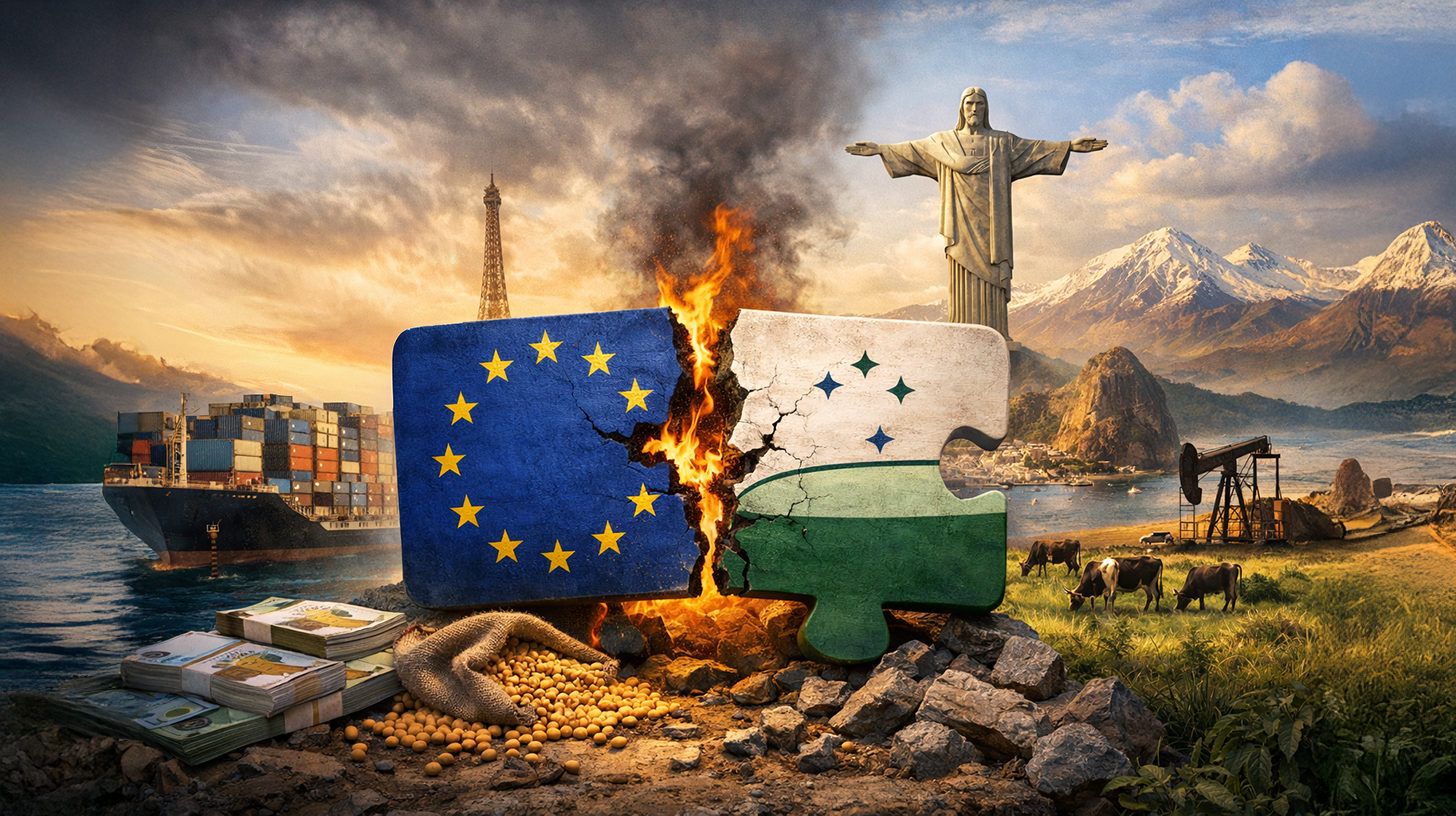
Mercosur deal on the verge of collapse: Is Europe squandering its last chance in South America? – Image: Xpert.Digital
Mercosur agreement: Europe's moment of strategic repositioning or institutional failure?
### Blockade from Paris & Co.: Will the Mercosur agreement fail due to Europe's fear of farmers' protests? ### Mercosur deal on the verge of collapse: Is Europe squandering its last chance in South America? ### Free trade with Mercosur: A once-in-a-century strategic opportunity or a sign of European failure? ###
EU hesitates, China invests: What the Mercosur agreement means for Europe's raw material security
For 26 years, Brussels and the South American Mercosur states of Brazil, Argentina, Uruguay, and Paraguay have been negotiating a free trade agreement that goes far beyond tariffs and quotas. At stake is whether Europe will still be perceived as a serious partner in South America – or whether the continent will definitively lose its influence to China and the USA.
While a political agreement in principle in December 2024 seemed to point to the signing of the treaty at the end of 2025, the familiar European blockade has resurfaced in the final days before the planned summit in Brazil: France, in particular, but also Poland, Austria, and other member states are intensifying their opposition – officially to protect domestic agriculture. In Brasília, Buenos Aires, and Montevideo, this argument is being met with increasing head-shaking and growing contempt.
At the same time, the tectonic plates of the global trading order are shifting rapidly. The EU's share of Mercosur's foreign trade has plummeted from over 31 percent to 15 percent since 2000, while China's share has increased fivefold from 2 percent to 24 percent in the same period. Today, Mercosur's trade volume with China is around 58 percent higher than its trade volume with the EU. This is not just a statistic, but an expression of a strategic loss of power: China is now the region's most important trading partner, purchasing about two-thirds of Mercosur's soybeans and a large share of its iron ore.
Economically, the agreement would be a catalyst, though not a miracle of growth. Tariffs on over 90 percent of goods would be gradually phased out, European companies could save billions in export duties, and sectors such as automotive, mechanical engineering, and pharmaceuticals would particularly benefit. At the same time, Europe would secure better access to critical raw materials—from lithium and copper to nickel and rare earth elements—which are essential for the energy transition and future technologies.
But from a South American perspective, the balance of power has long since shifted. The Mercosur states no longer see themselves as supplicants, but as sought-after partners in a region where China is investing heavily and the US is trying to revive its influence. The fact that the EU has made far-reaching concessions to Washington while demanding ever new conditions and safeguard clauses from Mercosur is seen in South America as an expression of European double standards.
Against this backdrop, the Mercosur agreement becomes a matter of destiny: Will the EU succeed in positioning itself as a reliable, strategically minded partner – or will its failure definitively document the loss of its claim to leadership in a region that is equally crucial for trade, raw materials and geopolitical influence?
Related to this:

A critical analysis of EU-South America relations in times of geopolitical shifts
European trade policy is at a critical juncture, where structural paralysis threatens to undermine the strategic interests of the entire continent. The proposed free trade agreement between the European Union and the South American Mercosur states symbolizes far more than a mere trade agreement – it represents the last realistic opportunity for the EU to assert its geopolitical position in South America and to stand up to the growing dominance of rival superpowers.
For 26 years now, the EU and the Mercosur countries of Argentina, Brazil, Uruguay, and Paraguay have been negotiating this free trade agreement. A quarter-century of diplomatic efforts, marked by alternating progress and frustrating setbacks. In December 2024, the finish line finally seemed in sight: a political agreement had been reached and was to be signed in December 2025. But in the final week before the planned summit in Brazil, European decisiveness has once again proven paralyzed.
France, Poland, Austria, and other EU member states have reaffirmed their opposition. The French argument is a familiar one, yet remains stubbornly persistent: the protection of domestic agriculture. South American governments are watching this spectacle with growing impatience and contempt. In Brasília, Buenos Aires, and Montevideo, they are increasingly shaking their heads at the Europeans.
Shift in the global trade architecture: Who is leaving whom?
The economic foundations for the agreement speak for themselves. With approximately 715 million inhabitants and combined economic output, Mercosur represents a potentially significant free trade area. Brazil alone contributes roughly three-quarters of Mercosur's GDP and acts as its regional center of gravity. With economic growth forecasts of around 2 percent for 2025 and 2026, and Argentina's impressive recovery with projected growth rates of 5.7 percent for 2025, these countries possess considerable economic momentum.
From a European perspective, however, the situation is critical. The EU's share of Mercosur's total foreign trade has shrunk dramatically since 2000 – from over 31 percent to just 15 percent in 2023. Trade volume between the EU and Mercosur amounted to only $117 billion in 2023. In contrast, China has increased its share of Mercosur trade fivefold, from 2 percent in 2000 to 24 percent in 2023. Chinese trade volume with the Mercosur countries now amounts to approximately $185 billion – around 58 percent more than trade with the EU.
These figures describe not merely a statistical phenomenon, but the gradual displacement of the European economy from a strategically important region. China is now by far the most important trading partner of the Mercosur countries. The South Americans have an export surplus of approximately $37 billion with China, while they have a deficit of over $12 billion with the EU. Around 69 percent of Mercosur's soybean exports and 64 percent of its iron ore exports go to China.
South America is also not primarily dependent on the North American market like Mexico or Central America. Therefore, the Mercosur countries can pursue their trade policies with greater independence. Brazil and Argentina, among others, benefit from the global energy transition as major suppliers of raw materials. With ideal conditions for wind, solar, and biomass energy, these countries are increasingly positioning themselves as attractive locations for energy-intensive industries.
The trade agreement as an economic catalyst
The specific details of the planned agreement are therefore not insignificant. According to the current state of negotiations, tariffs on 91 percent of all goods traded from the EU to Mercosur would be gradually phased out over a period of up to 15 years. At the same time, 92 percent of Mercosur exports to the EU would be duty-free or subject to reduced rates. Export taxes levied by Mercosur countries would be eliminated, and a secure framework for mutual trade and investment would be established.
The European Commission predicts that European companies could save around €4 billion annually in export tariffs through the agreement. EU exports to the Mercosur countries could increase by a total of $40 billion by 2040. This corresponds to an increase of approximately €39 to €49 billion annually. Currently, around 60,000 EU companies export to these countries, including 30,000 small and medium-sized enterprises (SMEs). The automotive, mechanical engineering, and pharmaceutical industries would particularly benefit from the reduction of the currently high tariffs on these product categories.
The German Economic Institute (IW) has also calculated more realistic long-term scenarios. According to these, the EU's GDP could increase by only 0.06 percentage points by 2040 as a result of the agreement – a modest effect explained by the relative size of Mercosur trade within the overall volume of European foreign trade. Mercosur trade currently accounts for approximately 2.5 percent of total EU foreign trade.
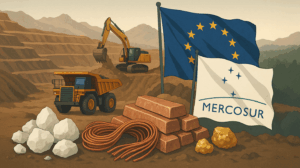
Nevertheless, the agreement would contribute to securing critical raw materials. The Latin American continent possesses half of the world's lithium reserves, over a third of its copper deposits, and about a fifth of the world's nickel and rare earth metals. Chile, Argentina, and Brazil are considered particularly attractive for European raw material investments. The International Energy Agency expects demand for critical raw materials to increase by more than 6 percent annually until 2030.
South American Perspective: The Failure of Europe's Claim to Leadership
From a South American perspective, however, the situation is significantly different. The Mercosur countries have already made considerable concessions from their point of view. The planned tariffs on South American agricultural products can be immediately suspended if imports in any sector increase by more than five percent. This is a safeguard clause that benefits European agricultural interests.
So far, South American governments have had to overcome massive internal resistance to achieve a national consensus on the agreement. Organized lobbies also exist in Brasília, Buenos Aires, Asunción, and Montevideo that oppose the agreement – for example, environmental and conservation organizations that have concerns about deforestation and sustainability standards.
The European negotiating stance, however, is increasingly perceived as unacceptable double standards. South American diplomats watched with astonishment as the Europeans caved in to Donald Trump. In July 2025, the EU and the US agreed on a trade deal that limited European tariffs to a maximum of 15 percent and prevented an escalation to 30 percent. In return, US farmers received significantly easier access to the EU single market.
For South Americans, this is shameful: The EU makes significant concessions to the US – an aggressive negotiating partner with a massive tariff policy – while simultaneously demanding new and additional safeguard clauses from Mercosur, an economic bloc striving for fair mutual agreements. European beef imports into the EU are minimal compared to what American agricultural products have received.
Our global industry and economic expertise in business development, sales and marketing

Our global industry and economic expertise in business development, sales and marketing - Image: Xpert.Digital
Industry focus areas: B2B, digitalization (from AI to XR), mechanical engineering, logistics, renewable energies and industry
More information here:
A thematic hub offering insights and expertise:
- Knowledge platform covering global and regional economies, innovation and industry-specific trends
- A collection of analyses, insights, and background information from our key areas of focus
- A place for expertise and information on current developments in business and technology
- A hub for companies seeking information on markets, digitalization, and industry innovations
Mercosur deal on the verge of collapse: How farmers' lobbies are jeopardizing Europe's global power
China's rise to become the dominant economic power in South America
This is leading to a fundamental geopolitical repositioning. Mercosur has been actively seeking new partners for trade agreements in Asia for some time. China has systematically expanded its presence in South America. Trade relations between Brazil and China are developing steadily. Brazil acts as a gateway to South American markets for China, while China is making massive investments. Chinese investments in Brazil increased by 34 percent in 2024.
Trade volume should also be understood as a means of investment. Brazil is striving to increase its soybean and raw material exports to China. Last year, soybean exports to China accounted for more than 70 percent of China's total imports of this product. To facilitate transport, China is building export terminals at Brazilian ports.
There is a growing number of think tanks suggesting that China could overtake the US as Latin America's most important trading partner by 2035. In another scenario, China could become a more significant import partner than the US for many Latin American countries by that time.
Under Trump, the US has again attempted to revive its influence in the region. This represents a change of course after decades of US neglect of Latin America. Washington is trying to curb China's massive involvement. Argentina is receiving substantial financial and political support. The US has provided Argentine President Javier Milei with aid funds to stabilize the peso and also aims to prevent Argentina from becoming further dependent on Chinese loans.
But here, too, the new realities are becoming apparent. Total US trade with Latin America amounted to approximately $365 billion in 2024. This is significantly larger than the trade volume between Europe and Latin America, which, at around €180 billion, is only about half as large. The competitive situation for European companies is thus intensifying on two fronts: from China's systematic market penetration on the one hand, and from the newly awakened US activity on the other.
Related to this:

European hesitancy as a sign of weakness
The ongoing European decision-making gridlock is therefore rightly interpreted in South America as a sign of weak political leadership on the part of the EU. An EU-Mercosur agreement has long ceased to be a top priority for South American countries, as a "divided and economically weak Europe" is no longer so attractive. Mercosur can afford to wait, seek other partners, or negotiate more selectively with Europe.
What is particularly galling about the European stance is its perceived hypocrisy. The Eurocentric approach of the Europeans and their constantly shifting sensitivities irritate their South American partners. While the EU demands that Mercosur meet sustainability criteria and adhere to environmental standards – which sounds legitimate but is perceived as protectionism from a South American perspective – the EU exhibits a completely different attitude towards the USA.
Trump imposed aggressive tariffs on European exports. The EU responded with concessions and openness. However, the EU is taking a rigid stance towards South America, making additional demands. This can be seen as a direct breach of trust. If the Europeans cannot find a common position towards key partner countries even now, in the face of Trump's aggressive trade policies, they will discredit themselves.
Structural instability of European trade governance
France's obstruction is symptomatic of a deeper European governance problem. France is operating from a position that is increasingly out of touch with modern European economic realities. The French Prime Minister stated that its demands have not been met. France refuses to accept the agreement in its current form and is demanding additional guarantees for its farmers.
The French agricultural sector is overrepresented in the EU. The EU's Common Agricultural Policy (CAP) exhibits structural over-subsidization and protects Western European agriculture – particularly France and the Netherlands – through subsidies and tariffs. The Mercosur agreement threatens this system of privileges through potential competition from South American agricultural exporters.
However, the European analysis also shows that the actual economic threats to EU agriculture are limited. The planned safeguard clauses are substantial. Beef quotas are limited and include transitional periods. Moreover, both sides – Mercosur and the EU – have already negotiated these points at length and reached compromises.
But France is operating under immense domestic pressure. The French agricultural lobby, embodied by farmers who repeatedly stage tractor blockades, is considered all-powerful in French domestic politics. French President Emmanuel Macron appears to be a prisoner of these sentiments. It is one of the few political projects on which Macron can count on the support of a majority of the French people. If Mercosur fails due to French resistance, Macron will go down in history as a tragic figure – a politician who can speak grandly about Europe's global role but lacks the domestic political will to realize his vision.
Geopolitical implications and strategic realignment
From a geostrategic perspective, however, the agreement is of fundamental importance to the EU. The European Commission has recognized this and emphasized that signing the agreement is currently of crucial economic, diplomatic, and geopolitical significance. In 2021, the EU adopted its "Economic Security Strategy," which aims to promote innovative technologies, combat unfair trade practices, and—keyly—diversify procurement and sales markets.
The Mercosur agreement is a key component of this strategy. It would secure EU access to critical raw materials without relying on a single country or region. This is particularly important in the context of China's monopoly on rare earth elements and the US's blocking policies regarding semiconductors.
The scientific analysis also shows that new free trade agreements could not only offset the negative effects of the Trump tariffs on the European economy, but even overcompensate for them. Depending on the scope of the free trade agreements, exports could increase by a total of 1.7 to 4.1 percent, and European GDP could rise by up to 0.5 percent. Compared to the 0.06 percentage points from the Mercosur agreement alone, this is a substantial effect if several agreements are ratified simultaneously.
Qualified majority instead of universal consensus
Institutionally, it's important to note that not all EU member states need to agree to the agreement. A qualified majority is required: at least 15 EU member states representing at least 65 percent of the EU population. Germany, Spain, Sweden, Belgium, and other countries support the agreement. Chancellor Friedrich Merz announced that Germany will endorse the agreement no later than the Council meeting on December 18 and 19. The German Cabinet has already approved the signing.
Austria, however, is bound by a parliamentary veto from 2019 and rejects the agreement. Italy, also a major agricultural exporter, is considered a weak link. Belgium also opposes the agreement. Overall, however, there are enough supporters to achieve the qualified majority. France, Austria, and Poland cannot, therefore, block the agreement on their own – technically speaking.
But this reveals a deeper European governance problem: the European decision-making culture increasingly strives for unanimity, not the formally stipulated system of qualified majority voting. This leads to paralysis. States like France can de facto arrogate to themselves a veto right, even though this right does not formally exist. The EU then refrains from making any decisions so as not to offend individual states.
This is a dangerous dynamic for the future of Europe. It means that individual member states holding a minority position – whether for domestic political reasons or due to the structural overrepresentation of their sectors – can paralyze the overall European strategy.
Long-term consequences for European positioning
Should the EU actually fail to sign the Mercosur agreement, this would have significant consequences for Europe's positioning. The agreement is indeed the EU's "foreseeable last chance to assume a geopolitical position of strength" in a region where European influence is increasingly dwindling.
South American countries will increase their negotiating distances with other partners. Brazil could focus more on close cooperation with China. Uruguay and Paraguay could intensify negotiations with the US. Argentina could move significantly closer to the US, whose support under Trump is very concrete.
This process would continue in a self-reinforcing manner. The less present the EU is in South America, the less significant it becomes as a negotiating partner. The less European companies benefit from local investment opportunities and access to raw materials. The more South American countries become mere appendages of the Chinese raw material supply chain or the US geopolitical sphere of influence.
The European strategy for economic security is to be implemented through diversification of trading partners. However, if individual European states prevent the EU from concluding agreements with important regions through obstructionist policies, this strategy becomes an illusion.
European leadership or institutional failure?
The EU-Mercosur agreement is not just a trade agreement, but a test of Europe's ability to act geopolitically coherently. It shows whether the EU is still capable of acting effectively in world politics, or whether it is so paralyzed by internal contradictions that individual states and sectors can sabotage the overall strategy.
The South American countries have already lost patience. Their discontent is not artificially inflamed, but legitimate. From their perspective, the EU made an offer, negotiations took place over 25 years, compromises were reached – and now the EU repeatedly caves to new demands without clearly communicating these transparent new requirements beforehand.
For Europe's future, the failure of the Mercosur agreement would be a disaster. It would demonstrate the EU's inability to implement its own strategies. It would show that individual countries, under domestic political pressure, can sabotage Europe's overall interests. This would severely damage the trust of not only South America, but also other potential trading partners – Asia and the Middle East – in European reliability.
The French farmers' lobby and short-term domestic political sensitivities in Paris or Vienna are completely disproportionate to Europe's long-term strategic interests. This realization is a painful but necessary lesson for European leaders: when short-term considerations of national lobby groups block European action, they inevitably lead to long-term strategic defeats.
EU/DE Data Security | Integration of an independent and cross-data-source AI platform for all business needs
Independent AI platforms as a strategic alternative for European companies - Image: Xpert.Digital
AI Game Changer: The most flexible AI platform - Tailor-made solutions that reduce costs, improve your decisions and increase efficiency
Independent AI platform: Integrates all relevant company data sources
- Rapid AI integration: Tailor-made AI solutions for businesses in hours or days, instead of months
- Flexible infrastructure: Cloud-based or hosting in your own data center (Germany, Europe, free choice of location)
- Maximum data security: its use in law firms is irrefutable proof
- Deployment across a wide variety of enterprise data sources
- Choice of own or different AI models (DE, EU, USA, CN)
More information here:
Consulting - Planning - Implementation

Konrad Wolfenstein
I would be happy to serve as your personal advisor.
You can contact me at wolfenstein∂xpert.digital or
Just call me on +49 7348 4088 965 .
🎯🎯🎯 Benefit from Xpert.Digital's extensive, five-fold expertise in one comprehensive service package | BD, R&D, XR, PR & Digital Visibility Optimization

Benefit from Xpert.Digital's extensive, five-fold expertise in a comprehensive service package | R&D, XR, PR & Digital Visibility Optimization - Image: Xpert.Digital
Xpert.Digital possesses in-depth knowledge across various industries. This allows us to develop tailored strategies precisely aligned with the requirements and challenges of your specific market segment. By continuously analyzing market trends and monitoring industry developments, we can act proactively and offer innovative solutions. The combination of experience and expertise generates added value and provides our clients with a decisive competitive advantage.
More information here: