The biggest misconception about China: Why China's supposed planned economy is actually a ruthless competition – Image: Xpert.Digital
It's not Beijing that decides: The secret economic engine that truly drives China's rise
Brutal bidding wars instead of bureaucracy: How China's cities are conquering the global market
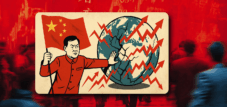
When China's economy is discussed in the West, a clear picture usually dominates: an all-powerful Communist Party in Beijing that dictates every factory construction and every technology investment from the top down through its five-year plan. But this notion of a rigid, centralized planned economy is a fundamental misconception. Anyone who truly wants to understand why the country has dominated global industries like electromobility in record time must look beyond President Xi Jinping and the Central Committee. The true driving force behind the Chinese economic miracle—and, paradoxically, also its greatest current crises—lies one level deeper. It is a ruthless, systematic competition between provinces and megacities for factories, talent, and capital. How this unique "competitive federalism" functions, why it transforms local officials into aggressive entrepreneurs, and why precisely this dynamic is now flooding the global market with overcapacity can be revealed by examining the internal architecture of the People's Republic.
Why the People's Republic is not a planned bureaucracy – but a gigantic tournament for growth, capital and power
China's Internal Architecture: A Realm of Competing Plains
Those who look at China from the outside see a unified leading power: one party, one central committee, one five-year plan. This image isn't wrong – but it hardly explains why China's economy functions the way it does. The real driving force behind the Chinese economic miracle lies one level deeper, in a system that initially seems paradoxical to Western observers: a profoundly decentralized, competitive state within an authoritarian framework.
China is divided into 34 provinces and region-like units, over 300 cities at the prefecture level, and thousands of counties and boroughs. According to the Chinese National Bureau of Statistics, at the end of 2023, China had a total of 694 cities, 29 of which had over five million inhabitants and 11 had over ten million – structures that simply have no equivalent in Europe. Over 100 Chinese cities have more than one million inhabitants. Each of these levels has its own budgetary targets, industrial priorities, and political ambitions – and thus tangible interests that do not necessarily align with those of Beijing.
This administrative diversity is not a deficit, but a constructive principle. Economists have coined the term "Chinese-style federalism" for this – a concept developed in 1995 by Montinola, Qian, and Weingast in the journal World Politics, which has since gained widespread acceptance in institutional economics. The core idea is that China practices fiscal decentralization, in which local governments have extensive control over economic resources and decisions within their jurisdiction – without, however, enjoying the political autonomy of formal federal states. It is a form of competitive federalism without the associated democracy.
Related to this:

The career system as a growth engine: When civil servants compete for promotion
The crucial institutional mechanism behind this system is what economists call "tournament competition" or "yardstick competition." For decades, the promotion of local officials in China depended—and despite recent reforms still depends—largely on the relative economic performance of their region compared to others. Those whose province or city grows faster, attracts more investment, and establishes new industries rise through the ranks of the party apparatus.
This system creates a structurally unique incentive structure: Governors and mayors behave less like administrators in economic matters and more like entrepreneurs competing in an internal market for capital, talent, and recognition. Empirical studies analyzing panel data from 29 Chinese provinces between 1980 and 2004 demonstrate statistically significant strategic interactions between provincial spending—clear evidence of active competition. Local growth coalitions outbid each other to attract industrial and infrastructure investment, and local policymakers develop private-owner-like economic behavior.
One consequence of this incentive system, which is also well-documented in research, is the temptation to manipulate data. Mayors whose promotions depended on GDP growth figures had statistically measurable incentives to inflate these figures between 1990 and 2013. A study by two economists from the Universities of Pittsburgh and Maryland shows that the promotion incentives increased statistically measured GDP growth by up to 3.4 percentage points—without a corresponding effect on non-manipulable indicators such as nighttime brightness from satellite images. After 2013, when Beijing reduced the weight given to GDP statistics in promotion evaluations, this effect largely disappeared.
The silent bidding war: How cities are fighting for factories, talent, and startups
The abstract institutional construct gains its true plasticity through concrete examples. The competition between Chinese cities for investment is not a theoretical concept – it is daily practice and often unfolds with an aggression that surprises Western observers.
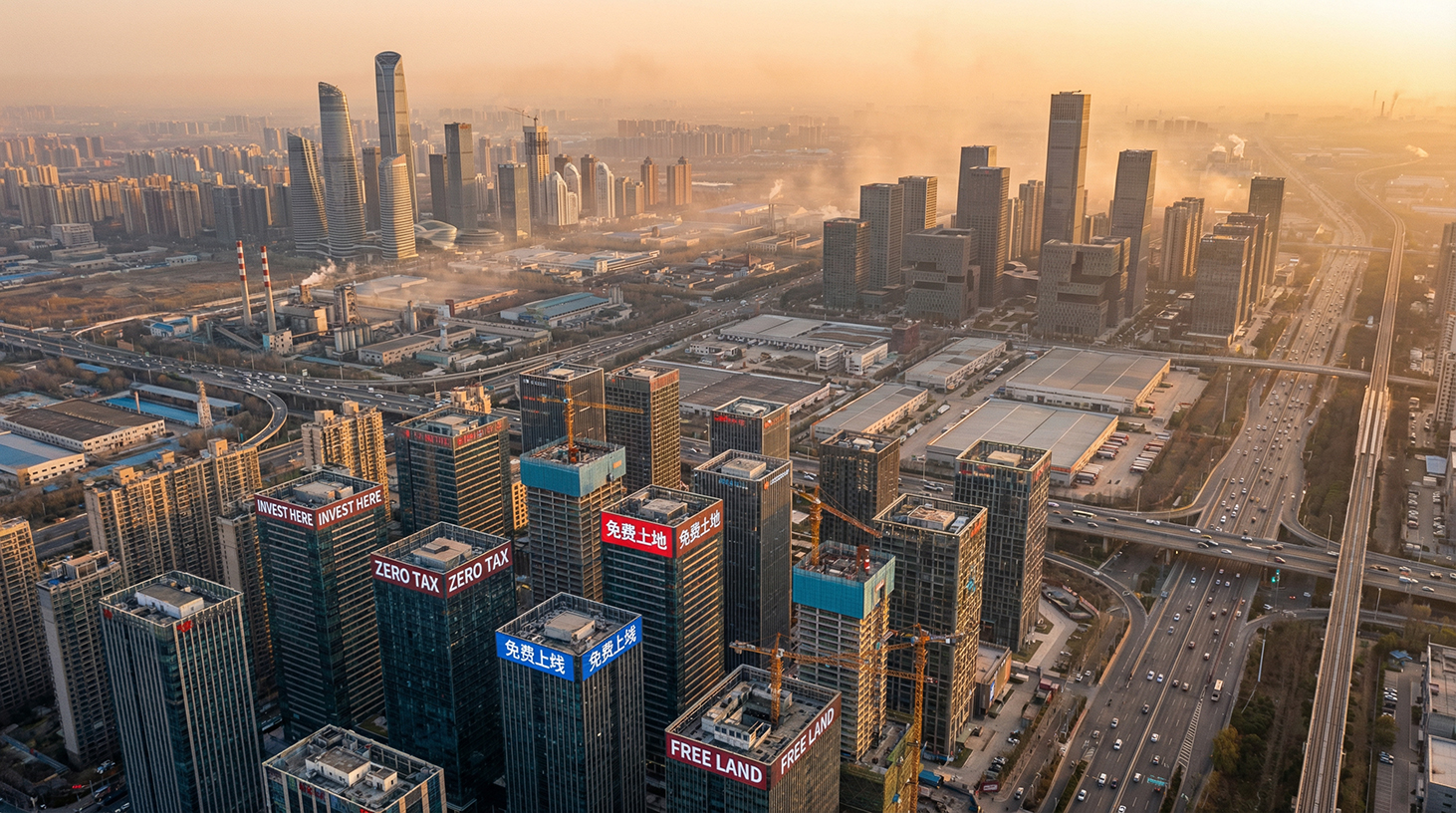
When BYD, China's rising electric vehicle manufacturer and now a global challenger to Tesla, was looking for a location for its new mega-factory, a bidding war erupted between at least five Chinese cities. Each city offered cheaper land, faster building permits, and tax breaks. Zhengzhou in Henan province ultimately won the bid, thanks to its excellent infrastructure and, crucially, the active support of the provincial government in the form of tax breaks, infrastructure investments, and assistance with land development. The resulting factory has become one of the world's largest automotive production sites, employing over 60,000 people and reportedly producing roughly one vehicle per minute annually.
Another case illustrates the intensity of this internal competition even more vividly: Chengdu, the capital of Sichuan province, has systematically positioned itself as a drone hub in recent years. The city boasts over 100 companies in the industrial drone sector, which, according to the city's economic bureau, is expanding at an average annual growth rate of over 20 percent. Chengdu has not hesitated to actively poach startups from other cities—a practice characterized in economic reports as "undermining fair competition" and which has led to official complaints from the disadvantaged cities.
This competition is also evident in the battle for skilled workers. Since 2017, dozens of cities—including Wuhan, Chengdu, Suzhou, Xi'an, and Hangzhou—have launched aggressive talent programs ranging from discounted hukou registrations and housing subsidies to free accommodation for applicants. A 2018 survey found that over 40 percent of university graduates preferred to move to cities like Hangzhou, Chengdu, Chongqing, Tianjin, Nanjing, or Wuhan. In October 2024, Chengdu announced plans to allow migrants to obtain local hukou registration simply by purchasing housing—a move that directly competes with similar initiatives in other cities. Economists openly refer to this as a “war for people” (战抢人), which is significantly shaping the country’s demographic dynamics.
The misconception of the “invisible hand of Beijing”: Efficiency through rivalry
The question that most concerns Western companies and investors is: How can a system formally considered communist-bureaucratic generate such economic efficiency? Fast approval processes, immediate provision of industrial land, tailored tax incentives, functioning infrastructure in record time – this is the China that foreign companies experience and which they often equate with central planning.
This equation is a fundamental analytical error. What Western investors perceive as the efficiency of the state apparatus is, in reality, the result of local government competition. A city that wants to attract a factory, a research center, or a corporate headquarters coordinates its internal authorities, expedites permits, removes bureaucratic obstacles, offers subsidies, and mobilizes resources—not because Beijing has ordered it, but because it wants to outdo the neighboring city. The reason for this drive is primarily political and careerist, not ideological: The mayor who attracts the factory advances his career. The one who loses it stagnates.
This also explains an apparent paradox in China's economic policy. While the country follows overarching five-year plans that set industrial priorities—for example, in electromobility, photovoltaics, or artificial intelligence—the implementation of these priorities is not mandated but rather driven by competitive incentives. When Beijing declared electric vehicles a strategic industry, the necessary capacities were not developed by a central planning committee. Instead, dozens of city governments entered into a race to attract the most EV manufacturers, build the best test tracks, and establish the strongest supply chain. The result was an industrial scale of historic proportions—and simultaneously, massive overproduction.
Our China expertise in business development, sales and marketing


Our China expertise in business development, sales and marketing - Image: Xpert.Digital
Industry focus areas: B2B, digitalization (from AI to XR), mechanical engineering, logistics, renewable energies and industry
More information here:
A thematic hub offering insights and expertise:
- Knowledge platform covering global and regional economies, innovation and industry-specific trends
- A collection of analyses, insights, and background information from our key areas of focus
- A place for expertise and information on current developments in business and technology
- A hub for companies seeking information on markets, digitalization, and industry innovations
China's competitive trap: Local debt, dumping exports and the Xi dilemma
The downside of the tournament: overcapacity, debt, and the phenomenon of involution
Any system based on intense rivalry produces not only winners but also systemic dysfunctions. The Chinese model of competitive federalism is no exception—on the contrary, it has developed a pathology in recent years that even Beijing recognizes as an urgent problem.
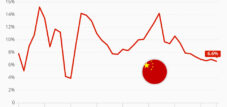
The buzzword is "involution"—in Chinese, neijuan, literally "rolling inwards." In economics, it describes a state of self-destructive over-competition in which ever-increasing resources flow into a saturated market without generating any real added value. When every province simultaneously tries to produce electric cars, solar panels, AI infrastructure, and drones, a structural oversupply emerges, driving prices below the profitability threshold. Nearly 30 percent of Chinese industrial companies are already operating at a loss—compared to 20 percent before the pandemic. Capacity utilization in the industrial sector recently stood at a mere 74 percent.
The effects of this overproduction are felt globally. China exports surplus goods at prices that international competitors cannot match – a phenomenon criticized as unfair trade by everyone from the EU Commission to the Trump administration. The Handelsblatt newspaper, citing a rhodium analysis, reported that Chinese overcapacity represents a "systemic problem" not limited to individual sectors, but affecting virtually the entire export industry. The largest surpluses were identified in non-metallic minerals, telecommunications equipment, and electrical machinery – but food, textiles, and chemicals are also structurally overproduced.
Another structural problem is local government debt. When cities compete for investment, they often do so with borrowed money. Empirical research based on the explicit and implicit debt of Chinese local governments from 2012 to 2020 shows that fiscal decentralization and government competition have a significantly positive impact on municipal debt risk—and that this impact diffuses spatially, meaning that one city's excessive debt also drives neighboring cities into debt through competitive pressure.
Related to this:

Xi Jinping's Dilemma: Centralization versus Growth Dynamics
President Xi Jinping has recognized and publicly addressed the contradictions of this system. In the summer of 2025, he spoke out against the “disorderly race to the bottom” practiced by local governments and companies. In a speech before the CCP’s Financial and Economic Affairs Committee, he posed the rhetorical question of whether every province really needed to simultaneously develop electric cars, AI data centers, and drones. The answer is obvious—no. Yet the system that creates this parallelism is the same system that has fueled China’s economic dynamism for the past four decades.
Beijing is caught in a structural dilemma. To combat overcapacity, it must dampen local competitive incentives. Yet these very incentives are the source of the economic speed and scalability that have made China a global industrial leader. An anti-involution campaign that merely cuts production capacity in certain sectors without changing the promotion logic for local officials does not solve the problem—it only shifts it to other industries. While investments in electric vehicles and solar energy are slowed, capacity building is accelerating in the petrochemical industry, a sector already undergoing its own involution cycle.
Xi Jinping's response to this dilemma has so far been ambivalent. On the one hand, he is urging economically strong provinces like Jiangsu to act as pilot zones for new models of high-quality development and to gain experience in resolving "deep-rooted contradictions." On the other hand, Beijing is sticking to the 5 percent growth target and providing additional stimulus funds, which—via the familiar transmission channels—in turn strengthen competitive incentives for local governments. A fundamental departure from the investment-driven growth logic would politically mean accepting lower growth rates and shifting the economy toward domestic demand and consumption—a step for which there is currently no discernible political will.
Green competition: When rivalry drives sustainability
An often overlooked aspect of regional competition is its potential constructive side with regard to environmental goals. In recent years, the competition system has also developed a green dimension that has at least partially benefited the goals of the energy transition.
At the 2025 National People's Congress sessions, provinces competed not only for industrial capacity but also for special allocations from the central budget for green infrastructure, tax breaks for clean industries, and the prestige of national pilot projects. According to an analysis of 31 provincial government reports, a significant portion of this economic competition has now shifted to the clean energy sector. In 2024, 26 percent of China's total GDP growth came from the clean energy industry—electric vehicles, lithium batteries, and solar panels alone accounted for over 18 percent of total GDP output.
A systematic study of 272 Chinese cities at the prefecture level shows that different dimensions of municipal competition have varying impacts on green economic growth. Ecological competition, service competition, and comprehensive comparability promote sustainable growth, while purely economic competition—at the expense of environmental standards—hinders it. The system thus contains both the potential for green transformation and the risk of greenwashing competition for subsidies.
What the West misunderstands – and what it could learn
The misunderstanding of China in the West is not accidental. It has historical and ideological roots: those who perceive a country as a one-party state tend to interpret all economic decisions as centrally controlled. But this equation of political centralization with economic planning does not reflect the Chinese reality of the 21st century.
The institutional truth is more complex and fascinating: China combines political hierarchy with economic decentralization. The central government sets framework objectives and controls strategic sectors, while simultaneously fostering intense internal competition among local governments, accelerating capital, talent, and innovation at a pace that pure bureaucracies simply cannot achieve. It is a system that economists describe as "regionally decentralized authoritarianism"—authoritarian in its political dimension, competitive in its economic one.
For European companies and policymakers, this understanding has immediate practical consequences. Those who want to do business with China don't primarily need to understand Beijing, but rather the specific city government they are dealing with – its particular growth targets, its rivalry with neighboring cities, its industrial priorities. Permitting a factory is not a central decision, but the result of a local negotiation process in which the city pursues its own interests. And those who read the publicly available annual plans of several cities simultaneously can often identify early on which sectors China will scale up next – long before Beijing officially communicates this.
In recent years, the German government and the EU have begun to scrutinize Chinese investment plans more critically. This is strategically understandable. However, the analysis must not stop at the superficial "China is investing." The real question is: Which city, which province, which local coalition of party cadres, state banks, and companies is driving this investment, and what career interests lie behind it? Only by answering these questions can one truly understand China's economy.
Related to this:

A system under transformation pressure
The Chinese model of competitive federalism is at a turning point. The structural successes of the past four decades are undeniable – no other country in history has lifted so many people out of poverty and built such a broad industrial base in a comparable timeframe. At the same time, the system is increasingly producing distortions: overcapacity, local debt, destructive price competition, and a growing decoupling between production growth and household income.
The publication of the 15th Five-Year Plan in March 2026 is considered a litmus test of whether Beijing is prepared to address the structural roots of these problems. Should the plan again focus primarily on production targets and industrial capacity expansion without fundamentally altering the incentive structure for local governments, the pattern of overinvestment, involution, and export pressure is likely to persist. Conversely, should it signal a serious reorientation toward domestic demand, consumption growth, and social infrastructure, this would represent a structural turning point—with far-reaching consequences for the global trade balance and the competitive position of European industries.
What remains certain is that China is neither the bogeyman of a totalitarian planned state nor the free-market Eldorado that some globalization optimists of the 1990s hoped for. It is something else entirely – a dynamic, contradictory, and profoundly competitive system that draws its energy from an institutional tension: between central control and local competition, between party directives and career incentives, between national planning and urban ambition. Anyone who wants to understand China must look precisely into this tension.
Your global marketing and business development partner
☑️ Our business language is English or German
☑️ NEW: Correspondence in your native language!

Konrad Wolfenstein
I and my team are happy to be available to you as your personal advisor.
You can contact me by filling out the contact form here wolfenstein@xpert.digital:or simply call me at +49 7348 4088 965. My email address is
I'm looking forward to our joint project.
☑️ SME support in strategy, consulting, planning and implementation
☑️ Creation or realignment of the digital strategy and digitization
☑️ Expansion and optimization of international sales processes
☑️ Global & Digital B2B trading platforms
☑️ Pioneer Business Development / Marketing / PR / Trade Fairs
🎯🎯🎯 Data-driven B2B industry hub as a quasi-in-house solution

The quasi-in-house solution: How Xpert.Digital closes operational gaps in B2B marketing and sales – Smart Content-Driven Business - Image: Xpert.Digital
Xpert.Digital is a data-driven B2B industry hub led by Konrad Wolfenstein . The company acts as an external, quasi-in-house solution for industrial partners, closing operational gaps in marketing, content, and sales – without requiring additional resources on the client side.
More information here: