Medical cannabis: Boom through legalization – Why vertical farming is the true future of the cannabis industry – Image: Xpert.Digital
Field cultivation was yesterday: Why the future of cannabis production is now pure high-tech pharmaceuticals in high-bay warehouses
Medical cannabis from the high-bay warehouse: How strictly controlled plants are conquering our pharmacies
90% less water, maximum yield: The ingenious technology behind medical cannabis
The market for medical cannabis in Europe – driven primarily by the pioneering country of Germany – is experiencing historic growth. However, those cultivating the sought-after flowers for pharmaceutical use face a major challenge: medical standards demand the highest quality, absolutely consistent active ingredient levels, and complete pesticide-free cultivation. This level of precision is virtually impossible to guarantee in conventional, weather-dependent open-field cultivation. The solution lies in a technological and industrial revolution: vertical farming. Cultivation in fully controlled high-bay racking systems merges traditional plant breeding with high-precision pharmaceutical production. This article comprehensively examines why vertical high-tech cultivation scores both economically and ecologically, why it pays off for producers despite immense energy costs, and how it sustainably secures the future of medical care for millions of patients.
Green Pharmacy of the Future — Why Controlled Production in High-Bay Warehouses is Not Just Plant Breeding, but a Key Industrial Policy Decision
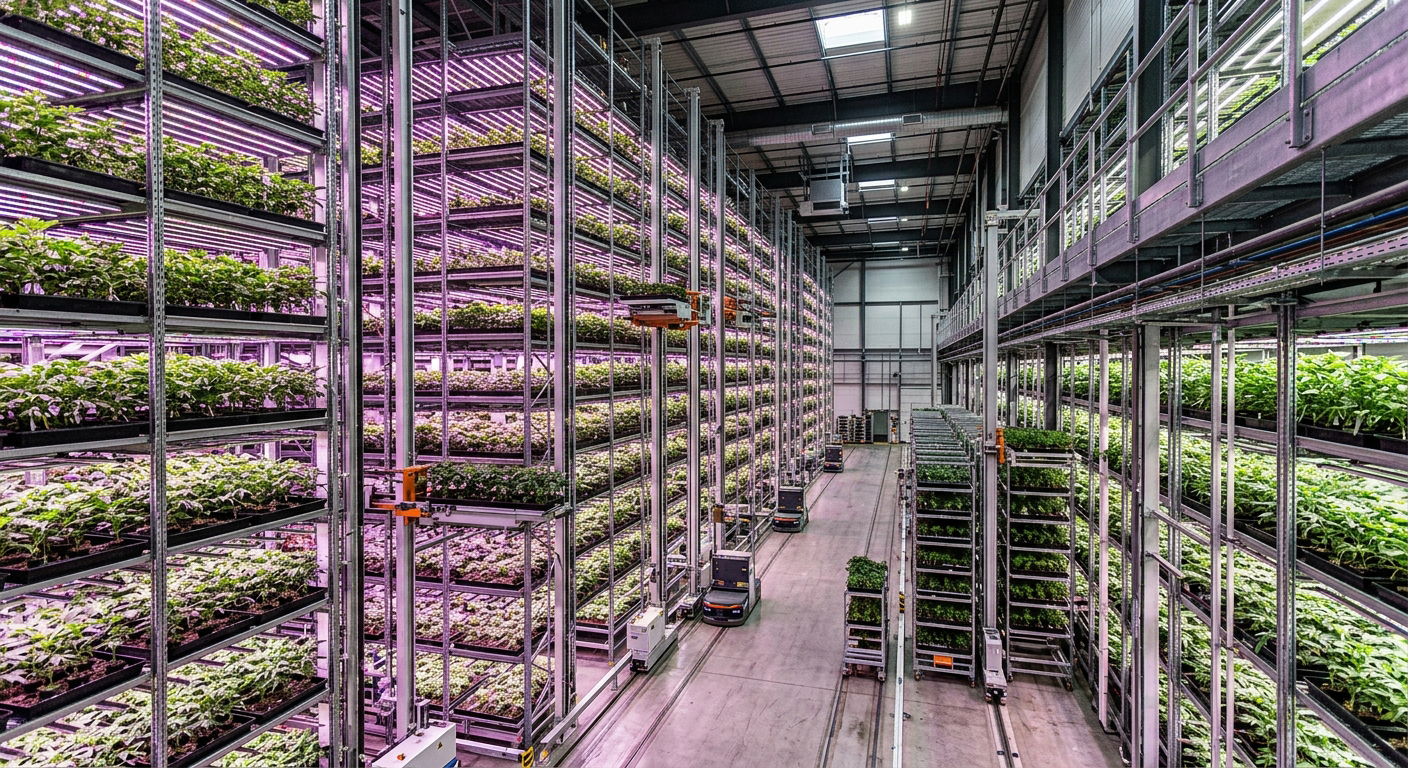
Those who cultivate medical cannabis are not producing food or a raw material in the conventional sense—they are manufacturing a pharmaceutical product whose efficacy and safety depend to a very high degree on the consistency of its active ingredients. This is precisely the decisive advantage of vertical farming over conventional open-field cultivation or traditional greenhouse farming. In vertical farming, plants are cultivated in multiple stacked levels within completely controlled environments—equipped with precisely programmable LED lighting, automated irrigation and nutrient systems, and seamless climate control over temperature, humidity, and CO₂ concentration. Each of these variables directly affects the levels of tetrahydrocannabinol (THC) and cannabidiol (CBD) in the plant—the two pharmacologically crucial active ingredients upon which physicians base dosages and patient-specific treatment plans.
The fundamental problem with open-field cultivation is variability. Sunlight, rainfall, soil quality, and temperature fluctuations are subject to natural variations, which, even with careful variety selection, can lead to significant deviations in the concentration of active ingredients. This is tolerable for food production—but unacceptable for a pharmaceutical product. Medical cannabis, like any other approved pharmaceutical preparation, must have a demonstrably identical active ingredient content batch after batch. This reproducibility can only be reliably achieved in a completely controlled production environment. Vertical farming is therefore less an agricultural innovation than an industrial manufacturing strategy for biological active ingredients.
Multiply space, halve area: The economic logic of space utilization
The most immediate economic advantage of vertical farming lies in the radical improvement in land productivity. While conventional open-field cultivation or a single-story indoor facility treats the ground area as a fixed production quantity, a vertical system utilizes the same floor space multiple times—by essentially stacking the plant layers on top of each other. This significantly increases the yield per cubic meter, resulting in a considerable cost advantage compared to locations on the outskirts, especially in urban or land-scarce regions. For a licensed cannabis producer, who is already required to operate within a security-sensitive, monitored building, this translates directly into a reduction in rental costs per kilogram produced.
Added to this is the advantage of year-round cultivation, which fundamentally changes the economic planning horizon. In open-field farming, there are growing seasons and harvest cycles that are associated with seasonal risks. Vertical farming knows no seasons: By completely decoupling itself from external climatic conditions, harvest times can be flexibly controlled and production capacities scaled according to demand. For a supplier that provides pharmacies or pharmaceutical distributors with standardized products, this security of supply is a significant competitive advantage and a key criterion when awarding supply contracts.
Water, nutrients, pesticides: Resource efficiency as a cost lever
Vertical farming, in combination with hydroponic or aeroponic systems, reduces water consumption by up to 90 percent compared to open-field cultivation. This figure is not only ecologically significant but also directly impacts operating costs in large-scale production. Hydroponic systems circulate water and nutrients in a closed loop, resulting in minimal runoff losses and continuous recirculation of the nutrient solution. In contrast, when irrigating conventional fields, a large portion of the water and dissolved nutrients seeps into the soil or evaporates without ever being absorbed by the plant.
Even more relevant for pharmaceutical quality is the pesticide-free environment inherent in vertical farming. Because the plants grow in a completely closed system, shielded from the outside environment, pests such as spider mites, caterpillars, or aphids have virtually no chance of penetrating. This not only reduces production costs for chemical pesticides but, more importantly, eliminates the risk of contamination, which is considered a critical quality criterion for GMP (Good Manufacturing Practice) certification in the pharmaceutical sector. GMP standards require that medical cannabis be free of pesticides, heavy metals, mold, and microbial contaminants—and these requirements can be met far more reliably in an indoor vertical farming system than under outdoor conditions.
In terms of growth technology, hydroponics offers another advantage: Cannabis plants cultivated hydroponically demonstrably grow 30 to 50 percent faster than in soil substrates and achieve 20 to 25 percent higher yields because nutrients are delivered directly to the roots in optimal concentrations. Shorter production cycles mean more harvest cycles per year with the same capital investment—and thus a higher return on investment in buildings, technology, and licenses.
LEDs instead of sunlight: What the lighting costs and why it still pays off
The biggest cost center in a vertical farming facility for cannabis is lighting. Since natural sunlight doesn't reach the inner levels of multi-story indoor systems, all plants must be artificially lit—usually with LED grow lights that produce a light spectrum optimized for photosynthesis. Electricity consumption is considerable: A 450-watt LED lamp running for eighteen hours a day incurs monthly electricity costs of around €100, based on a German industrial electricity price of approximately €0.42 per kilowatt-hour. In a commercial facility with hundreds or thousands of lights, this quickly adds up to one of the largest operating costs.
Nevertheless, investing in LED technology is significantly more cost-effective than older high-pressure sodium (HPS) lamps: LEDs consume 50 to 60 percent less electricity than comparable HPS systems, have a lifespan of up to 50,000 operating hours compared to 10,000 for HPS, and generate considerably less waste heat, thus reducing cooling requirements. Over a five-year period, using LEDs results in energy cost savings of several thousand euros per lighting unit. Furthermore, the light spectrum can be precisely adjusted to the respective growth phase—vegetative growth, flowering initiation, and ripening—which is not possible with HPS and positively influences the active ingredient content.
However, energy consumption is also the decisive counterargument compared to open-field cultivation or simple greenhouses that utilize natural light. For medical cannabis, however, the pharmacological argument prevails: The ability to precisely control light intensity and spectrum allows for targeted manipulation of the plant's cannabinoid profile—and thus the production of pharmaceutically specified strains with clearly defined THC/CBD ratios.
Physical security and regulatory control: The underestimated locational advantage
The cultivation of medical cannabis involves security requirements unlike those found in any other type of crop. The high economic value of the harvest—combined with the product's historical black market value—makes cannabis cultivation facilities particularly vulnerable to theft. Outdoor facilities are especially exposed to this risk: plants are highly visible, access routes are difficult to control, and break-ins can be carried out with simple means. Several US states have documented spectacular thefts from outdoor and semi-indoor facilities, in which hundreds of kilograms of finished harvest were stolen.
In contrast, a vertical farming operation in a secure building offers structurally far superior security conditions: key card systems, biometric access control, comprehensive video surveillance of all levels, alarm systems, and, above all, complete shielding of production from external view. These measures meet the requirements that regulatory authorities in Germany and the EU impose on licensed cannabis producers—and can be structurally integrated into a vertical farming building, making their implementation more cost-effective and seamless than in sprawling outdoor facilities. Strict batch traceability, as mandated by GMP, is also technically easier to implement in a closed, digitally monitored environment than in decentralized, open-air operations.
This regulatory compliance is not merely a bureaucratic detail—it is the entry ticket to the legal European pharmaceutical market. In Germany, cannabis for medical purposes cannot be marketed without GMP certification. Vertical farming structurally lowers the hurdle to GMP compliance because the controlled environmental conditions of the cultivation facility are inherently compatible with the control standards of pharmaceutical production.
Legal situation in Europe: A divided continent between prohibition and pragmatism
The legal situation regarding cannabis in Europe cannot be described in a single sentence—it is a patchwork of national regulations, ranging from outright prohibition to partial recreational legalization. France maintains a strict ban in all forms, with fines of up to €3,750 and prison sentences of up to one year for simple possession. At the other end of the spectrum is Germany, which in April 2024 became the first major EU country to legalize the possession of up to 25 grams and the cultivation of up to three plants for personal use by adults. Malta and Luxembourg also permit the private cultivation of small quantities. Portugal decriminalized cannabis in 2001, along with all other drugs, meaning that possession is not prosecuted, even if no legal sales channel exists. The Netherlands has practiced a policy of tolerance for decades through its coffeeshop system, where retail sales are tolerated, but wholesale sales remain formally illegal.
The picture is different for medical cannabis, and in some respects more consistent. Many European countries have regulated or at least simplified medical access to cannabis in recent years. The Czech Republic will officially become one of the regulated European markets on January 1, 2026, while simultaneously expanding its export capacity. Poland has become the fourth-largest market in Europe, with a projected volume of €72 million in 2025, supported by telemedicine and newly approved products. The UK has listed medical cannabis among prescription substances since 2018, and the market is estimated at over €300 million in 2025, with a growth forecast to €630 million by 2029.
Nevertheless, significant differences in practical accessibility remain. In France, medical cannabis exists only under restrictive conditions and without comprehensive, standardized coverage. In many Central and Eastern European countries, medical cannabis is formally available, but practically inaccessible because doctors lack experience in prescribing it or bureaucratic hurdles impede access. The fragmentation of the European market thus remains a structural obstacle to pan-European production and supply strategies.
Your intralogistics experts

Consulting, planning and implementation of complete solutions for high-bay warehouses and automated storage systems - Image: Xpert.Digital
More information here:
From import dependency to domestic production: Business models for medical cannabis
Germany as a pacesetter: From narcotic to regular medicine
Why medical cannabis is becoming a driver for high-tech farming
Germany occupies a special position within Europe—not only because of the size of its market, but also because of the speed of its regulatory transformation. Since the Medical Cannabis Act (MedCanG) came into force on April 1, 2024, medical cannabis has been removed from the Narcotics Act and is treated as a regular prescription drug. This means that any doctor can prescribe cannabis on a standard electronic prescription without having to go through the lengthy approval process of health insurance companies, which previously involved waiting times of several weeks.
The impact of this decision was immediate and dramatic: Between March 2024 and December 2025, prescriptions for medical cannabis increased by approximately 3,300 percent. Germany imported around 192 tons of medical cannabis in 2025, compared to 32 tons in the last full year before the reform. The annual revenue of the German medical cannabis market doubled from around one billion euros in 2024 to an estimated two billion euros in 2025. This makes Germany not only the largest medical cannabis market in Europe—it is by far the dominant European market, representing around 670 million euros in 2025 alone, with a projected growth to 1.3 billion euros by 2029.
This development, however, was not without its drawbacks. Imports of cannabis flowers for medical purposes increased by 170 percent from the first to the second half of 2024, while prescriptions covered by statutory health insurance rose by only nine percent. This difference was due to the explosive increase in private prescriptions issued via telemedicine platforms, without any in-person doctor-patient contact. In October 2025, the German Federal Cabinet responded with a draft law to amend the Medical Cannabis Act (MedCanG), which stipulates that initial prescriptions will only be issued after in-person contact between doctor and patient and prohibits mail-order sales of cannabis flowers. This course correction demonstrates that the regulatory framework is not yet fully developed and further adjustments are to be expected in the coming years.
The pan-European market and its growth potential
Europe's medical cannabis market is still in its early stages. The total European market was estimated at around US$3.51 billion in 2024 and is projected to grow to US$35.59 billion by 2032—an average annual growth rate of 33.6 percent. These projections are based on a combination of increasing regulatory liberalization, growing clinical acceptance, and demographic factors such as Europe's aging population, which is facing chronic illnesses and pain. Globally, the medical cannabis market is projected to reach US$235.58 billion by 2032, with an annual growth rate of 24 percent.
The fact that Europe is the fastest-growing regional market worldwide underscores the structural importance of this development for investors, producers, and policymakers. At the same time, Europe remains heavily dependent on imports: in 2025, Germany sourced almost half of its cannabis imports from Canada, while Portugal, Denmark, and the Czech Republic gained importance as European cultivation locations. Therefore, building a robust domestic production base—and this is where vertical farming comes into play—is not only an economic issue but also a matter of supply policy.
Which industries truly need cannabis and why the demand is not structurally decreasing
Medical cannabis is not a niche product for a narrowly defined patient group. The range of medical indications for which cannabinoids are prescribed or clinically tested includes some of the most common and costly conditions in modern medicine.
The largest group of patients by far are those with chronic pain. According to data from the Federal Institute for Drugs and Medical Devices, they account for around three-quarters of all cannabis treatments in Germany. Chronic pain is one of the most expensive diagnoses in terms of economics—in Germany alone, it is estimated that chronic pain conditions cost several billion euros annually due to treatment, lost work time, and early retirement. If cannabis-based medications can help replace opioids or reduce their dosage, the added value for healthcare economics is considerable.
In the field of oncology, medical cannabis plays an increasingly recognized role in symptom control during cancer treatments: nausea and vomiting due to chemotherapy, loss of appetite, weight loss, and tumor pain are among the most common indications for the use of THC and CBD. Palliative care patients receiving specialized outpatient palliative care (SAPV) in Germany even have particularly simplified access: they do not require approval from their health insurance provider, and the processing time for applications requiring simple approval is only three days. This special status demonstrates how seriously the legislature takes the therapeutic needs in the palliative care context.
Neurology represents another key sector. Conditions such as multiple sclerosis, where CBD and THC have muscle-relaxing and pain-relieving effects, forms of epilepsy in children for which CBD is already approved as a separate medication (Epidiolex), as well as PTSD, anxiety disorders, and sleep disorders are continuously expanding the clinical spectrum. An Australian study confirmed the positive efficacy of cannabis-based oil preparations in treating anxiety disorders, depression, and insomnia. What is interesting about these indications is their epidemiological relevance: anxiety disorders and depression are among the most common mental illnesses in Europe, and their prevalence has increased further in the wake of the COVID-19 pandemic.
In geriatrics and general internal medicine, the willingness to prescribe cannabis is also increasing. Since October 2024, physicians with specialist qualifications in anesthesiology, internal medicine, neurology, psychiatry, or general medicine in Germany have been permitted to prescribe cannabis without prior authorization from the health insurance provider. This expansion of the prescribing pool has significantly lowered the barriers to access and structurally broadened the market.
The pharmaceutical industry is the most important distribution infrastructure for medical cannabis: wholesalers like Cansativa, publicly traded companies like the Cantourage Group, and specialized telemedicine platforms form a new value chain that extends from licensed cultivation facilities through pharmaceutical wholesalers to pharmacies. Companies like Cansativa reported year-over-year revenue growth rates of 75 to 80 percent in 2024. The Cantourage Group reported a revenue increase of almost 90 percent for the second quarter of 2024. These growth rates indicate that the market is driven not by a temporary hype, but by structural demand dynamics.
Added value through quality: Why vertical farming is competitive in the premium segment
One of the key economic questions surrounding vertical farming is its competitiveness compared to field producers in sunny, low-wage countries like Portugal, Morocco, or Colombia. This question is easier to answer for medical cannabis than for food products: the decisive competitive factor is not the price per kilogram, but rather the reliability of pharmaceutical quality, batch traceability, and proximity to the market.
Cannabis from an EU-GMP-certified vertical farming facility in Germany or another EU member state meets the regulatory requirements for the European pharmaceutical market without the complex and costly import certification process. Import bureaucracy, the need for a cold chain, and the logistics costs of international transport are eliminated. Furthermore, the average market price for medical cannabis in Germany—which, despite increasing imports and growing supply, still hovers around seven euros per gram—offers a sufficient margin for a quality-oriented domestic producer to justify the higher operating costs of a vertical farming facility.
Cannabis was not a random inclusion in the history of vertical farming. Climate reporters, such as the editors of Klimareporter, pointed out as early as 2023 that manufacturers of vertical farming systems were using cannabis as a pioneering market because it was there that consumers were most willing to pay a premium price for consistent quality. No other plant product commands such a high willingness to pay for reproducible, certified quality as the medical sector. This makes medical cannabis the economic driving force behind the technological development and scaling of vertical farming systems—with the medium-term effect of reducing the costs of these systems and making their application economically viable for other high-value crops as well.
Risks, limitations and open questions: A sober assessment
A comprehensive analysis cannot ignore the weaknesses of vertical farming for medical cannabis. The high investment required to build a GMP-compliant facility—including lighting technology, climate control, hydroponic systems, security systems, and cleanroom standards—presents a significant financial hurdle for smaller companies. Start-up costs for a professional vertical farming facility quickly reach tens of millions of euros before the first harvest can be marketed. Added to this are the ongoing energy costs, which, with rising industrial electricity prices, can become a significant expense.
Regulatory dynamics also pose risks. The planned tightening of the German Medical Cannabis Act (MedCanG)—which aims to make initial prescriptions for telemedicine more difficult and prohibit mail-order sales of cannabis flowers—could abruptly slow the surge in demand. If a significant portion of demand relies on private prescriptions from online platforms and these channels are restricted, market volume could decline sharply in the short term. Investors in cultivation capacity must factor this regulatory uncertainty into their business models.
Ultimately, the fragmented legal situation in Europe remains a structural obstacle to the development of a unified EU-wide market. As long as France, Hungary, Bulgaria, and other member states treat medical cannabis restrictively, European producers cannot freely scale their market. Establishing a productive vertical farming facility in a liberal market like Germany cannot compensate for the lack of pan-European harmonization.
A convergence of technology, pharmaceutical law and market dynamics
Medical cannabis and vertical farming converge for structurally complementary reasons. Cannabis requires reproducible conditions for its pharmaceutical qualification, which only a controlled production environment can provide. Vertical farming seeks an economic pioneering culture that justifies high initial investments in specialized technology with a premium-priced product. Both requirements fulfill each other—which explains why billions are already flowing into this sector internationally and why Australia's largest indoor vertical cannabis farm has put its investment at $10 million and is aiming for annual revenues of over $100 million.
Europe's market is poised for a decade of growth, driven by an aging population, a growing body of clinical evidence, and regulatory reforms that facilitate access. With the German Medicines and Cancer Act (MedCanG), Germany has paved the way for a model that can serve as a blueprint for other European countries—and simultaneously demonstrates how regulatory frameworks can transform a market virtually overnight. Those wishing to produce in this market need more than just plant knowledge: they need pharmaceutical expertise, industrial precision, and regulatory resilience. Vertical farming is the technology that combines all three requirements under one roof.
Consulting - Planning - Implementation

Konrad Wolfenstein
I would be happy to serve as your personal advisor.
You can contact me at wolfenstein∂xpert.digital or
Just call me on +49 7348 4088 965 .