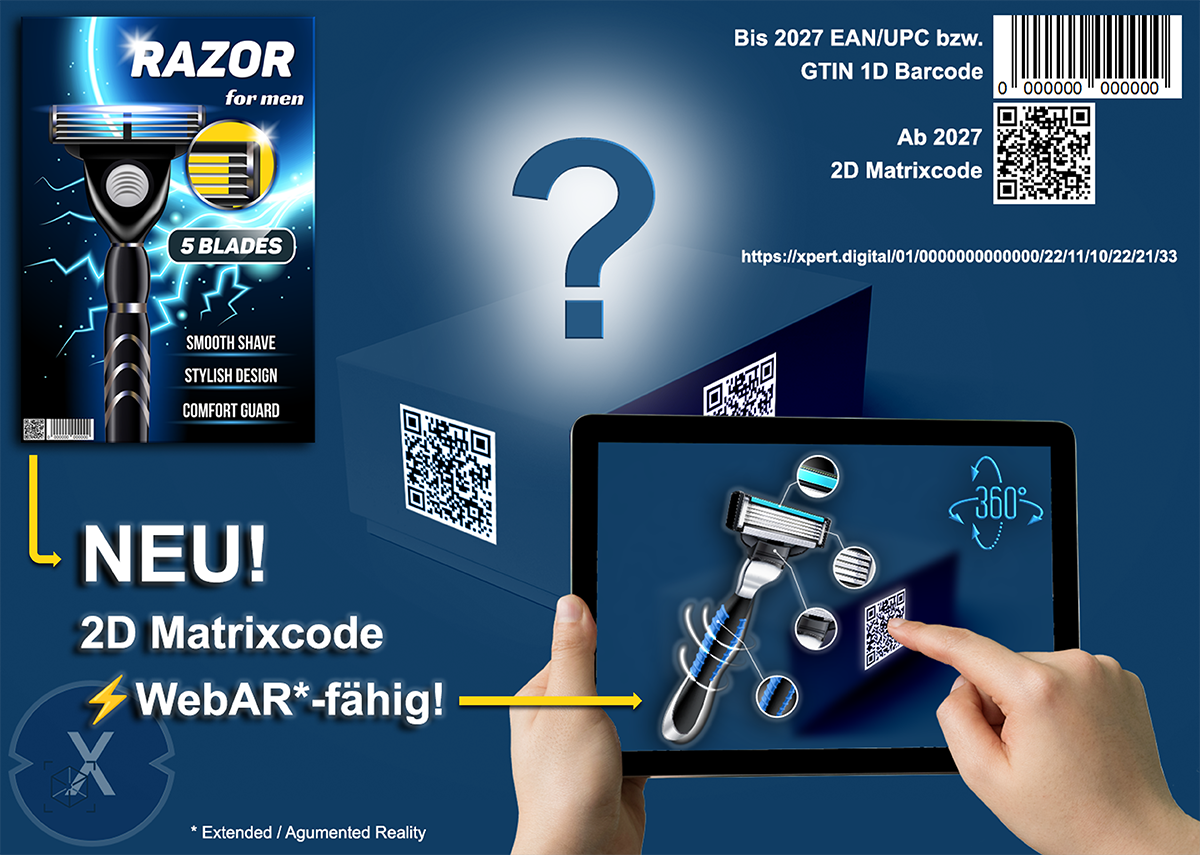
The 2D matrix code, the successor to the 1D barcode, is WebAR compatible and WebXR-enabled! – Image: Xpert.Digital
A quick explanation: EAN, UPC, GTIN and matrix code
EAN (European Article Number), UPC (Universal Product Code) and GTIN (Global Trade Item Number) are all names for 1D barcodes used to store and read product information.
UPC and EAN barcode standards were developed to efficiently capture and process product information. Both standards use a combination of numbers and bars to encode product information. UPC barcodes are primarily used in the USA and Canada, while EAN barcodes are used worldwide.
GTIN is a globally standardized identifier for trade and logistics units. It is used to identify products and services and is an internationally recognized identifier. A GTIN is a number that allows for the unique identification of a product. GTINs are available in various formats, such as GTIN-8, GTIN-12, GTIN-13, and GTIN-14, which contain different numbers of digits depending on the user's requirements.
2D matrix codes, such as QR codes, can store a much larger amount of data than 1D barcodes and are therefore particularly useful for applications like mobile payments, marketing, and advertising. 2D matrix codes contain a great deal of information in a smaller area than 1D barcodes and can also be used to encode information in various ways, such as text, URLs, and multimedia files. 2D matrix codes are capable of storing both 1D and 2D barcodes and are therefore a more powerful way of encoding product information.
That's how it all began in 1973
The global logistics revolution with the 1D barcode – Image: Rawpixel.com|Shutterstock.com
The EAN code was introduced in 1977 by the European Article Numbering Association (now GS1) to establish a uniform barcode standard in Europe. UPC codes were developed and introduced in the USA in 1973 by the Uniform Product Code Council (now GS1 US) to improve automated checkout processes in retail.
Over the years, EAN and UPC codes have become some of the most widely used barcodes worldwide, and today they are used by many companies and organizations around the globe to identify and track products and information.
Difference between UPC and EAN (GTIN)
The EAN code is compatible with the Universal Product Code (UPC), but encodes one additional character. Most retail chains in the USA and Canada now accept the EAN-13. Due to differing package sizes and languages, many international consumer goods companies use the UPC-A barcode for North America, but the EAN-13 for the rest of the world. Although the term "UPC code" is often used in commerce and everyday language, the correct designation is now GTIN-12.
Until 2009, the GTIN was called EAN (short for European Article Number). EAN and GTIN therefore mean the same thing. The term GTIN simply replaced the EAN used in Europe in 2009.
GS1 and GTIN
GS1 is a global, non-profit organization dedicated to developing and implementing standards and solutions for the supply chain. Founded in 1977, it is headquartered in Brussels, Belgium.
GS1 works with companies and organizations worldwide to ensure that products and information can be communicated consistently and efficiently throughout the supply chain. GS1 standards cover the identification of products, locations, and facilities, as well as data collection and electronic communication within the supply chain.
GS1's best-known products are the EAN-13 barcodes, which can be found on almost all retail products worldwide. GS1 also operates the Global Data Synchronization Network (GDSN), which enables companies to synchronize and exchange product data globally.
GS1 is a membership organization whose members include companies from various industries such as retail, pharmaceuticals, transport and logistics, automotive and healthcare.
The GTIN is a 14-digit number that can be represented in various barcode formats, including EAN-13, UPC, and GS1-128. The GTIN is a number developed by GS1 and is part of the GS1 system.
GS1 also assigns manufacturer identification numbers (GS1 Company Prefixes), which are part of the GTIN. GS1 Company Prefixes enable manufacturers to identify and track their products worldwide. In addition, GS1 offers various services to support companies in implementing GS1 systems and standards.
Overall, GTIN and GS1 are closely linked, as the GTIN is an important part of the GS1 system and was developed by GS1.
EAN has been renamed GTIN
EAN is part of the GS1 system and was developed by GS1 to enable a uniform identification of trading units (such as products and services) in Europe.
In 2005, EAN was officially integrated into the GS1 system and renamed GTIN (Global Trade Item Number) with 13-digit barcode formats. GTIN is now the international standard for the identification of trade units, developed by GS1 and available in various barcode formats such as EAN-13, UPC, and GS1-128.
Although the term “EAN” is no longer used today, it is still sometimes used in connection with the identification of products in Europe, as it was widely used in the past.
The introduction of the barcode in 1973 revolutionized global logistics
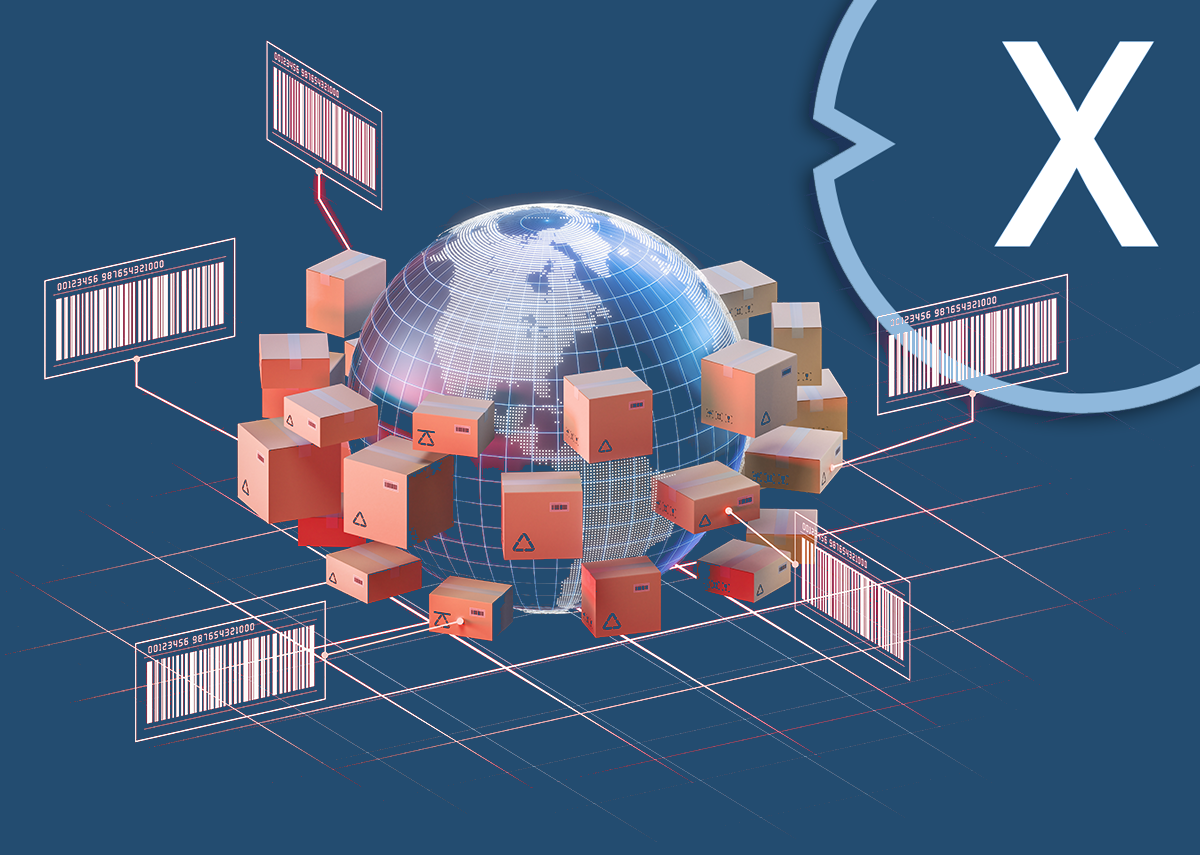
The 1D barcode revolutionized global logistics – Image: Xpert.Digital / Vink Fan|Shutterstock.com
The barcode has revolutionized global logistics in several ways:
Improved inventory management
By using barcodes, companies can manage their inventory more effectively. Each product is assigned a unique barcode that can be scanned to automatically update the inventory. This enables faster and more accurate inventory tracking and reduces the risk of overstocking or understocking.
More efficient goods distribution
Barcodes help speed up the flow of goods and reduce error rates. When each product is assigned a barcode, shipping labels can be printed quickly and easily, which speeds up order processing and reduces the risk of shipping errors.
Improved traceability
Barcodes enable companies to track the whereabouts of products in the supply chain, from manufacturing to sale. This is particularly important for tracing products in the event of recalls or product quality issues.
Automation of business processes
The use of barcodes has helped automate business processes by reducing manual data entry and enabling the use of automated scanners and readers. This has led to increased efficiency and productivity in the logistics industry.
Overall, barcodes have revolutionized the logistics industry by enabling faster, more efficient, and more precise processing of goods. The technology has helped to increase productivity and reduce costs, which in turn has led to greater customer satisfaction and improved competitiveness for companies.
Where are 1D barcodes used and deployed?
1D bar codes are used in a wide variety of industries and applications. Here are some examples of how 1D bar codes can be used. The application possibilities are virtually limitless.
retail
1D barcodes are commonly used on products in retail to store item number, price, and other information.
logistics
1D barcodes are used in the supply chain to track and identify products during transport.
healthcare
1D barcodes are used in medication management and patient identification.
Libraries
1D bar barcodes are used to track books and other media in libraries.
production
1D barcodes are used to track parts and components in manufacturing.
food industry
1D barcodes are used in the food industry for product traceability and regulatory compliance.
Government
1D barcodes are used for managing government documents and identifying individuals.
Entertainment
1D barcodes are used to identify tickets for concerts, sporting events and other events.
How the GS1 Data Link works for product identification and web capability
GS1 Data Link is a standardized data format developed by the international GS1 organization. It is used to store and exchange information about products and their identifying characteristics. GS1 Data Link enables companies to electronically exchange information about their products and goods flows, thereby improving the efficiency and accuracy of business processes.
Product identification is achieved through the use of GS1 standard identification numbers (Global Trade Item Numbers, GTINs). Each product receives a unique GTIN consisting of 8, 12, 13, or 14 digits, based on the EAN/UPC code structure. This number is affixed to the product itself and its packaging and serves as a unique key for identifying the product within the supply chain.
If a company wants to exchange data about a product, it can format this data in GS1 Data Link and send it to other companies. This data can include, for example, product descriptions, images, prices, supplier information, or information about the product's origin. Companies can also use GS1 Data Link to exchange information about the status of orders, deliveries, and inventory.
The use of GS1 Data Link and GTINs standardizes and simplifies product identification and data exchange in the supply chain, leading to improved efficiency and accuracy of business processes.
GS1 Data Link is web-enabled and can also be used for WebAR (Web-based Augmented Reality)
The GS1 Data Link can be exchanged in various formats via the Internet or web applications, including XML, JSON or EDI (Electronic Data Interchange).
WebAR is a technology that allows users to experience augmented reality content via the web without needing a dedicated app. Businesses can use GS1 Data Link to store product data and images and use them on websites or in WebAR experiences. For example, companies can use GS1 Data Link to add QR codes or other types of identification codes to their products. When a customer scans this code with their smartphone, they can access the stored information and even WebAR experiences.
By using GS1 Data Link in conjunction with WebAR, companies can offer a comprehensive and interactive shopping experience and provide their customers with a better understanding of the products. Furthermore, by using GS1 Data Link and WebAR, companies can measure and analyze the success of their campaigns in order to optimize their marketing strategies.
The GS1 Data Link is not yet a 2D matrix code!
The GS1 Data Link is a standardized data format used to store and exchange information about products and their identifying characteristics. However, the GS1 Data Link can also be used in conjunction with various types of barcodes, including 2D matrix codes, to store and identify product information.
The GS1 organization has developed various types of barcodes, including the well-known EAN code, which is found on most products worldwide. A 2D matrix code is a barcode that stores information in two dimensions, unlike a traditional barcode, which stores information in only one dimension. 2D matrix codes can store more data than traditional barcodes and can also be placed on smaller surfaces.
The use of GS1 Data Link in conjunction with barcodes enables fast and accurate identification of products in the supply chain, thereby improving the efficiency and accuracy of business processes.
How does the GS1 Data Link work in combination with a matrix code?
The GS1 Data Link can be used in combination with a matrix code to store and exchange information about a product. Here is an example of how this could work:
Suppose a company wants to store and exchange information about a specific product in its supply chain. First, the company would convert the product data into the standardized GS1 Data Link format, which can contain information such as product descriptions, images, prices, supplier information, or information about the product's origin. This data would then be assigned a unique Global Trade Item Number (GTIN) to the product.
Next, the company would print the GS1 standard matrix code, such as the DataMatrix code, onto the product. The matrix code contains the GTIN number and can also include additional information such as the batch number or the product's expiration date. When a customer scans the matrix code with their smartphone, they can access the information stored in GS1 Data Link.
As the product moves through the supply chain, companies can use the matrix code to quickly and easily access information about the product. Using GS1 Data Link in conjunction with matrix codes enables companies to store and exchange product information in a standardized and efficient manner, improving the efficiency and accuracy of business processes.
Benefits and application possibilities for potential customers

View products and details via WebAR and matrix code – Image: Xpert.Digital / Zapp2Photo|Shutterstock.com
See things and details that were previously hidden by packaging, outer carton, or other obstructions!
Product information
Consumers can scan the matrix code with their smartphone to obtain detailed information about a product, such as its origin, nutritional information, or instructions for use.
Authentication
Manufacturers can use the matrix code and GS1 Data Link to authenticate their products and assure consumers that they are purchasing a genuine product.
marketing
WebAR allows manufacturers to display digital content such as 3D models or animations directly on the consumer's smartphone or tablet screen. This can create an interactive and engaging brand experience and increase sales.
Traceability
Consumers can scan the code to track the traceability of products in the supply chain, improving transparency and increasing trust in the brand.
sustainability
Consumers can scan the code to obtain information about the sustainability of products and their manufacturing, such as whether the product is recyclable or made from sustainable materials.
Relevant links on the topic
In 2027, the Data Matrix code or QR code will replace the barcode

Consulting, planning and implementation of 2D matrix codes with integrated augmented reality and WebAR
Xpert.Plus is a project by Xpert.Digital. We have many years of experience in supporting and consulting for (Extended) Augmented Reality and warehouse optimization, which we combine under Xpert.Plus in a large network.

Konrad Wolfenstein
I would be happy to serve as your personal advisor.
You can contact me by filling out the contact form below or simply call me on +49 7348 4088 965 (Munich) .
I'm looking forward to our joint project.
Write to me


Xpert.Digital – Konrad Wolfenstein
Xpert.Digital is a hub for industry focusing on digitalization, mechanical engineering, logistics/intralogistics and photovoltaics.
With our 360° Business Development solution, we support renowned companies from new business to after-sales.
Market intelligence, smarketing, marketing automation, content development, PR, mail campaigns, personalized social media and lead nurturing are part of our digital tools.
You can find more information at: www.xpert.digital – www.xpert.solar – www.xpert.plus
Keep in touch