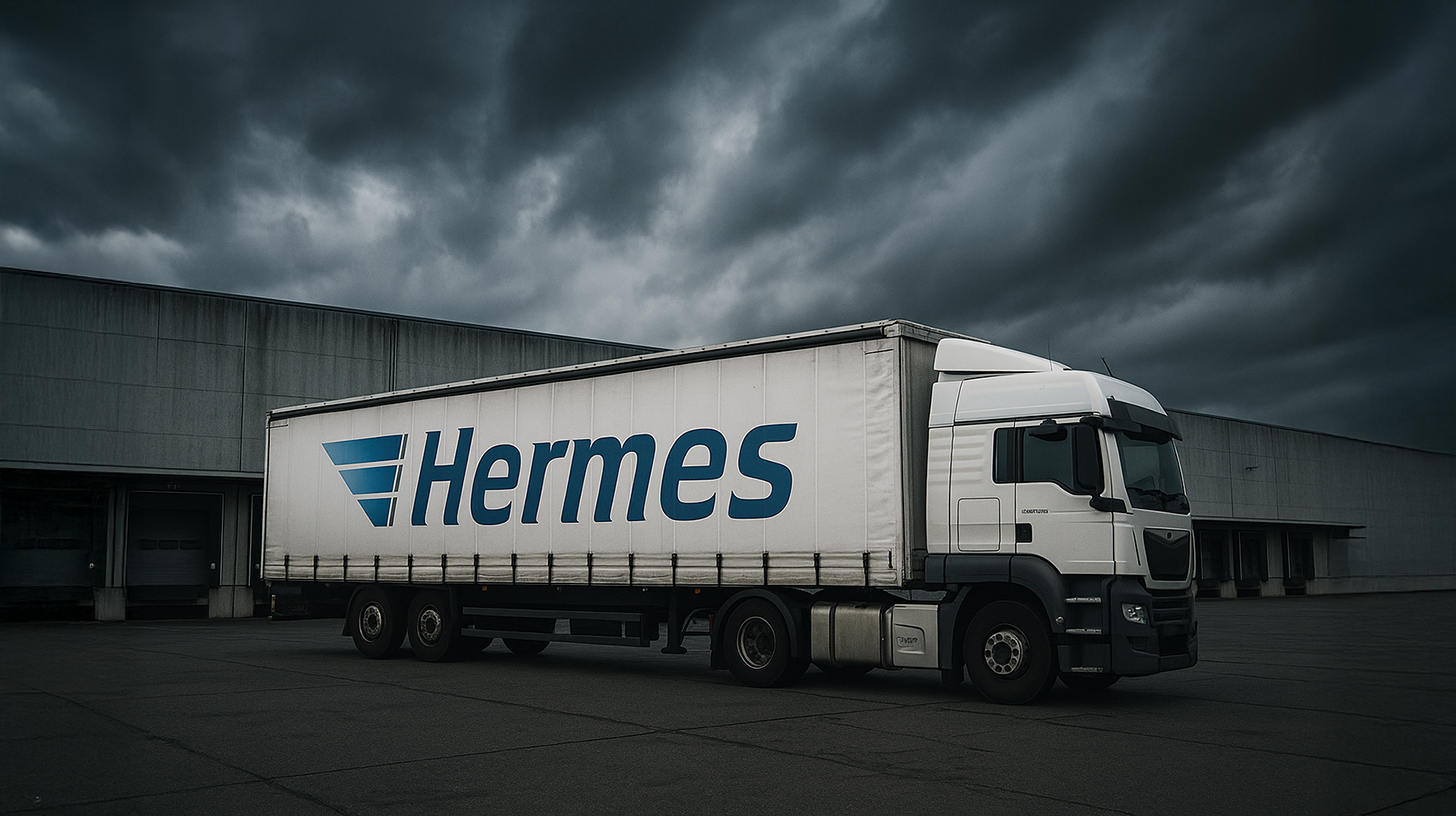
The Hermes drama: A German logistics giant fights for survival – Fatal errors and missed opportunities – Creative image: Xpert.Digital
The rise and fall of the logistics company Hermes
From parcel pioneer to restructuring case: The dramatic story of Hermes' decline
For years, the name Hermes was synonymous with parcel delivery in Germany, a familiar sight on countless doorsteps, and often praised as a test winner by Stiftung Warentest (Germany's leading consumer testing organization). But behind the facade of this former industry pioneer lies a company in a deep, existential crisis. Founded in 1972 as an innovative alternative to the slow German Federal Post Office and a pioneer in services such as returns collection, the logistics giant is now struggling with the consequences of fatal strategic decisions, neglected digitalization, and a grueling price war. The situation is so dire that the parent company, the Otto Group, has written down the value of Hermes Germany to zero in its consolidated financial statements – an unprecedented collapse. This analysis traces the path from rising challenger to crisis case, uncovers the crucial errors, and illuminates why the Hermes case is far more than just the story of one company, but rather a symptom of the profound challenges facing the entire German economy.
How did the Hermes success story begin?
The story of Hermes begins in 1972 with a strategic vision from the Otto mail-order company. As early as the late 1960s, an investigation by the mail-order association had revealed serious shortcomings in the German Federal Post Office: the state-owned postal service was considered too slow, too unreliable, and too expensive. These findings did not escape the attention of the entrepreneur Werner Otto.
After a planning phase of approximately five years, during which Otto Versand developed and tested a multi-stage, postal-independent parcel distribution system, Hermes Paket-Schnell-Dienst GmbH & Co. KG was founded on June 1, 1972. The partners were Otto Versand with 70 percent and Werner Velbinger with 30 percent, who contributed his "Parcel Service" division to the Werner Velbinger Organization, which was already one of the leading private delivery companies.
The alternative to the state-run monopoly quickly established itself. Just six months after its founding, Hermes had 20 branches in Germany. Its business model was designed to offer Otto Versand customers a better delivery service than was possible through the then-existing German Federal Post Office.
What innovations shaped the early years?
From the outset, Hermes distinguished itself through innovative approaches that would later become industry standards. In 1973, Hermes vehicles were retrofitted to enable particularly gentle delivery of outerwear as "hanging garments." This delivery flexibility quickly paid off: During the 1973 Christmas season, Hermes was already able to deliver its one millionth shipment.
Another milestone was the early introduction of returns collection as an integral part of Hermes' service. This service, now taken for granted, was revolutionary at the time and significantly supported the growth of mail order. By 1975, just three years after its founding, Hermes had a nationwide presence in Germany and, with around 560 employees, handled the entire shipment volume of Otto Versand.
The first major expansion steps took place in the 1970s. In 1976, Schwab became the first subsidiary of Otto Versand to use Hermes Versand-Service, increasing its shipment volume by almost five million to 16.2 million shipments per year.
How did the expansion proceed in the 1980s and 1990s?
The 1980s marked a period of continuous professionalization. In 1986, Otto became the first mail-order company in Germany to introduce a 48-hour express service, implemented by Hermes. German reunification was a historic moment: Following the currency conversion on July 1, 1990, Hermes' express parcel service was the first parcel service able to deliver to customers throughout East Germany.
The expansion was primarily achieved through the newly founded Hermes Versand Service Berlin GmbH, a temporary branch in Coburg, and five new cooperative branches. This rapid response to the political changes gave Hermes a decisive competitive advantage in the German market as a whole.
In its 20th year, 1992, Hermes delivered its 500 millionth shipment. The number of depots increased to 64, and important technical innovations such as the introduction of the one-day cycle and Hermes' own cell coding facilitated the development of the courier system in 1995.
When did digitization and modernization begin?
The turn of the millennium brought further important developments. On February 1, 1999, the first Hermes ParcelShop opened, a concept that would later become one of the company's biggest pillars. In 2002, Hermes celebrated its 30th anniversary with around 4,000 employees, 10,000 delivery partners, and over 5,000 ParcelShops.
In 2003, the various Hermes companies were consolidated under the umbrella brand "Hermes Logistics Group." In November of the same year, the service was expanded to include private parcel delivery from Hermes shops. International expansion began in 2006 with the delivery of private parcels to EU countries and continued in 2007 with the founding of Hermes Logistik GmbH Austria.
In 2009, the Hermes Logistics Group became Hermes Europe. That year, the company achieved a turnover of €840 million and handled 266 million shipments. Continuous expansion meant that Hermes already had over 14,000 acceptance points in the German retail sector at that time.
What role did technological development play?
Hermes recognized the importance of technological innovation early on. In 2010, with ten electric vehicles in its own fleet, the company was among the world's first in the CEP (courier, express, and parcel) industry to use electric vehicles. With the introduction of the WE DO! word-image mark, the company made its extensive environmental commitment visible, which had already reduced CO2 emissions per shipment by almost 40 percent.
As part of its expansion within Germany, HLGD began construction of a new main transshipment base in Hanover-Langenhagen, investing approximately €35 million. Simultaneously, the new Hermes II office complex in Hamburg was completed with an investment of €18 million.
In 2016, the two companies Hermes Logistik Gruppe Deutschland GmbH and Hermes Transport Logistics GmbH were merged to form the current Hermes Germany GmbH. As part of a future-oriented and innovation program, the site structure throughout Germany was reorganized between 2016 and 2020.
When did the first problems begin?
Despite its apparent success, the first structural problems emerged as early as the 2010s. Working conditions in parcel delivery came under increasing criticism. In 2015, a report by Günter Wallraff about ruthless business practices at GLS caused a stir, and Hermes also came under scrutiny due to similar problems.
In 2017, media outlets reported on the "Hermes system" and its dependence on subcontractors. In Neuenkirchen near Osnabrück, journalists encountered young Romanians who, in some months, earned less than four euros an hour, despite working as parcel delivery drivers for Hermes. Although Hermes has operated a comprehensive audit and certification system since 2012—the first and, to date, only major logistics company in Germany to do so—such cases revealed the limitations of control over subcontractors.
The structural problems were exacerbated by the business structure. A former Hermes subcontractor admitted: "It simply wasn't financially feasible; I couldn't have paid more, even if I had wanted to. I was already stretched to the limit, barely able to make ends meet." His accusation: While Hermes demanded the minimum wage from its subcontractors, the amount paid by Hermes per package was insufficient to cover it.
What was the impact of the Corona pandemic?
The COVID-19 pandemic initially brought an enormous boom to the entire parcel delivery industry. In 2021, the sector reached a record volume of 4.5 billion shipments. This high capacity utilization led to rising hourly wages above the legally mandated minimum wage, and the delivery services still made substantial profits.
Hermes benefited from this boom and at times reached record highs. In the 2019/20 financial year, Hermes companies transported over 760 million shipments in Germany and Great Britain. Due to the pandemic, both companies recorded strong volume growth, which led to an expansion of staffing levels.
This seemingly positive development, however, masked structural weaknesses. In the 2020/21 financial year, Advent International acquired 25 percent of the shares in Hermes Germany GmbH and 75 percent of the shares in Hermes Parcelnet Limited in Great Britain. The Otto Group was thus forced to seek an external partner to unlock further growth potential in this highly competitive business segment.
Your intralogistics experts

Consulting, planning and implementation of complete solutions for high-bay warehouses and automated storage systems - Image: Xpert.Digital
More information here:
Who benefits from the decline? Opportunities for DHL, DPD, and others.
What strategic errors led to the decline?
Hermes made several crucial strategic errors that contributed to its current decline. While competitors like DPD, GLS, and UPS cleverly focused on business customers, Hermes concentrated primarily on private customers. This focus proved fatal, as deliveries to households often require multiple attempts, whereas business customers are reliably reachable.
Another serious mistake was the lack of digitalization. Hermes is considered the least digitalized delivery service in the industry. While a Hermes study on the digitalization of supply chains in the logistics sector was published in 2018, revealing that only eight percent of companies had a digitalized supply chain, the company apparently failed to consistently apply these findings to its own business.
The reliance on subcontractors proved to be another structural problem. In Germany, Hermes cooperates with around 330 subcontractors who handle 90 to 95 percent of daily parcel deliveries. This structure led not only to problems with quality control and working conditions, but also to legal difficulties, as demonstrated by a 2025 ruling by a British employment tribunal that classified 15 couriers not as self-employed but as employees.
How dramatic is the current crisis?
Hermes' current crisis is unprecedented in the company's history. In the 2024/25 financial year, Hermes Germany closed with a net loss of €231 million on revenues of €1.6 billion. The previous year's loss was €63 million. The Otto Group has written off the company's value in its consolidated financial statements.
This dramatic decline is primarily due to falling parcel volumes. The reluctance of online shoppers to spend is causing order volumes, and consequently parcel volumes, to fall. A rule of thumb in the delivery industry is that a ten percent decrease in parcels translates to a 50 percent drop in pre-tax profit, assuming the same network infrastructure. This rule is hitting Hermes hard.
The German parcel market shrank in 2023 for the first time in nine years, and Hermes was the biggest loser in this decline. At the same time, rising energy costs and a relentless price war are weighing on its balance sheet. Among the five major competitors – Deutsche Post/DHL, DPD, GLS, UPS, and Hermes Germany – price increases are proving difficult to implement.
What measures will be taken?
Hermes is responding to the crisis with drastic cost-cutting measures. The parcel service is eliminating more than 700 jobs and outsourcing further operations to subcontractors. At the end of 2024, the parcel delivery company employed around 5,500 of its own staff, while approximately 10,000 delivery drivers worked for external companies. In the future, deliveries are to be handled entirely by external drivers.
The impact on the remaining employees is dramatic. Drivers have to deliver significantly more packages in less time. In Berlin, 200 deliveries a day are no longer unusual. The Verdi union calls the agreed-upon social plan for the job cuts a compromise, but doubts the employees' motivation under these conditions.
The Otto Group's annual report states: "Significant risks remain in the Services segment, particularly in logistics." In response, a restructuring program was initiated at Hermes Germany in April. However, a warning follows: "Due to the persistently difficult market conditions, there is also a risk that the Otto Group will have to initiate new turnaround processes or closures."
Is there any hope for a rescue?
Rumors of a sale of Hermes have been circulating for years. Talks with DPD were unsuccessful, and FedEx also expressed interest but is otherwise engaged. A realistic candidate appears to be the Polish InPost Group, which already acquired Mondial Relay from the Otto Group.
Industry experts also suspect that Chinese online retailers like Temu or Shein might be particularly interested in acquiring the company. "Chinese online retailers are likely to be very interested in a German parcel service," emphasized industry expert Rico Back. However, such a sale would mean the end of the traditional German parcel service Hermes.
Should a sale fail to materialize, further drastic cutbacks are likely. A withdrawal from rural areas is probable, while the focus would shift to profitable major cities. Hermes already cooperates closely with DHL and feeds shipments into their network – an admission of its own weakness.
How does Hermes compare to its competitors?
Despite the current crisis, Hermes has had its share of successes in the past. In tests conducted by Stiftung Warentest, Hermes was a multiple test winner: in 2004, 2010, and 2017, the company received top marks. In 2017, Stiftung Warentest awarded Hermes the title of test winner among parcel services for the third time, achieving a "good" rating (2.4) along with one other competitor.
In more recent tests, Hermes still performs respectably. In a major comparison test in 2025, Hermes was the surprise: fast and reliable for home deliveries, although less popular with customers. In a speed test between Sylt and Tegernsee, Hermes was usually the fastest, closely followed by GLS.
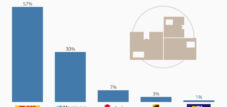
In terms of market share, Hermes remains in second place behind DHL. Measured by parcel volume, DHL holds a dominant market share of approximately 48-50 percent, followed by Hermes with around 15 percent. Interestingly, however, Hermes ranks only fifth in revenue, behind UPS, DPD, and FedEx. This suggests the company's pricing weakness.
What does the Hermes case mean for the industry?
The decline of Hermes is symptomatic of the challenges facing the German economy and the logistics sector. The crisis exemplifies how structural problems, strategic errors, and external factors can combine to create an existential threat.
The reliance on subcontractors, which had functioned as a cost-effective business model for years, proved to be a weakness in times of declining margins. The lack of digitalization and the focus on the price-sensitive residential customer segment exacerbated the problems. At the same time, rising energy costs, excessive bureaucracy, and intense competitive pressure are revealing the limitations of traditional business models.
For competitors, Hermes's weak state presents an opportunity to gain market share. DHL, with its near-monopoly position, is already benefiting from the redistribution of market share. Smaller providers like DPD and GLS can further strengthen their position in the business customer segment.
What lessons can be learned?
The Hermes case illustrates several important lessons for the modern logistics industry. First, it demonstrates the importance of a balanced customer base: the one-sided focus on private customers proved to be a strategic error, while competitors with a mix of private and business customers were more successful.
Secondly, the Hermes crisis highlights the need for continuous technological innovation. The lack of digitalization made the company vulnerable to more efficient competitors. In an industry increasingly characterized by automation and data-driven processes, technological lag can quickly become a threat to a company's survival.
Thirdly, this case illustrates the risks of excessive reliance on subcontractors. While this structure may offer short-term cost advantages, it complicates quality control in the long run and leads to legal and reputational risks.
Fourth, it becomes clear how important a timely strategic realignment is. Hermes failed to adapt to changing market conditions early on and only reacted when the crisis was already well advanced.
What could the future look like?
The future of Hermes remains uncertain. A sale to international investors or integration into an existing logistics network are the most likely scenarios. The days of the independent German parcel service Hermes appear to be numbered.
Should the company survive as an independent brand, it would require a radical realignment. This could include a stronger focus on profitable markets, massive investments in digitalization, and a fundamental overhaul of the subcontractor structure.
For the German logistics landscape, the disappearance of Hermes would mean further market consolidation. DHL's dominance would intensify, while international providers could expand their positions. This would impact pricing and the range of services available to German consumers and businesses.
The case of Hermes exemplifies the transformation of the German economy. Traditional business models are coming under pressure, while new, often international players are conquering the market. The story of Hermes – from innovative challenger to crisis-ridden restructuring case – reflects the challenges facing many German companies in a globalized and digitalized economy.
The next few months will show whether Hermes has a future as an independent company or whether the 52-year history of the German parcel service is coming to an end. One thing is certain, however: Hermes' era as a major player in the German parcel market is drawing to a close, and with it, another piece of German corporate history is disappearing.

Xpert.Plus Warehouse Optimization - High-bay warehouses and pallet warehouses: Consulting and planning
We are here for you - Consulting - Planning - Implementation - Project Management
☑️ SME support in strategy, consulting, planning and implementation
☑️ Creation or realignment of the digital strategy and digitization
☑️ Expansion and optimization of international sales processes
☑️ Global & Digital B2B trading platforms
☑️ Pioneer Business Development

Konrad Wolfenstein
I would be happy to serve as your personal advisor.
You can contact me by filling out the contact form below or simply call me on +49 7348 4088 965 .
I'm looking forward to our joint project.
Write to me


Xpert.Digital - Konrad Wolfenstein
Xpert.Digital is a hub for industry focusing on digitalization, mechanical engineering, logistics/intralogistics and photovoltaics.
With our 360° Business Development solution, we support renowned companies from new business to after-sales.
Market intelligence, smarketing, marketing automation, content development, PR, mail campaigns, personalized social media and lead nurturing are part of our digital tools.
You can find more information at: www.xpert.digital - www.xpert.solar - www.xpert.plus
Keep in touch