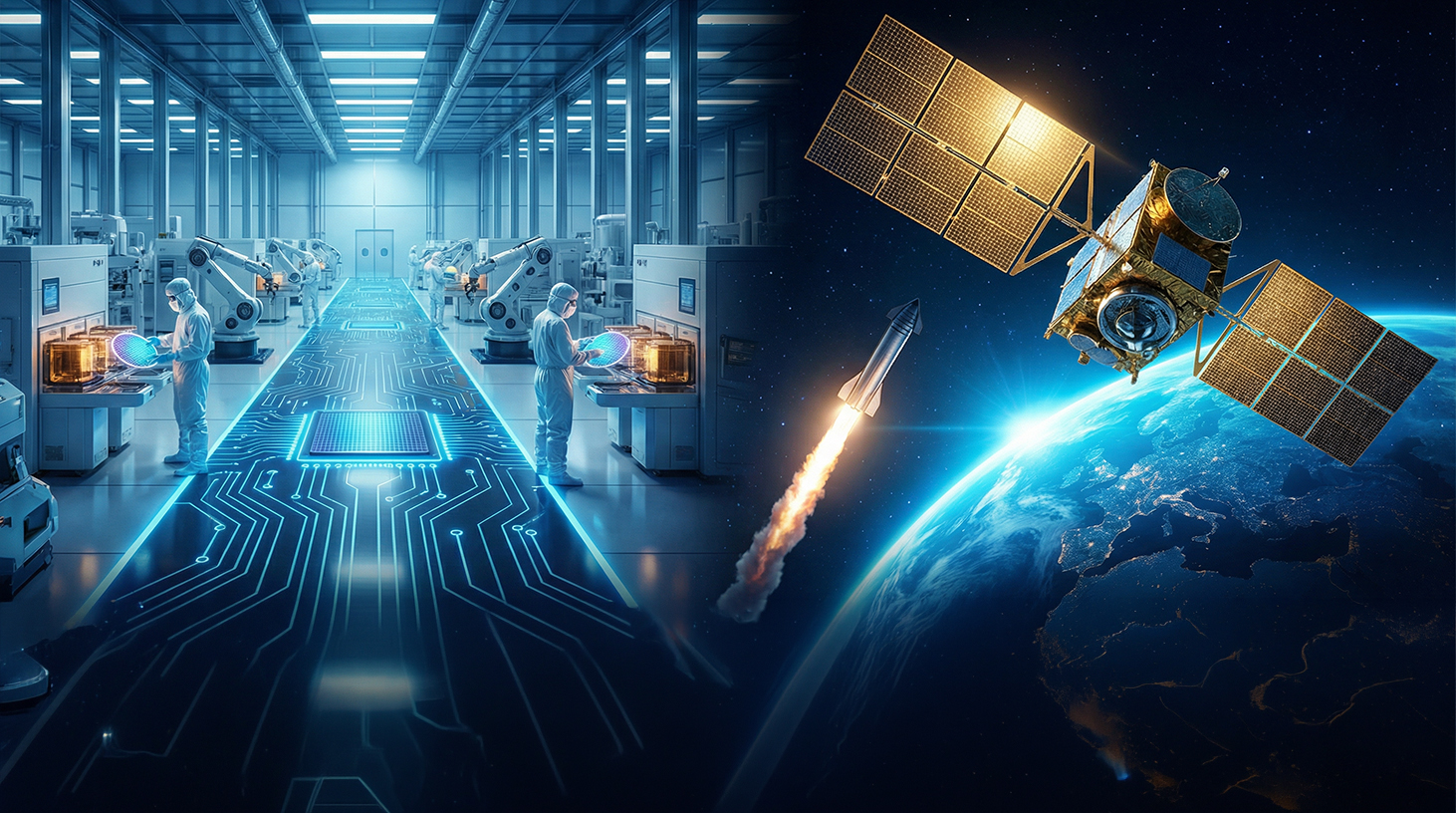
Orbit as the last resort in AI's energy crisis? Terafab: When an entrepreneur wants to reinvent the entire semiconductor industry – Image: Xpert.Digital
Trillion-dollar boondoggle or stroke of genius? Analysts dissect Musk's crazy chip vision
When Earth becomes too small: Why Google and Musk are launching their AI chips into space
Global artificial intelligence is inevitably reaching its physical limits. As the energy demands of new AI models explode, Earth is literally running out of space and power for new data centers. It is precisely at this critical juncture that Elon Musk's latest, highly ambitious vision, "Terafab," comes into play. With a gigantic multi-billion-dollar investment, Tesla, SpaceX, and xAI aim not only to challenge the global semiconductor industry but also to relocate the epicenter of computing power to where solar energy flows endlessly and the cooling problem is inherently solved – Earth orbit. But while tech giants like Google and Jeff Bezos are forging similar plans for space, industry experts are sounding the alarm. Is this project a brilliant way out of the looming AI energy crisis, or a utopian trillion-dollar boondoggle destined to crash and burn against industrial reality?
Vertical integration as a survival strategy
On March 21, 2026, in Austin, Texas, Elon Musk presented a project to an audience that included Governor Greg Abbott, a project that challenges the semiconductor industry as a whole: "Terafab"—a joint chip factory project by Tesla, SpaceX, and xAI, now a subsidiary of SpaceX. The stated goal is an annual production of one terawatt (TW) of AI computing power—a figure 50 times greater than the total current annual production of the global semiconductor industry. With an estimated project volume of 20 to 25 billion US dollars, Musk called the venture "the most epic chip-building exercise in history." The logic behind it is strikingly simple: Tesla needs chips for autonomous vehicles, for the humanoid robot Optimus, and for AI inference; SpaceX requires radiation-proof space chips for a planned orbital data center infrastructure; and xAI, according to Musk himself, will claim the majority of the total capacity. Since existing suppliers like TSMC and Micron Technology can no longer fully meet the steadily growing demand, Musk sees no other way: "We either build the Terafab or we don't have the chips."
Two products, one industrial quantum leap
The Terafab concept envisions the production of two fundamentally different chip categories, each optimized for entirely different physical environments. The first category comprises inference and edge processors for Tesla's full self-driving systems, the robotaxi fleet, and the Optimus humanoid – comparable to the currently used AI4 chip, whose successor, AI5, was initially planned for 2026 but had already been delayed to mid-2027 before the Terafab announcement. The second category consists of so-called D3 chips, designed specifically for operation in space and constructed to be radiation-resistant, for use in orbital computing nodes by SpaceX and xAI. Musk plans for 80 percent of the total Terafab computing power to be allocated to these space-based applications, while only 20 percent is intended for terrestrial purposes. Both chip variants are to be produced on the 2-nanometer manufacturing node, with a targeted throughput of one million wafer starts per month. For context: The global semiconductor industry reached an estimated $975 billion in annual revenue in 2026 – after decades of massive investment by TSMC, Samsung, Intel, and others. TSMC alone holds a market share of nearly 65 percent in the foundry segment. Musk envisions a long-term annual production volume of one to ten billion units for humanoid robots, which would far exceed the global automotive market – a scenario at least partially supported by external market forecasts: Goldman Sachs expects a $38 billion humanoid robot market by 2035, while Morgan Stanley even predicts a five-trillion-dollar potential by 2050.
Orbit as the most cost-effective computing location of the future
The truly revolutionary – and simultaneously most controversial – core of the Terafab project lies not in the semiconductor factory on Earth, but in the vision of an orbital data center network. Musk argues this with tangible physical advantages: Solar radiation in Earth orbit is about five times higher than at the Earth's surface, and the vacuum of space naturally solves the most serious operational problem of terrestrial data centers – heat dissipation. The satellites, internally designated "AI Sat Mini," are reportedly about 170 meters long and have an onboard power output of 100 kilowatts for AI calculations; future iterations are expected to reach the megawatt range. SpaceX already submitted an application to the US Federal Communications Commission (FCC) in 2026 for approval of an orbital data center constellation project that, in its maximum configuration, could comprise up to one million satellites. As a point of comparison, SpaceX, with its current fleet of approximately 8,000 Starlink satellites, already operates a de facto distributed data center in orbit, whose combined solar power output is about 100 megawatts – comparable to a large terrestrial data center, only distributed across hundreds of individual nodes. Looking further into the future, Musk also outlined a "petawatt era" in which factories would be built on the moon to manufacture solar panels and heat sinks using lunar resources – a mass launch vehicle on the lunar surface would then launch completed AI satellites directly into space.
Not a solo effort: The orbital computing model as an industry topic
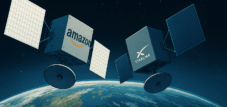
Musk is by no means alone in this idea. The notion of solving the AI industry's growing energy shortage by shifting computing power into orbit is gaining significant traction among technology leaders. Sundar Pichai, CEO of Alphabet and Google, has publicly described the concept as a "moonshot" that should be seriously pursued, pointing to the virtually inexhaustible energy potential of the sun in space. Under the name "Project Suncatcher," Google plans to begin testing the first prototype satellites in 2027, which will power Tensor Processing Units—Google's proprietary AI chips—in orbit. Jeff Bezos, through Blue Origin, has announced the "TeraWave" project: a network of 5,408 satellites designed to achieve data transfer rates of up to six terabits per second and serve data centers and government agencies, with launch dates starting in the fourth quarter of 2027. Bezos has indicated a timeframe of 10 to 20 years within which orbital data centers could undercut their terrestrial counterparts in terms of cost. Even Eric Schmidt, the former Google CEO, has signaled his view of orbital computing infrastructure as a serious answer to the AI industry's energy demands by acquiring a majority stake in the aerospace company Relativity Space. While the market for orbital data centers is currently estimated at less than two billion US dollars, it is projected to grow to nearly 39 billion US dollars by 2035 – with an annual growth rate of approximately 67 percent.
🎯🎯🎯 Data-driven B2B industry hub as a quasi-in-house solution


The quasi-in-house solution: How Xpert.Digital closes operational gaps in B2B marketing and sales – Smart Content-Driven Business - Image: Xpert.Digital
Xpert.Digital is a data-driven B2B industry hub led by Konrad Wolfenstein . The company acts as an external, quasi-in-house solution for industrial partners, closing operational gaps in marketing, content, and sales – without requiring additional resources on the client side.
More information here:
Between science fiction and collapse: Why the semiconductor world remains skeptical
When the vision clashes with industrial reality
This is precisely where the semiconductor industry's fundamental criticism begins. Terafab is not the first ambitious announcement from Musk that analysts and engineers have met with skepticism. The comparison to Tesla's infamous "Battery Day" in 2020 is compelling: Back then, production targets of three terawatt-hours of battery capacity by 2030 were announced – a goal that Tesla is still far from achieving. Barclays analyst Blayne Curtis described Terafab as a "show-me story" that will initially have to make do with considerably more modest goals, pointing to Tesla's limited manufacturing experience, the technological complexity of modern 2-nanometer processes, and the long lead times involved in procuring lithography equipment. Stacy Rasgon of Bernstein Research, in a note aptly titled "Do you believe in Elon?", wrote that a true terafab would be a monumental undertaking, but also raised the question of whether Musk would consider partnerships with existing manufacturers if he couldn't realize the project on his own. However, Bernstein delivered the real weight of its criticism with a quantitative estimate: Achieving the goal of one terawatt of annual computing capacity would require capital expenditures of $5 to $13 trillion – a sum equivalent to more than 70 percent of the current global semiconductor industry, which the analysts believe would be virtually impossible to raise even with the involvement of sovereign wealth funds, major investors, and international capital markets. The analysts further pointed out that such a project faces limitations not only financially, but also in terms of physical and industrial infrastructure: The necessary machinery, raw materials, and skilled personnel to build this capacity within a reasonable timeframe are simply lacking.
The structural context: Why the vision can still be rationally justified
To fairly assess Musk's ambitions, one must understand the structural drivers that make this seemingly irrationally ambitious project plausible in the first place. Global demand for computing power for AI applications is developing with a dynamic that exceeds all previous industry forecasts. According to Gartner, global data center energy consumption was 448 terawatt-hours in 2025 and will increase to nearly 980 terawatt-hours by 2030 – a doubling in just five years. AI-optimized servers, which already accounted for 21 percent of data center power consumption in 2025, will rise to a share of 44 percent by 2030. By 2035, experts predict a global data center energy demand of 1,596 terawatt-hours – an increase of 255 percent compared to 2025. In 2025 alone, around 580 billion US dollars were invested worldwide in AI-focused data center infrastructure. In this context, Musk's core argument is not absurd: Earth is literally running out of physical capacity – there is a lack of space, electricity, and cooling capacity. Anyone who wants to finance the next stage of AI expansion must inevitably explore new solution spaces. In this logic, space is not the whim of an eccentric billionaire, but a physically logical answer to a real bottleneck. SpaceX already possesses the Starship rocket, which delivers payloads on a scale that no other commercial platform even comes close to achieving – and thus has a structural cost advantage that its competitors simply lack. The Starlink operation with 8,000 satellites and almost half a million onboard computers also demonstrates that SpaceX is already capable of operating and maintaining an infrastructure the size of a data center in orbit.
Capital market reaction and strategic implications
The immediate reaction of the financial markets to the Terafab announcement was mixed – a reflection of the deep uncertainty surrounding the project. While Tesla shareholders were met with the typical Musk presentation mix of enthusiasm and disillusionment, Bernstein's question – "Do you believe in Elon?" – precisely captured the core issue: The financial markets are less concerned with the technical soundness of the vision than with its financial viability and feasibility within the announced scope and timeframe. Tesla has already secured an agreement with the Samsung factory in Austin for the production of future chips and continues to source chips from TSMC. The Terafab project – assuming it begins with a smaller "Advanced Technology Fab" – can therefore initially be interpreted as complementary research and development capacity from which Musk's company can gradually build manufacturing expertise. Comparisons to the development of SpaceX's rocket expertise, which was also dismissed as impossible in the early 2000s, are certainly valid – and yet the difference remains fundamental: Manufacturing chips in the 2-nanometer range requires not only capital and willpower, but decades of accumulated materials and process science knowledge, which has cost TSMC, Samsung, and Intel a total of over 100 billion US dollars. Jensen Huang, CEO of Nvidia, has repeatedly emphasized that semiconductor manufacturing is one of the most complex engineering achievements of humankind – an ecosystem of suppliers, specialized tools, and expertise that cannot be built from scratch in just a few years.
Between science fiction and economic necessity
The Terafab announcement is ultimately a symptom of a much larger structural tension gripping the entire technology industry: The computing power required for the next generation of transformative AI systems increasingly exceeds the capacity that can be provided through conventional means. In this context, it's noteworthy that Musk isn't the only one considering orbital solutions—he's simply the loudest and fastest. The economic question isn't whether orbital AI infrastructure will ever become a reality—the cost curves of rocket launches, solar energy efficiency in orbit, and the heat dissipation problem do indeed favor the concept in the long run. Rather, the crucial question is who will build this infrastructure, and within what timeframe—and who will reap the economic benefits. A Musk ecosystem that combines rocket launches, satellite networks, AI software, and chip manufacturing under one roof would have a structural competitive advantage that would fundamentally threaten any existing cloud hyperscaler. Whether Terafab will be a stroke of genius or a galactic money pit depends on variables that are simply impossible to predict today: Will 2-nanometer manufacturing licenses or technology transfers become possible? Will government collaborations partially close the immense capital gap? And will Starship technology actually reduce launch costs so drastically that orbital data centers can compete with terrestrial alternatives? Until then, the billions will continue to flow into terrestrial data centers. Terafab and the planned AI satellites remain an experiment—the largest the technology industry has ever seen, and one that demonstrates just how willing a single player is to rewrite the entire infrastructure order of the AI era.
Your global marketing and business development partner
☑️ Our business language is English or German
☑️ NEW: Correspondence in your native language!

Konrad Wolfenstein
I and my team are happy to be available to you as your personal advisor.
You can contact me by filling out the contact form here wolfenstein@xpert.digital:or simply call me at +49 7348 4088 965. My email address is
I'm looking forward to our joint project.
☑️ SME support in strategy, consulting, planning and implementation
☑️ Creation or realignment of the digital strategy and digitization
☑️ Expansion and optimization of international sales processes
☑️ Global & Digital B2B trading platforms
☑️ Pioneer Business Development / Marketing / PR / Trade Fairs
A new dimension of digital transformation with 'Managed AI' (Artificial Intelligence) - Platform & B2B solution | Xpert Consulting

A new dimension of digital transformation with 'Managed AI' (Artificial Intelligence) – Platform & B2B solution | Xpert Consulting - Image: Xpert.Digital
Here you will learn how your company can implement customized AI solutions quickly, securely and without high entry barriers.
A managed AI platform is your all-inclusive, worry-free solution for artificial intelligence. Instead of dealing with complex technology, expensive infrastructure, and lengthy development processes, you receive a ready-made solution tailored to your needs from a specialized partner – often within just a few days.
The key advantages at a glance:
⚡ Rapid implementation: From idea to ready-to-use application in days, not months. We deliver practical solutions that create immediate added value.
🔒 Maximum data security: Your sensitive data stays with you. We guarantee secure and compliant processing without sharing data with third parties.
💸 No financial risk: You only pay for results. High upfront investments in hardware, software, or personnel are completely eliminated.
🎯 Focus on your core business: Concentrate on what you do best. We take care of the entire technical implementation, operation, and maintenance of your AI solution.
📈 Future-proof & scalable: Your AI grows with you. We ensure continuous optimization and scalability, and flexibly adapt the models to new requirements.
More information here: