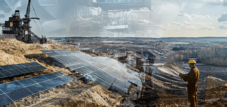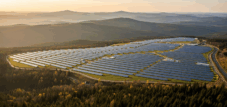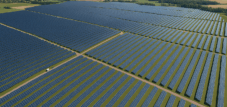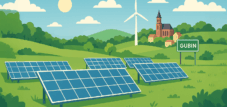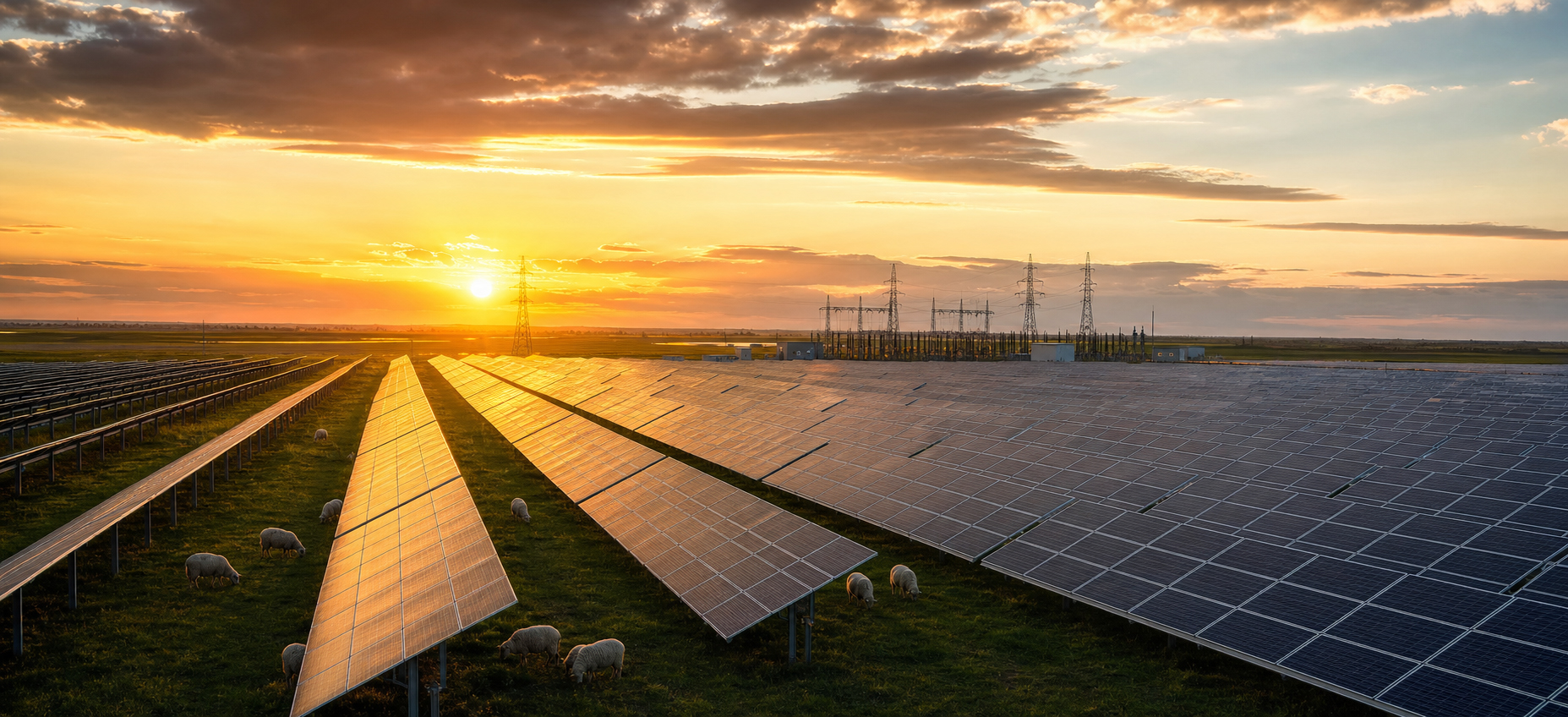
The EU's largest solar park: How Romania is now dethroning Leipzig – 1.2 gigawatts & 520 million euros – Creative image on the topic, with AI: Xpert.Digital
A 520 million euro bet: The mega-project that is shaking up Europe's electricity market
1.2 gigawatts for the energy transition: Romania's gigantic solar plan
Solar power and sheep pastures: The story behind the EU's largest solar park
Romania is often considered Europe's problem child when it comes to the energy transition – plagued by political delays, a hesitant coal phase-out, and a heavy reliance on fossil fuel imports. But now the country is planning a historic breakthrough: the "Dama Solar" project, located near the Hungarian border, will create what will be the largest solar park in the European Union, even surpassing gigantic facilities like the one in Witznitz, Saxony. Formal building permits for the 1.2-gigawatt mammoth project have been granted, and international financing is taking shape. Nevertheless, a crucial systemic question remains: Is a single record-breaking solar park enough to solve the profound structural problems and glaring storage deficit of an entire national economy? A closer look at a project that is far more than just a prestige project – it is the ultimate stress test for Europe's energy transition in the east.
Romania's solar gamble: Can a megaproject save the energy transition of a laggard?
Romania's energy policy stands at a crossroads, exemplifying the ambivalence of many Central and Eastern European economies. While Brussels is pushing ahead with the transformation of Europe's electricity supply towards renewable energies, Romania lags significantly behind the EU average in meeting key expansion targets. Last year, according to the energy think tank Ember, only 9.78 percent of Romania's electricity came from solar power, compared to an EU average of 13.1 percent. A similar picture emerges for wind power: 12 percent compared to 17 percent on average across the EU. These shortfalls are not a mere footnote, but rather point to a structural problem in Romanian energy policy, one that has persisted for years due to political indecisiveness, investment barriers, and a continued dependence on fossil fuels.
The building permit as a turning point for a mammoth project
The Romanian Energy Regulatory Agency (ANRE) has granted Rezolv Energy approval to construct the Dama Solar solar park – a process typically only undertaken when project developers can demonstrate secured financing for a major undertaking. This formal hurdle signals that the project has moved beyond the critical announcement phase and is entering a robust implementation phase. The solar park is being built in the northwest of Arad County, near the Hungarian border, in the municipalities of Grăniceri and Pilu. With a planned installed DC capacity of 1.2 gigawatts peak, the plant, once commissioned in the first half of 2028 – or according to other sources, from 2030 onwards – will surpass the current record holder, the Witznitz solar park near Leipzig, as the largest operating solar power plant in the EU.
From mines to photovoltaic fields: The country's contradictory energy balance
Romania's electricity mix reveals a paradoxical structure that cannot be explained solely by a lack of political will. In 2025, hydropower accounted for the largest share of electricity production at 24.3 percent, followed by natural gas at 16.9 percent and coal at 15.2 percent. Both fossil fuel shares are above the EU average of 16.8 percent for gas and 9.18 percent for coal. At the same time, since the end of 2022, Romania has imported around 20 percent of its natural gas needs from Azerbaijan, and these imports are expected to increase by up to 50 percent in the medium term if the country adheres to its coal phase-out plan. This situation makes it clear that the planned withdrawal from coal will by no means automatically lead to a cleaner energy supply, but could initially result in increased dependence on imported natural gas as long as the expansion of renewable energy capacity is not pursued at a sufficient pace.
A coal phase-out with changing target dates
The political history of Romania's coal phase-out reveals a pattern of repeated postponements, raising doubts about the binding nature of national climate targets. Originally set for 2032, the target date was first brought forward to 2030 in 2022 in the wake of the energy crisis following Russia's attack on Ukraine, before a revised regulation once again allowed for individual power plants to be kept in reserve until 2032. A Romanian decarbonization law mandates the final closure of coal-fired power plants by 2030, but permits some facilities to maintain a strategic reserve status until then. Currently, eight coal-fired power plants with an installed capacity of 4,590 megawatts supply approximately 17 percent of the country's electricity consumption – a share that, given the need for security of supply, appears difficult to replace in the short term. The national recovery plan aims to increase solar and wind capacities from around 1,600 megawatts to 4,600 megawatts by 2030, although interim targets, such as at least 3,000 megawatts of installed wind and solar power by 2026, have not yet been consistently met.
The technical specifications of the Dama solar park
According to Rezolv Energy, the solar park will have an installed capacity of 1.24 gigawatts and could theoretically generate up to 10.86 terawatt-hours of electricity per year – more than double Romania's current total solar power production. However, this theoretical maximum output should be viewed with caution, as solar power plants, by their very nature, cannot operate at full capacity continuously but depend on solar irradiance and weather conditions. Even with a conservative annual average utilization of 15 percent of capacity, the plant could still deliver 1.63 terawatt-hours of electricity. The project developers anticipate that the annual electricity production will be able to meet the needs of more than 280,000 households, which corresponds to supplying nearly one million people, and also expect the creation of more than 500 new jobs over the next three years.
New: Patent from the USA – install solar parks up to 30% cheaper and 40% faster and easier – with explanatory videos!

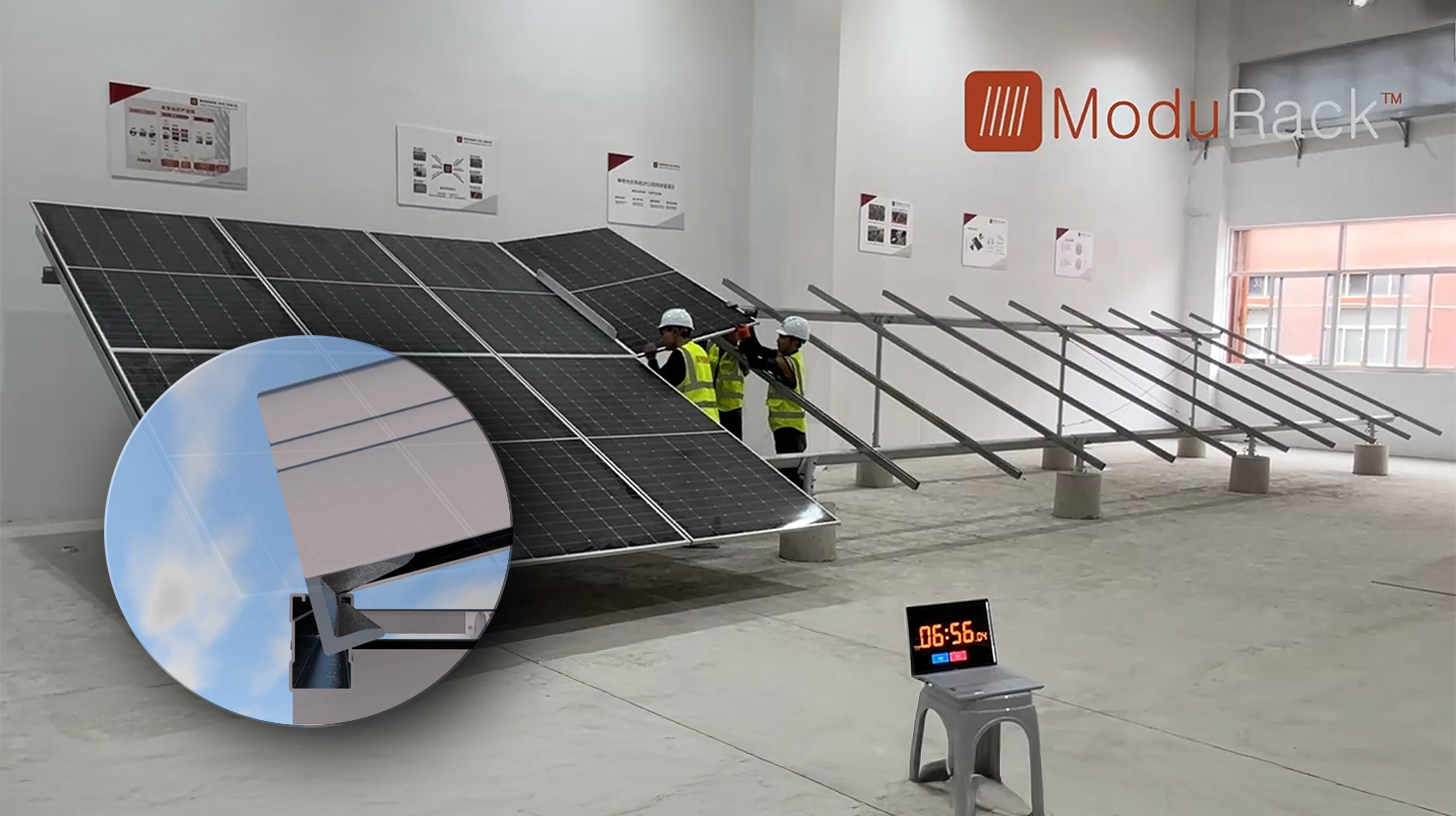
New: Patent from the USA – Install solar parks up to 30% cheaper and 40% faster and easier – with explanatory videos! - Image: Xpert.Digital
The core of this technological advancement is the deliberate departure from conventional clamp mounting, which has been the standard for decades. The new, more time- and cost-effective mounting system addresses this with a fundamentally different, more intelligent concept. Instead of clamping the modules at specific points, they are inserted into a continuous, specially shaped support rail and held securely in place. This design ensures that all forces – whether static loads from snow or dynamic loads from wind – are distributed evenly across the entire length of the module frame.
More information here:
Dama Solar in Romania: What the major EU project really costs and can achieve
Who is behind the project and what it really costs
The project is being managed through the special purpose vehicle West Power Investments SRL, which is wholly owned by Rezolv Energy, an independent power producer specializing in renewable energy and based in the Czech Republic. The estimated project costs have fluctuated considerably over time: earlier estimates ranged from €800 million to €1 billion, while current figures put the costs at around €520 million. To finance the project, the special purpose vehicle is seeking a loan of up to €107 million from the International Finance Corporation, part of the World Bank Group, which lends the project a degree of international security and credibility. Construction is scheduled to begin after the signing of the engineering, procurement, and construction contract, with an estimated construction period of approximately two and a half years.
Network connection and technical infrastructure as a critical success factor
The generated electricity will be fed into the Romanian transmission grid via a dedicated underground high-voltage infrastructure. The plant will be connected to the existing 400-kilovolt overhead line between Nădab and Békéscsaba, operated by the Romanian transmission system operator Transelectrica. The project includes ground-mounted photovoltaic module arrays, inverter stations, an internal medium-voltage network, a main substation, and a 400-kilovolt interconnection substation, known as Grăniceri, all connected by approximately 3.5 kilometers of underground high-voltage cable. Notably, the project requires no physical relocation of any people, as all necessary land has been secured through voluntary transactions and easement agreements. This significantly reduces one of the most common sources of conflict in large-scale projects of this kind and should limit political and public opposition to the project.
The structural storage problem of the Romanian power grid
A key, often underestimated problem with the Romanian energy system lies in insufficient storage capacity and a lack of grid flexibility. Romania produces significant amounts of inexpensive electricity during the day, but due to a lack of adequate storage infrastructure, this cannot be retained within the country, leading to economic losses and fluctuations in supply. This problem is confirmed by data from the operator Transelectrica, which shows that despite political declarations of energy independence, electricity prices continue to rise and grid stability is declining, while energy-intensive industries warned of unsustainable energy costs as early as spring 2026. An additional, weather-related strain is the extremely low water level of the Danube, which reduces electricity production from hydroelectric power plants, particularly at the Iron Gates, by up to 30 to 40 percent below the long-term average. Against this backdrop, it is understandable why Rezolv Energy is considering the future integration of extensive energy storage systems to prevent surplus solar power from being lost during periods of low grid demand. Without a parallel investment in storage technology and grid flexibility, the Dama solar park, despite its impressive nominal output, faces a structural curtailment risk, as other European countries with rapid solar expansion have already experienced.
Ecological support as a differentiating feature
Unlike many large-scale renewable energy projects, Dama Solar combines pure electricity generation with a comprehensive ecological compensation concept. A significant portion of the lower-quality agricultural land will be converted back into pasture, where sheep will graze to keep the vegetation under the rows of modules short – a form of dual-use land use that is increasingly becoming standard practice in the photovoltaic industry. Furthermore, the project includes an 82-hectare nature reserve, which, according to the company, represents one of the largest privately initiated renaturation measures ever associated with a solar project in Southeast Europe. Experience has shown that such accompanying measures not only serve nature conservation but also facilitate the permitting process and increase public acceptance of large-scale projects of this magnitude.
Why a single large-scale project cannot solve the systemic question
For all the symbolic importance of the EU's largest solar park, it would be an oversimplification to view the project as the sole solution to Romania's energy policy shortcomings. Even under optimistic assumptions regarding capacity utilization, the plant would cover only a fraction of Romania's total electricity demand and would not automatically address the country's deeper structural deficiencies—primarily a lack of storage capacity, a volatile hydropower base, and a growing dependence on imported natural gas. The OECD also points out that even with the full and timely implementation of the reforms and investments outlined in the national energy and climate plan, Romania is likely to miss its emissions reduction targets in the non-emissions trading sector by 2030, as the required annual emissions reductions of 1.2 percent are significantly higher than the historical trend of 1.3 percent annual emissions growth in the previous decade. The European Commission has also repeatedly called for improvements in its assessment of the updated national energy and climate plan, particularly regarding the gradual reduction of fossil fuel subsidies and a clearer timetable for phasing out coal.
The economic dimension beyond mere kilowatt hours
From an economic perspective, the Dama project nevertheless marks a significant precedent for foreign direct investment in the Romanian energy sector, demonstrating that international developers and multilateral financial institutions like the IFC are willing to commit substantial capital to a country whose regulatory environment has long been considered deterrent to investment. The fact that the estimated project costs have decreased over time from up to one billion euros to around 520 million euros also points to declining technology costs in the photovoltaic industry and more mature project planning, allowing for more realistic calculations. The promised creation of over 500 jobs within three years should provide a noticeable economic boost to the structurally weak border region of Arad, which is traditionally dominated by agriculture – although experience shows that the long-term employment impact of solar parks during operation, unlike during the construction phase, is considerably lower than that of conventional power plants.
A sober assessment for the coming years
The Dama solar park is a significant, but not sufficient, element of Romania's energy transition. It demonstrates that Romania is technically and financially capable of realizing large-scale renewable energy projects, but the real test lies in the parallel modernization of the grid infrastructure, the development of sufficient storage capacity, and the reliable implementation of the repeatedly postponed coal phase-out. If the solar park can be successfully integrated with the planned storage solutions while simultaneously addressing grid bottlenecks, the project could indeed act as a catalyst for accelerating Romania's energy transition. However, if the accompanying infrastructure policy falls short of expectations, Dama Solar, despite its symbolic size, risks becoming an isolated flagship project that highlights the structural weaknesses of the Romanian energy system rather than addressing them.
📈🚀 From visibility to trust 👀🤝 Your scalable path with Xpert.Digital


From visibility to trust: Your scalable path with Xpert.Digital - Image: Xpert.Digital
In industrial B2B, sustainable business relationships rarely emerge overnight. They develop step by step – through visibility, professional relevance, recurring touchpoints, and growing trust. Xpert.Digital's 4-stage model addresses precisely this: It offers a structured path that begins with a manageable entry point and can evolve into deeper collaboration in business development if needed.
Instead of relying on loud marketing promises, this model puts the relationship at the forefront. Companies start with clearly defined, easily calculable measures and then decide, based on their own experience, how far they want to expand the collaboration. A key factor for this undisturbed trust-building process: The platform completely avoids annoying advertising ads, so the editorial focus remains solely on the companies' expertise.
More information here:
Your partner for business development in the fields of photovoltaics and construction
From industrial rooftop PV to solar parks and larger solar parking lots
☑️ Our business language is English or German
☑️ NEW: Correspondence in your native language!

Konrad Wolfenstein
I and my team are happy to be available to you as your personal advisor.
You can contact me by filling out the contact form here wolfenstein@xpert.digital:or simply call me at +49 7348 4088 965. My email address is
I'm looking forward to our joint project.