

Published on: July 18, 2025 / update from: July 18, 2025 – Author: Konrad Wolfenstein
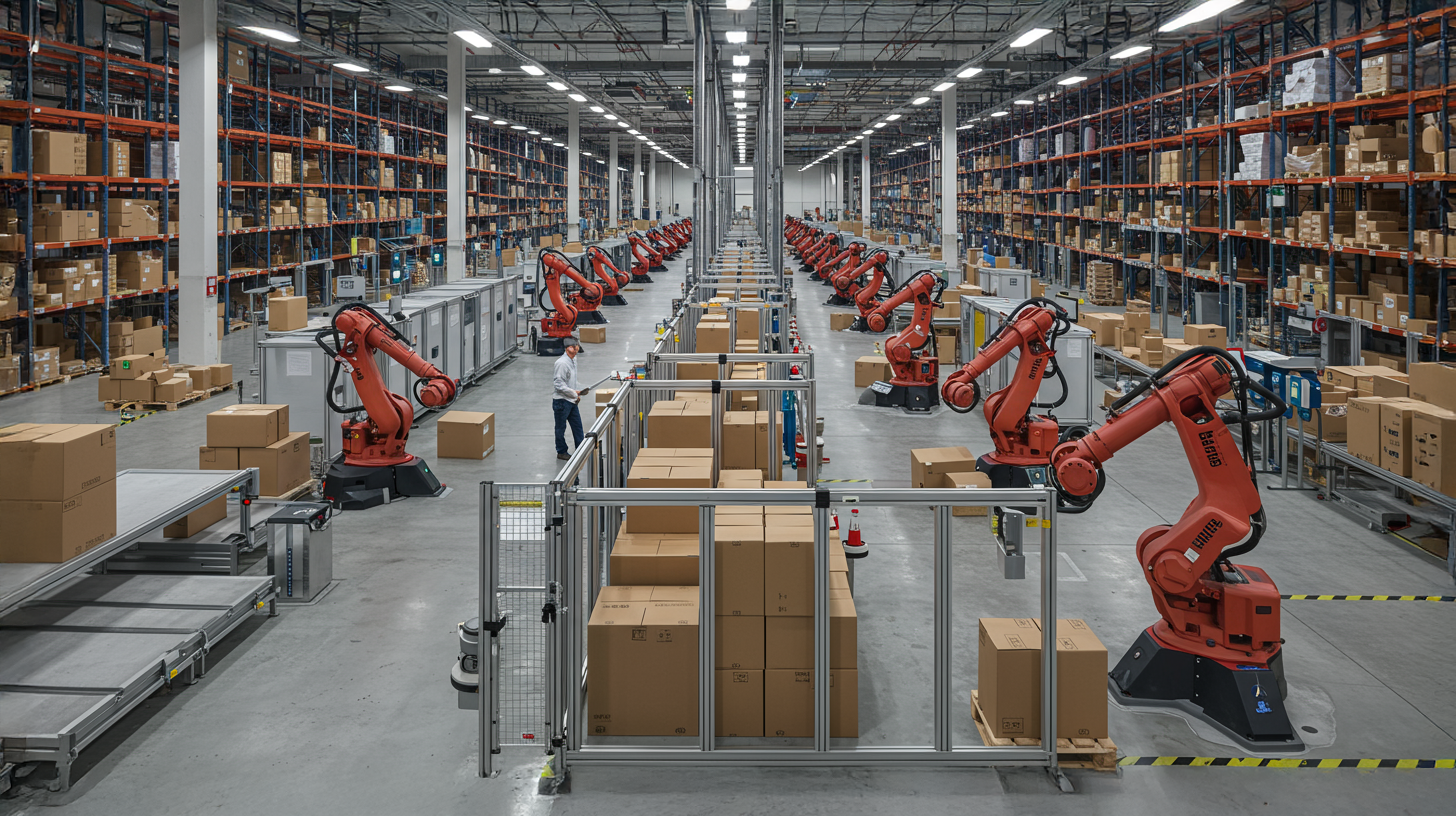
Local shortage? AS/RS and warehouse automation: The key to 85% more capacity and massive cost savings – creative image: xpert.digital
From the cost factor to strategic resource: modern warehouse technologies
Supplier transformation: 5 keys to agility
In today's dynamic economic landscape, companies face the huge task of making their supply chains of agile, more efficient and more resistant. The warehouse, once a pure cost factor, moves to the center of strategic considerations. Automation, in particular through the use of automated storage and provision systems (AS/RS), is no longer a futuristic vision, but an operational necessity. This article serves as a profound examination that aims to illuminate any critical aspect of AS/RS technology and its surrounding ecosystem. The aim is to offer strategic decision -makers a well -founded, data -based basis for one of the most important investments in modern intralogistics.
The strategic imperative for warehouse automation
Why did the automation of warehouses, especially through AS/RS, have become such a critical and urgent topic for modern companies?
The urgency of promoting warehouse automation results from the meeting of several fundamental and irreversible market forces. These forces act together and create surgical pressure that manual processes can hardly withstand.
First, we experience unprecedented growth in the logistics sector. The global market for warehousing and distribution is expected to reach a volume of $ 650 billion by 2026, driven by a robust annual growth rate of around 8 %. This growth alone requires massive scaling of capacities, which is difficult to realize with traditional methods.
Second, the e-commerce boom is the decisive catalyst for a structural change in the requirements. By 2025, e-commerce is expected to make 22 % of global retail sales. This changes the order profiles radically: Instead of large pallet deliveries to a few branches, fulfillment centers now have to handle an immense number of smaller, more complex orders with shorter delivery periods to individual end customers. This complexity is tightened by the fact that e-commerce fulfillment needs up to three times more storage space than traditional retail logistics, which makes room optimization an absolute priority. As a result, 40 % of companies plan to invest in automation in order to meet this demand.
Third, companies act in an increasingly tense labor market. Increasing labor costs and an acute lack of available workers for repetitive and physically exhausting bearing activities represent a significant surgical hurdle. Almost 60 % of the warehouse operators therefore plan targeted investments in automation technologies such as AS/RS and robotics in the next two years in order to increase productivity and reduce the dependency on a shrinking work of work.
Finally, the Covid 19 pandemic has disclosed the fragility of global supply chains and put the need for resilience in the foreground. Companies recognize that automation is a key factor to strengthen their supply chains. It reduces susceptibility to workforce failures and enables a quick adaptation to unpredictable fluctuations in demand, such as being observed during pandemic.
These four forces – market growth, e-commerce complexity, shortage of labor and the call for resilience – form an “operational pliers” that makes manual processes increasingly unsustainable. The automation by AS/RS is therefore no longer an optional efficiency measure, but a strategic need to secure the surgical ability to act and to be in competition. The investment changes from a pure cost reduction measure to a decisive pioneer for business growth and customer satisfaction.
What exactly is an automated storage and provision system (AS/RS) and what fundamental advantages does it promise?
An automated warehouse and provision system, for short AS/RS, is a computer-controlled system that carries out the storage and outsourcing of goods with minimal human intervention. It represents a highly developed combination of hardware and software. The hardware typically includes shelf structures, shelf control units (RBGS), shuttles, robots and conveyor technology, while the software from storage control (toilet), warehouse execution (WES) and warehouse management systems (WMS) consists that coordinate all activities.
The fundamental advantages of an AS/RS can be summarized in several key areas that go far beyond a simple increase in efficiency:
- Effective use of space: The most obvious advantage is the drastic improvement of the storage density. By using the vertical height of a building, AS/RS maximize the storage capacity on a given floor area. This reduces the need for expensive building extensions or additional locations.
- Increased throughput: Due to the automation of the input and outsourcing processes, AS/RS can move a significantly higher volume of goods per hour than manual systems. This is crucial to cushion top loads and ensure fast delivery times.
- Improved picking accuracy: Human mistakes in picking are one of the main causes of costs and customer satisfaction. AS/RS work with computer -controlled precision, which leads to an almost flawless order composition.
- Improved ergonomics and security: AS/RS take on physically exhausting, repetitive and potentially dangerous tasks such as lifting heavy loads or working at high heights. This reduces the risk of work accidents and significantly improves working conditions for employees.
- Increased product safety and inventory control: The systems offer controlled access to the goods and exact, software -based tracking of each individual warehouse movement. This minimizes the risk of theft, damage and existence.
- Reduced labor costs and bottlenecks: Automation significantly reduces the dependency on manual work, which not only reduces direct wage costs, but also reduces susceptibility to labor shortages.
These advantages lead to a fundamental paradigm shift in warehouse operations. The traditional “person-to-goods” principle, in which employees cover long distances in the warehouse to pick articles, is replaced by the “Ware-Zur-Person” principle (Goods-to-person). In this model, the AS/RS brings the required items directly to a stationary, ergonomically optimized workplace. Since the running paths of the employees can make up to 50 % of their working hours, this change leads to a dramatic increase in productivity. The introduction of an AS/RS is therefore more than just a technology upgrade; It is a catalyst that forces a complete redesign and standardization of the warehouse processes and thus enables a completely new level of efficiency.
Can these promised advantages be underpinned with specific data? What quantitative performance improvements can a company realistically expect?
Yes, the qualitative promises of AS/RS technology are supported by an impressive series of quantitative performance data that have been proven in numerous implementations. These numbers form the basis for every solid business case.
Space savings & density: AS/RS can increase the storage capacity by 40 % to 80 % by optimal use of the vertical room height. In some configurations, especially with high -density systems, the storage density can be increased by up to 85 % compared to traditional shelf systems. This means that almost twice as many goods can be stored on the same base area.
Accuracy: The precision of computer -controlled systems enables picking accuracy of 99.9 % or even higher. This value is not only an operational key figure, but also has profound financial effects. A reduction of the error rate from, for example, 2 % (typical of manual systems) to 0.1 % means a 20-fold reduction in expensive returns, after-delivery deliveries and dissatisfied customers.
Throughput & speed: The automation of the input and outsourcing processes leads to up to three times faster order processing times. This enables companies to offer later acceptance times for orders (cut-off times), which is a significant competitive advantage in e-commerce.
Labor costs and productivity: The reduction of the dependence on manual work leads to a reduction in labor costs by 40 % to 70 %. At the same time, productivity increases from 30 % to 50 % are realized, since the remaining employees work on highly efficient “goods-to-person” workstations.
Security: By minimizing manual handling and interaction of people with forklifts in the corridors, security incidents and accidents of work can be reduced by up to 50 %.
Operating time: AS/RS are designed for continuous operation and enable 24/7 operation without breaks or shift changes, which maximizes the capacity utilization of the invested capital.
Return on Investment (ROI): Due to these considerable savings and performance increases, companies that invest in AS/RS often achieve a return on investment within just 1 to 3 years. In a documented case, a ROI of 204 % was even achieved with an amortization period of only 6 months.
These quantitative advantages are not to be viewed in isolation, but create a positive feedback effect. Higher accuracy lowers the costs of troubleshooting and increases the client loyalty. A higher throughput enables more sales volume with the same infrastructure and workforce. The combination of these effects not only leads to a fast ROI, but also creates a sustainable, difficult to copy competitive advantage. The warehouse becomes a pure necessity of an engine for profitability and growth.
Quantifiable performance promises from AS/RS systems: What realistic improvements can be proven?
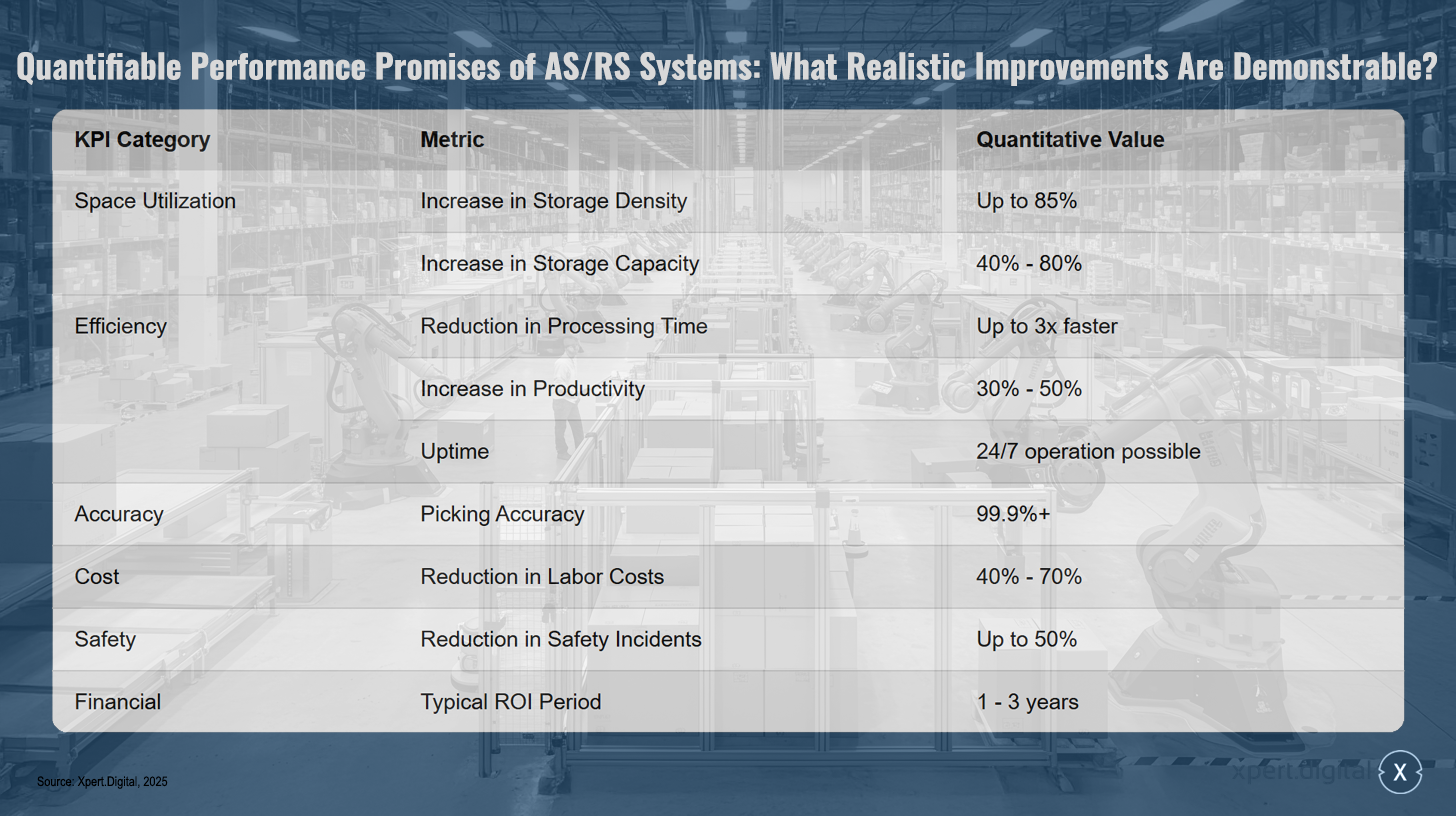
Quantifiable performance promises from AS/RS systems: What realistic improvements can be proven? – Image: Xpert.digital
Automated warehouse systems (AS/RS) offer impressive performance improvements in various corporate areas. The analysis of the key performance indicators (KPIS) shows significant advantages: In the use of space, companies can increase the storage density by up to 85 % and increase the storage capacity by 40 to 80 %. With regard to efficiency, these systems enable up to three times faster processing time and increase productivity by 30 to 50 %.
Another crucial advantage is the potential for a 24/7 operation that maximizes the continuity of the warehouse processes. The picking accuracy reaches an impressive 99.9 % and thus clearly exceeds manual processes. Cost optimization is also a key aspect: labor costs can be reduced by 40 to 70 %. In addition, AS/RS systems improve occupational safety by reducing security incidents by up to 50 %.
From a financial point of view, the typical return on investment (ROI) is between one and three years, which underlines the long -term economic attractiveness of this technology.

Xpert partner in warehouse planning and construction
Technology upgrade: The smart systems behind efficient warehousing
A technical insight: the anatomy of modern AS/RS solutions
What are the primary types of AS/RS, and for which specific operational scenarios is every type best suited?
The world of automated storage and provision systems is diverse, and the choice of the right system depends crucially on the specific requirements of a company. There is no universal “best” system; Rather, every technology represents an optimized compromise between storage density, throughput and flexibility. The primary types can be categorized as follows:
Unit-Load AS/RS (pallet-akl)
This is the classic form of the AS/RS, designed for the handling of large and heavy loading units such as pallets or lattice boxes. Shelf control units (RBGS) move in and out in narrow corridors and store the pallets on and out on high shelves. This system is ideal for buffer warehouse in production, the storage of raw materials or the consolidation of ready -made goods, i.e. scenarios with relatively few article variants (skus), but high volume per sku.
Mini-Load AS/RS (container-akl)
The mini-load system for handling small to medium-sized articles is designed as a counterpart to the unit load system in standardized containers, boxes or on tablets. It is the backbone of many “Ware-Zur-Person” Commissioning solutions and is ideal for applications with a very high variety of sku and high demands on the accuracy, as is typical in e-commerce, in the pharmaceutical industry or in spare parts logistics.
Shuttle systems
This technology represents a further development of the mini-load principle and offers the highest level of flexibility and scalability. Autonomous shuttles move independently at every level of a shelf system, while separate lifts take over the vertical transport. This decoupling of horizontal and vertical movement enables extremely high throughput rates. Shuttle systems are predestined for highly dynamic e-commerce operations with strongly fluctuating order volumes, since the performance can be adjusted by simply adding or removing shuttles. Some systems offer a scalability of 100 %.
Vertical lift systems (VLM) & carousel
These are high -density, encapsulated warehouse solutions. VLMS work like a cupboard with two rows of tablets and an extractor in the middle, which brings the requested tablet to an ergonomic opening. Carousels rotate either horizontally or vertically to bring the stored goods to the operator. They are ideal for storing small parts in a very limited space, for example directly in the production line, in workshops or for service parts.
Cubic storage systems (e.g. Autostore)
This architecture offers the highest possible storage density. Robots drive on a grid (grid) above a block of containers stacked directly. They lift containers and dig through (“dig-out”) if necessary. Since no corridors are required, the use of space is unsurpassed. This system is perfect for applications in which maximizing the storage capacity on a limited base area has top priority and a medium to high throughput is required.
The choice of the system is a profound strategic decision. It reflects a company's expectations of its future business volume and its volatility. A stable production environment could be well served with a robust unit load system. A rapidly growing e-commerce company that has to adapt to unpredictable demand tips will prefer the scalability and throughput of a shuttle system or the density of a cubic system. The evolution of these systems shows a clear trend: away from monolithic, centralized architectures (an RBG per gear) towards decentralized, resilients and granularly scalable systems (fleets of shuttles or robots), which are better prepared for the uncertainties of the modern economy.
When we immerse yourself in the technology, how do the mechanical core components of shelf operating devices (in unit load systems) and shuttles actually work?
In order to understand the performance and limits of the various AS/RS types, a look at their mechanical core components is essential. The design philosophies of shelf operating devices and shuttles differ fundamentally.
Shelf control units (RBGS / Stacker Cranes)
RBGs are the work horses of the traditional pallet and container as/RS. Your functional principle is monolithic and integrated.
Basic principle and axle of movement: An RBG is a high mast vehicle that drives on a single rail on the floor and often with an upper guide rail on the shelf roof along a narrow gang. Its movement takes place simultaneously in two main axes: horizontally along the gang (driving axis) and vertically along the mast through a lifting sled (lifting axis). The ability to carry out both movements at the same time (diagonal journey) is crucial for minimizing the cycle time.
Load accommodation (LAM): The LAM is attached to the lamban sled, which makes the actual deposit and outsourcing. In pallet systems, these are typically telescopic forks that simply or twice deep into the shelf subjects, raise the palette and withdraw. With mini-load systems, these can be gripper, vacuum cleaner or small telescopic tables for containers.
Mast design: The design of the mast is a critical factor for stability and performance. One-mast RBGs are lighter and potentially more energy-efficient, but more susceptible to vibrations at high speeds or large heights, which can affect positioning accuracy. Here, sophisticated control technology is required for vibration damping.
Two-mast RBGs offer significantly higher rigidity and stability, which makes it preferred for very high applications (over 40 meters) or very heavy loads. However, this stability is bought with a higher weight and thus a higher energy consumption for acceleration and braking.
Shuttle vehicles
Shuttle systems are based on the principle of decentralization and decoupling the movement axes, which gives them a higher dynamic and flexibility.
Disclosed principle: In contrast to the RBG, the driving and lifting combines in a machine, the shuttle system separates these functions.
Horizontal movement: The shuttle itself is a flat, battery -operated and autonomous vehicle. It operates on rails within a single level of the shelf system and is only responsible for the fast horizontal movement to get containers or boxes from the shelf subjects and to bring the beginning of the gear.
Vertical movement: At the head end of each course there is one or more high -performance lifts. These absorb a shuttle (often already loaded with a container) and transport it extremely quickly between the different shelves and to connect to pre-zone funding technology, where the containers are handed over to the picking places.
These different mechanical approaches have profound consequences. The bottleneck in an RBG system is the RBG itself; His cycle time dictates the performance of the entire course. In a shuttle system, the lift is the potential bottleneck. The system design aims to optimally utilize this bottleneck by "feeding" the elevator of several shuttles. This not only makes the system more powerful, but also granularly scalable: If you need more throughput, add more shuttles until the capacity of the lift is reached. This offers flexibility that a monolithic RBG system cannot do.
Your intralogistics experts
Advice, planning and implementation of complete solutions for high -bay warehouse and automated storage systems – Image: Xpert.digital
More about it here:
Shuttle vs. robot: Which storage system will dominate industry?
How do the leading system architectures – RBG-based, shuttle-based and cubic storage – do-compared to critical key figures such as throughput, storage density and flexibility?
The decision for a specific AS/RS architecture requires careful consideration of the three central performance parameters: storage density, throughput and flexibility. Every technology has its specific strengths and weaknesses here.
Storage density
The density indicates how many items can be stored on a certain floor area.
Cubic systems (e.g. Autostore): They offer the undisputed highest storage density, especially in buildings with a limited ceiling height (less than 12 meters or 40 feet). Since they completely avoid corridors and stack the containers directly one above the other, practically no room is wasted. You can increase the storage capacity by fourfold compared to manual shelf systems.
Shuttle and RBG systems: These systems achieve their high density through extremely narrow corridors and the ability to take advantage of the full building height (often up to 25 meters or more). In very high buildings (over 12-15 meters) you can achieve a higher density than cubic systems, since the latter cannot fully exploit the vertical dimension. The density can be further increased by double or multiple depth storage, but this limits direct access to each individual article and increases the administrative effort.
Throughput
The throughput measures the number of input and outsourcing per unit of time.
Shuttle systems: They are considered the kings of throughput. By decoupling the movement axes and the parallel use of many vehicles, you can reach the highest performance rates. They are the preferred choice for “very high or ultra-high” throughput requirements, such as those in dynamic e-commerce fulfillment. A single lift can move up to 400 containers per hour.
RBG systems: offer a solid, high and very constant throughput. However, the performance is limited due to the physical limits of one shelf control unit per gait. A typical pallet RBG creates around 40 input and outsourcing per hour. They are well suited for stable processes with a planned high volume.
Cubic systems: achieve an average to high throughput. The performance can be scaled very easily here by simply using more robots on the grid and additional picking ports are installed. A limiting factor can be the need to clear up the upper container in order to get to deeper (“dig-out”), which can extend the cycle time for certain orders.
Flexibility & scalability
This dimension describes the system's ability to adapt to changed business requirements.
Shuttle and cubic systems: offer maximum flexibility. The throughput can be dynamically adapted to business growth by adding other vehicles (shuttles or robots) to the fleet without having to change the basic shelf or grating structure. This enables a “pay-as-you-grow” investment strategy.
RBG systems: are significantly more limited in their scalability. The performance is firmly linked to the number of gears. A significant increase in performance usually requires the construction of completely new corridors, which represents a large, sudden investment.
A decisive factor that connects these three dimensions is the building infrastructure. The choice of technology and the real estate strategy are inextricably linked. A company that wants to retrofit an existing warehouse with a low ceiling will probably prefer the unsurpassed density of a cubic system. A company that is planning a new building on an expensive property could build an extremely high hall to minimize the base area and install a shuttle system in order to combine maximum throughput and high use.
System comparison for flexibility & scalability: Which storage technology is best adapted to growth and changes?
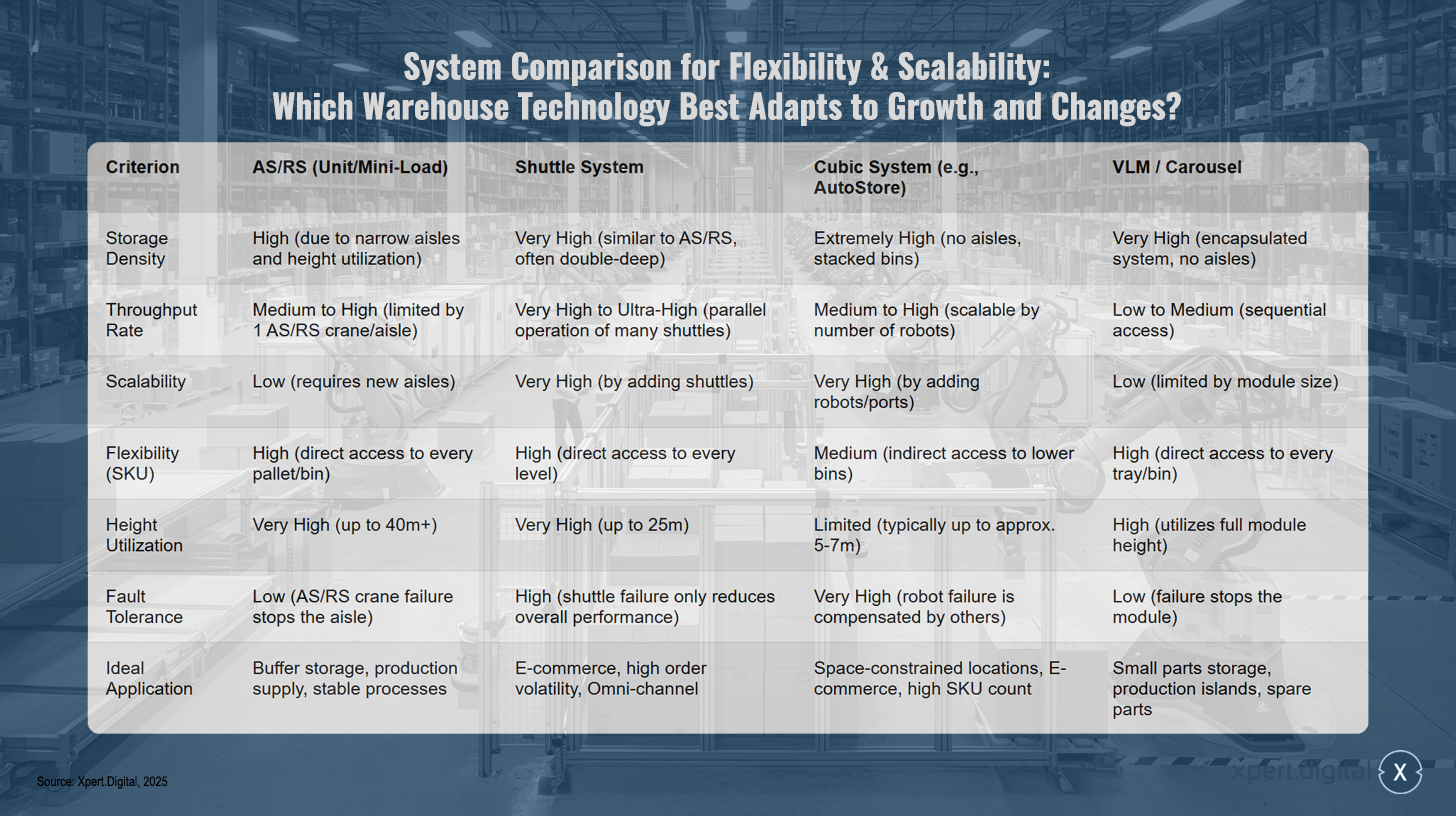
System comparison for flexibility & scalability: Which storage technology is best adapted to growth and changes? – Image: Xpert.digital
In logistics and warehouse technology, there are various system solutions that differ in flexibility and scalability. A detailed comparison shows the advantages and disadvantages of different storage technologies.
The RBG system (shelf control unit) is characterized by a high storage density, which is achieved by narrow corridors and optimal use of heights. With a height of up to 40 meters, it offers direct access to every palette. However, its scalability is limited and a system failure immediately stops the entire gear.
Shuttle systems impress with very high throughput rates and excellent scalability. You can react flexibly to changes through parallel operation of several shuttles. They reach heights of up to 25 meters and offer high fault tolerance.
Cubic systems such as Autostore are ideal for space -limited locations. You can achieve an extremely high bearing density without corridors and enable very high scalability by adding robots. The fault tolerance is very high because a robot failure can be compensated for by others.
Vertical storage systems (VLM) or carousels are particularly suitable for small parts storage and production islands. They use the full module height, but have a lower throughput rate and limited scalability.
The choice of the right system depends on specific requirements such as order volume, space requirements, process stability and flexibility.
Which sensor technologies form the “nervous system” of an AS/RS, and how do you ensure the required level of precision, security and efficiency?
Modern AS/RS and the autonomous robots interacting with them are complex mechatronic systems, the function of which depends on a sophisticated “nervous system” from various sensor technologies. These sensors provide the data that are essential for precise movements, the safety of personnel and material as well as the general system efficiency.
Position sensors
They are the foundation for precise control. Your task is to continuously grasp the exact position of the movable components – such as the shelf control unit, the lifting sled on the mast or the shuttle on its level – This is realized by technologies such as laser distance sensors that measure the distance to the current measurement, rope train encoder that measure the handling of a rope, or highly precise linear measuring systems that read a barcode band mounted on the shelf. Without this millimeter accuracy, the storage spaces would be impossible.
Distance and photoelectric sensors
This group of sensors takes over a variety of surveillance and control tasks. They work like the “eyes and ears” of the system at a short distance.
Specialist-occupying control: Before a loading unit is stored, a sensor checks whether the target place is actually free to avoid collisions and false bookings.
Presence control: Detect sensors to the conveyor technology or on the load capacity whether a container or a palette has been recorded correctly and is available.
Supervision control: one of the most important security functions. Photoelectric sensors (light barriers) create a virtual “frame” around the charging unit. If part of the load protrudes beyond this frame, the movement is stopped to prevent a collision with the shelf structure.
Vision sensors (computer vision)
Cameras systems, often in connection with AI algorithms, give the AS/RS a form of “vision”. They go beyond pure presence recognition and enable more complex tasks such as the identification of objects, the review of barcodes or QR codes for verification, quality control (e.g. detection of damaged packaging) and the high-precision fine position when starting a storage space.
Lidar (Light Detection and Ranging)
This technology is less to be found in the rail -bound AS/RS itself, but all the more to be found in the freely navigating autonomous mobile robots (AMRS) that transport goods to the AS/RS. Lidar sensors scan the surroundings with laser pulses and create a precise 2D or 3D point cloud card from the term of the reflected light. This card serves the AMR for navigation and to detect obstacles in real time.
Slam (simultaneous localization and mapping)
Slam is not a sensor, but a crucial algorithm that processes the data of the sensors (such as Lidar or cameras). He solves the “henne egg problem” of autonomous navigation: a robot needs a card to localize yourself on a card. To create a card, he needs to know where it is. Slam enables the robot to do both at the same time – create a map of an unknown environment and continuously track its own position within this card.
The true strength of modern autonomous systems lies in the sensorus. Instead of relying on a single technology, advanced AMRs combine the data of different sensors. For example, they merge the high -precision distance measurements of lidar (good for the mapping of walls and large objects) with the high -resolution image data of cameras (good for the detection of small, flat obstacles or reading signs). This approach creates a redundant and much more robust understanding of the environment, which dramatically increases the safety and reliability in dynamic warehouses in which humans and machines share the same space. The evolution of the sensor technology from simple position sensors towards complex, merged reversible detection is a reflection of the evolution of warehouse automation itself – from rigid, isolated systems to flexible, collaborative ecosystems.

Xpert.plus warehouse optimization – high -bay warehouse such as pallet warehouse advice and planning
Your global marketing and business development partner
☑️ Our business language is English or German
☑️ NEW: Correspondence in your national language!

Konrad Wolfenstein
I would be happy to serve you and my team as a personal advisor.
You can contact me by filling out the contact form or simply call me on +49 7348 4088 965 (Munich) . My email address is: wolfenstein ∂ xpert.digital
I'm looking forward to our joint project.


