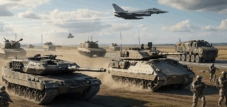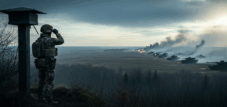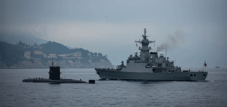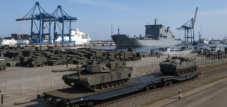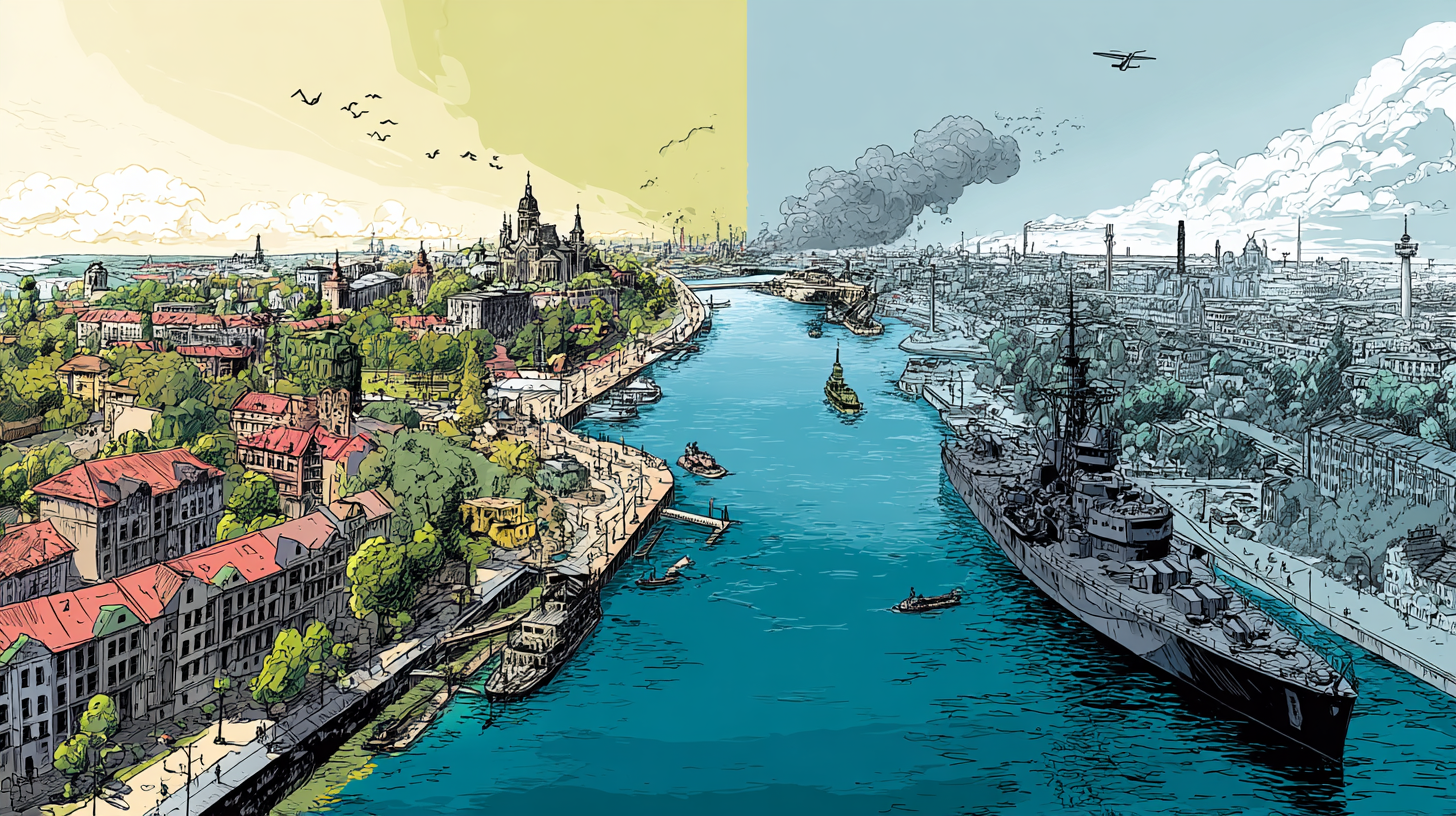
Kaliningrad is militarily valuable to Russia, politically sensitive, economically fragile, and socially vulnerable – Image: Xpert.Digital
Between missiles and empty shelves: The risky double life of Russia's westernmost outpost
Russia's problem exclave: Why Putin can never give up Kaliningrad despite enormous costs
It is Russia's dagger, aimed at the heart of NATO – and simultaneously its own Achilles' heel. We are talking about Kaliningrad, the Russian exclave on the Baltic Sea, completely surrounded by Poland and Lithuania, and thus by EU and NATO territory. Strategically, the region is an unsinkable aircraft carrier: home to the Baltic Fleet, equipped with S-400 air defense systems and nuclear-capable Iskander missiles, whose range extends as far as Berlin. For the Kremlin, Kaliningrad is an indispensable military outpost, intended to secure the balance of power in the Baltic region.
But behind this facade of military strength lies a profound fragility. Economically, the oblast is isolated and hit by sanctions; its energy and goods supplies hang by the threads of transit, and society feels the growing divide with neighboring Europe. Every political crisis, every round of sanctions, and every military movement at the nearby Suwałki Gap makes the exclave more vulnerable. The Russian war of aggression against Ukraine has dramatically exacerbated these structural problems, transforming the former "window to the West" into a besieged fortress.
This raises an existential question for the Kremlin: Is Kaliningrad still a strategic trump card or has it long since become a costly burden that would be difficult to maintain in a crisis? This text examines the multifaceted issues
Related to this:

Surrounded by NATO: How vulnerable is Russia's "unsinkable aircraft carrier" Kaliningrad really?
A brief overview: Kaliningrad is militarily valuable to Russia, politically sensitive, economically fragile, and socially vulnerable. Its exclave status, exacerbated by EU and NATO enlargement, Russia's war of aggression against Ukraine, and the resulting sanctions, has transformed this geostrategic outpost into an isolated, costly, and vulnerable bastion. Supply, energy, transit, trade, demographics, political climate, border regime, A2/AD military role, and proximity to the Suvałki Gap intertwine to form a complex web of risks that Moscow cannot dominate without risk, but also cannot abandon. For Russia, the core problems remain: accessibility, security of supply, economic diversification, legitimacy and loyalty management in an increasingly hostile foreign policy environment, and the calculated vulnerability to NATO scenarios that—in a crisis—simulate and prepare for blockade, encirclement, or rapid capture. This complex situation makes Kaliningrad both a Trump card and an Achilles heel for Russia.
What makes Kaliningrad so special – and so problematic – from a Russian perspective?
Kaliningrad is the westernmost region of the Russian Federation and, as an exclave, is completely surrounded by EU and NATO states (Poland and Lithuania). Originating in Soviet military history as an "armed fist on the Baltic," the region is now home to the Baltic Fleet, airfields, air defense systems, and nuclear-capable Iskander short-range missiles. At the same time, the oblast is economically and logistically isolated from mainland Russia, creating dependencies in transit, energy, trade, and mobility. NATO considers Kaliningrad an A2/AD node and a potential base for military pressure on the Baltic states; Russia views it as a forward shield and sword—but with the structural weakness of a "vulnerable island" in a hostile environment.
How has history prepared the ground for today's structural problems?
The history of Königsberg/Kaliningrad is a complex interplay of geostrategic location, population exchange, and military function. After nearly 700 years of Prussian-German history, the city was renamed Kaliningrad in 1946 following its capture by the Red Army. Northern East Prussia was incorporated into the RSFSR, and the remaining German population was expelled by 1948. The region became a restricted military zone and a base for the Baltic Fleet. After 1991, the situation became an exclave, with a complete upheaval of all border, transit, and trade regimes. This was accompanied by hopes for a special economic zone and EU cooperation—hopes that were only partially fulfilled and have since suffered repeated setbacks.
What military role does Kaliningrad play – and what risks arise from this?
Militarily, Kaliningrad is a highly concentrated hub: home to the Baltic Fleet, significant air defenses (including S-400 systems), coastal defenses, long-range sea and land-based precision weapons, and nuclear-capable Iskander-M missile systems with a range extending to Central European capitals. This supports a Russian A2/AD (Area of Defense/Advanced Defense) assessment of the Baltic Sea. At the same time, the exclave is operationally difficult for Russia to reinforce and supply; troop and materiel deliveries are only possible via air or sea routes, and it is vulnerable to blockades, pincer movements from Poland and Lithuania, and maritime containment. In NATO planning, Kaliningrad is considered a bridgehead that can be isolated or quickly neutralized in the event of escalation. This duality—threat and vulnerability—makes Kaliningrad both a potential amplifier and a risk factor in Russia's security strategy.
Why is the Suwałki Gap so central to the problem?
The Suwałki Gap, a narrow strip of land on the Polish-Lithuanian border, connects the Baltic states to the rest of NATO territory. Situated between Kaliningrad and Belarus, it is considered NATO's Achilles' heel. A Russian-Belarusian pincer movement could sever land links and isolate the Baltics. Therefore, NATO is reinforcing the region, stationing troops, building protective infrastructure, and planning logistics by sea and air. Conversely, the gap acts as a natural weak point, through which Russia's Kaliningrad could be cut off more quickly than it could be evicted in a crisis. Its existence intensifies the structural pressure on the exclave and increases the escalation sensitivity of both sides.
How do EU and NATO enlargements affect Kaliningrad?
With Poland and Lithuania's accession to the EU and NATO, Kaliningrad has de facto transformed into an EU/NATO-framed enclave. This development has complicated transit, visa, and border regimes, increased dependencies, and polarized security relations. Russia has responded in part with rearmament, while the EU and NATO have increased their presence and infrastructure in the Baltic Sea region. The accession of Finland and Sweden to NATO reduces Russia's freedom of action in the Baltic Sea but simultaneously increases pressure on the exclave—both militarily and politically.
What are the effects of sanctions and transit restrictions?
Since 2022, EU sanctions and Lithuanian transit restrictions have led to significant shortages of goods such as steel, metals, building materials, coal, and high technology. Lithuania implemented the EU rules, which sparked controversy and triggered uncertainty, price increases, and supply concerns in Kaliningrad. Estimates suggest the measures affected up to 40–50 percent of imports. Russia shifted supply chains more heavily to maritime routes and expanded ferry services—at a higher cost, with longer transit times and reduced resilience. The result is partial stabilization, but with lower efficiency and continued vulnerability.
What is the energy supply like – and where are the risks?
Energy has long been an Achilles' heel of the exclave. Dependence on electricity and gas imports via neighboring countries, coupled with geopolitical tensions and grid restructuring (the Baltic states' disconnection from the BRELL grid), made security of supply a persistent problem. Russia invested in power plants, LNG options, and gas storage facilities, but only partially stabilized the situation. The transition has yielded some successes toward energy independence, but remains costly and politically vulnerable. Energy is thus a constant lever for external influences and an internal cost driver for industry and households.
What is the state of the oblast's economy, and why does it remain fragile?
Kaliningrad's economy suffered from declining investment, weak governance, corruption, border and customs complexities, and the erosion of old special legal regimes. Key companies like Avtotor, once a symbol of industrial integration, were hit hard by the withdrawal of Western partners and attempted to shift to Chinese cooperation and e-mobility approaches – with limited success. Tourism boosts, such as those for the 2018 FIFA World Cup, proved short-lived. The rerouting of supply chains to sea is increasing the cost base; the domestic market is small; and foreign markets are politicized. The result is a structural brake on growth with cyclical shocks.
What social problems characterize the region?
Over the years, social and health problems have become entrenched in Kaliningrad. Unemployment, relatively low incomes compared to other major Russian cities, shortages and price spikes due to import restrictions, and an above-average prevalence of infectious diseases such as HIV and tuberculosis have all been documented. Medical facilities are inadequate, particularly outside the capital. Social tensions are exacerbated by limited mobility, travel and visa restrictions, and rising prices. While societal resilience exists, it remains dependent on economic growth and more open integration.
Is Kaliningrad a political special case within Russia?
The region is considered comparatively pluralistic in opinion and at times actively involved in opposition, a phenomenon often attributed to its border location, direct comparison with EU neighbors, and the high visibility of external standards. At the same time, the military presence is politically influential, and central government control remains pronounced. In times of crisis, security considerations reinforce priorities at the expense of more open formats. The tension between demands for loyalty, local self-perception, and domestic control generates latent political friction.
How does the war against Ukraine change the Kaliningrad issue?
The war exacerbated isolation, reduced Western cooperation channels, worsened investment conditions, hampered parts of cross-border mobility, and led to harsh sanctions. Militarily, its importance as an outpost is increasing; economically, its vulnerability is growing. Russia is compensating through maritime logistics and domestic programs, but can only partially offset the structural disadvantages of a sanctioned exclave in a NATO-dominated Baltic Sea. The result is a spiral of costs and risks that weighs military gains against economic and social losses.
What role does Kaliningrad play in NATO planning – and what scenarios are being considered?
In NATO schools of thought, Kaliningrad appears as an A2/AD core that, in a crisis, would have to be isolated, blockaded, and neutralized to ensure the supply of the Baltic states. Exercises and analyses address the defense against a Suwałki pincer movement, naval supremacy in the Baltic Sea, and the rapid elimination of enemy sensor and weapons systems. At the same time, statements circulate that emphasize a "rapid capture" in the event of escalation, creating a strong rhetoric of deterrence but also incentivizing Russian preemptive action. The balancing act between credible deterrence and escalation control makes Kaliningrad a focal point of modern deterrence logic.
How real is the nuclear dimension in Kaliningrad?
The deployment of nuclear-capable Iskander systems is well-documented, but their operational doctrine remains deliberately ambivalent. From NATO's perspective, this creates an unacceptable reduction in response times and increases the risk of escalation. Russia, in turn, claims the need to "neutralize" US/NATO capabilities in Poland, Romania, and the Baltic region. The nuclear card is regularly emphasized in the information sphere, generating psychological effects without reducing the political cost-benefit analysis of a first use. The result is a constant strategic hum in the background, keeping Kaliningrad involved in rhetorical and planning-related nuclear scenarios.
Which transit and train infrastructure issues are exacerbating the situation?
Besides freight transit, security debates also concern passenger and special transit. In Lithuania, there are persistent fears that transit trains could be used for the covert transfer of personnel or materials, which is why restrictive stances and political discussions continue. A complete ban is considered delicate and prone to escalation. These debates have repercussions for daily life in Kaliningrad, as predictability and political trust are the lifeblood of traffic in the exclave. The more fragile the trust, the higher the likelihood of operational disruptions.
Which key economic sectors were and are under pressure?
Traditional strengths such as fishing, port operations, assembly (automotive), trade, and tourism were cyclical and politically vulnerable. Investment stagnation, supply chain disruptions, higher-cost import substitution, the loss of Western technology partners, and the narrowing of target markets had a cumulative effect. Initiatives for special economic zones suffered from regime changes, WTO compatibility issues, administrative challenges, and corruption risks. While new partnerships are emerging, for example with Chinese manufacturers, the vertical integration of value chains is limited, the domestic market is small, and export capacity is restricted by sanctions.
Hub for Security and Defense - Advice and Information


Hub for Security and Defense - Image: Xpert.Digital
The Security and Defence Hub offers expert advice and up-to-date information to effectively support companies and organizations in strengthening their role in European security and defence policy. Working closely with the SME Connect Defence Working Group, it particularly promotes small and medium-sized enterprises (SMEs) that wish to further develop their innovative capacity and competitiveness in the defence sector. As a central point of contact, the Hub thus creates a crucial bridge between SMEs and European defence strategy.
Related to this:
From "Window to the West" to sealed fortress: The Kaliningrad Question
To what extent is Kaliningrad more of a burden than an asset for Russia?
In peacetime, the exclave was envisioned as a "window to the West," a pilot region for EU-Russia relations, and a logistical hub in the Baltic Sea region. Since 2014, and especially since 2022, however, its functions as a "reinforced outpost" and a "cost center of isolation" have become predominant. The military benefits remain, but the political price is rising: supplies and reinforcements are vulnerable; economic modernization is stalled; the population and local elites are caught between central government demands and the realities of the border; and international actors view the region as a risk factor. Strategically, Kaliningrad is a double-edged sword that Russia cannot wield without exposing its own flank.
Related to this:
What role do regional sentiment and social dynamics play?
Proximity to EU member states fosters an empirical mode of comparison among the population, shaping political expectations, consumer preferences, and mobility desires. Difficult travel, visa restrictions, price increases, and shortages of goods exacerbate frustration. Simultaneously, military presence and government programs secure income and infrastructure, creating ambivalent dependencies. The political climate remains sensitive to economic fluctuations and security situations. Narratives from Moscow clash with everyday experiences at the border; this tension influences patterns of loyalty and the willingness to protest.
What information and propaganda battles are obscuring reality?
Kaliningrad is often symbolically exaggerated – on both sides – as an "unsinkable aircraft carrier" and a threatening backdrop, as a "vulnerable island" and a potential quick target, as a "Russian dagger" against Europe, and as a "besieged fortress" of the West. These images structure media narratives and influence political gestures. However, they do not replace the material realities of transit costs, energy flows, budget balances, population growth, and military logistics. The stronger the symbolic charge, the greater the discrepancy with everyday administrative and supply problems.
Are there viable development paths beyond militarization?
Historically, Kaliningrad has repeatedly been envisioned as a pilot region for EU-Russia cooperation: a modernized special economy, border trade, transport and logistics hubs, a service sector, and academic and cultural exchange programs. Under current geopolitical conditions, these paths are blocked or severely hampered. Theoretically, a partially self-sufficient economic diversification with eastward-oriented supply chains, optimized maritime logistics, energy projects, and dual-use industries would be conceivable – in practice, however, size, access to capital, technology imports, and market access remain limiting factors. Without structural easing of tensions with the EU and without reliable, liberal legal frameworks, this potential remains stagnant.
How do developments in the Baltic Sea affect Kaliningrad's position?
With Finland and Sweden's accession to NATO and increased maritime cooperation, the Baltic Sea has effectively become a "NATO sea." Sea lanes, underwater infrastructure, sensors, anti-submarine warfare, mine countermeasures, and air superiority restrict Russia's room for maneuver. Kaliningrad, as the base of the Baltic Fleet, retains operational importance, but its sea access and freedom of movement are more heavily monitored, more easily blocked, and more politically sensitive. This increases the costs of Russian power and reduces the chances of using the exclave as an economic hub.
What role do demographics and the urban structure play?
Kaliningrad, a city of roughly half a million inhabitants, is the center of an oblast with over 900,000 people. The urban area bears the burden of infrastructure, healthcare, education, and employment in an environment of scarce resources and political priorities focused on security. Demographic trends—emigration, aging, and changing skill profiles—affect regional innovation and local demand. Periods of crisis intensify emigration pressure and dampen the return of residents, while military installations and government services can counteract this.
What exactly does BRELL decoupling and the transformation of energy systems mean?
The Baltic states are becoming less dependent on the Russian-dominated BRELL grid for energy. This eliminates the existing buffering and transit logic for Kaliningrad. Russia is responding with local power plants, reserve technology, and import substitutions. This reduces the short-term risk of a blackout but increases operating costs, capital commitment, and dependence on fragile supply chains for spare parts and fuels. Electricity prices, security of supply, and industrial loads are coming under pressure; this limits the establishment of energy-intensive value creation facilities.
To what extent is Kaliningrad a "Window to Europe" or a "sealed fortress"?
The idea of a "window to the West" failed to solidify into a robust institutional and economic framework in the 1990s and 2000s. Instead, the strategic estrangement between the EU and Russia relegated the region to the status of a "sealed fortress": heavily guarded by border police, politically distrustful, and militarily exposed. Temporary openings—tourism, small-scale border traffic, special zones—proved to be reversible. In the current security situation, the logic of closure prevails, with significant negative consequences for prosperity and social openness.
What impact do visa and mobility regimes have on everyday life and the economy?
Mobility is the social glue of border regions. Stricter visa regulations, restricted travel privileges, and politicized border processes diminish familial, cultural, and economic interactions. Commuter relationships, shopping tourism, and craft and service networks lose their elasticity. For businesses, the available labor and sales markets shrink; for households, costs and opportunity losses increase. Over time, this also changes expectations and reinforces inward focus—at the expense of innovation and exchange.
What does the “rapid capture” rhetoric from NATO circles mean for regional stability?
Statements and reports that Kaliningrad could be neutralized or captured "in unprecedented time" are part of Russia's deterrence and signaling policy. This rhetoric, on the one hand, reinforces deterrence by demonstrating its costs; on the other hand, it fuels Russian fortification and forward displacement logics, fosters distrust, and reduces the political room for de-escalation. As a result, volatility increases during crises without reducing Russia's structural vulnerabilities—supply, transit, energy.
How vulnerable is Kaliningrad in the event of a maritime or land-based blockade?
A coordinated NATO operation could control sea lanes, establish air superiority, and simultaneously exert pressure on land from Poland and Lithuania. Due to the enclave's location, supplies would be quickly disrupted, military reinforcements hampered, and sustained defense capabilities limited. While air defense and coastal defense systems exist, they would be overwhelmed in a comprehensive NATO scenario. Awareness of this vulnerability shapes Russian planning and narratives; it is a genuine problem that cannot be resolved through symbolic gestures.
What role do disinformation and hybrid operations play between Kaliningrad and its neighbors?
In the gray area below the threshold of war, information operations, cyberattacks, GPS jamming, influence peddling, logistical pinpricks, and border incidents are key tools. Kaliningrad's location makes the region particularly susceptible to such activities, whether as a launching point for influence operations or as a target for countermeasures. These hybrid dynamics increase friction between neighbors and keep security agencies on constant alert; they also exacerbate the political strain on bilateral relations.
Why is a sustainable special economic zone strategy failing?
Special economic zones require legal and planning certainty, reliable customs and border processes, stable rules for international investors, and predictable supply chains. Kaliningrad suffered from multiple regime changes, WTO adjustments, complex customs practices, corruption risks, and political volatility. Furthermore, sanctions neutralize key advantages: technology inflows, capital base, and export markets. Without depoliticizing foreign relations, administrative reforms, and credible long-term guarantees, the special economic zone model remains dysfunctional.
What options does Russia have in the short to medium term?
In the short term, Moscow can further stabilize supply chains via sea, redundancy in logistics corridors, strengthen local energy and food production, increase critical stockpiles, expand civilian resilience programs, and modernize military defense systems. In the medium term, the strategic lever remains political: Any détente with the EU/NATO that allows for limited technical corridors, customs simplifications, or visa facilitation would have a disproportionately large impact. Without such détente, economic measures remain palliative and expensive; the enclave premium in terms of costs and risks cannot be subsidized away.
What options do the EU and its neighbors have?
From an EU/NATO perspective, deterrence, resilience, and escalation control are paramount: secure Suwałki land bridges, maritime dominance in the Baltic Sea, protection of critical underwater infrastructure, and proportionate responses to hybrid attacks. At the same time, humanitarian and stability-related questions arise: Where can transit and basic supply issues be depoliticized, misunderstandings about goods classifications reduced, and local emergencies mitigated without undermining sanctions objectives? This balance is difficult but crucial to avoid unintended spirals of escalation.
What are the prospects for de-escalation?
De-escalation requires a minimum level of trust and communication channels. Technically conceivable measures include narrowly defined transit agreements with transparent controls, mutual deconfliction mechanisms in the Baltic Sea, early warning protocols, and limitations on particularly risky exercises near the border. Economically, targeted, reversible relaxations of restrictions on everyday goods, accompanied by robust inspection regimes, would be possible. Politically, all of this is currently unrealistic, but not impossible should the overall security situation change. Without a shift in political course, de-escalation pathways will remain blocked.
What could alternative future scenarios for Kaliningrad look like?
A restrictive status quo scenario prolongs isolation, increases supply costs, maintains high military tensions, and reduces investment. A gradual rapprochement scenario would create technical solutions for transit, examine targeted visa facilitations, enable port and logistics cooperation with strict compliance requirements, and thus mitigate the costs of the enclave's status. An escalation scenario would make Kaliningrad a first-strike target area—with high risks for the civilian population and regional security. The most viable approach appears to be a controlled, verifiable détente in narrowly defined civilian areas that does not affect core strategic conflicts but reduces human and economic costs.
Why is Kaliningrad indispensable for Russia – despite all the problems?
Symbolically, the region represents victory in World War II; geopolitically, it stands for ice-free access to the Baltic Sea; militarily, it represents a forward-looking A2/AD junction and strategic options in the northern European periphery. A withdrawal would be difficult to justify domestically and strategically costly. Therefore, Moscow remains compelled to hold, supply, and militarily secure the exclave – even as costs rise and efficiency declines. This path dependency makes Kaliningrad a permanent structural challenge for the Russian state.
What lessons can be learned from three decades of Kaliningrad?
The most important lesson is that geostructural factors—enclave location, border regimes, alliance geographies—have a longer-lasting impact than cyclical projects. Without a stable foreign policy framework and trustworthy governance, special economic models remain vulnerable to crises. Military buildup can temporarily mask political weaknesses, but it cannot sustainably compensate for economic and social deficits. Finally, Kaliningrad demonstrates how strongly narratives bind politics: the stronger the symbolic charge, the more difficult pragmatic, small-scale progress becomes.
What are the core problems and realistic options?
The core problems are structural: dependence on exclaves, vulnerability to transit and energy flows, the risk of military and political escalation around the Suwałki Gap, stagnant economic diversification, social burdens, and a high price for symbolic power projection. Real options lie in increasing technological resilience, improving maritime logistics efficiency, selectively depoliticizing vital rivers, and, in the medium term, in political arrangements that reduce human costs without strategic concessions. Without macro-political détente, Kaliningrad will remain Russia's expensive, militarily valuable, but vulnerable island in NATO's sea – a constant balancing act between deterrence and attrition.
Consulting - Planning - Implementation

Markus Becker
I would be happy to serve as your personal advisor.
Head of Business Development
Chairman SME Connect Defense Working Group
Consulting - Planning - Implementation
Konrad Wolfenstein
I would be happy to serve as your personal advisor.
You can contact me at wolfenstein∂xpert.digital or
Just call me on +49 7348 4088 965 .