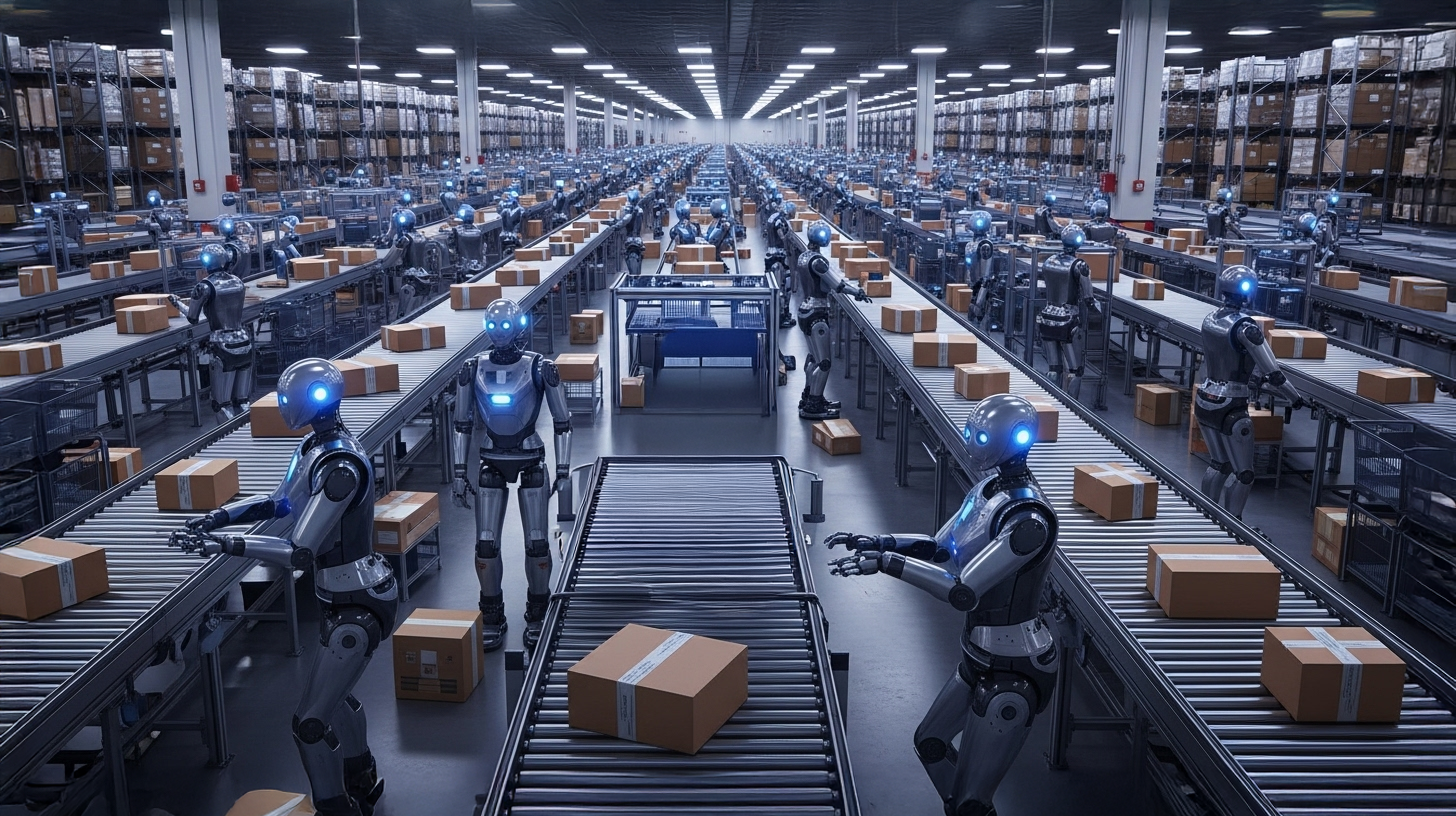
Leaked internal Amazon strategy papers: Will autonomous mobile robots eliminate 600,000 jobs? – Creative image: Xpert.Digital
The automation wave at Amazon: When the biggest employer becomes the biggest job killer
Amazon's calculated transformation
The leaked internal strategy documents of the world's largest online retailer read like a dry business plan, but their implications are epochal. According to the New York Times, Amazon is planning an automation offensive that could eliminate over 600,000 jobs in the US by 2033. This isn't about a gradual adaptation to technological changes, but a fundamental restructuring of the low-wage workforce. The figures are clear: By 2027, 160,000 new hires are to be avoided, while simultaneously automating 75 percent of all operational processes. The company anticipates savings of $12.6 billion within just two years – equivalent to a cost reduction of approximately 30 cents per shipped item.
This automation strategy is no longer a theoretical vision of the future. Amazon already operates over a million robots in its more than 300 logistics centers worldwide – a number that is dangerously close to its current workforce of around 1.5 million people. The newly developed AI system DeepFleet coordinates these robot fleets like an intelligent traffic management system, ensuring that robots now assist with 75 percent of all Amazon deliveries. From heavy-duty transport robots like Hercules, which can move up to 570 kilograms, to autonomous units like Proteus, and highly specialized robotic arms like Sparrow and Cardinal – the range of technologies used demonstrates the company's determination.
Particularly revealing is the planned communication strategy: According to the leaked documents, Amazon is considering replacing terms like automation or artificial intelligence with more neutral expressions such as advanced technology or cobots in order to defuse potential public resistance. This semantic camouflage reveals more about the anticipated societal tensions than any business forecast. The company itself dismisses the information as incomplete and emphasizes that the documents do not reflect its entire personnel strategy. However, the sheer consistency of the data from various sources, as well as the already visible developments in the warehouses, tell a different story.
Related to this:


The economic rationality of displacement
The economic logic behind Amazon's drive for automation is compelling. Studies on the cost-effectiveness of autonomous mobile robots and driverless transport systems show that investments in warehouse automation can pay for themselves within just one to two years – provided it operates on a three-shift system. The direct savings from reduced personnel costs are only one part of the equation. Automated systems operate with a precision that can reduce material damage by up to 60 percent, optimize routes, and minimize downtime through continuous operation. In Germany, where the average hourly wage in the logistics sector is €33.50 and the tax burden on low wages is 43.9 percent, automation appears virtually indispensable from a business perspective.
The global market for logistics robots vividly illustrates this development. From US$6.41 billion in 2024, it is projected to grow to US$20.5 billion by 2032 – an average annual growth rate of 16.7 percent. In 2023 alone, nearly 113,000 service robots for transport and logistics tasks were sold worldwide, with mobile robots recording a 24 percent increase in sales. These figures demonstrate that Amazon is by no means an isolated case, but merely the most visible protagonist of an industry-wide transformation. In Germany, the robot density in industry reached 415 industrial robots per 10,000 employees in 2023 – the third highest figure worldwide after South Korea and Singapore.
The development of humanoid robots marks the next stage of evolution. Systems like Digit from Agility Robotics, which is already being tested in Amazon warehouses, can lift, transport, and precisely place loads of up to 16 kilograms. Unlike previous generations of warehouse robots, which relied on specially adapted infrastructure, humanoid robots integrate seamlessly into existing work environments designed for humans. This characteristic makes them particularly cost-effective, as expensive modifications are unnecessary. Tesla with its Optimus model, Figure AI with Figure 02, Boston Dynamics with Atlas – the list of developers is growing, and analysts at Goldman Sachs predict that the market for humanoid robots could grow to over $150 billion by 2035.
The forgotten downside of efficiency
While Amazon sells its automation strategy as a necessary step forward, creating new, more skilled jobs in areas like maintenance, engineering, and AI-powered process optimization, the empirical evidence paints a more nuanced picture. The company points out that over 700,000 employees have already been retrained for new roles. But this portrayal obscures the fundamental asymmetry between the jobs lost and those created. The reality in Amazon's warehouses tells a different story.
Investigations by the US Senate committee led by Senator Bernie Sanders revealed shocking figures regarding working conditions. During Prime Day week in 2019, the overall injury rate in Amazon's American warehouses reached almost 45 percent – nearly half of all employees suffered an injury. The rate of reportable injuries was over 10 percent, more than double the industry average of 5.5 injuries per 200,000 work hours. Internal recommendations to lower productivity targets to curb injuries were rejected by Amazon management. The company, it is alleged, accepts employee injuries as a calculated cost of business.
These figures take on an additional dimension in light of automation plans. The robots are not primarily replacing dangerous or strenuous tasks – they are primarily replacing people whose work performance, under extreme time pressure, is already reaching its physical limits. The promised new jobs in maintenance and programming will never be able to compensate for the displaced warehouse positions. One maintenance technician can look after hundreds of robots; hundreds of warehouse workers create one maintenance technician job. The mathematical inequality is obvious.
The historical context: Creative destruction or destructive disruption
The Austrian economist Joseph Schumpeter coined the term "creative destruction" as a core mechanism of capitalist development. His thesis states that economic progress necessarily displaces and destroys old structures in order for something new to emerge. This perspective is often used to downplay technological unemployment as a temporary phenomenon. Historical examples seem to support this view: The Industrial Revolution of the 18th and 19th centuries destroyed countless craft professions, but ultimately created a wealthier society with more jobs in new sectors.
However, the current situation differs fundamentally from previous technological upheavals. The automation of routine tasks since the 1990s already led to a polarization of the labor market, primarily affecting the middle class. While highly skilled analytical jobs and low-skilled service jobs requiring physical presence and interpersonal interaction remained relatively protected, intermediate skill levels disappeared. Accountants, clerks, and skilled industrial workers faced technological substitution, with computer systems replacing their routine-dominated tasks.
The current phase of automation through AI and robotics differs qualitatively from this routine-biased technological change. For the first time, non-routine manual tasks are also affected—precisely those jobs that were previously considered difficult to automate. Humanoid robots like Digit or Optimus can grasp, navigate, and adapt to changing environments. The traditional protective function of flexibility and situational adaptation is eroding. At the same time, the process is accelerating: While previous industrial revolutions spanned generations and allowed time for societal adjustments, the current transformation is taking place within just a few years.
The Nobel laureate's warning
Daron Acemoglu, the economist who won the Nobel Prize in Economics in 2024, has been explicitly critical of Amazon's automation plans. His warning is unequivocal: Should Amazon implement its strategy, one of the largest employers in the US could transform from a job creator into a job destroyer. This assessment carries significant weight, because Acemoglu's research on the importance of inclusive institutions for economic prosperity has shown that technological progress alone is no guarantee of social progress.
Acemoglu's central thesis is that the way technological innovations are implemented significantly determines whether they benefit society as a whole or merely exacerbate existing inequalities. In Amazon's case, there is a risk of a signaling effect: if the company demonstrates that complete automation is economically superior, other companies will follow suit. The resulting domino effect could lead to a phenomenon that Goldman Sachs analysts call jobless growth—an economy that grows and is productive, but does not create jobs.
Empirical data from the US indicate that this process has already begun. Employment growth outside the healthcare sector has turned negative in recent months, while GDP has continued to grow robustly. McKinsey studies predict that between 39 and 73 million jobs could be lost to automation in the US by 2030, primarily in manufacturing, transportation, administration, and logistics. The net effect is estimated to be negative: without effective retraining programs, a loss of 19 to 23 million jobs is threatened. Young technology professionals, whose employment prospects have already deteriorated, are particularly affected.
🎯🎯🎯 Benefit from Xpert.Digital's extensive, five-fold expertise in one comprehensive service package | BD, R&D, XR, PR & Digital Visibility Optimization

Benefit from Xpert.Digital's extensive, five-fold expertise in a comprehensive service package | R&D, XR, PR & Digital Visibility Optimization - Image: Xpert.Digital
Xpert.Digital possesses in-depth knowledge across various industries. This allows us to develop tailored strategies precisely aligned with the requirements and challenges of your specific market segment. By continuously analyzing market trends and monitoring industry developments, we can act proactively and offer innovative solutions. The combination of experience and expertise generates added value and provides our clients with a decisive competitive advantage.
More information here:
Amazon replaces hundreds of thousands: Who bears the social costs?
The American dimension: low wages and lack of social security
The socioeconomic conditions in the USA significantly exacerbate the problem. Unlike in Germany, where only about 16 percent of the workforce lacks vocational training, this figure is almost 46 percent in the United States. This discrepancy reflects fundamental differences in education systems and labor market structures. The American labor market is characterized by pronounced wage polarization: an excellently trained and well-paid elite contrasts sharply with a poorly paid underclass comprising almost half of the workforce.
This structure has far-reaching consequences for the automation debate. While in Germany, in-company training, even for low-skilled workers, has increased over the past 15 years, it has declined in the USA during the same period. Companies in the American low-wage sector are no longer investing in the training of their employees – a rational decision if these workers are considered interchangeable or replaceable by machines anyway. Automation in the low-wage sector has already led to massive job losses in the USA, while in Germany, higher qualification levels and stronger institutional safeguards have so far allowed for relative stability.
Amazon's working conditions exacerbate this dynamic. The lack of unionization at most of Amazon's American facilities means that workers are largely defenseless against the company's downsizing strategies. While the Amazon Labor Union's historic victory at the JFK8 logistics center in New York in 2022 was an important milestone, Amazon has consistently refused any negotiations since then. Internal conflicts further weaken the union, while the corporation funds multi-million-dollar anti-union campaigns. The power and information asymmetry between one of the world's most valuable companies and precariously employed warehouse workers could hardly be greater.
Related to this:

The skills gap and the retraining dilemma
The idea that displaced warehouse workers could be retrained as AI developers or robotics specialists lacks any realistic basis. While experts rightly emphasize the need for retraining and further education in future-oriented fields such as data science, artificial intelligence, and automation technology, the hurdles are immense. Retraining as a data scientist or AI developer generally requires a university degree or at least extensive prior knowledge of mathematics and programming. A 45-year-old warehouse worker without formal vocational training, who has sorted packages for years, will only be able to undergo this transformation in exceptional cases.
The World Economic Forum estimates that by 2025, around 85 million jobs will be displaced due to the shift in the division of labor between humans and machines, while at the same time 97 million new jobs could be created. However, this aggregated view obscures individual fates and regional disparities. The new jobs are primarily located in urban technology hubs and require skills that necessitate several years of training. In contrast, the displaced jobs are located in logistics centers in rural areas and are filled by people whose formal education is often based on a high school diploma or less.
Even with massive investments in continuing education programs, the time dilemma remains. The World Economic Forum estimates that 40 percent of the core competencies of 50 percent of all workers will change within the next five years. The window of opportunity for adaptation has shrunk to just a few years due to the combination of automation and other disruptions. However, substantial retraining often takes two to four years—time that many affected individuals simply don't have, given economic constraints. The discrepancy between the speed of technological change and the inertia of human learning processes represents a fundamental challenge for which no convincing solutions yet exist.
Systemic fragility and societal tensions
The macroeconomic implications of Amazon's automation strategy extend far beyond the jobs directly affected. When one of the largest private employers in the US systematically eliminates low-wage jobs without creating equivalent alternatives, cascading effects occur. The purchasing power of millions of households declines, dampening consumer demand—the very foundation upon which Amazon's own business model rests. This inherent contradiction was recognized as early as the 1920s by Henry Ford, who paid his workers above-average wages so they could afford his cars.
The fiscal consequences are also significant. Unemployed or underemployed former warehouse workers no longer pay income taxes and social security contributions, but at the same time place a greater burden on social security systems. In the US, where the social safety net is already porous, there is a risk of exacerbating the already pronounced inequality. Data shows that as early as 2014, one percent of the world's population owned over 48 percent of global wealth. Automation threatens to further intensify this concentration, as productivity gains primarily accrue to capital owners, while labor incomes erode.
Political instability is a likely consequence of this development. Historically, technological upheavals that deprived large segments of the population of their livelihoods have always been accompanied by social unrest. The Luddite movement of the early 19th century, the labor unrest of industrialization, the protests against globalization and outsourcing—all these phenomena reflect resistance to changes perceived as threatening and unjust. The current popularity of populist movements in the US and Europe is fueled, not least, by the diffuse fear of economic decline, which large parts of the population are already experiencing or anticipating.
Amazon's communication strategy of portraying automation as an advanced technology and avoiding the term artificial intelligence demonstrates an awareness of these tensions. However, semantic obfuscation will not change the material realities. When hundreds of thousands of people lose their jobs while stock prices soar and corporate profits reach new records, the social legitimacy of such a system is fundamentally called into question.
Alternatives and regulatory options
The question is not whether automation is happening – it is already a reality and will continue. The crucial question is how it is designed and who bears its costs and benefits. Various regulatory approaches are conceivable to mitigate the negative consequences and achieve a more inclusive distribution of productivity gains.
A robot tax, as proposed by Bill Gates among others, might not prevent automation, but it could slow its pace and generate revenue to fund retraining programs and social security. The basic idea is that companies would pay a levy for each human job replaced, equivalent to the lost income tax and social security contributions. Critics argue that such a tax would stifle innovation and jeopardize international competitiveness. Proponents counter that the long-term societal costs of uncontrolled automation outweigh any short-term competitive disadvantages.
A reduction in working hours with full wage compensation is another option that has been successfully used in the past to manage productivity gains. If robots take over some of the work, the remaining human labor could be distributed among more people, allowing everyone to work less but still earn a living. Historically, reduced working hours have been a key mechanism for distributing the productivity gains of industrialization: the 40-hour week was unthinkable in the 19th century but is standard today. A further reduction to 30 or 25 hours could have a similar effect.
Unconditional basic income is being discussed as a more radical solution. If human labor is increasingly replaced by machines, a basic income decoupled from earned income could guarantee material security. It would be financed by taxing corporate profits and wealth resulting from automation. Critics warn of work incentive problems and fiscal unsustainability. However, pilot projects in various countries have shown that many people continue to work despite a basic income, often in more self-determined and creative roles.
Stronger employee rights and co-determination could also play a role. In Germany, the co-determination system prevents rationalization decisions from being made solely by capital. Works councils and trade unions have influence over shaping technological change. In the US, such structures are largely absent, giving companies like Amazon enormous leeway. Strengthening union organization and statutory co-determination rights could at least ensure a more socially responsible implementation of automation.
The Paradox of Progress
The current situation reveals a fundamental paradox: Humanity possesses technologies that could theoretically enable everyone to live a life of material prosperity while simultaneously reducing their workload. Robots and AI could take over monotonous, dangerous, and stressful tasks, allowing people to dedicate themselves to more creative, fulfilling, and socially valuable endeavors. However, instead of realizing such a utopian vision, automation under current conditions threatens to plunge millions into unemployment and poverty, while a small elite monopolizes the productivity gains.
Amazon's automation strategy is symptomatic of a broader systemic problem in this context. The company operates rationally within existing incentive systems. Shareholders demand profit maximization, competitors focus on increasing efficiency, and consumers expect low prices and fast delivery. Automation makes all of this possible. The fact that hundreds of thousands of jobs are lost and social tensions increase in the process appears, from a business perspective, to be external effects that are not factored into the calculations.
However, external effects have the unpleasant tendency to eventually become internalized—just not voluntarily. When social upheaval reaches a level that threatens political stability, governments will be forced to intervene. The question is whether this intervention will be preventive and proactive, or reactive and chaotic. History shows that technological upheavals accompanied by significant social costs have ultimately always provoked regulatory responses—from the Factory Act in Victorian England to Bismarck's social legislation and Franklin D. Roosevelt's New Deal programs.
A turning point for the working world of the 21st century
Amazon's plan to replace 600,000 jobs with robots is more than just a corporate decision. It's a precedent that could shape the future of work for decades to come. If the largest private employer in the US demonstrates that complete automation in the low-wage sector is not only technically feasible but also economically superior, others will follow. The signal effect is enormous.
The leaked internal documents reveal a strategy that ruthlessly exploits technological possibilities without adequately considering the societal consequences. The planned obfuscation through euphemisms like "advanced technology" demonstrates that the company is indeed aware of the explosive nature of its plans. However, awareness alone does not lead to behavioral change as long as the economic incentives clearly favor automation.
Daron Acemoglu's warning that Amazon could transform from a job creator into a job destroyer should be taken seriously. The Nobel laureate's research has shown that institutions and societal frameworks determine whether technological progress is inclusive or exacerbates inequality. In Amazon's case, the institutional safeguards that would ensure socially responsible automation appear to be lacking. The absence of unionization, weak employee rights, inadequate social safety nets, and policies that prioritize corporate interests—all of this creates an environment in which the negative consequences of automation are maximized.
At the same time, it would be wrong to demonize technology or reject automation outright. History shows that technological progress cannot be stopped and, in the long run, has indeed led to greater prosperity. However, this prosperity was never distributed automatically and equally. It had to be fought for, fought for, and shaped through astute policy. The challenge lies in developing mechanisms that ensure the productivity gains of automation are widely shared, rather than concentrated in the hands of a few.
The coming years will show whether modern societies are capable of shaping this technological transformation or whether they will be shaped by it. Amazon's automation plans are a stress test for democratic systems, social market economies, and the idea that economic progress should benefit everyone. The outcome of this test is by no means predetermined. It depends on political decisions, societal power dynamics, and the ability to reconcile short-term business rationality with long-term societal common sense. The leaked documents from Seattle are less a glimpse into an inevitable future than a warning about a possible future—and thus also a call to pursue alternative paths.
Your global marketing and business development partner
☑️ Our business language is English or German
☑️ NEW: Correspondence in your native language!

Konrad Wolfenstein
I and my team are happy to be available to you as your personal advisor.
You can contact me by filling out the contact form here wolfenstein@xpert.digital:or simply call me at +49 7348 4088 965. My email address is
I'm looking forward to our joint project.
☑️ SME support in strategy, consulting, planning and implementation
☑️ Creation or realignment of the digital strategy and digitization
☑️ Expansion and optimization of international sales processes
☑️ Global & Digital B2B trading platforms
☑️ Pioneer Business Development / Marketing / PR / Trade Fairs
Our US expertise in business development, sales and marketing

Our US expertise in business development, sales and marketing - Image: Xpert.Digital
Industry focus areas: B2B, digitalization (from AI to XR), mechanical engineering, logistics, renewable energies and industry
More information here:
A thematic hub offering insights and expertise:
- Knowledge platform covering global and regional economies, innovation and industry-specific trends
- A collection of analyses, insights, and background information from our key areas of focus
- A place for expertise and information on current developments in business and technology
- A hub for companies seeking information on markets, digitalization, and industry innovations