


Using the GS1 SMART-Box and the GS1 2D DataMatrix code for intelligent logistics in food distribution – Image: Xpert.Digital
Digital transformation in the food industry: How 2D codes reduce waste by 50%
Parla Deli demonstrates: Digitization leads to less food waste
The introduction of 2D codes and smart reusable containers will fundamentally transform the food industry. Brazilian delicatessen Parla Deli demonstrates how digital technologies can reduce waste, automate processes, and promote sustainability by integrating QR codes with GS1 Digital Link and the GS1 SMART-Box. By combining precise data capture, real-time communication with suppliers, and dynamic pricing, the company succeeded in reducing food waste by 50%. This report analyzes the technological, operational, and strategic innovations that enabled this success and highlights their implications for the global food industry.
Related to this:
Technological foundations: From 2D codes to intelligent logistics
The development of barcode technology
The transition from linear 1D barcodes to two-dimensional codes marks a paradigm shift in supply chain logistics. While traditional barcodes could only encode the GTIN (Global Trade Item Number), 2D codes such as QR codes or GS1 DataMatrix allow for the storage of additional data like batch numbers, expiration dates, and serial numbers. The GS1 Digital Link syntax further extends this functionality by providing a structured URL that links both machine-readable data and consumer-facing content. At Parla Deli, each QR code contains the GTIN, lot number, production and expiration dates, net weight, and price, enabling seamless traceability and automated inventory management.
Data density and flexibility
A key advantage of 2D codes lies in their compactness: they store up to 100 times more information than 1D codes in the same space. This capacity allows for the embedding of dynamic data that can be updated with every scan. Parla Deli thus uses the same code for inventory management, point-of-sale transactions, and customer interaction – without having to make any physical changes to the packaging.
Implementation at Parla Deli: A systemic approach
Automated waste reduction through real-time data
The core of Parla Deli's system is the integration of 2D codes with a cloud-based ERP platform. When the code is scanned at the checkout or in the warehouse, the expiration date and stock level are automatically recorded. Algorithms classify products into three categories based on their shelf life:
- Optimal freshness (more than 75% of shelf life remaining)
- Discount level 1 (50–75% remaining)
- Discount level 2 (remaining below 50%).
A rules-based system adjusts prices in real time, with discount levels being transferred to digital price tags and online shops. This approach reduced waste of perishable goods by 40% within the first six months.
Integration of the GS1 SMART-Box into the supply chain
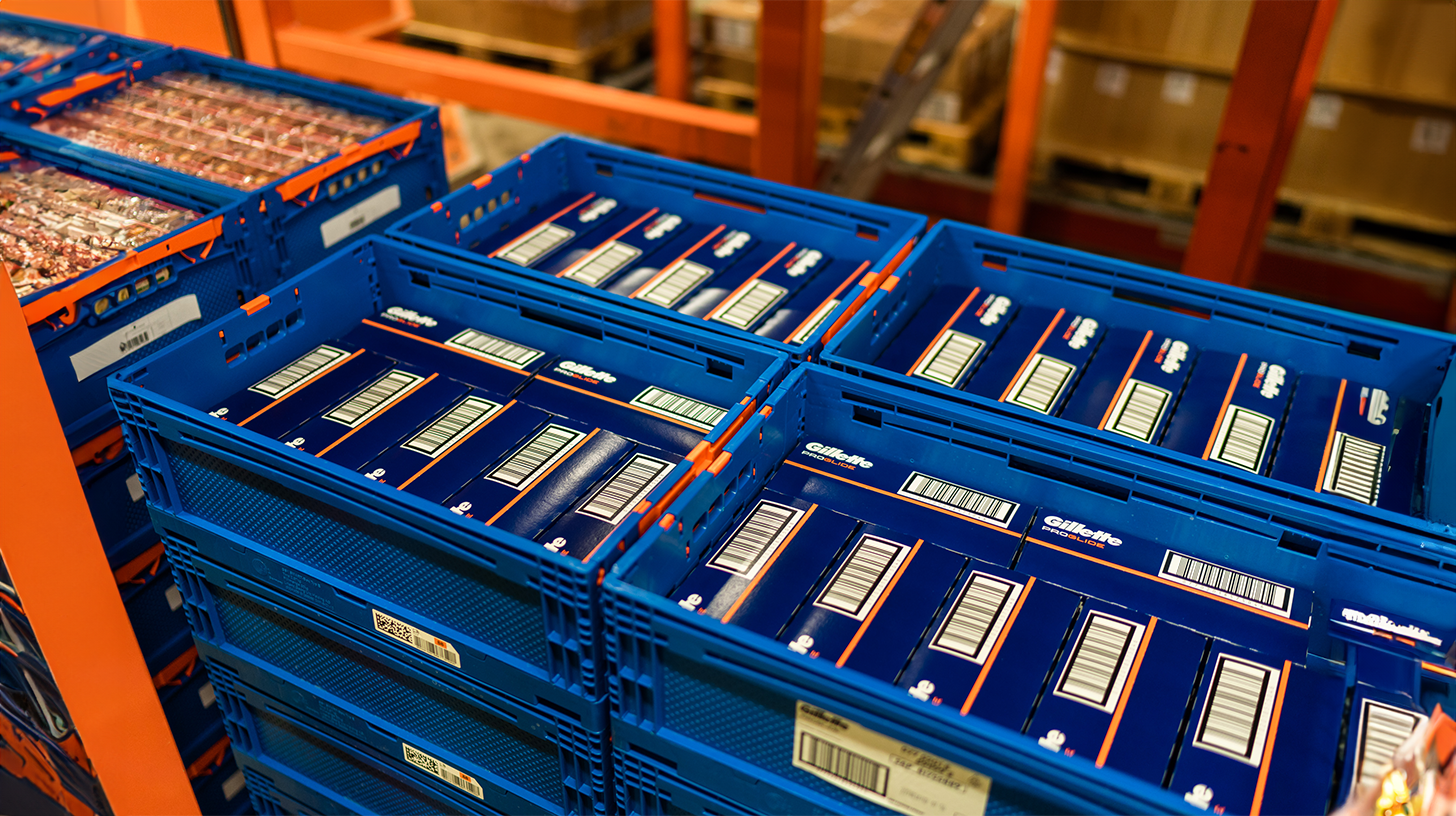
Integration of the GS1 SMART-Box into the supply chain – Image: GS1
The GS1 SMART-Box – a standardized reusable container with GRAI (Global Returnable Asset Identifier) – plays a central role in logistics. Each box is equipped with RFID tags and a 2D code that tracks the following:
- Real-time location
- Temperature trend (via IoT sensors)
- Filling weight.
This data is fed into a forecasting model that predicts the demand for each branch. At Parla Deli, this reduced excess inventory by 30% and improved delivery accuracy to 98%.
Supply chain synchronization: From supplier to consumer
Dynamic supplier communication
Parla Deli's ERP system is connected to the Verified by GS1 network, a global product data validation service. When sensors in the SMART boxes report a critically low stock level, the system automatically generates orders with pre-qualified suppliers. Specifications include:
- Required batch numbers
- Maximum transport duration (based on expiration dates)
- Preferred SMART Box capacity.
Suppliers gain access to a real-time KPI dashboard that tracks their performance in terms of delivery reliability, cold chain, and container return.
Consumer interaction and circular economy
The GS1 Digital Link in the QR code enables multifunctional consumer interaction:
- When scanned in-store: Display of recipe suggestions and discounts
- Post-purchase: Access to certificates of origin and recycling information
- Returns management: Automated refunds for quality defects, identifiable by the serial number.
Through a gamification app, customers collect points for scanning products nearing their expiration date, which they can redeem for sustainable products – an approach that further reduced the waste rate by 8%.
Ecological and economic impacts
Reducing food waste
Before implementation, 18% of Parla Deli's fresh produce ended up in the trash. Predictive order management and dynamic pricing reduced this rate to 9% – a saving of 62 tons of food per year. The SMART-Box contributed an additional 12% to the reduction by minimizing damage during transport.
Cost efficiency in logistics
Standardization on the GS1 SMART-Box eliminated manual process steps:
- Order picking time decreased from 45 to 12 minutes per pallet
- Truck utilization increased from 78% to 94% thanks to stackable containers
- Return costs were reduced by 60% thanks to RFID-based tracking.
Overall, the company saved €520,000 annually – with a payback period for the technology investments of less than two years.
Challenges and limitations of the technology
Interoperability in heterogeneous supply chains
Despite adhering to GS1 standards, Parla Deli encountered compatibility issues: 23% of suppliers were using outdated WMS systems that could not process GS1 Digital Links. The solution involved providing API adapters that translate GS1 data into proprietary formats.
Related to this:
Data security and consumer trust
Storing batch data in public QR codes required robust encryption. Parla Deli implemented tokenized access for this purpose: Sensitive data remains in a private blockchain, while the QR code contains only a temporary access token.
Future prospects: Scaling and artificial intelligence
Predictive Analytics for Supply Chain 4.0
Parla Deli is currently testing an AI model that combines weather data, social media trends, and historical sales patterns to predict demand with 92% accuracy. The system automatically recommends:
- Optimal discount levels for seasonal products
- Ideal SMART-Box configurations for peak season
- Preventive maintenance intervals for cooling equipment based on sensor data.
Global standardization needs
While the EU mandates the widespread use of 2D barcode scanners at checkout counters by 2027, the necessary infrastructure is still lacking in many regions. GS1 estimates that 35% of SMEs in emerging markets need investment assistance to avoid falling behind.
Blueprint for a sustainable food industry
Parla Deli's success proves that the symbiosis of 2D codes, IoT-enabled logistics, and data-driven decision-making enables systemic change. Crucial to this success was the holistic integration of all stakeholders – from suppliers and warehouse workers to end consumers. While technical hurdles such as interoperability and cybersecurity remain challenges, the model offers a scalable solution for achieving the UN's goals for reducing food waste. The next stage of evolution will involve the integration of decentralized ledgers to create a fully transparent and tamper-proof representation of supply chains.
Related to this:
We are here for you - Consulting - Planning - Implementation - Project Management
☑️ Our business language is English or German
☑️ NEW: Correspondence in your native language!

Konrad Wolfenstein
I and my team are happy to be available to you as your personal advisor.
You can contact me by filling out the contact form here wolfenstein@xpert.digital:or simply call me at +49 7348 4088 965. My email address is
I'm looking forward to our joint project.