
Instead of Managed AI: Why Rewe relies on Camunda for its logistics – AI agents under control – Image: Xpert.Digital
Fear of vendor lock-in? The real reason for Rewe's new software strategy
How Rewe is digitally preparing for the next wave of automation
Who will control the supermarket of the future? Rewe's ingenious move in process automation
The digital transformation of the grocery retail sector is reaching a new dimension. When a giant like Rewe decides to manage its highly complex merchandise management and logistics processes via the Camunda orchestration platform, it's about far more than just a routine IT update. It's a strategic answer to one of the most pressing questions in modern business management: How can artificial intelligence (AI) be integrated productively and, above all, legally compliant into business-critical processes without relinquishing control to external providers? In an environment characterized by strict KRITIS regulations, looming NIS2 regulations, and the constant threat of supply chain disruptions, digital governance is moving into the spotlight. This article analyzes in depth why Rewe is consciously opting for so-called "agentic orchestration" instead of traditional managed AI solutions, how the company is protecting itself against technological dependencies, and why this strategic decision could serve as a blueprint for the entire retail and logistics industry.
When software selection becomes a strategic decision
The announcement that Rewe will digitally manage its merchandise management and logistics via the Camunda platform seems at first glance like a typical IT news item from the retail sector. In reality, however, this decision represents a fundamental economic shift that extends far beyond the individual case of Rewe. It concerns the question of who will retain control over the most critical processes of a retail group as artificial intelligence increasingly intervenes in operational procedures.
Camunda positions itself not as a traditional AI provider, but as a so-called platform for agentic orchestration. Essentially, this means that the software itself does not generate content, train language models, or possess any independent cognitive abilities. Instead, it assumes the role of a conductor, determining when which actor—whether human, IT system, or AI agent—becomes active at which point in a business process. This distinction is crucial for understanding the true economic implications of Rewe's decision.
The invisible infrastructure behind billions of goods movements
Rewe Digital is the technology subsidiary of the Rewe Group and, as the group's largest IT unit, is responsible for the digital services of several million customers and around 380,000 employees across the entire group, with approximately 2,500 employees at eleven locations in five countries. Logistics, inventory control, and supply chain management are among the core tasks of this unit, as it must ensure the daily supply of food to more than 80 million people.
In this environment, Rewe Digital is now relying on Camunda to manage orders, invoices, and logistics processes with suppliers and partners more reliably, scalably, and transparently. The decisive factor from the software provider's perspective was that the application can be adapted during operation and integrated into the existing IT architecture without major system changes. For a company of this size, which moves enormous quantities of goods daily through a complex network of warehouses, vehicle fleets, and supplier relationships, this operational continuity is a value that translates directly into euros and cents, because any system downtime in food logistics causes immediately measurable costs and, in the worst-case scenario, supply shortages.
BPMN as a common language between department and technology
A key element of the Camunda platform is BPMN modeling, or Business Process Model and Notation. This is a graphical notation language used to represent business processes as flowcharts that can be read and understood by both IT professionals and employees without programming knowledge. Frank Rothmann, Senior Product Owner for Workload Automation at Rewe digital, emphasizes that this common language between technology and business departments is crucial in a company of this size because complex and dynamic processes must be mapped in a way that is comprehensible to all involved.
This transparency is by no means merely a convenient feature for internal communication. It fulfills a concrete regulatory function, because Rewe, due to its size in the food retail sector, is classified as a KRITIS company, meaning an operator of critical infrastructure. In Germany, for the food sector, thresholds of approximately 434,500 tons of food or 350 million liters of beverages per year apply, above which companies are classified as critical infrastructure and are therefore subject to strict legal reporting requirements. Systems for central control and monitoring, such as ERP, merchandise management, and warehouse management systems, are explicitly mentioned – precisely the area in which Camunda is now being used.
Regulatory pressure as the actual driver of the decision
The European NIS2 Directive and the German IT Security Act are continuously tightening the requirements for operators of critical infrastructure. Companies must conduct risk assessments, establish documented incident response processes, report security incidents to the Federal Office for Information Security (BSI) within a short timeframe, and regularly provide evidence of their IT security measures. Violations can be sanctioned with fines of up to €20 million and, in cases of proven negligence, with personal liability for management.
From this perspective, the choice of Camunda appears less as a decision for a particularly innovative tool and more as a decision for legal certainty. The software provider itself explicitly points to a unified, compliant, and auditable orchestration layer designed to make it easier for retailers to comply with stringent legal requirements. Equally important was the platform's enterprise maturity, as while open-source solutions offer a low barrier to entry, professional vendor support, clear liability terms, and guaranteed response times are essential for business-critical infrastructure.
What Camunda can actually do technically and what it can't
To answer the question of whether Camunda is a managed AI, it's first necessary to clarify what the term "managed AI" actually describes. Managed AI typically refers to the outsourcing of AI functions and responsibilities to a specialized external service provider who takes over all or parts of the AI lifecycle. This includes preparing training data, developing and training models, deploying them in production environments, and continuously monitoring, scaling, and maintaining these models. Ideally, the customer focuses solely on using the AI functionality, while the provider handles all the technical complexity in the background.
Camunda does not meet this definition, nor does the platform claim to. Camunda does not train its own language models, does not operate its own AI infrastructure in the sense of machine learning data centers, and assumes no responsibility for the quality of AI-generated responses. Instead, the company explicitly positions itself as an LLM-agnostic orchestration layer that sits above existing systems, agents, and automation tools, coordinating when and how each agent, language model, or human becomes active in a process. Camunda describes itself as a layer that remains consistent regardless of which model or cloud provider is being replaced in the background.
The architectural separation of decision-making and execution
From a technical perspective, the Camunda architecture is based on a deliberate separation of two responsibilities. On the one hand, there is the language model, which interprets the system prompt, the current user request, and the available tool descriptions, and decides which tool is called, in what order, and with which parameters. On the other hand, there is Camunda itself, which actually executes the specifically selected BPMN activities, permanently stores the process state, handles retries and fault management, and ensures the coordination of human tasks and deterministic process logic.
This approach allows AI agents to be treated as equal participants within a business process without granting them unrestricted autonomy. Each agent runs as an ad-hoc subprocess with its own language model, tools, system prompt, and structural guardrails. The underlying execution system, Zeebe, is event-driven, horizontally scalable, and stores the state at each step, creating a complete audit trail for every process execution.
A new dimension of digital transformation with 'Managed AI' (Artificial Intelligence) - Platform & B2B solution | Xpert Consulting

A new dimension of digital transformation with 'Managed AI' (Artificial Intelligence) – Platform & B2B solution | Xpert Consulting - Image: Xpert.Digital
Here you will learn how your company can implement customized AI solutions quickly, securely and without high entry barriers.
A managed AI platform is your all-inclusive, worry-free solution for artificial intelligence. Instead of dealing with complex technology, expensive infrastructure, and lengthy development processes, you receive a ready-made solution tailored to your needs from a specialized partner – often within just a few days.
The key advantages at a glance:
⚡ Rapid implementation: From idea to ready-to-use application in days, not months. We deliver practical solutions that create immediate added value.
🔒 Maximum data security: Your sensitive data stays with you. We guarantee secure and compliant processing without sharing data with third parties.
💸 No financial risk: You only pay for results. High upfront investments in hardware, software, or personnel are completely eliminated.
🎯 Focus on your core business: Concentrate on what you do best. We take care of the entire technical implementation, operation, and maintenance of your AI solution.
📈 Future-proof & scalable: Your AI grows with you. We ensure continuous optimization and scalability, and flexibly adapt the models to new requirements.
More information here:
Why Rewe focuses on governance rather than managed services for AI
Governance instead of intelligence as the core promise
This governance capability is precisely where Camunda's true value lies – and at the same time, the fundamental difference to a managed AI solution. While a managed AI platform is primarily designed to give companies quick and easy access to powerful AI capabilities without requiring them to build their own technical expertise, Camunda pursues a different goal. It's about channeling existing or acquired AI capabilities, regardless of the provider, into controlled, traceable, and regulatory-compliant channels.
Camunda itself articulates this claim with the analogy that the platform orchestrates agents from the outside while simultaneously integrating enforceable control points from within the process, ensuring that guidelines, approvals, and escalation paths are firmly embedded in the workflow and do not need to be added retroactively. For a critical infrastructure company like Rewe, this promise is the decisive lever, as it allows for the future integration of AI agents into business-critical processes without sacrificing the required human oversight, auditability, and traceability necessary for the transition from the pilot phase to productive use.
Would a managed AI have been the better choice?
The question of whether a traditional managed AI solution would have been the better alternative for Rewe can be clearly answered in the negative from an economic perspective, for several independent reasons. Firstly, a managed AI platform addresses a different problem: providing rapid and low-risk access to AI functionality for companies that are unwilling or unable to develop in-depth technical expertise themselves. However, Rewe Digital already possesses one of the largest IT organizations in the German retail sector, with nearly 2,500 in-house IT specialists. Therefore, Rewe Digital does not have the need to completely outsource technical complexity, but rather the need to orchestrate a growing number of heterogeneous systems and, in the future, AI agents from various providers in a controlled manner.
Secondly, committing to a single managed AI platform would effectively mean dependence on a specific model provider or AI architecture. For a company that has worked with different suppliers, partners, and systems over many years and whose technological landscape is constantly evolving, such a commitment would pose a significant strategic risk. For example, if a different language model turns out to be better suited for certain tasks, or if a provider drastically increases its prices, the entire process landscape would have to be rebuilt in the worst-case scenario of a managed AI solution. In contrast, Camunda's orchestration model allows the underlying model to be replaced without requiring a complete remodel of the overarching business process.
Thirdly, the regulatory situation in the food retail sector is a crucial factor. As a critical infrastructure operator, Rewe requires complete traceability of which decisions were made, when, by whom, and on what basis. A managed AI solution, where an external service provider is responsible not only for the infrastructure but also for significant parts of operational control and sometimes even the model selection itself, would potentially complicate this chain of evidence because it creates additional dependencies on the transparency and willingness to cooperate of an external provider. In contrast, the orchestration approach retains control over the entire decision-making process in-house, while only the actual cognitive performance, i.e., the language model, can be outsourced.
The economic logic of manufacturer neutrality
Another economically significant aspect is the so-called vendor neutrality of the Camunda architecture. The company actively promotes the fact that customers can use any agent framework, any language model such as GPT-4, Gemini, or Claude, and any cloud provider without having to rewrite the underlying process logic when switching. For a company the size of the Rewe Group, which operates heterogeneous IT systems that have evolved over decades and simultaneously needs to continuously integrate new technologies, this independence from individual technology providers is a considerable strategic advantage, resulting in lower switching costs and greater negotiating power with individual AI providers.
This logic can be explained by the classic economic concept of vendor lock-in. Anyone who relies entirely on a single provider's closed managed AI platform creates a dependency that, in the medium to long term, weakens their negotiating position with that provider and limits their flexibility in responding to technological innovations from other market participants. A vendor-independent orchestration layer like Camunda significantly reduces this risk, as it acts as a neutral intermediary, enabling the replacement of individual components without jeopardizing the overall architecture.
Scaling as a core business management issue
An often underestimated aspect of Rewe's decision is the sheer size of the company. With millions of customer interactions per week, hundreds of thousands of employees, and a logistics network that supplies more than 80 million people with groceries, Rewe operates on a scale where even minor inefficiencies in process control can add up to significant absolute costs. A central, networked orchestration layer that coordinates orders, invoices, and logistics processes with suppliers and partners promises direct savings through lower error rates, faster throughput times, and better utilization of existing inventory management systems.
The fact that the application can be adapted during operation is by no means a minor economic consideration. Any major system change in a company of this size typically incurs significant conversion costs, productivity losses during the transition phase, and considerable operational risk. A solution that can be implemented gradually and in parallel with existing systems significantly minimizes these transformation costs and allows Rewe to make and evaluate the investment in smaller, manageable steps before a company-wide rollout.
Preparing for the next wave of automation
What's remarkable about the communication from Rewe digital and Camunda is that the current rollout is explicitly described as a preliminary step towards deeper AI integration. As a next step, Rewe digital intends to extend the orchestration platform to other business areas, thereby simultaneously preparing for the regulatory-compliant use of AI across the entire process chain. This wording reveals much about the project's true strategic priority, as it shows that the real transformative impact is only expected to emerge in a second phase, when autonomous AI agents are gradually embedded into already established, monitorable process structures.
This approach reflects an increasingly common pattern in business practice, where companies first establish the organizational and technical foundation for governance and traceability before actually integrating autonomously acting AI systems into business-critical areas. The reason is obvious: an AI agent that independently adjusts orders, manages supplier communication, or performs invoice checks in a logistics process can cause significant economic damage if it makes incorrect decisions. Without a robust control structure that logs every single step and allows for human intervention if necessary, such deployment would hardly be justifiable in a critical infrastructure company.
Economic risks and open questions
Despite the compelling governance arguments, closer examination reveals some critical points. Firstly, it remains unclear to what extent and with what investment volume Rewe is actually using the platform, as the available information comes solely from a press release by the software provider and lacks independent confirmation from Rewe itself or details regarding costs and contract durations. Such announcements naturally also serve the provider's own promotional purposes, which is why a degree of caution is warranted when assessing the actual impact.
On the other hand, the increasing centralization of business processes on a single orchestration platform creates a new form of dependency, one that is not tied to a specific AI model, but rather to the orchestration provider itself. Should Camunda encounter financial difficulties, significantly alter its pricing structure, or shift strategic priorities, Rewe Digital would face considerable costs should a change become necessary. This concentration of operational control on a single infrastructure provider, even one that operates model-agnostic, remains a structural risk that is naturally not addressed in public discourse.
Significance for the entire retail industry
Beyond the specific case of Rewe, this decision can be interpreted as a signal for the entire retail and logistics sector. Given the increasing regulatory requirements imposed by NIS2 and the KRITIS overarching law, which have been intensifying since 2025 and 2026 respectively, many companies in the food retail sector face the same challenge: to use artificial intelligence productively without compromising the necessary accountability and controllability of their systems. Camunda's positioning as a neutral governance layer between business processes and AI capabilities thus addresses a critical issue that extends far beyond the retail sector and is potentially relevant for all regulated, process-intensive industries – from finance and energy supply to healthcare.
In this respect, the Camunda-Rewe collaboration can be seen as an exemplary case of a larger trend in which companies are increasingly recognizing that the real challenge of AI implementation lies not in the availability of powerful language models, which are now provided by numerous vendors at competitive prices, but in the reliable, auditable, and legally compliant integration of these models into existing, often long-established and highly regulated business processes. Companies that outsource this integration to an external managed AI provider risk losing precisely the control that, for a critical infrastructure company like Rewe, constitutes the very foundation of its digital sovereignty.
📈🚀 From visibility to trust 👀🤝 Your scalable path with Xpert.Digital

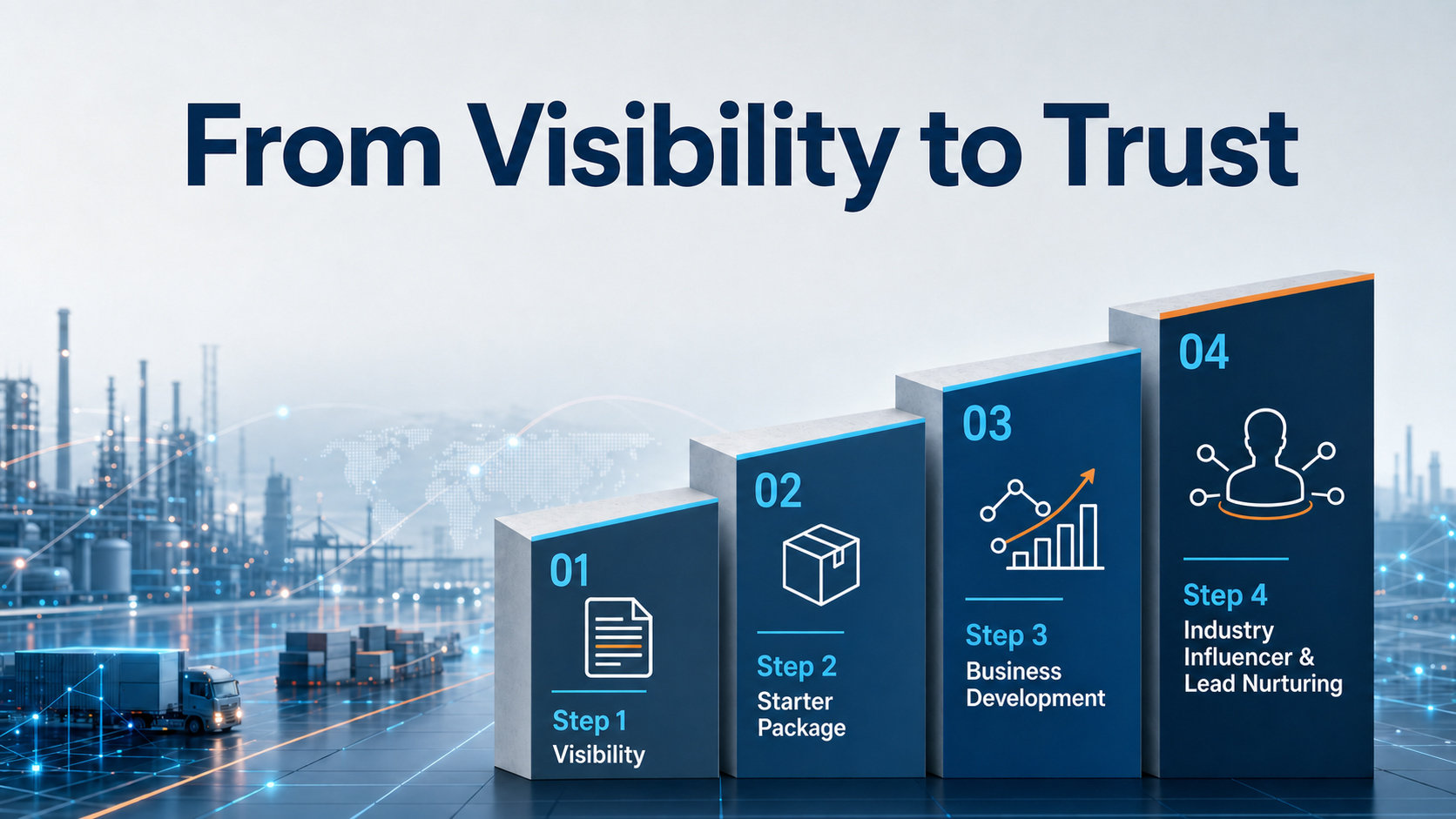
From visibility to trust: Your scalable path with Xpert.Digital - Image: Xpert.Digital
In industrial B2B, sustainable business relationships rarely emerge overnight. They develop step by step – through visibility, professional relevance, recurring touchpoints, and growing trust. Xpert.Digital's 4-stage model addresses precisely this: It offers a structured path that begins with a manageable entry point and can evolve into deeper collaboration in business development if needed.
Instead of relying on loud marketing promises, this model puts the relationship at the forefront. Companies start with clearly defined, easily calculable measures and then decide, based on their own experience, how far they want to expand the collaboration. A key factor for this undisturbed trust-building process: The platform completely avoids annoying advertising ads, so the editorial focus remains solely on the companies' expertise.
More information here:
Your global marketing and business development partner
☑️ Our business language is English or German
☑️ NEW: Correspondence in your native language!

Konrad Wolfenstein
I and my team are happy to be available to you as your personal advisor.
You can contact me by filling out the contact form here wolfenstein@xpert.digital:or simply call me at +49 7348 4088 965. My email address is
I'm looking forward to our joint project.