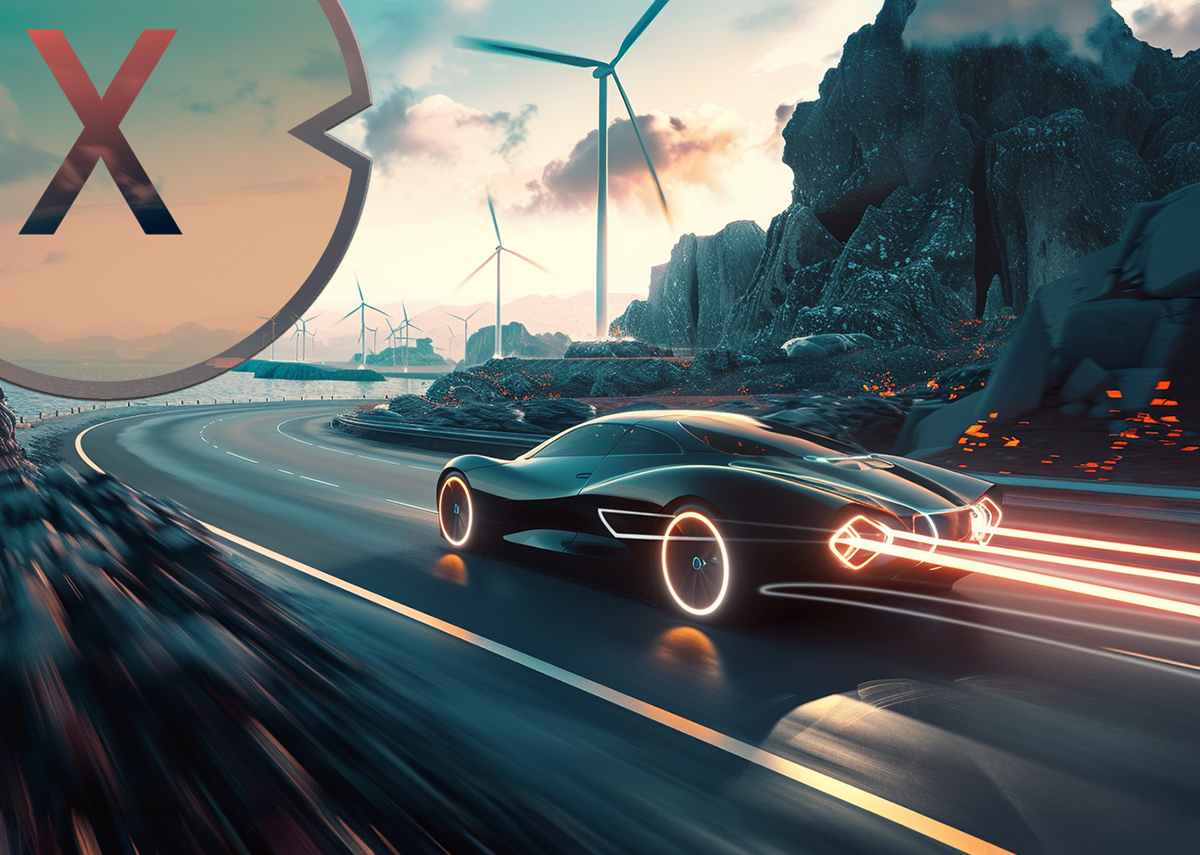
China's lead in electromobility is not solely due to a lack of innovation among EU car manufacturers – Image: Xpert.Digital
🚗🔋 China's lead in electromobility: Challenges and opportunities for Europe
🏭 Innovation crisis: Europe's automotive industry compared to China 🇨🇳
China's lead in electromobility is currently the subject of heated debate. Karlheinz Zuerl, CEO of the German Technology & Engineering Corporation (GTEC), has a clear opinion on this: the crisis at Volkswagen and other European car manufacturers is largely self-inflicted. He emphasizes that European industry has not been innovative enough compared to China for many years, and not only in the automotive sector.
Zuerl cites concrete examples from the Chinese automotive industry to support his thesis. Manufacturers like Li Auto and Leapmotor have achieved enormous success with their range-extender concepts. These vehicles, known as EREVs (Electrical Range Extender Vehicles) or REEVs (Range-Extender Electric Vehicles), use an electric motor as their drive system, just like conventional electric cars. However, they also feature a compact combustion engine that recharges the battery while driving, thus increasing the range by several hundred kilometers. This alleviates range anxiety for consumers and makes the vehicles usable even in regions with limited charging infrastructure.
🚌 🪫 Insights into China's innovation: Battery swapping and range 🌍
Another example of China's innovative strength is Nio's battery swapping concept. The company has built a network of swapping stations where a nearly empty battery can be exchanged for a fully charged one within minutes. Long charging times are thus a thing of the past, significantly increasing convenience for consumers.
BYD has reached another milestone with the introduction of the Blade battery, which uses lithium iron phosphate instead of the usual nickel-cobalt-manganese. This technology is considered particularly safe, less susceptible to thermal runaways, and characterized by low production costs. The flat design also allows for more efficient integration into the vehicle.
🤖 Autonomous Driving: China's Technological Advances 🤖
In the field of autonomous driving, Zuerl highlights XPeng's XPilot system, which is considered superior to Tesla's Autopilot (Full Self-Driving) in urban traffic. Xiaomi is also bringing a breath of fresh air to the industry with its MS11 electric car. Here, the driver can customize the cockpit by attaching flexible control elements later using magnets – a concept reminiscent of Apple's MagSafe technology.
Zuerl criticizes the fact that European automakers have, in recent years, focused solely on developing a platform for electric vehicles in order to compete with Tesla. He considers the oversized 56-inch screen in the Mercedes flagship to be the pinnacle of innovation, which seems rather modest compared to the progress made by Chinese manufacturers.
💰 Subsidies and market distortions: China's strategies 🏭
But despite all the justified criticism of the European automotive industry, Zuerl overlooks a crucial factor: China's lead in electromobility is not solely the result of superior innovation. The Chinese government massively subsidizes its domestic companies to give them a market advantage and weaken international competition. These subsidies distort competition and are completely disproportionate to fair, supranational competition.
Government support enables Chinese companies to offer products at prices that European manufacturers struggle to match. This applies not only to manufacturing costs but also to investments in research and development. While European companies are often bound by strict budget constraints and return-on-investment expectations, Chinese firms can experiment and innovate with virtually unlimited resources.
Furthermore, Chinese companies benefit from a huge domestic market, which allows them to test and optimize new technologies on a large scale. The government promotes the expansion of charging infrastructure and creates incentives for the purchase of electric vehicles, which increases public acceptance.
📈 📊 Global Supply Chains: China's Unique Selling Points 🏗️
Another aspect is access to rare earth elements and raw materials, which are essential for the production of batteries and electric motors. In recent years, China has secured strategically important positions in the global supply chain, giving domestic manufacturers an advantage.
Given these circumstances, it is an enormous challenge for European car manufacturers to remain competitive. They not only have to catch up technologically, but also find ways to compete with the subsidized prices of their Chinese rivals.
🌍 Europe and China: A necessary change of perspective for the future 🔄
Zuerl advises Western businesses to fundamentally rethink their approach to China. Instead of viewing the People's Republic primarily as a sales market, Western manufacturers should draw inspiration from China's innovative spirit. He argues that the superiority of Western industry has dwindled in many areas. The automotive and mechanical engineering sectors serve as prime examples. Many politicians and executives in the West are still unwilling to acknowledge this reversal. However, the solution lies not in denying the facts, but in entering into a new relationship with China's innovative and economic power. For decades, the Chinese have learned from the West; now the tables have turned.
This perspective, however, falls short if one ignores the political and economic context. Uncritically adopting Chinese models could lead to increased dependence in the long run and undermine European standards. It is important to recognize and cultivate our own strengths instead of simply adapting Chinese concepts.
🏆💡 Quality and safety: Europe's strengths in electromobility 🚙
European manufacturers could refocus on their traditional core competencies: quality, safety, and sustainability. They have the opportunity to develop their own innovative solutions through investments in research and development, solutions that meet the high demands of European consumers. Furthermore, they could benefit from closer cooperation within Europe to leverage synergies and present a stronger, unified front.
It should also be considered that state subsidies in Europe are regulated differently and cannot be used to the same extent as in China. Therefore, alternative strategies must be found to remain competitive. This could be achieved through tax incentives, funding programs for research and development, or by creating a fair trading environment.
Karlheinz Zuerl's criticism of the European automotive industry is nevertheless partly justified. There is certainly room for improvement in terms of innovation and adaptability. However, when assessing China's lead in electromobility, the role of state subsidies and market distortions should also be considered. Fair competition is only possible if all market participants operate under the same conditions.
It is now up to European manufacturers and policymakers to take appropriate measures to safeguard competitiveness. This requires the courage to embrace change, investment in future technologies, and a clear strategy for how Europe can maintain its position in the global automotive industry.
📣 Similar topics
- 🚗 Europe's innovation backlog in the race to electromobility
- 👍 Electric pioneers from China: The secrets to their success
- 🌐 Chinese subsidies: An unfair competitive advantage?
- 📉 Europe's car manufacturers in crisis: A wake-up call for the industry
- 🔋 Interchangeable batteries and electromobility: Nio's innovative strength
- 🤖 Autonomous Revolution: China's Progress in Vehicle Technology
- 💰 Economic activity under unequal conditions: The influence of government subsidies
- 🚀 Catching up into the future: Strategies for Europe's automotive industry
- Traditional strengths of European manufacturers: opportunities and challenges
- 🔄 Change in global competition: Europe's answer to China's lead
#️⃣ Hashtags:
#Innovation #Electromobility #Competition #Subsidies #AutomotiveIndustry
🔄📈 B2B trading platform support – Strategic planning and support for export and the global economy with Xpert.Digital 💡


B2B trading platforms - Strategic planning and support with Xpert.Digital - Image: Xpert.Digital
Business-to-business (B2B) trading platforms have become a critical component of global trade dynamics and thus a driving force for exports and global economic development. These platforms offer significant advantages to companies of all sizes, especially SMEs—small and medium-sized enterprises—which are often considered the backbone of the German economy. In a world where digital technologies are increasingly prominent, the ability to adapt and integrate is crucial for success in global competition.
More information here:
💭📦 Why? Duty-free imports from China lead to distortions of competition and tax losses – and then there are also safety and quality concerns

Duty-free imports from China lead to distortions of competition and tax losses – Image: Xpert.Digital
In recent years, the rise in duty-free imports from China has caused quite a stir, particularly in Europe and the USA. At first glance, duty-free imports seem like a Segen for consumers, offering a wide selection of inexpensive products. However, closer inspection reveals significant drawbacks that far outweigh the apparent advantages. These imports not only lead to massive distortions of competition but also to substantial tax losses and pose risks to the safety and quality of the products entering the market.
More information here:
We are here for you - Consulting - Planning - Implementation - Project Management
☑️ SME support in strategy, consulting, planning and implementation
☑️ Creation or realignment of the digital strategy and digitization
☑️ Expansion and optimization of international sales processes
☑️ Global & Digital B2B trading platforms
☑️ Pioneer Business Development

Konrad Wolfenstein
I would be happy to serve as your personal advisor.
You can contact me by filling out the contact form below or simply call me on +49 7348 4088 965 .
I'm looking forward to our joint project.
Write to me


Xpert.Digital - Konrad Wolfenstein
Xpert.Digital is a hub for industry focusing on digitalization, mechanical engineering, logistics/intralogistics and photovoltaics.
With our 360° Business Development solution, we support renowned companies from new business to after-sales.
Market intelligence, smarketing, marketing automation, content development, PR, mail campaigns, personalized social media and lead nurturing are part of our digital tools.
You can find more information at: www.xpert.digital - www.xpert.solar - www.xpert.plus
Keep in touch