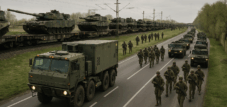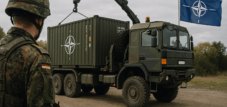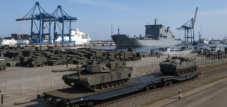
Inland ports: Europe's Achilles' heel and NATO's underestimated pillar for military mobility – Creative image: Xpert.Digital
Waterways of Strength: The Indispensable Role of Inland Ports for Europe's Security
Inland ports as a cornerstone of military mobility in Europe
The new reality of European defense and the renaissance of logistics
The turning point in history and the return of geography
The security landscape of Europe has fundamentally changed. The revitalization of national and collective defense has become the core mission of NATO and its member states. In this new paradigm, the geography of Europe is no longer merely an economic, but above all a strategic reality. Credible deterrence and robust defense capabilities are not based solely on the existence of modern combat forces. Crucially, they depend on the ability to deploy these forces rapidly, in large numbers, and over long distances under resilient conditions. The speed and scale of this deployment have become a direct indicator of the Alliance's resolve and capacity to act.
Logistics as a strategic factor
In this context, logistics has evolved from a purely supportive function to a central strategic factor. The ability to rapidly deploy forces is crucial for responding to crises before they escalate. The efficiency of logistics chains determines victory or defeat. A potential aggressor assesses not only NATO's nominal combat strength, but above all its ability to concentrate that strength at a critical point. A visible, well-functioning, and redundant logistics infrastructure signals a high level of readiness and rapid response capability. This demonstration of logistical competence increases the credibility of deterrence, as it directly impacts the costs and risks of an attack for the aggressor. An investment in logistics infrastructure is therefore also an investment in the deterrent effect of the Alliance.
Inland ports as a key to military mobility in Europe
Inland ports and their associated waterways are a critical, yet systematically underestimated, factor for military mobility in Europe. They provide indispensable capacity for transporting heavy and oversized military equipment, relieve the chronically congested rail and road networks, and increase the resilience of the entire NATO logistics chain. Their modernization is therefore not merely a matter of transport policy, but a defense policy imperative of the highest order.
Germany as a "hub": Geostrategic role and multimodal transport corridors
Germany's central role in host country support
Due to its geographical location in the heart of Europe, Germany serves as a central transit and staging area for allied forces and is therefore referred to as NATO's "hub." As part of its host country support mission, Germany has the national responsibility of ensuring the deployment and logistical support of both allied and its own armed forces. This complex task is coordinated by the "Operations Plan Germany," which governs civil-military cooperation between federal ministries, states, and municipalities and is aligned with NATO's requirements.
The “model corridor” to the eastern flank
A key initiative for improving military mobility is the "Model Corridor" agreed upon in January 2024 between Germany, the Netherlands, and Poland. Its aim is to organize seamless military traffic from west to east in the event of an alliance conflict. The focus is on transporting troops, equipment, and supplies from the deep-sea ports on the North Sea, where reinforcements from the US in particular disembark, to NATO's especially exposed eastern flank. To achieve the necessary resilience and capacity, this corridor must integrate all modes of transport – road, rail, and waterway. While concentrating on defined corridors does streamline traffic and maximize efficiency, it also makes these routes predictable and highly attractive targets for sabotage, cyberattacks, or conventional attacks. Inland waterways, which often run parallel to these main routes, offer a completely separate infrastructure and thus essential redundancy. The ability to switch to waterways in the event of a disruption on the rail or road network is therefore a fundamental component of a resilient overall strategy.
Integration into European frameworks (TEN-T and CEF)
Upgrading transport routes for military purposes is closely linked to civilian EU infrastructure programs. The Trans-European Transport Network (TEN-T) forms the basis for defining military corridors. Investments in this dual-use infrastructure – meaning it is usable for civilian purposes but also upgraded for military use – are co-financed by the EU's Connecting Europe Facility (CEF). This approach recognizes that military and civilian transport networks largely overlap and that synergies must be exploited. In applying for CEF funding, Germany has focused on improving the rail infrastructure on the TEN-T core network corridor between the North Sea and the Baltic Sea, for example, by upgrading bridges and expanding passing loops for 740-meter-long freight trains.
Hub for Security and Defense - Advice and Information

Hub for Security and Defense - Image: Xpert.Digital
The Security and Defence Hub offers expert advice and up-to-date information to effectively support companies and organizations in strengthening their role in European security and defence policy. Working closely with the SME Connect Defence Working Group, it particularly promotes small and medium-sized enterprises (SMEs) that wish to further develop their innovative capacity and competitiveness in the defence sector. As a central point of contact, the Hub thus creates a crucial bridge between SMEs and European defence strategy.
Related to this:
Inland waterway transport as the key to efficient heavy transport
Inland waterways as a transport mode: A strategic advantage for heavy transport
Mass handling capacity for heavy and large goods
Inland waterway transport is ideally suited for transporting heavy and oversized military equipment (heavy and bulky cargo). Modern weapon systems such as the Leopard 2 main battle tank, which weighs over 60 tons, or self-propelled howitzers often exceed the load-bearing capacity of many bridges and roads. A single modern inland vessel can carry the cargo of up to 100 trucks or an entire freight train, enabling the transport of entire tank companies in a cohesive unit. The main advantage here lies not only in the sheer transport capacity but also in the ability to maintain the operational integrity of combat units during deployment. A military unit is more than the sum of its vehicles; its combat effectiveness depends on its cohesion. While road transport breaks a unit down into dozens of individual heavy transport vehicles that arrive over several days and then have to be painstakingly reassembled, a push convoy on the waterway can transport the entire unit at once. The unit arrives as a unit, which drastically reduces the time to operational readiness at the destination and represents a crucial operational advantage in a crisis.
Relief for critical infrastructures
Shifting heavy transport to waterways significantly relieves the chronically congested and dilapidated rail and road networks. This creates urgently needed capacity for more time-critical or lighter goods, as well as for personnel transport. Unlike roads and railways, inland waterways still possess considerable capacity reserves along key corridors.
Operational flexibility and reliability
Inland waterway vessels also offer significant operational advantages. They can operate 24 hours a day, seven days a week, as they are not subject to night-time navigation bans or noise restrictions that often hinder military transport by road and rail. This allows for continuous and more predictable deployment. Inland waterway transport is also less prone to congestion and is characterized by a high degree of punctuality. Although secondary for military planning, lower transport costs and reduced energy consumption are also positive side effects that can offer budgetary advantages, particularly during large-scale exercises or prolonged deployments.
Inland ports as critical logistics hubs: Requirements for dual-use infrastructure
The port as a trimodal interface
Inland ports are crucial hubs in the logistics chain. As trimodal terminals, they link the transport modes of waterway, rail, and road, thus enabling the seamless onward transport of goods arriving by water. A port's military suitability is not determined by its total cargo volume, but rather by the presence of a few highly specialized "bottleneck assets." A port can handle millions of tons of bulk cargo per year and still be unsuitable for transporting a single battle tank if the necessary specific equipment is lacking.
Technical and infrastructural requirements
Specific technical and infrastructural requirements are essential for the handling of large military equipment.
Handling technologies (superstructure):
Roll-on/Roll-off (RoRo): Fixed or mobile ramps with sufficient load-bearing capacity and width for heavy tracked vehicles are required. Although RoRo ramps are available in principle at German inland ports, they are underutilized, and it needs to be determined whether they meet military requirements. Lift-on/Lift-off (LoLo): Heavy-duty cranes (port mobile cranes, gantry cranes) with lifting capacities exceeding 100 tons are essential for the vertical handling of tanks, bridge sections, or heavy containers. The fact that cranes are explicitly excluded from CEF funding for military mobility represents a critical and counterproductive deficiency, as it ignores the core of the handling process.
Infrastructural requirements:
Harbor basins and quays: Sufficient quay lengths are required for mooring large push convoys, as well as guaranteed water depths that ensure reliable operation even at low tide. Storage and staging areas: There is a high demand for large, paved, and secured areas. These serve for the temporary storage of vehicles and materials, as well as for the establishment of rest and assembly areas (convoy support center). The areas must withstand high soil bearing capacity and meet adequate safety standards.
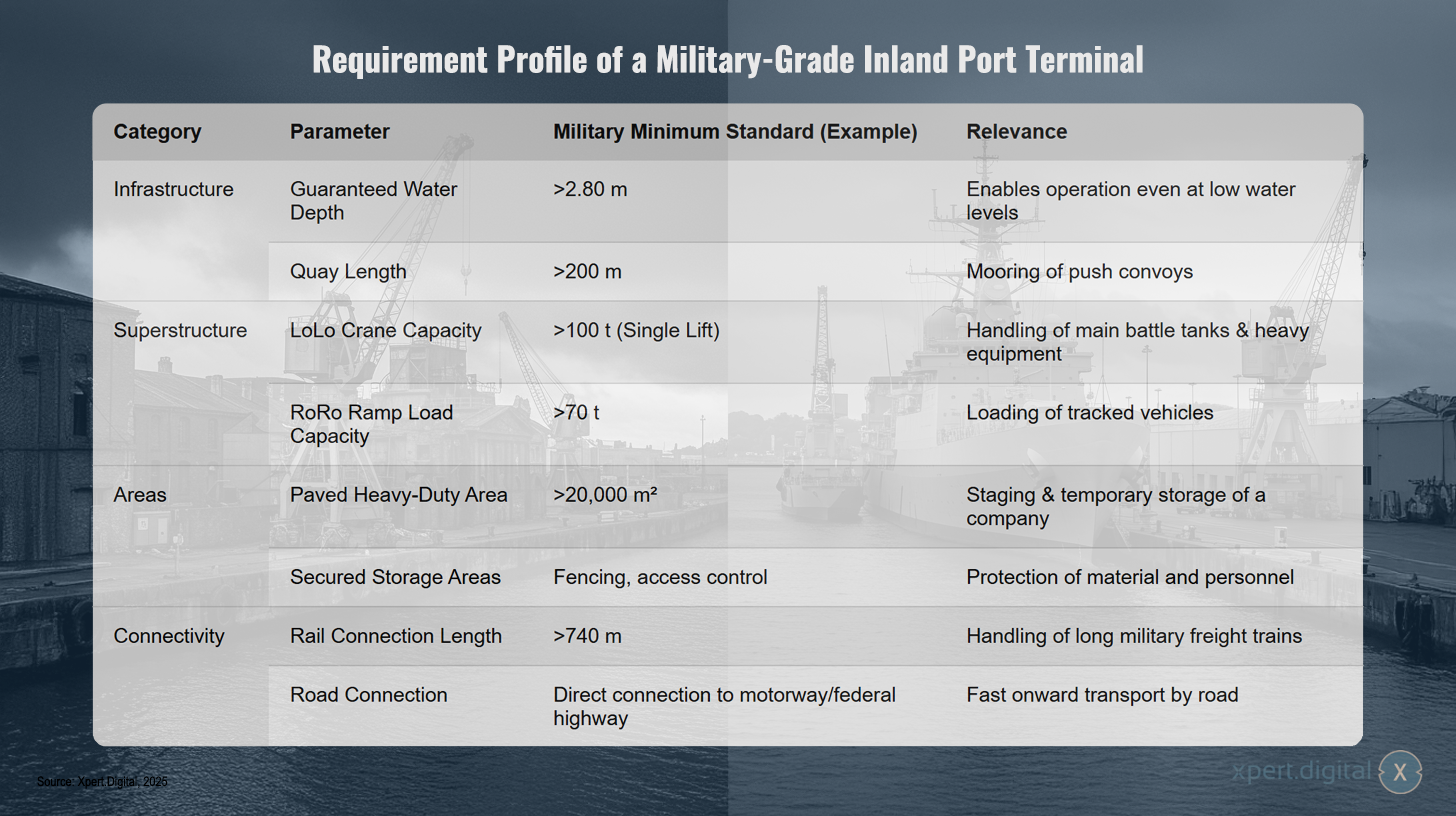
The following table summarizes the requirements profile for a military-suitable inland port terminal and can serve as a planning tool for the evaluation and upgrading of sites.
Requirements profile for a military-grade inland port terminal
Requirements profile for a military-grade inland port terminal – Image: Xpert.Digital
The requirements profile for a military-grade inland port terminal encompasses various criteria that define the minimum military standard. The infrastructure must have a guaranteed water depth of more than 2.80 meters to ensure operation even during low tide. The quay length should exceed 200 meters to allow for the berthing of push convoys. The superstructure requires a low-loader (LoLo) crane capacity of more than 100 tons for handling main battle tanks and heavy equipment, while the roll-on/roll-off (RoRo) ramp load capacity must be at least 70 tons to ensure the loading of tracked vehicles. The site must include over 20,000 square meters of paved heavy-load areas for the deployment and temporary storage of a company. Secure storage areas with fencing and access control protect equipment and personnel. In terms of connectivity, a rail connection over 740 meters long is required to facilitate the handling of long military freight trains. Finally, there should be a direct road connection to a motorway or federal highway to ensure rapid onward transport.
Your container high-bay warehouse and container terminal experts

Container terminal systems for road, rail and sea transport in the dual-use logistics concept of heavy-lift logistics - Creative image: Xpert.Digital
In a world marked by geopolitical upheavals, fragile supply chains, and a new awareness of the vulnerability of critical infrastructure, the concept of national security is undergoing a fundamental reassessment. A state's ability to guarantee its economic prosperity, the provision of essential goods and services to its population, and its military capability increasingly depends on the resilience of its logistical networks. In this context, the concept of "dual-use" is evolving from a niche category of export control to a broader strategic doctrine. This shift is not merely a technical adjustment but a necessary response to the "paradigm shift" that demands a profound integration of civilian and military capabilities.
Related to this:
Strategic risks in focus: Why Germany's waterways urgently need modernization
The Achilles heel of the alliance: Systemic deficiencies and weaknesses
Despite its strategic importance, the logistics chain, which relies on inland waterways and ports, is characterized by significant weaknesses and systemic deficiencies.
Infrastructure decay: The investment backlog as a strategic risk
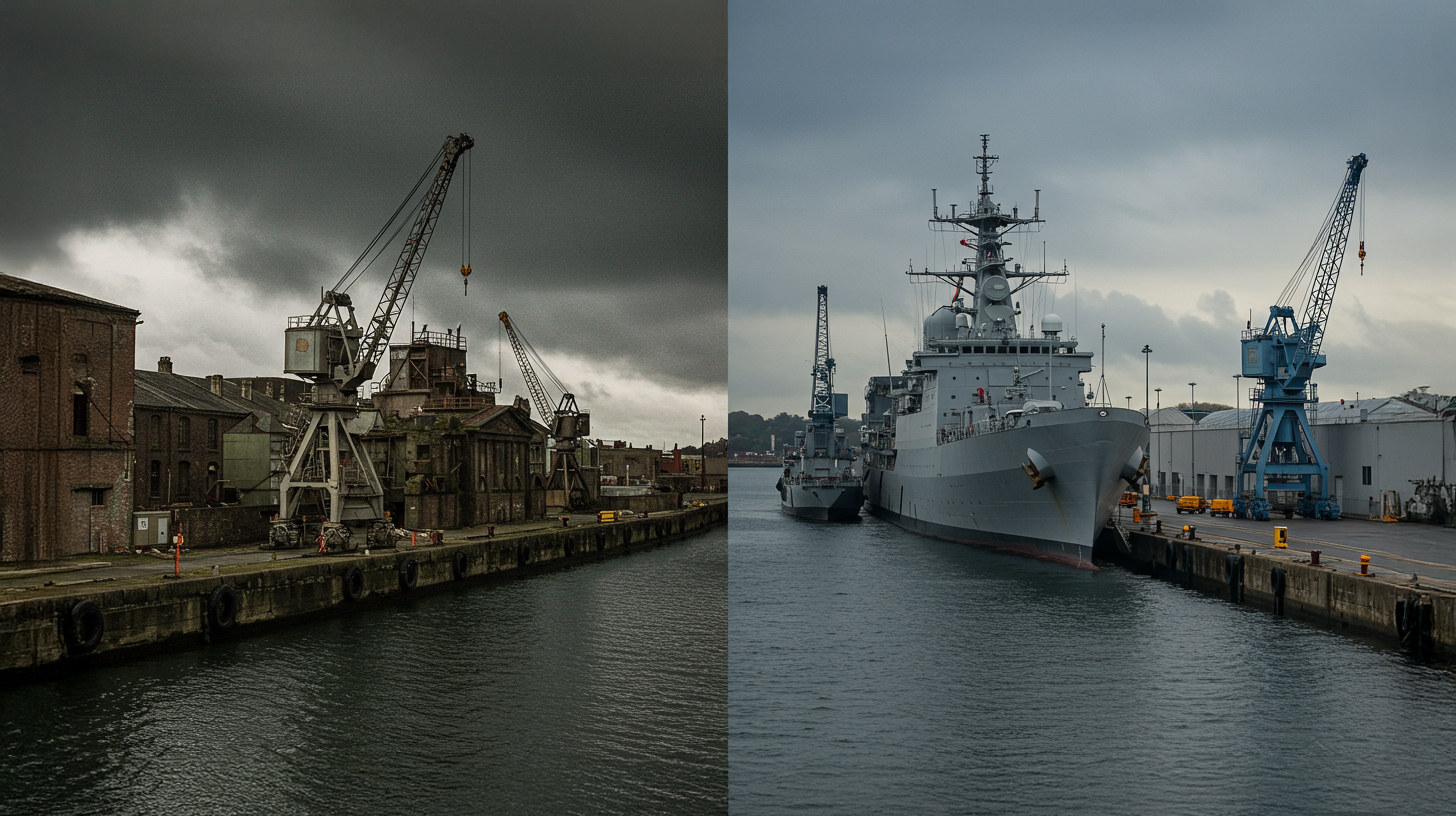
Germany's inland waterway infrastructure is suffering from a massive backlog of investment and is in a partially dilapidated state. Locks and weirs are on average 65 years old, and some important structures, such as those in the Kiel Canal, even date back to the Imperial era. As a result, disruptions and breakdowns are increasingly leading to the closure of entire waterways, which would have catastrophic consequences in a crisis, as alternative routes are often unavailable. The Federal Ministry for Digital and Economic Affairs (BMDV) estimates the investment required by 2030 at €6.5 billion.
Bureaucratic shackles: The lack of a "military Schengen"
The rapid deployment of troops and equipment is hampered by a multitude of bureaucratic hurdles. Approval periods for cross-border transports of up to five working days are in clear contradiction to NATO's maximum operational planning time of 72 hours. Added to this is regulatory fragmentation due to differing regulations between the German federal states, as well as cumbersome customs procedures that require the submission of applications twice (NATO Form 302 and EU Form 302).
Capacity bottlenecks and new vulnerabilities
Besides the state of the infrastructure, limited transport capacities, especially for specialized vessels, and competition with commercial freight transport during times of crisis also pose challenges. Furthermore, the infrastructure is exposed to new vulnerabilities. Critical points such as locks and port facilities are susceptible to sabotage or hybrid attacks. At the same time, climate change is exacerbating the situation: Recurring low water levels, particularly on the Rhine, drastically reduce the draft of ships, increase transport costs through low-water surcharges, and in extreme cases can paralyze entire transport chains, forcing a shift to the already overburdened rail and road transport systems.
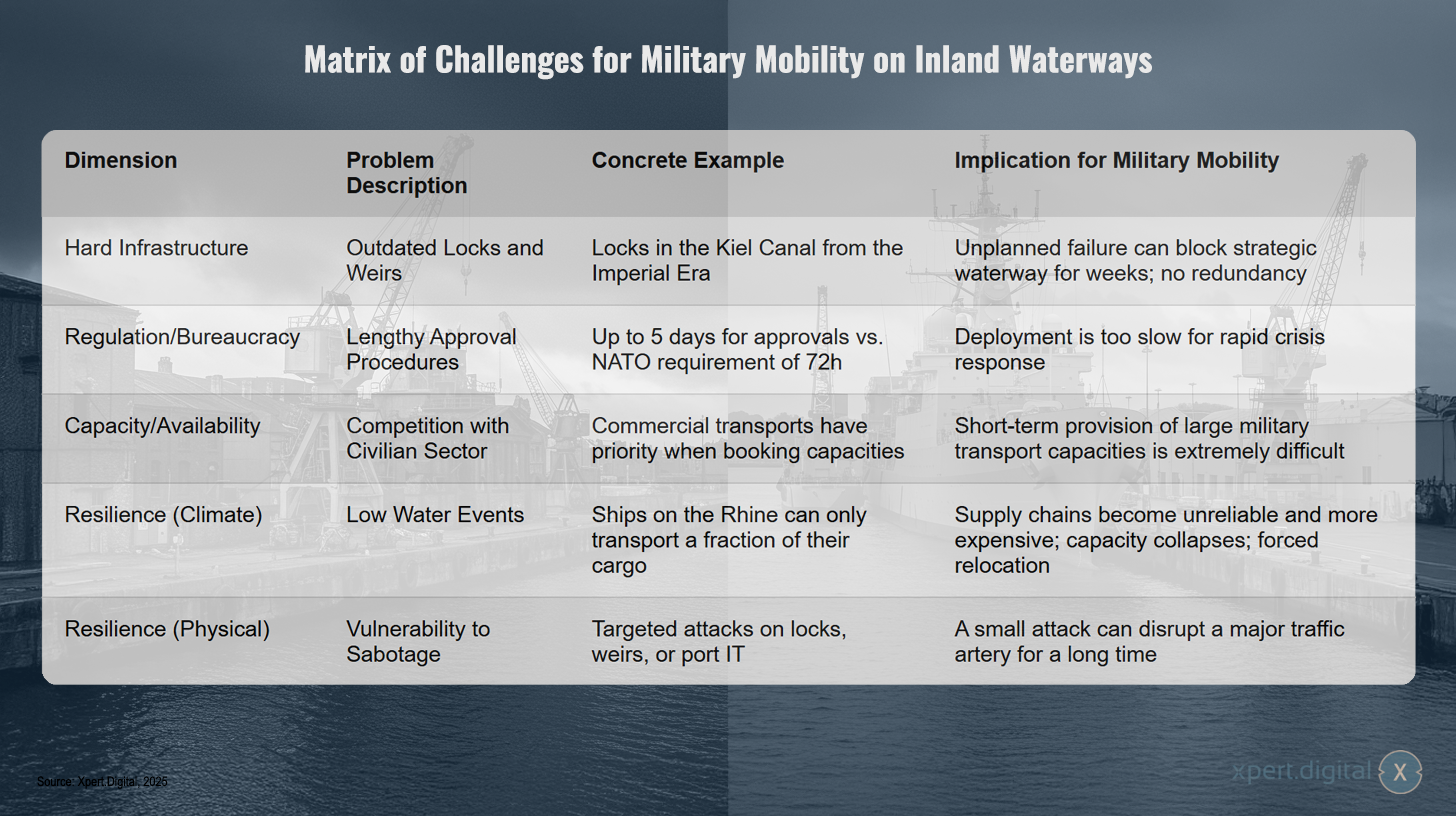
The following matrix structures these diverse challenges.
Matrix of challenges for military mobility on inland waterways
Matrix of challenges for military mobility on inland waterways – Image: Xpert.Digital
Military mobility on inland waterways faces numerous challenges. The infrastructure is partly outdated, such as the locks in the Kiel Canal dating back to the Imperial era, whose unplanned failure can block a strategic waterway for weeks due to a lack of redundancy. Regulatory and bureaucratic hurdles, including lengthy approval processes that can take up to five days (in contrast to NATO's 72-hour requirement), result in excessively slow deployments, hindering rapid crisis response. Furthermore, military transport competes with the civilian sector, as commercial transport takes priority for capacity bookings, making the short-term deployment of large military resources extremely difficult. Added to this is the issue of climatic resilience, for example, low water levels on the Rhine, which severely restrict ships' cargo capacity and make transport chains less reliable and more expensive. Finally, physical resilience is also compromised, as acts of sabotage against locks, weirs, or port IT systems can escalate a minor attack into a long-term disruption of vital transport routes.
Pathways to empowerment: strategies, projects and recommendations for action
Addressing the identified shortcomings requires a paradigm shift from a purely transport policy approach to an integrated security policy approach that considers infrastructure, regulation and finance as a single unit.
Rethinking financing strategies and accelerating processes
While existing financing instruments like the CEF are an important step, their budget of €1.69 billion is far from sufficient given the immense need and is already fully committed. A shift is needed from purely project-based funding to permanent federal funding for strategic infrastructure, understood as an integral part of defense spending. At the same time, bureaucracy must be radically reduced. Specific recommendations include: abolishing domestic licensing requirements for military transports between German states; harmonizing and digitizing cross-border licensing procedures at the EU/NATO level to ensure processing within 72 hours; and creating a single, harmonized customs form to avoid duplicate applications to NATO and the EU.
Targeted expansion and civil-military cooperation
Investments must be specifically directed toward infrastructure projects along the routes identified as military corridors. PESCO projects such as the "Network of Logistic Hubs," which connects logistics hubs across Europe, like the one in Pfungstadt, are a promising approach. At the same time, cooperation with the private sector must be intensified. Models in which logistics companies and port operators are contractually obligated to provide capacity and services even in the event of a defense emergency can significantly increase flexibility and efficiency. The German Armed Forces Logistics Command has already initiated projects to better integrate private companies into material management, transport, and maintenance.
Strengthening resilience
Infrastructure resilience must be increased. This includes, firstly, the physical protection and cybersecurity of critical points such as locks and terminals. Secondly, technical measures to mitigate the effects of climate change are essential. One example of this is the planned deepening of the fairway on the Middle Rhine to improve navigability during low water, even though completion is not expected for another decade.
From bottleneck to strategic multiplier
The analysis unequivocally demonstrates that inland ports and their associated waterways represent an indispensable, yet highly fragile, component of the European defense architecture. A dangerous gap exists between the strategic necessity of rapid and massive deployment capability and the current state of the infrastructure, capacities, and bureaucratic processes. The modernization of inland logistics is a litmus test for Germany's and NATO's ability not only to proclaim the proclaimed "turning point" but also to implement it materially and procedurally. Neglecting waterways as a redundant and high-capacity transport route for heavy equipment is a strategic oversight that weakens the resilience of the entire alliance. Integrating inland ports into a resilient, responsive, and redundant overall logistics system is not an option, but a strategic necessity. Failure to act decisively here undermines the credibility of alliance defense at one of its most fundamental points: the ability to be in the right place at the right time with the right means.
Consulting - Planning - Implementation

Markus Becker
I would be happy to serve as your personal advisor.
Head of Business Development
Chairman SME Connect Defense Working Group
Consulting - Planning - Implementation
Konrad Wolfenstein
I would be happy to serve as your personal advisor.
You can contact me at wolfenstein∂xpert.digital or
Just call me on +49 7348 4088 965 .