


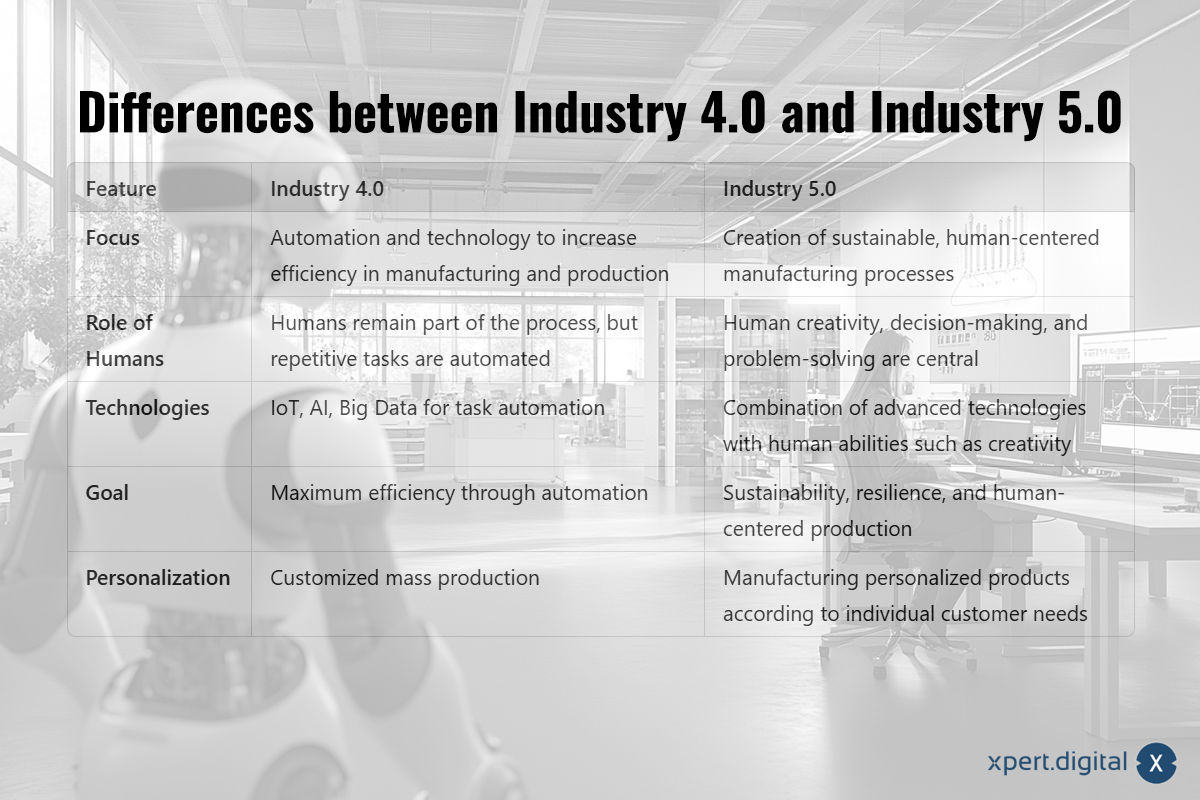
Differences between Industry 4.0 and Industry 5.0 – Image: Xpert.Digital
From robots to collaboration: The path from Industry 4.0 to 5.0
Industrial Development: From Efficiency to Human-Machine Interaction
Industrial development has changed rapidly in recent decades, and we are currently at the transition from the fourth to the fifth industrial revolution. While Industry 4.0 places a strong emphasis on automation and the use of technologies to increase efficiency, Industry 5.0 focuses more on people and sustainable production processes. This paradigm shift brings with it both technological and societal changes. In this text, I will explain in detail the key differences between Industry 4.0 and Industry 5.0 and highlight the opportunities and challenges that the new industrial era presents.
1. Focus of industrial development
Industry 4.0 focuses primarily on the automation and networking of processes. The emphasis here is on increasing efficiency through technologies such as the Internet of Things (IoT), artificial intelligence (AI), and big data. The goal is to optimize production processes, reduce costs, and increase productivity. Machines and systems are interconnected to exchange real-time data and thus improve the production process. Humans play a more supportive role, as repetitive tasks are increasingly automated.
In contrast, Industry 5.0 goes beyond simply increasing efficiency and focuses on sustainable, human-centered manufacturing processes. The emphasis here is on combining advanced technologies with human creativity and problem-solving skills. Industry 5.0 doesn't just see people as part of the process, but places their skills and well-being at its core. This is a response to the realization that a purely technology-driven industry is insufficient to meet the complex challenges of the modern world. Sustainability and resilience are just as important goals as increasing efficiency.
2. The role of humans
In Industry 4.0, humans remain part of the production process, but in a significantly reduced and monitored role. Many repetitive tasks are taken over by machines, while humans are primarily responsible for monitoring and maintaining the automated systems. Humans are thus largely relegated to a supporting function, aiming to use machines and technology efficiently and to minimize errors.
Industry 5.0, on the other hand, places human creativity, decision-making, and problem-solving at the heart of the production process. The goal is no longer simply to relieve humans of tasks, but to strategically leverage their unique abilities such as creativity and complex thinking. Here, the focus is on collaboration between humans and machines: cobots (collaborative robots) support humans in their work, interacting in ways that maximize human potential. This collaboration opens up new possibilities for developing customized and innovative solutions that better meet individual customer requirements while simultaneously promoting employee well-being.
3. Technologies in use
The technologies used in Industry 4.0 focus on the automation and optimization of tasks. Key technologies include the Internet of Things (IoT), Artificial Intelligence (AI), and Big Data. IoT enables the networking of machines, sensors, and devices to exchange data in real time and optimize processes. AI is used to analyze data, recognize patterns, and make predictions, which in turn contribute to increased efficiency. Big Data allows companies to process large volumes of data and gain valuable insights for optimizing production processes.
Industry 5.0 combines these advanced technologies with human skills such as creativity and problem-solving abilities. While IoT, AI, and Big Data continue to play a vital role, the focus is now on a symbiotic relationship between humans and machines. New technologies like Augmented Reality (AR) and Virtual Reality (VR) are being used to facilitate human-machine interaction and further increase efficiency. These technologies allow people to visualize complex tasks and interact with machines in a more intuitive way, making collaboration more effective. Furthermore, sustainability technologies, such as renewable energies and circular economy systems, are playing a greater role in making production more environmentally friendly.
4. Objectives of industrial development
The main goal of Industry 4.0 is to maximize efficiency through automation. The priority is to reduce production costs and accelerate processes to remain competitive. Companies are investing heavily in technologies that help them increase productivity while minimizing operating costs. This primarily involves streamlining workflows and reducing human error.
Industry 5.0, on the other hand, pursues goals beyond efficiency gains, including sustainability, resilience, and human-centered production. The fifth industrial revolution recognizes that a long-term corporate strategy cannot focus solely on productivity and cost reduction, but must also consider the needs of society and the environment. The aim is to create production processes that consume fewer resources, produce less waste, and are more sustainable overall. Furthermore, the resilience of production should be increased so that companies can respond better to unexpected events such as pandemics or natural disasters. A human-centered approach promotes employee well-being, which has a positive long-term impact on motivation and productivity.
5. Personalization in production
Industry 4.0 has laid the foundations for individualized mass production. Thanks to advanced technologies, companies can adapt products to customer needs without sacrificing the advantages of mass production. This type of production makes it possible to manufacture standardized products with certain individual customizations, offering customers more choice and personalized solutions.
Industry 5.0, however, goes a step further, aiming to produce highly personalized products tailored to individual customer needs. This involves not only individualizing mass production but also manufacturing completely customized products precisely aligned with the customer's specific requirements. This necessitates close collaboration between humans and machines, as creative decisions and adjustments must be made at an individual level. This type of production allows companies to build deeper relationships with their customers and respond flexibly to market changes.
Industrial advancement with advanced technologies
Industry 4.0 and Industry 5.0 represent two distinct approaches to industrial development, both based on advanced technologies. While Industry 4.0 focuses on automation and increased efficiency, Industry 5.0 emphasizes sustainability, resilience, and human-centered production. This transformation is a response to the challenges facing businesses and society today, such as environmental issues, demographic shifts, and the desire for a better work-life balance.
Industry 5.0 offers a new perspective with the potential to fundamentally transform industry. By integrating human creativity and technological capabilities, it creates a dynamic and flexible production environment better suited to the needs of the modern world. Companies that successfully navigate this transformation can not only increase their efficiency but also build more sustainable and resilient production facilities that meet future demands. A human-centric approach is increasingly becoming a competitive advantage, as it enhances employee satisfaction while simultaneously fostering innovative and creative solutions.
Overall, Industry 5.0 represents a further development of Industry 4.0, combining the best of both worlds: the efficiency of automation and human creativity. The industrial future is thus not only automated, but also sustainable, resilient, and human-centered – a vision of great importance both economically and socially.
Related to this: