
India aims to become a chip powerhouse: Why logistics is now crucial – How DHL and NX are paving the way for production
Xpert Pre-Release

Available in 27 languages 📢
Prefer Xpert.Digital on GoogleⓘPublished on: November 5, 2026 / Updated on: November 5, 2026 – Author: Konrad Wolfenstein
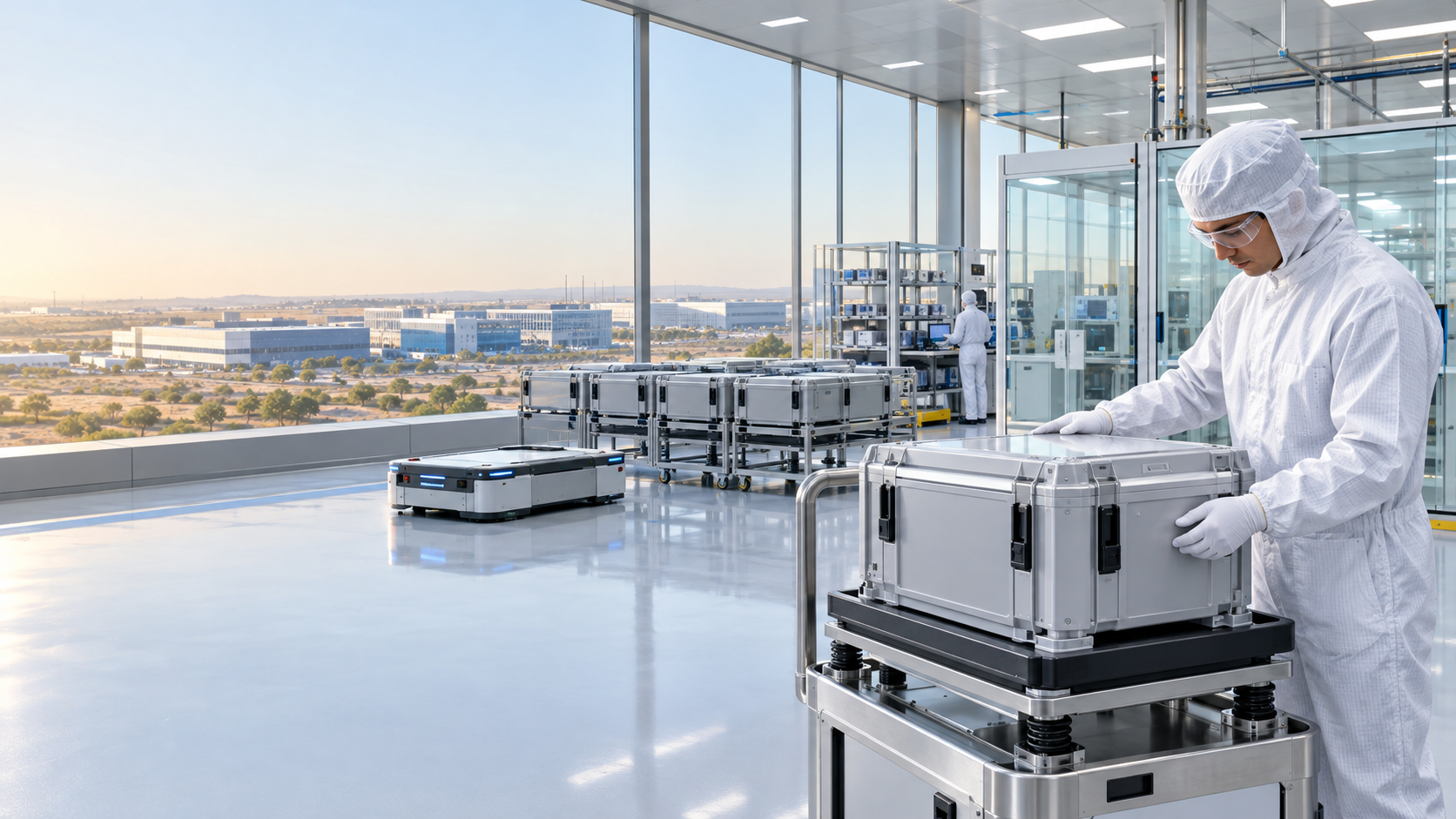
India aims to become a chip powerhouse: Why logistics is now crucial – How DHL and NX are paving the way for production – Creative image on the topic, with AI: Xpert.Digital
Billions for chip factories: This challenge could slow down India's plans
Dholera is becoming a semiconductor location: Why supply chains determine success
New chip factories alone are not enough: What India's semiconductor strategy needs
India aims to establish itself as a major semiconductor hub. However, large-scale factory projects and billions in investment alone are not enough: specialty chemicals must arrive reliably, sensitive equipment must be installed safely, and finished chips must be delivered on time. This is precisely where the expansion of semiconductor logistics comes in. DHL is planning a specialized warehouse in Dholera, western India, while the Japanese NX Group also intends to invest there. Together with the planned manufacturing and packaging facilities in Gujarat, this could create an industrial network that integrates India more closely into global supply chains. But building the infrastructure is just the beginning. Whether the investments pay off depends primarily on how quickly the factories can ramp up production, acquire customers, and ensure a consistently reliable supply.
Billions are being built into factories – but without functioning supply chains, chip power remains an illusion
India's rise as a semiconductor hub is usually measured by large-scale factory projects, government support programs, and international technology partnerships. But whether this translates into a competitive industry depends on more than just cleanrooms. Specialty chemicals must arrive on time, sensitive manufacturing equipment must be installed without damage, and manufactured chips must be reliably delivered to customers. Between investment announcements and industrial capacity lies a supply chain whose quality determines whether billions in investments are productive or simply waiting for missing materials.
DHL's planned semiconductor logistics center in Dholera, western India, is therefore more than just another warehouse. It represents an attempt to build the infrastructure that a chip industry needs for its daily operations. A spatially concentrated network of planned wafer fabrication, chip assembly, testing, packaging, and specialized services is being created in Gujarat. DHL is collaborating with the Japanese NX Group, which is also preparing a semiconductor logistics center in Dholera. Both companies are positioning themselves for a market whose industrial base is still growing and whose economic scale depends on the actual implementation of the manufacturing projects.
The economic perspective is therefore twofold: Specialized logistics can significantly strengthen India's semiconductor strategy because it reduces production risks and makes international supply chains more interconnected. At the same time, investments in warehousing should not be confused with already secured demand. Crucial factors are production ramp-up, customer capacity utilization, the quality of local infrastructure, and the ability to consistently meet technical requirements.
Dholera and Sanand are developing into a collaborative industrial network
At the heart of this development is Tata Electronics' planned semiconductor factory in Dholera. Together with the Taiwanese Powerchip Semiconductor Manufacturing Corporation (PSMC), Tata is building a production facility that, according to the company, will be able to process up to 50,000 wafers per month. The announced investment volume amounts to up to 91,000 crore rupees. Since one crore equals ten million, this equates to 910 billion rupees. The original announcement put the figure at approximately eleven billion US dollars. It is important to distinguish between these figures: this amount refers to the total announced investment volume, not necessarily an equivalent amount of government funding.
Dholera will primarily handle front-end manufacturing. There, the electronic structures of the future chips are created on silicon wafers through numerous coordinated process steps. The nearby Sanand site, on the other hand, is developing into a hub for downstream production steps. These include the assembly, testing, and packaging of the semiconductors. Micron, Kaynes Semicon, and CG Semi are among the companies shaping this location. The CG Power project also includes technology partners Renesas from Japan and Stars Microelectronics from Thailand.
This division of labor is economically significant. A semiconductor industry does not consist of a single factory, but rather of interconnected specializations. Front-end and back-end production differ in terms of capital requirements, technical processes, qualifications, and material flows. Only their combination enables broader industrial value creation.
However, geographical proximity does not automatically mean that all wafers manufactured in Dholera will subsequently be processed in Sanand. Whether such a connection is established depends on product types, technical approvals, customer contracts, and available packaging processes. A cluster creates opportunities but does not replace concrete industrial coordination.
Why more mature manufacturing processes are economically relevant
The planned Tata factory is intended to cover a technology portfolio ranging from 28 to 110 nanometers. Specifically mentioned are 28, 40, 55, 90, and 110 nanometers. Applications include energy management, display drivers, microcontrollers, and analog and digital integrated circuits. The planned facility will operate with 300-millimeter wafers.
This focus is easily underestimated if semiconductors are equated solely with the smallest feature sizes and particularly powerful AI processors. However, the economic importance of a chip does not derive solely from miniaturization. For many applications, reliability, cost, lifespan, available manufacturing capacity, and suitability for specific electrical functions are at least as important.
This presents India with a logical entry point. Instead of immediately striving for technological leadership in every segment, the country can develop an industrial base for widely used components. Such components align with the sales sectors identified by Tata: automotive, communications, data processing, and electronics.
However, this does not automatically guarantee profitability. More mature manufacturing processes are also subject to international competition. A new factory must convince customers, qualify its technical processes, and achieve a sufficiently high yield. This refers to the proportion of manufactured chips that are actually functional and marketable. A modern building and installed machinery initially only create production capabilities. Competitiveness only arises from stable processes, reliable delivery capability, and economically viable unit costs.
For logistics, this means that it must not only accompany a one-off factory setup, but also enable long-term, low-disruption production operations.
DHL is focusing on early access to the emerging market
DHL is planning its first dedicated semiconductor warehouse in India, located in Dholera. According to published plans, the facility will initially require an investment of approximately 50 crore rupees (500 million rupees) and is expected to be operational by August 2027. Depending on customer growth, a subsequent expansion to three or four times this initial investment by 2030 is anticipated. These figures are to be understood as projections and not as fully invested capital.
The scale illustrates the difference between the manufacturing industry and logistics. Compared to a semiconductor factory with a planned investment of 91,000 crore rupees, a specialized warehouse initially appears small. However, its operational importance cannot be deduced from this. A comparatively manageable infrastructure can be indispensable for a much larger production complex if it provides critical materials and ensures the flow of materials.
DHL is pursuing a positioning strategy with this approach. Those involved in the planning early on can develop warehouse concepts, transport processes, safety regulations, and digital interfaces together with the future users. Such a service provider not only sells space and transport capacity but also takes on a portion of the organizational complexity of the production system.
Timing is crucial. A logistics facility that is available too late can hinder factory ramp-up. Conversely, a warehouse built too early and too large ties up capital before corresponding sales are generated. A phased expansion can mitigate this tension, provided that each expansion step is technically and spatially prepared.
The NX Group brings network scale and Japanese process knowledge
Competition isn't limited to DHL. The NX Group, formerly Nippon Express, also views India as a strategic growth market. The company aims to increase revenue from its Indian operations to 60 billion yen by 2028. According to the company, this represents roughly a threefold increase compared to 2023. This target figure refers to the entire Indian business and should not be confused with revenue expected solely from semiconductor logistics.
The starting point is already substantial. At the beginning of 2026, the group reported 103 business locations and 60 warehouses in 39 Indian cities. Later reports describe an expansion to 113 locations and 67 warehouses, still in 39 cities. The differing figures therefore reflect different reporting dates and should not be considered as simultaneously valid inventory figures. A dedicated semiconductor logistics center is planned for Dholera in 2027.
NX is linking its expansion plans to a collaboration with the India Semiconductor Mission. This involves warehousing infrastructure, transport connections, land use, and the development of specialized supply chains. Cooperation with materials and chemical specialists like Nagase also fits into this strategic framework: Semiconductor logistics requires not only transport expertise but also a deep understanding of the materials being transported and their industrial applications.
The economic strength of such a network lies in combining international procurement with local delivery. A service provider must not only transport materials to India, but also reliably deliver them within the country to the production line. Global reach and regional execution thus become complementary capabilities.
A semiconductor warehouse is not an ordinary warehouse
The term "warehouse" only partially conveys what is required for a semiconductor supply chain. Different goods demand different environments. Sensitive materials may require controlled temperature and humidity conditions. Certain components must be protected against electrostatic discharge. Specialty chemicals and gases require appropriate safety concepts, while precision equipment must be particularly carefully secured against vibrations and mechanical stress.
It would be inaccurate to subject every semiconductor product to a completely identical cleanroom regime. The decisive factors are the specific material condition, the packaging, the manufacturer's specifications, and the customer's requirements. A sealed transport container with wafers presents different challenges than a hazardous materials container or a multi-ton production plant.
The specialization therefore lies primarily in reliably managing these differences. This includes suitable storage areas, trained personnel, documented handling processes, and seamless batch tracking. Incorrect storage or unnoticed packaging damage can have consequences that extend far beyond the immediate value of the goods.
This changes the value proposition for logistics companies. The focus is no longer on the tonnage moved, but on the verifiable preservation of defined product characteristics. Economically, a volume-based service becomes a quality-critical service. This is precisely where the opportunity for higher added value lies, but also the cause of higher liability and operational risks.
The decisive price is often that of an avoided interruption
In typical supply chains, logistics is often evaluated based on the price per shipment, pallet, or kilometer. In a semiconductor factory, this approach is insufficient. If a missing material delays a production step, the economic damage affects not only the individual material but potentially the utilization of a very capital-intensive system.
This results in a different procurement logic. More expensive transport can be economically sensible if it reduces the risk of a significantly more costly disruption. Similarly, additional warehousing can be justified even though, viewed in isolation, it incurs higher inventory and operating costs.
The appropriate benchmark is therefore the risk-adjusted total cost. This includes transport, storage, insurance, inventory financing, quality control, potential scrap costs, and the consequences of delayed deliveries. Without specific company data, no generally optimal value can be determined. However, the principle remains clear: the cheapest individual transport is not necessarily the most cost-effective supply solution.
This creates a challenging business model for DHL and NX. They must demonstrate their added value not only through speed, but also through reliable process quality. Ultimately, customers will be interested in how frequently delivery deadlines are met, how quickly deviations are detected, and whether disruptions can actually be avoided.
Why Just-in-Time needs to be supplemented by strategic safety stocks
Time-critical supply is often associated with the lowest possible inventory levels. However, for a new semiconductor site, an uncompromising minimization of stock levels can be problematic. International procurement, not yet fully established import processes, and an evolving supplier network increase the importance of suitable buffers.
This doesn't mean stockpiling as much of every material as possible. Some substances have a limited shelf life or, for safety reasons, cannot be stored in unlimited quantities. Others are expensive but rarely critical. Still others cost relatively little but, if unavailable, can block an important process.
An economically sound inventory management concept therefore differentiates based on replenishment time, consumption fluctuations, shelf life, interchangeability, and production relevance. Critical materials with long lead times require different rules than frequently available standard items.
Specialized warehouses located near factories enable a combination of international consolidation and short-term delivery. The factory can be supplied according to its needs, while an upstream warehouse maintains suitable stock levels. This way, inventory doesn't disappear from the supply chain; it's organized in a more operationally efficient location.
This distinction is important because otherwise just-in-time delivery is mistaken for being risk-free. A robust semiconductor supply chain doesn't need to be maximally lean, but rather as lean as possible and as resilient as necessary.
The factory's economic viability begins long before the first chip is sold
Semiconductor logistics arises as early as the plant construction phase. Production machines, supply systems, and precision components must be procured internationally, transported, cleared through customs, and delivered to the construction site in a suitable sequence. Some of these goods require special packaging, appropriate lifting equipment, and specially trained teams.
The transport process doesn't end at the factory gate. Internal movement, bringing equipment into buildings, and handover to installation teams are also part of the logistics task. Accordingly, NX describes services ranging from equipment transport and customs clearance to warehousing, factory delivery, installation, and distribution.
Coordination is crucial for the project's progress. If a machine arrives too early, storage and additional handling may be required. If it arrives too late, subsequent installations may be delayed. In complex systems, a single missing component can significantly hinder an entire assembly process.
This creates a separate market for specialized services even before series production begins. However, this project-based business differs from subsequent regular operation. Construction and installation phases generate high, time-limited transport volumes. Ongoing production, on the other hand, leads to recurring flows of materials and spare parts.
A viable business plan must evaluate both phases separately. A temporarily high turnover during factory construction is not proof of consistently high revenues.
Our Asia expertise in business development, sales and marketing

Our Asia expertise in business development, sales and marketing - Image: Xpert.Digital
Industry focus areas: B2B, digitalization (from AI to XR), mechanical engineering, logistics, renewable energies and industry
More information here:
A thematic hub offering insights and expertise:
- Knowledge platform covering global and regional economies, innovation and industry-specific trends
- A collection of analyses, insights, and background information from our key areas of focus
- A place for expertise and information on current developments in business and technology
- A hub for companies seeking information on markets, digitalization, and industry innovations
Logistics as the key to semiconductor production in India
Ports and airports will become part of the production system
For Gujarat, the development of a semiconductor industry opens up additional challenges at international transport hubs. Imports include not only finished electronic components, but also production equipment, precision parts, specialty chemicals, and other industrial intermediates. On the outbound side, there is a need for transporting processed wafers, packaged chips, and other semiconductor products.
The choice between air and sea freight depends on the specific goods and their urgency. Time-critical spare parts and particularly urgent deliveries can justify air transport. Larger, predictable, and appropriately suitable shipments, on the other hand, can be transported by sea. Dangerous goods regulations and product-specific restrictions limit the available options.
Proximity to a port or airport is therefore only one initial locational advantage. Equally important are available capacity, suitable handling conditions, predictable processing times, and reliable onward transport.
Economically, it's not just the average transit time that matters, but also its variability. A delivery that usually arrives quickly but is occasionally significantly delayed may require larger safety stocks than a somewhat slower, but more reliable connection. Infrastructure quality is therefore largely reflected in its predictability.
This presents both an opportunity and an obligation for the region. High-quality industrial developments require a level of transport and handling infrastructure that goes beyond simply providing additional space.
Customs clearance and data quality can be just as important as roads
A high-performance transport network does not solve all supply chain problems. Technically complex goods must be correctly described, classified, and documented. Errors in accompanying documents or permits can delay physical transport, even if aircraft, trucks, and warehouses are available.
In a semiconductor supply chain, the diversity of goods exacerbates this challenge. Production machinery, spare parts, chemicals, and electronic products differ considerably. Furthermore, international requirements can vary depending on the product, its origin, and its intended use.
A specialized logistics provider can make a significant contribution here by compiling technical and administrative information early on. Customs clearance should not begin only after a shipment has already arrived. Reliable documentation should be available as far as possible before transport.
This also applies to digital traceability. Location data alone is insufficient if a customer needs to know which batch was transported under which conditions. A combination of shipment identity, status information, and traceable responsibilities is required.
The economic impact of good data is immediate: fewer ambiguities mean fewer queries, reduced risks of delays, and better inventory management. Digitization does not replace process discipline. It simply makes good processes more efficient and poor processes more readily apparent.
Early market presence creates advantages, but does not guarantee lasting dominance
DHL and NX are trying to establish themselves early in an emerging industry system. This can create significant advantages. Once a logistics provider has been technically approved and is familiar with the operational processes, switching providers would involve additional testing and conversion efforts for the customer.
Such switching costs don't only arise from contracts. They also stem from digital interfaces, qualified personnel, documented work instructions, and practical experience with customer-specific requirements. Those who build up this knowledge early can solidify their position.
Nevertheless, it would be wrong to conclude that this automatically leads to market foreclosure. Semiconductor companies have an interest in limiting dependencies. They can use multiple suppliers, divide services, and additionally secure critical transport routes. The high importance of supply, in particular, often argues against an uncontrolled reliance on a single service provider.
Competition should therefore not be decided solely on warehouse space and freight rates. Technical expertise, international reach, local implementation, financial stability, and the ability to react quickly to disruptions are also relevant.
For smaller Indian suppliers, this presents a double-edged sword. International corporations are increasing competitive pressure. At the same time, they require regional partners, personnel, and specialized supply services. This can create opportunities for growth, provided local companies can demonstrably meet the necessary standards.
An industrial cluster arises from shared capabilities, not from neighboring buildings
The spatial concentration of factories and service providers can trigger positive feedback loops. If several companies require similar technical services, it becomes more worthwhile to establish corresponding service providers. These providers, in turn, improve the location's conditions for further investors.
In the semiconductor industry, this includes maintenance, measurement technology, packaging, hazardous materials management, technical training, and specialized transport. A shared labor market can also emerge, in which skilled workers transfer their experience between companies and fields of activity.
Dholera and Sanand have a logically sound complementary approach in this respect. The combination of a frontend project and several backend activities potentially broadens the demand base for specialized infrastructure. The economic impact is greater when service providers are not entirely dependent on a single major client.
However, this process takes time. A cluster cannot be created simply by the geographical arrangement of businesses. Companies must actually collaborate, coordinate technical requirements, and generate sufficient, continuous demand.
Local sourcing doesn't happen automatically. International manufacturers may initially rely on existing suppliers for quality or contractual reasons. Therefore, developing Indian supply capabilities must be based on proven performance. Politically desired localization and industrially approved supply relationships represent two distinct stages of development.
Security of supply begins with electricity, water and functioning backup solutions
Public attention often focuses on factories, machinery, and workplaces. However, basic utilities are crucial for ongoing operations. Production facilities, water treatment, controlled storage conditions, and digital control systems all require a reliable infrastructure.
Safety should not be limited to normal operations. A site must also be able to cope with maintenance work, technical defects, weather events, or traffic disruptions. For logistics companies, the question therefore arises as to which alternative routes, backup capacities, and emergency procedures are actually available.
Redundancy incurs costs. A second suitable transport option, additional supply technology, or an alternative transshipment point may remain unused in daily operations. From a purely short-term perspective, this may seem inefficient. However, in a critical situation, precisely this reserve can make the decisive economic difference.
The correct sizing depends on the specific risk. Not every process requires the same level of protection. Crucially, a structured assessment of the consequences of a failure and the time required for recovery is essential.
For Gujarat, this is an important location challenge: An internationally competitive semiconductor cluster needs not only high-performance individual facilities, but also robust connections between energy supply, transport, communication and industrial services.
Skilled workers are the bottleneck between built infrastructure and reliable operation
Specialized buildings cannot be used without qualified personnel. Semiconductor logistics requires precise workflows, basic technical knowledge, and the ability to detect deviations early. Errors that can be corrected in other goods flows can have more serious consequences when dealing with sensitive or safety-critical goods.
The NX Group is therefore combining its expansion with training. Reports include further training programs in Japan and the development of managers who will transfer specialized knowledge to the Indian operations. This underscores the need to first translate international experience into local skills.
This represents a significant development opportunity for India. The employment effect is not limited to factory engineers. Skilled workers are also needed in warehouse technology, occupational safety, hazardous materials, customs, quality management, maintenance, and digital supply chain management.
The challenge lies in not treating training as a one-off introductory event. Reliability is built through repeated training, verifiable work instructions, and a company culture where problems are reported promptly.
A professional approach to mistakes is economically productive. Concealing deviations can exacerbate later damage. Early detection and documentation enable targeted countermeasures. Therefore, personnel development is not a secondary consideration, but an integral part of industrial risk management.
Government funding can accelerate development, but it cannot guarantee sales
The India Semiconductor Mission aims to support the development of an Indian semiconductor industry. Collaboration with international manufacturers and logistics companies demonstrates that the approach must extend beyond individual factory buildings. Infrastructure, materials, technical skills, and industrial services all belong to the same site system.
Economically, government support can be beneficial when high initial investments and interdependencies hinder private investment. A material supplier might be waiting for a factory to be built, while the factory requires a functioning material network. Coordinated support can help overcome such start-up obstacles.
However, this does not justify subsidies without limits. The crucial factor is whether they result in sustainably competitive capacities. A location is not successful simply because large sums of investment have been announced or buildings have been completed.
More meaningful evaluation criteria include capacity utilization, qualified customers, reliable deliveries, local value creation, and the development of independent capabilities. The costs borne by the state and companies must also be considered.
Especially in the semiconductor industry, a distinction must be made between independence and risk diversification. A new manufacturing base can reduce international dependencies without eliminating them entirely. Technology partnerships, imported equipment, and international material flows remain important components of the business model.
The production ramp-up remains the key uncertainty factor
New semiconductor projects often have different deadlines that don't describe the same event. Construction completion, machine installation, technical commissioning, first test wafers, and commercial mass production can be significantly separated in time.
Several timelines have been published for Dholera. Therefore, a single date does not guarantee the start of full-capacity production. The planned capacity of 50,000 wafers per month should also be understood as a target figure, not as an immediately available initial output.
This distinction is directly relevant for the logistics industry. A warehouse can be technically complete while its largest potential customer is not yet calling down regular production volumes. This results in operating costs even though the expected volumes are not yet fully available.
Conversely, significant services may be required even during a delayed ramp-up, such as for equipment, spare parts, and preparatory material flows. Demand does not necessarily disappear, but its composition changes.
This leads to a clear business requirement: investment models must be able to withstand different ramp-up speeds. Anyone relying solely on a single, optimistic timeline underestimates the risk. Flexible scalability and a diversified customer base are therefore particularly valuable.
Three development paths illustrate the economic range
In a favorable scenario, front-end and back-end activities grow largely in alignment. Factories gain customers, technical processes stabilize, and specialized service providers achieve increasing capacity utilization. Shared infrastructure becomes more economical, local providers improve their qualifications, and international material flows can be better consolidated.
In a medium scenario, the industry develops gradually, but more slowly than initially expected. Assembly and testing grow earlier, while wafer manufacturing takes longer. Logistics companies generate revenue from different project phases and must carefully align expansion investments with actual demand.
In a worst-case scenario, delays coincide with low capacity utilization or inadequately coordinated infrastructure. Specialized areas remain partially unused, ongoing costs burden operators, and the expected supply network develops more slowly. At the same time, customers may continue to rely on established international locations.
These scenarios are not forecasts with fixed probabilities. They illustrate which factors determine the economic outcome. These include technical implementation, customer qualification, security of supply, capacity utilization, and the financial capacity to sustain a longer ramp-up period.
The crucial question, therefore, is not whether India fundamentally needs semiconductor logistics. It is at what pace and in what composition solvent demand will emerge.
Success can be recognized by a few hard key figures
Further development should be assessed less on the basis of new announcements and more on the basis of measurable performance. For manufacturing, this includes actual production volumes, yield, quality products, and repeat customer orders. For logistics, relevant factors include on-time delivery, damage rates, and the number of documented deviations.
The duration and reliability of import processing are also crucial. A decreasing average processing time is helpful, but less variability is equally important. Only then can companies adjust safety stock levels in a controlled manner.
At the regional level, the breadth of the supplier network and the development of local capabilities are significant indicators. A cluster becomes more resilient when several qualified suppliers are available and not every technical task has to be outsourced.
The utilization of specialized warehouses also deserves attention. High investments alone indicate supply. However, recurring, economically viable use shows whether the infrastructure is actually integrated into functioning value creation.
Finally, the use of public funds must be considered in relation to the results achieved. What matters is not only how many projects were supported, but also what lasting skills, jobs, and industrial connections resulted from them.
India's opportunity lies in its industrial reliability
The investment plans of DHL and NX mark an important step towards a broader Indian semiconductor industry. They demonstrate that international service providers are not only reacting to factory announcements, but are preparing for specific requirements regarding material supply, equipment movement, and ongoing operations.
The strongest economic prospect does not lie in a complete decoupling from international supply chains. It lies in the ability to establish India as an additional, reliable node in a global production system. This requires technology partnerships, local infrastructure, and international logistics to work together seamlessly.
Dholera and Sanand offer a sound spatial and industrial foundation for this. The planned wafer manufacturing, backend activities, and competition among specialized service providers can mutually reinforce each other. However, this effect will only occur if planned capacities translate into stable production and individual shipments into predictable supply chains.
The sobering conclusion is therefore: India's semiconductor strategy succeeds not solely through the size of its investments, but through the quality of its execution. Anyone who wants to produce chips economically must be able to consistently coordinate materials, people, machines, and information. It is precisely at this intersection that the question of whether a political ambition translates into a robust industry will be decided.
🎯🎯🎯 Data-driven B2B industry hub as a quasi-in-house solution

The quasi-in-house solution: How Xpert.Digital closes operational gaps in B2B marketing and sales – Smart Content-Driven Business - Image: Xpert.Digital
Xpert.Digital is a data-driven B2B industry hub led by Konrad Wolfenstein . The company acts as an external, quasi-in-house solution for industrial partners, closing operational gaps in marketing, content, and sales – without requiring additional resources on the client side.
More information here:
Your global marketing and business development partner
☑️ Our business language is English or German
☑️ NEW: Correspondence in your native language!

Konrad Wolfenstein
I and my team are happy to be available to you as your personal advisor.
You can contact me by filling out the contact form here [email protected]:or simply call me at +49 7348 4088 965. My email address is
I'm looking forward to our joint project.