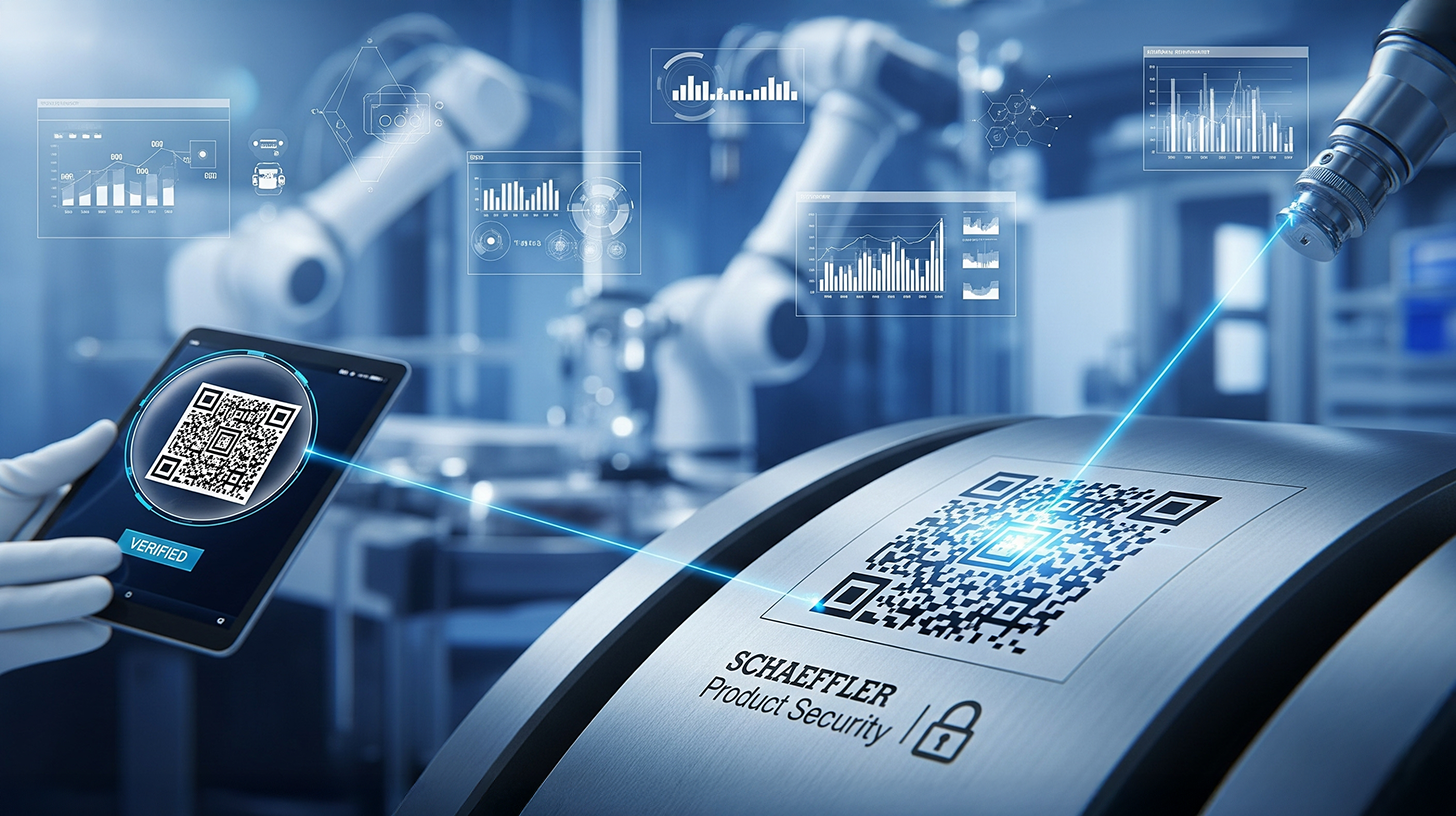
Schaeffler in the fight against product piracy: The GS1 Data Matrix code as a key technology – Image: Xpert.Digital
From anti-counterfeiting measures to digital twins: Why Schaeffler's small code has a huge future
Dangerous forgeries: How a simple code became a powerful weapon for the industrial giant Schaeffler
The Schaeffler Group, as a technology and industrial group, has developed a comprehensive and systematic approach to combating product counterfeiting, in which the GS1-standard Data Matrix code plays a central role. This technological solution is far more than just a simple barcode – it forms the foundation for a holistic strategy for anti-counterfeiting measures and digital traceability.
Related to this:


The challenge of product piracy in industry
Product piracy poses a growing problem for industrial companies like Schaeffler, extending far beyond traditional luxury goods. Rolling bearings and other machine components are particularly affected, as they are often safety-critical and their failure can have serious consequences. Counterfeit industrial components not only jeopardize operational safety but can also lead to production downtime, damage, and, in the worst-case scenario, personal injury.
The quality of counterfeit products is unpredictable and does not meet the stringent standards required for industrial applications. Even if an initial shipment of counterfeit products appears functional, there is no guarantee of long-term reliability or compliance with technical specifications. Furthermore, the similarity between the original and the counterfeit often makes it extremely difficult to distinguish them with the naked eye.
The GS1 Data Matrix code as a key technology
Schaeffler relies on the GS1-standard Data Matrix Code (DMC) to combat product counterfeiting. This code has been applied to all product packaging for years and is increasingly being used directly on the products themselves. This two-dimensional code encodes a wide range of information and uniquely identifies each individual product worldwide.
The DMC used by Schaeffler is based on the internationally recognized GS1 standard and is ECC200 compliant. This standardization ensures that the codes are uniquely readable worldwide and that no overlaps can occur. The code contains a Global Trade Item Number (GTIN) for product identification as well as an individual serial number, which enables the unique identification of each individual product.
The technical characteristics of the DMC make it particularly suitable for industrial applications. It can store a large amount of information in a very small space and, thanks to its error correction algorithms, remains readable even if up to thirty percent of its surface is damaged. This robustness is crucial in industrial environments where codes are exposed to dirt, heat, abrasion, and other environmental influences.
The OriginCheck app as a verification tool
A key component of Schaeffler's anti-counterfeiting strategy is the OriginCheck app, which was launched in 2017 and has been continuously developed since then. This smartphone application enables end customers, retailers, and authorities to quickly and easily perform an initial authenticity check on INA and FAG products.
The app works by scanning the DMC (Digital Marketing Communications Code) on the product packaging or the product itself. After scanning, the user immediately receives feedback on the code's authenticity. This is done by querying a database maintained by Schaeffler, which records every shipped code. The app uses a traffic light system to indicate to the user whether the code is authentic or suspected of being counterfeit.
In cases of suspicious activity, the app offers a guided photo documentation function, allowing users to take pictures of the suspect product and send them directly to the Schaeffler Brand Protection Team via email. This feature significantly simplifies the reporting of suspected counterfeit products and enables rapid processing by experts.
The OriginCheck app goes beyond simple product verification, offering additional features such as the verification of merchant certificates and a search function for authorized distributors. This allows buyers to verify not only the authenticity of the products but also the legitimacy of their sources.
The Brand Protection Team as the central coordination point
Since 2004, Schaeffler has operated a specialized Brand Protection Team, which serves as a central point of contact for combating product and brand piracy. This team has a comprehensive arsenal of measures to combat counterfeiting and works closely with customs and law enforcement agencies.
The team pursues a multi-dimensional strategy encompassing legal, organizational, and public relations measures. These include civil and criminal proceedings against counterfeiters, active market surveillance, cooperation with authorities, and awareness and training initiatives for retailers and customers.
The success of this strategy can be measured in concrete figures. In 2017 alone, Schaeffler investigated over 700 suspected cases and was able to seize and destroy counterfeit goods worldwide with a retailer purchase value of five million euros. In one case from 2023, 30,000 counterfeit rolling bearings were destroyed, which had been seized primarily in Europe during the preceding two and a half years.
Technical implementation and serialization
The technical implementation of the DMC at Schaeffler follows a well-thought-out concept that ensures both product safety and traceability. Each code is individually generated and may only be used once. This uniqueness is a fundamental requirement for ensuring that every product can be unequivocally identified as an original Schaeffler product.
Serialization follows a structured scheme in which a serial number in block 21 of the GS1 code contains a timestamp in the form of the day and time of code generation. By linking it to other internal information in the Schaeffler data infrastructure, each code can be traced back to its point of origin, i.e., to the plant level.
This traceability enables Schaeffler not only to identify counterfeit products, but also to collect detailed information about production batches, manufacturing dates, and distribution channels. This data is of great importance for both quality control and product monitoring obligations.
Direct Part Marking for permanent marking
A particularly important aspect of Schaeffler's strategy is Direct Part Marking (DPM), in which the DMC is laser-etched directly onto the product. This method ensures that the marking remains visible even if the original packaging is removed or damaged.
Direct laser marking (DPM) is particularly advantageous in industrial applications where components are often in use for years or even decades. Direct laser engraving withstands extreme environmental conditions and remains legible even after millions of operating hours. This is especially important in the rail, aerospace, and automotive industries, where complete traceability throughout the entire product lifecycle is essential.
The combination of DMC on the packaging and DPM on the product itself creates double security. Both codes are linked, allowing users to access the same authentication information via both channels. This increases verification flexibility and makes the system more robust against tampering attempts.
🎯🎯🎯 Benefit from Xpert.Digital's extensive, five-fold expertise in one comprehensive service package | BD, R&D, XR, PR & Digital Visibility Optimization


Benefit from Xpert.Digital's extensive, five-fold expertise in a comprehensive service package | R&D, XR, PR & Digital Visibility Optimization - Image: Xpert.Digital
Xpert.Digital possesses in-depth knowledge across various industries. This allows us to develop tailored strategies precisely aligned with the requirements and challenges of your specific market segment. By continuously analyzing market trends and monitoring industry developments, we can act proactively and offer innovative solutions. The combination of experience and expertise generates added value and provides our clients with a decisive competitive advantage.
More information here:
How GS1 standards make supply chains safer and more efficient
Integration into digital supply chains and Industry 4.0
At Schaeffler, the DMC not only serves as a counterfeit protection system, but also forms the foundation for the digitalization of the entire supply chain. The unique identification of each product lays the groundwork for the development of digital twins and integration into Industry 4.0 concepts.
The DMC (Delivery Chain Management) enables track-and-trace functionality at the individual item level, going far beyond simple authenticity verification. In outbound logistics, serialized handling units such as pallets and cartons can be linked to the product codes, allowing for seamless tracking throughout the entire supply chain.
This data collection also supports the remanufacturing of Schaeffler products, as all relevant data across the product lifecycle is available. With a single scan, operators and remanufacturing companies can gain complete access to order status, remanufacturing information, and the history of each individual bearing.
Related to this:
Logistics applications and smart box system
Schaeffler is continuously expanding the application possibilities of the DMC in logistics. One example is the Smart Box system for large warehouse applications, which was introduced in 2021. These reusable transport containers are equipped with GPS trackers and enable precise tracking throughout the entire transport process.
The integration of DMC and GPS technology creates new opportunities for monitoring and optimizing logistics processes. Location and environmental data are captured in real time and can be used to improve delivery times, reduce downtime, and optimize return processes.
This development demonstrates how the DMC has evolved from a simple authentication feature to a comprehensive information carrier for intelligent logistics systems. The data from the trackers enables data-driven control of delivery and return logistics and contributes to sustainability by optimizing the use of reusable containers.
Quality Management System and Technical Compliance
The implementation of the DMC is closely linked to Schaeffler's comprehensive quality management system. The SHAPE (Sharpen, Accelerate, Perform) quality program, introduced in 2021, integrates divisional and central quality aspects and leverages the resulting synergies for continuous improvement.
A key component is the Technical Compliance Management System (TCMS), which comprises standardized and auditable processes for product safety and compliance. This system includes management systems for integrated product safety, functional safety, and product cybersecurity management, all aimed at minimizing technical risks arising from the increasing connectivity of products.
Integrating the DMC into these systems ensures that anti-counterfeiting measures are not considered in isolation, but rather as an integral part of the overall product safety strategy. This is particularly important in times of increasing regulatory requirements and the growing complexity of industrial products.
Digital Transformation and Future Prospects
Schaeffler is using the DMC as a springboard for more extensive digitalization measures. The technology partnership with NVIDIA for the development of digital twins demonstrates how traditional marking technologies can be integrated into modern Industry 4.0 concepts. In the NVIDIA Omniverse, all elements of Schaeffler's production are mapped and simulated as digital twins.
Schaeffler Digital Solutions GmbH develops innovative solutions for the factory of the future using the autinity software platform. These web-based applications utilize the data provided by the DMC for condition monitoring, quality assurance, and traceability functions along the entire supply chain.
The company plans to integrate at least half of all its plants into the digital ecosystem by 2030. The Digital Marketing Center (DMC) will play a key role as a link between physical products and their digital representation. This integration enables real-time monitoring, analysis, and continuous optimization of production processes.
International cooperation and standardization
Schaeffler is actively involved in international committees and organizations dedicated to advancing anti-counterfeiting and product safety. The company initiated the Product Safety Network, which now comprises thirteen companies and is supported by the industry associations VDA, VDMA, and ZVEI.
At the EU level, Schaeffler has been participating in the steering committee for the development of the European Union Intellectual Property Office's (EUIPO) Enforcement Database since 2013. Through this database, rights holders provide European authorities with product information and contact details to facilitate the detection of counterfeits and the initiation of counterfeiting measures.
The OriginCheck app is accessible to authorities in this database along with accompanying information and is demonstrated at joint events. This international collaboration enhances the effectiveness of individual measures and contributes to the development of industry-wide standards.
Economic impact and performance measurement
Schaeffler's investments in anti-counterfeiting measures and DMC technology are paying off in several ways. Besides directly protecting against revenue losses due to product piracy, these measures also contribute to strengthening brand reputation and customer trust.
Concrete successes can be measured using various key performance indicators. Around ninety percent of the products delivered by Schaeffler today are already marked with a DMC (Dealer Marketing Communications) label. The Brand Protection Team handles hundreds of suspected cases annually and regularly removes significant quantities of counterfeit products from circulation.
The system's preventive effect is particularly important. The mere existence of a robust authentication technology like the DMC significantly increases the costs and risks for counterfeiters. Since each code is valid only once, counterfeiters would have to copy a different valid code for each counterfeit package, which is extremely time-consuming and considerably increases the risk of detection.
AI and training as a key to combating increasing product piracy
Despite the successes of DMC-based anti-counterfeiting measures, challenges remain. The increasing professionalization of counterfeiters necessitates the continuous development of security features and verification methods.
Schaeffler addresses these challenges through continuous innovation and improvement of its systems. The integration of artificial intelligence into analysis methods makes it possible to detect even sophisticated counterfeiting attempts. At the same time, the user-friendliness of the verification tools is continuously improved to increase acceptance among end customers and retailers.
Another important aspect is the training and awareness-raising of all parties involved in the supply chain. Schaeffler offers regular training courses for authorized dealers and provides comprehensive information materials to raise awareness of the problem of product piracy.
Future-proof anti-counterfeiting: Schaeffler's holistic DMC approach
The implementation of the GS1 Data Matrix code at Schaeffler represents an outstanding example of a holistic approach to anti-counterfeiting that goes far beyond mere product identification. By combining technical innovation, strategic planning, and international collaboration, the company has created a system that not only addresses current threats but also forms the basis for future developments in the digital industry.
The success story of the Digital Marketing Center (DMC) at Schaeffler demonstrates that anti-counterfeiting measures are most effective when understood as an integral part of a comprehensive digitalization strategy. The technology not only protects against counterfeit products but also enables new business models, improved customer service, and more efficient production processes.
Looking ahead, Schaeffler plans to further expand and deepen its use of Digital Manufacturing Computing (DMC). Integration into IoT systems, its use for preventive maintenance concepts, and its incorporation into automated quality management systems will further increase the importance of this technology. At the same time, the continuous development of security features and verification methods will ensure that Schaeffler can continue to offer effective protection against product counterfeiting.
Your global marketing and business development partner
☑️ Our business language is English or German
☑️ NEW: Correspondence in your native language!

Konrad Wolfenstein
I and my team are happy to be available to you as your personal advisor.
You can contact me by filling out the contact form here wolfenstein@xpert.digital:or simply call me at +49 7348 4088 965. My email address is
I'm looking forward to our joint project.