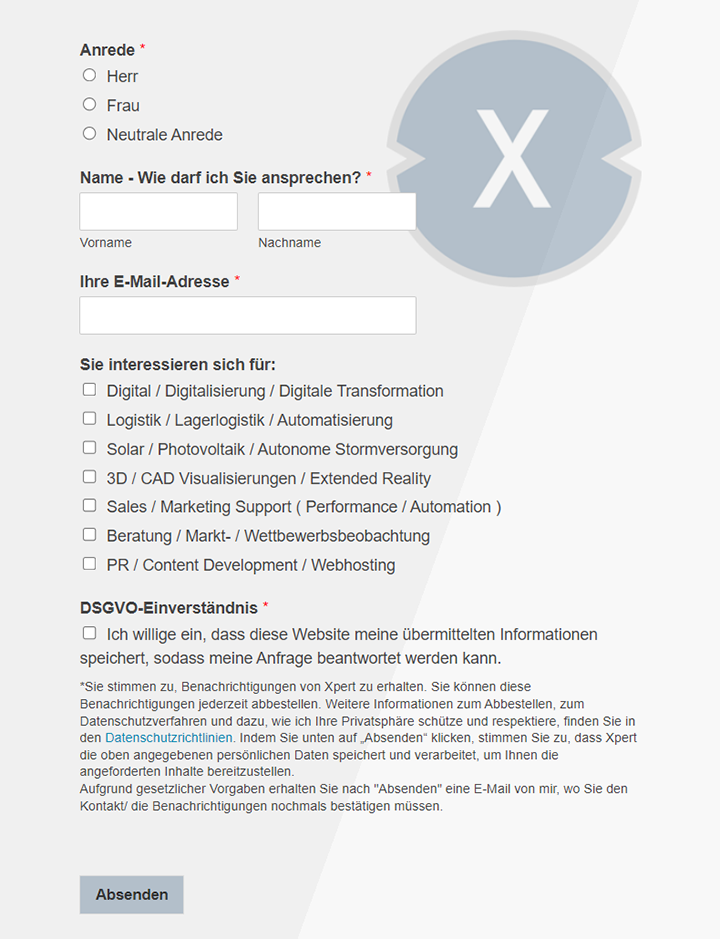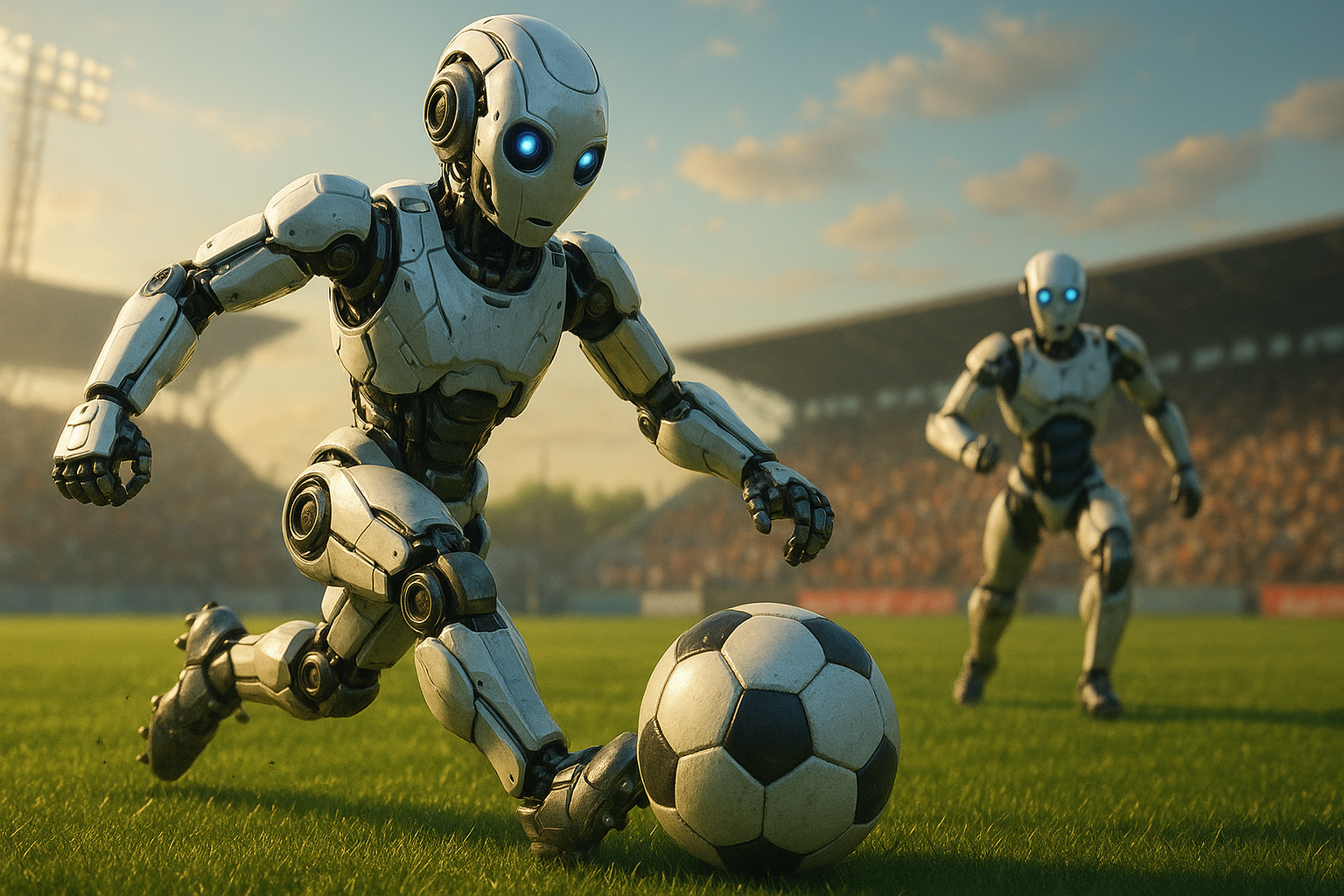
The future of sports? Humanoid robots conquer the football fields – Image: Xpert.Digital
Artificial intelligence conquers the football pitch: Historic tournament without human intervention
A milestone in robotics: Autonomous androids compete for the first title
In a remarkable demonstration of technological advancements, the first fully autonomous football tournament for humanoid robots took place in Beijing on June 28, 2025. This groundbreaking event marks a crucial turning point in the development of artificial intelligence and robotics, and offers a fascinating glimpse into the future of sports.
The THU Robotics team from Tsinghua University won the title at the first fully autonomous soccer tournament for humanoid robots. In the final, THU Robotics defeated the Mountain Sea team from the Agricultural University of China 5-3. However, only Chinese universities participated in the tournament in Beijing.
Related to this:

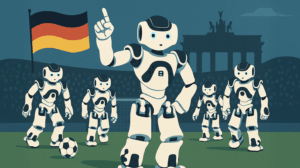
The historic tournament for fully autonomous robots in Beijing
The RoboLeague tournament, held at the Beijing Smart Esports Event Centre, marked a significant milestone in Chinese robotics research. The final pitted two top university teams against each other: the THU Robotics team from the prestigious Tsinghua University and the Mountain Sea team from China Agricultural University. In a thrilling duel that captivated the audience, the Tsinghua University team emerged victorious with an impressive 5-3 win, claiming the first championship title in this emerging sport.
The unique aspect of this event lay in the complete autonomy of the robots. Unlike traditional robotics competitions, where human remote control often still plays a role, these humanoid players acted solely on the basis of their built-in artificial intelligence. Each team consisted of three robots plus one substitute player, with the games divided into two ten-minute halves.
Technological achievements and challenges
The robots demonstrated impressive technological capabilities, the result of years of research and development. Equipped with advanced visual sensors and cameras, the mechanical footballers were able to detect balls from a distance of up to 20 meters with an accuracy of over 90 percent. This exceptional precision allowed them not only to locate the ball but also to identify field markings, teammates, and opposing players.
The robots possessed sophisticated navigation systems that allowed them to move independently across the playing field and make tactical decisions. Their ability to right themselves after falls was further proof of the advanced technology, although this function didn't always work flawlessly. At times, the mechanical players, much like their human counterparts, had to be carried off the field on stretchers, adding an almost ironic, yet undeniably charming, touch to the event.
Dou Jing, CEO of the tournament organizing committee, emphasized the importance of the event as a combination of technological innovation and practical application. The event offered a unique platform to raise public awareness of robotics technology while simultaneously testing real-world application scenarios.
China's ambitious robotics strategy
The football tournament in Beijing is part of a comprehensive Chinese strategy to establish itself as a global leader in robotics. The Chinese government has identified humanoid robots as the next groundbreaking technology after computers, smartphones, and electric vehicles. This vision is reflected in concrete policy measures: The Chinese Ministry of Industry and Information Technology has presented an ambitious plan that aims for humanoid robots to reach a level of maturity by 2025 that allows for mass production.
As early as 2014, the Chinese leadership under Xi Jinping recognized the immense potential of robotics, describing robots as the "jewel in the crown of the manufacturing industry." To realize this vision, the central government plans to invest over one trillion yuan (approximately 128 billion euros) in robotics, artificial intelligence, and cutting-edge innovations over the next 20 years.
Diverse sporting events as a test laboratory
China systematically uses sporting events as a testing ground for the development of humanoid robots. As early as April 2025, the world's first half-marathon for humanoid robots in Beijing garnered international attention. In this extraordinary race, 21 robots competed alongside 12,000 human runners. The fastest robot, Tiangong Ultra from X-Humanoid, crossed the finish line in an impressive 2 hours, 40 minutes, and 42 seconds. Although this time was about an hour and a half slower than that of the human winner, it nevertheless marked an important milestone in the development of walking robots.
Related to this:
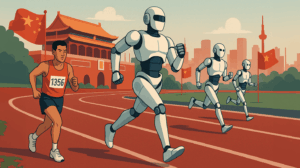
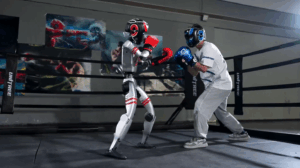
The diversity of sporting events is remarkable: in addition to football and running, boxing matches between humanoid robots have already taken place, allowing participants to demonstrate their fighting skills and reflexes. These events not only serve as entertainment but also function as important data collection points for the further development of robotics technology.
Related to this:
🎯🎯🎯 Benefit from Xpert.Digital's extensive, five-fold expertise in one comprehensive service package | BD, R&D, XR, PR & Digital Visibility Optimization


Benefit from Xpert.Digital's extensive, five-fold expertise in a comprehensive service package | R&D, XR, PR & Digital Visibility Optimization - Image: Xpert.Digital
Xpert.Digital possesses in-depth knowledge across various industries. This allows us to develop tailored strategies precisely aligned with the requirements and challenges of your specific market segment. By continuously analyzing market trends and monitoring industry developments, we can act proactively and offer innovative solutions. The combination of experience and expertise generates added value and provides our clients with a decisive competitive advantage.
More information here:
Artificial intelligence turns robots into human-like partners instead of mere tools
The World Championship of Humanoid Robots
The pinnacle of China's robotics ambitions will be the first World Championship for humanoid robots, held in Beijing from August 15-17, 2025. This historic event will take place at the iconic National Stadium and National Speed Skating Arena and promises to be a spectacle of unprecedented scale.
The World Championship comprises 19 different disciplines, divided into three main categories: athletic competitions, performances, and scenario-based challenges. In the athletic competitions, the robots will compete in eleven different disciplines, including seven track and field events, free gymnastics, and soccer matches with varying team sizes. The performances will include solo and group dances showcasing the coordination skills and teamwork of multiple robots.
Particularly exciting are the scenario-based challenges, which simulate practical applications in industrial, medical, and hotel-specific environments. Here, the robots will have to handle tasks such as material handling, medication sorting, and hotel service, demonstrating their versatility and practical applicability.
Related to this:
International robotics research and competitions
The development of soccer-playing robots is not exclusively a Chinese phenomenon. Since 1997, the RoboCup international research initiative has been dedicated to promoting robotics and artificial intelligence through soccer competitions. The original goal of this initiative was to develop a robot team by 2050 that could compete against the human soccer world champions.
German teams have achieved remarkable success in this field. Team B-Human from the University of Bremen and the German Research Center for Artificial Intelligence won the RoboCup World Championship 2024 for the eleventh time. With an impressive goal difference of 86:1, the German robots demonstrated their technological superiority in the Standard Platform League.
These international competitions serve as important platforms for scientific exchange and the further development of robotics technology. Approximately 3,000 participants from 45 countries competed in the last RoboCup World Championship, underscoring the global dimension and importance of this field of research.
Technological revolution in industry
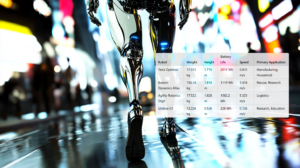
Advances in humanoid robotics are not limited to sporting events but are already having a concrete impact on industry. Leading companies like Amazon, BMW, and Mercedes-Benz are already testing humanoid robots in their production environments. Amazon, for example, uses the Digit robot from Agility Robotics in its warehouses, while BMW is testing the Figure 02 from Figure AI in its car body shop.
Market forecasts for humanoid robots are exceptionally optimistic. Goldman Sachs estimates that the global market for humanoid robots will reach a volume of US$38 billion by 2035. ARK Invest's forecast is even more ambitious, predicting a maximum market potential of US$24 trillion for humanoid robots.
Experts predict that around 20 million humanoid robots will be in use by 2030, primarily in industrial applications. This development is being driven by drastically decreasing manufacturing costs: While a humanoid robot currently costs around US$250,000, Tesla CEO Elon Musk forecasts a reduction to approximately US$20,000.
Technological breakthroughs and application areas
The rapid development of humanoid robots is enabled by several technological breakthroughs. Multimodal generative artificial intelligence allows the robots to understand language, communicate with humans, and independently perform complex tasks. Advances in actuator and sensor technology have significantly improved the robots' mobility and precision.
The improvements are measurable: Between 2023 and 2025, the capabilities of humanoid robots improved by 35 to 40 percent in areas such as speed, precision, and application fields. These advances enable the robots to automate up to 40 percent of tasks that were previously performed manually.
The potential applications are diverse: In the first wave, humanoid robots can primarily handle logistical tasks such as sorting, transporting, and providing goods. From 2028 to 2030, it is expected that they will also be able to manage tasks with high variance and complex processes, such as in assembly.
Societal impacts and future prospects
The development of humanoid robots has far-reaching societal implications. It could offer a solution to the growing shortage of skilled workers in many industries. At the same time, it raises important questions about the future of work and the relationship between humans and machines.
Cheng Hao, founder and CEO of Booster Robotics, even envisions a future where humans could play soccer against robots. He emphasizes the importance of safety: "This means we have to ensure the robots are completely safe. For example, a robot and a human could play a game where winning isn't the priority, but rather genuine offensive and defensive interactions take place.".
This vision of harmonious human-robot interaction is at the heart of current research. Sporting competitions serve as an ideal testing ground for these developments, as they allow the robots' capabilities to be tested in controlled yet dynamic environments.
Related to this:

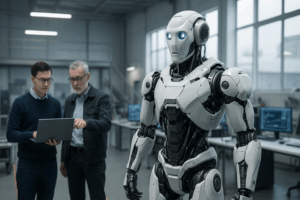
Artificial intelligence meets sports: Robotics technology breaks down barriers
The football tournament in Beijing marks only the beginning of a technological revolution with the potential to fundamentally change our society. The combination of advanced artificial intelligence, precise sensors, and improved motor skills transforms humanoid robots into versatile assistants that can be used in almost all areas of life.
The Chinese government has already announced that numerous other robotics events will take place in 2025, including the tenth World Robot Conference and the World Humanoid Robot Games. These events will not only showcase technological advancements but also raise public awareness of the potential of robotics technology.
This development shows that we are at the beginning of a new era in which intelligent machines are increasingly developing human-like abilities. The football tournament in Beijing was more than just a sporting event – it was a glimpse into a future where robots could become not just tools, but partners to humans. This transformation will not only revolutionize the world of work, but also give rise to new forms of entertainment and sport that are difficult to imagine today.
We are here for you - Consulting - Planning - Implementation - Project Management
☑️ SME support in strategy, consulting, planning and implementation
☑️ Creation or realignment of the digital strategy and digitization
☑️ Expansion and optimization of international sales processes
☑️ Global & Digital B2B trading platforms
☑️ Pioneer Business Development

Konrad Wolfenstein
I would be happy to serve as your personal advisor.
You can contact me by filling out the contact form below or simply call me on +49 7348 4088 965 .
I'm looking forward to our joint project.
Write to me



Xpert.Digital - Konrad Wolfenstein
Xpert.Digital is a hub for industry focusing on digitalization, mechanical engineering, logistics/intralogistics and photovoltaics.
With our 360° Business Development solution, we support renowned companies from new business to after-sales.
Market intelligence, smarketing, marketing automation, content development, PR, mail campaigns, personalized social media and lead nurturing are part of our digital tools.
You can find more information at: www.xpert.digital - www.xpert.solar - www.xpert.plus
Keep in touch