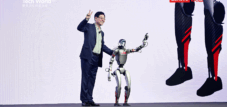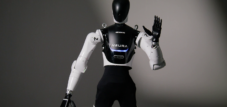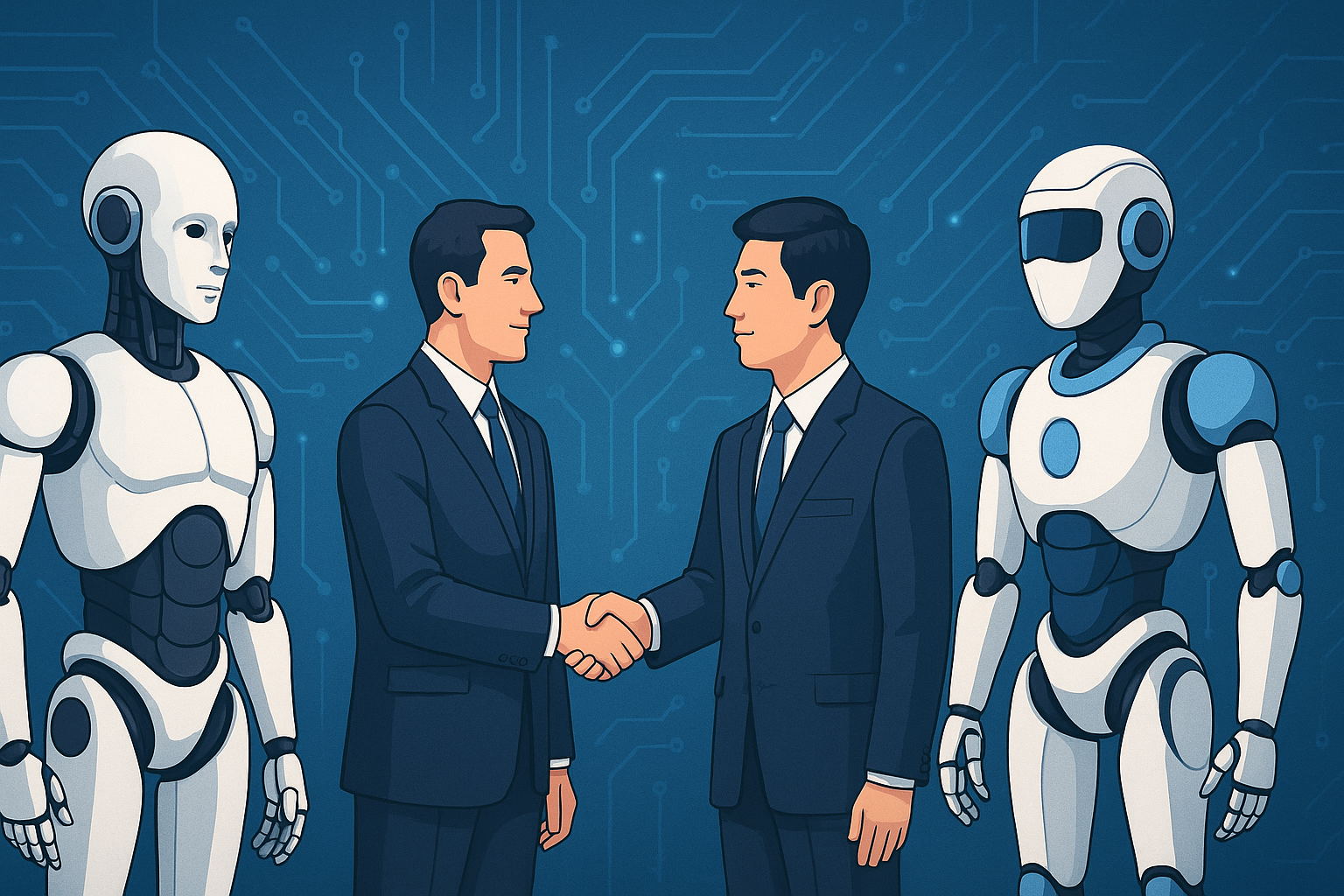
Huawei and UBTech: Strategic alliance to develop humanoid robots for industry and households – Image: Xpert.Digital
Future technologies from China: How Huawei and UBTech are transforming robotics
Technology giants Huawei and UBTech recently announced a groundbreaking partnership aimed at developing humanoid robots for both industrial and domestic applications. This collaboration marks a significant step in China's ambition to achieve a leading position in the global robotics market and could fundamentally change the way we interact with technology.
Related to this:

The strategic partnership: Foundations and objectives
The two Shenzhen-based companies have signed a cooperation agreement aimed at "accelerating the transition of humanoid robots from laboratory innovations to large-scale application in industrial, domestic, and other scenarios." This alliance combines the complementary strengths of both companies: Huawei contributes its advanced AI and cloud technologies, while UBTech provides its expertise in developing humanoid and smart service robots.
Under the agreement, the companies plan to create smart factories with humanoid robots and develop both bipedal and wheeled service robots for household use. A key element of the partnership is the establishment of an innovation center focused on "embodied intelligence"—an advanced form of artificial intelligence that embeds cognitive processes in a physical body.
Huawei will contribute its self-developed Ascend and Kunpeng AI processors, its cloud computing technologies, and large-scale AI models to the partnership, along with its extensive experience in research, development, and supply chains. This technological foundation is intended to enable the development of humanoid robots that can not only be remotely controlled but also make independent decisions.
Technological Foundations: From 5G-A to Embodied AI
A key aspect of humanoid robot development is the integration of advanced connectivity technologies. At Mobile World Congress 2025, Huawei unveiled the world's first 5G-A (5G-Advanced) humanoid robot, developed in collaboration with China Mobile and Leju Robot. This technology provides a solid technical foundation for the diverse application scenarios of humanoid robots through its wider bandwidth, extremely low latency, and more intelligent network architecture.
5G-A technology enables humanoid robots to achieve precise location tracking in large-scale environments without additional equipment, increasing the reliability of multi-machine collaboration. Furthermore, it supports real-time remote control of the robots and their ability to handle complex tasks.
In parallel, Huawei is pursuing an approach known as "Embodied AI." Huawei researchers argue that large language models like ChatGPT cannot fully understand the real world because they do not exist within it. Instead, AI needs a physical body to understand actions, memory, and learning. This approach is being pursued at Huawei's newly established "Global Embodied Intelligence Innovation Center," which opened in Shenzhen in November 2024.
The development of humanoid robots: From industry to the household
UBTech initially focused on developing bipedal robots for household applications, but during its commercialization efforts, it discovered that numerous technical and logistical challenges remained unresolved. This led to a strategic realignment: deploying robots in factories as a first step.
By the end of 2024, UBTech had deployed the world's largest number of humanoid robots for training in automotive factories and had established partnerships with major automakers such as Dongfeng Liuzhou Motor, Geely Auto, and BYD. UBTech's Walker-S series is already in use on most vehicle manufacturers' production lines to perform various tasks, and the company has received over 500 orders for these robots from electric vehicle manufacturers.
UBTech's long-term roadmap follows a three-stage strategy: First, the company focuses on deploying humanoid robots in industrial environments, where they are already proving their value in factory operations. The second phase aims to expand into commercial service applications, such as hotels, reception areas, and airports. The final phase envisions the introduction of humanoid robots for home use, which is considered the most promising long-term application.
The Chinese market for humanoid robots: growth and government initiatives
The market for humanoid robots is growing rapidly in China – a market value of €44 billion is expected by 2031. According to the government's roadmap, China is to begin mass production of humanoid robots in 2025, and the human-like machines are to be integrated into the real economy as early as 2027.
The Chinese robotics industry is expected to grow to 5.3 billion yuan ($740 million, £560 million) this year, doubling its current size, according to figures from LeadeRobot. UBTech itself plans to produce more than 1,000 humanoid robots this year.
Huawei is investing heavily in the Chinese robotics sector to accelerate AI growth in the country. Around six of its eleven humanoid robotics companies aim to build more than 1,000 units this year. Furthermore, the company has established partnerships with 16 other firms, including Huayan Robotics and Leju Robot.
Related to this:

The next era of robotics: Advances and visions for home use
Despite the ambitious plans, significant challenges remain in the development of humanoid robots for home use. A domestic environment is far more complex than an industrial one—possibly ten to one hundred times more complicated. Every household is different, and the tasks required vary widely. This complexity cannot be addressed with pre-programmed procedures or predefined workflows.
Experts estimate that it will take another 5 to 8 years before robots are sophisticated enough to fully integrate into a household. Humanoid robots cope better in orderly factories than in private settings, where they are confronted with a multitude of unpredictable situations.
UBTech's approach to consumer robotics focuses on steady progress rather than a sudden market entry. The first milestone phase involves companion robots – robots designed to understand user actions and enable meaningful interactions. UBTech is currently developing biomorphic humanoid robots specifically for this purpose. Once the company has established a strong presence in this area, the next step will be the development of full-service robots capable of performing complex household tasks.
Huawei and UBTech: Pioneers of humanoid robot technology
The partnership between Huawei and UBTech marks a significant step in the development of humanoid robots that can be used in both industrial and domestic environments. By combining Huawei's strengths in AI, cloud computing, and chip development with UBTech's expertise in humanoid robotics, the companies aim to bridge the gap between laboratory innovations and practical applications.
While the initial focus is on industrial applications, where the technology is already being tested, the long-term vision aims at integrating humanoid robots into everyday life. In the future, these robots could not only take over simple household tasks but also serve as conversation partners and companions, potentially leading to a fundamental change in how we interact with technology.
This development runs parallel to China's national ambition to take a leading position in the global AI and robotics industry. With government support and significant investment, China is on its way to becoming a hub for the development and production of humanoid robots, with companies like Huawei and UBTech at the forefront of this technological revolution.
Related to this:
Your global marketing and business development partner
☑️ Our business language is English or German
☑️ NEW: Correspondence in your native language!

Konrad Wolfenstein
I and my team are happy to be available to you as your personal advisor.
You can contact me by filling out the contact form here wolfenstein@xpert.digital:or simply call me at +49 7348 4088 965. My email address is
I'm looking forward to our joint project.