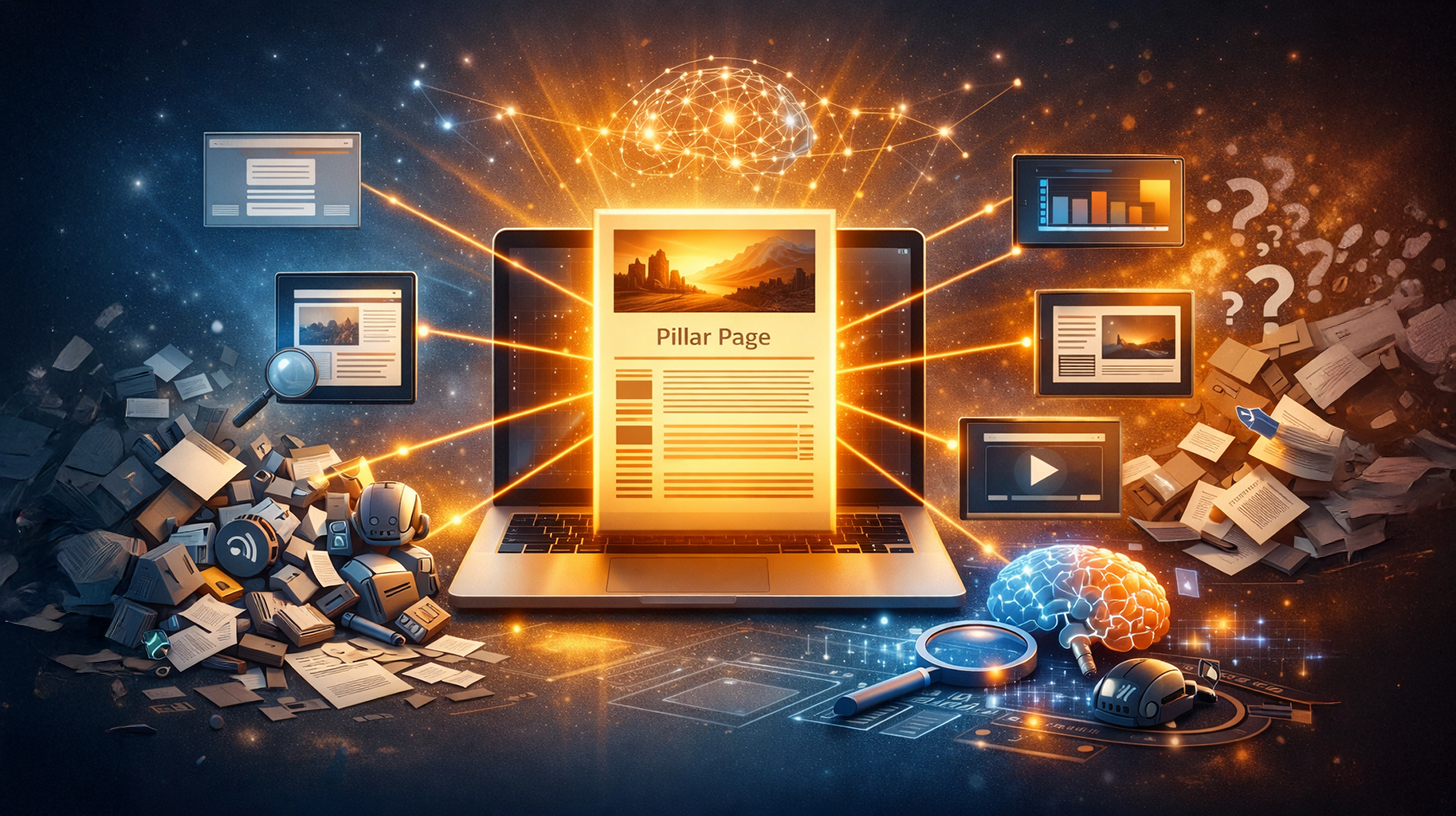
"Hub-and-spoke" method: Not one-pagers, not chaos – Why pillar pages are the golden mean for AI search – Image: Xpert.Digital
The Topic Cluster Secret: How to achieve 25% higher rankings with a pillar strategy
Structure beats scrolling: How to stop keyword cannibalization with pillar pages
For a long time, the sleek, endlessly scrollable one-page website was considered the gold standard for modern web design. But in the age of AI-powered search and Generative Engine Optimization (GEO), this dogma is crumbling dramatically. Today's algorithmic reality demands more than just aesthetics: anyone who wants to be cited as an expert by Google AI Overviews or ChatGPT needs structural depth. The solution lies beyond the simple one-pager: in the strategic architecture of pillar pages and topic clusters, as seen at the industry hub Xpert.Digital.
This article analyzes why the "hub-and-spoke" method—a central pillar page surrounded by detailed clustered content—is becoming the new key to success. We demonstrate why this hybrid strategy demonstrably achieves 25 percent higher rankings for clustered keywords and how it elegantly solves the problem of keyword cannibalization. Learn why AI models favor the clear semantic hierarchy of content hubs, how bidirectional linking strengthens your authority, and why it's time to transform your website from a flat "wallpaper" into an intelligent knowledge network.
Quoted from ChatGPT, Gemini & Co.: Why Topic Clusters are crucial for Generative Engine Optimization
The question of whether comprehensive one-page websites or clearly structured multi-page websites are superior for search engine optimization and generative engine optimization touches upon a paradigm shift in digital information architecture. The answer is far more nuanced than the widespread assumption suggests that complete content on a single page is inherently advantageous. Economic reality shows, rather, that page structure is not a matter of binary superiority, but a strategic decision that depends on business objectives, content types, and user behavior.
Structural advantage through thematic depth
The development of search engines and AI-powered answer engines has fundamentally shifted the weight of individual ranking factors. Multi-page architectures offer a crucial structural advantage in establishing thematic authority. Google and other search engines no longer primarily evaluate websites based on isolated keyword density, but rather on semantic completeness and the depth of thematic coverage. A website with ten dedicated subpages on different aspects of a core topic signals, algorithmically, more comprehensive expertise than a single page that only superficially touches upon the same topics.
The empirical evidence from practice is clear. Studies show that multi-page structures are superior for more complex information needs. Each dedicated page can target specific long-tail keywords and semantic variations that would compete with each other on a single page. An analysis of over ten thousand websites revealed that multi-page content hubs rank for an average of forty percent more related search queries than comparable one-page sites. This effect increases proportionally to the complexity of the topic.
The technical explanation lies in how search engines evaluate relevance. Modern ranking algorithms operate at the passage level, assessing not only entire pages but also individual text sections for their thematic coherence. A dedicated page on a subtopic allows for consistent semantic focus, whereas the same information on a one-page website is diluted within a broader context. Concentrating thematic signals on separate URLs leads to more precise matching in search queries and increases the likelihood that specific passages will be used as authoritative answers.
The power of indexing diversity
An often underestimated economic advantage of multi-page architectures lies in the multiplication of indexable units. Each URL represents a unique entry point into organic search results. While a one-page website can theoretically rank for a multitude of keywords, in practice it competes against itself for different search intents. An e-commerce study showed that product pages with category-based multi-page structures generated, on average, three times more organic traffic than variant-based single pages, even with identical overall content.
This superiority stems from search engines' ability to assign different user intents to different URLs. A user searching for basic information receives an overview page. Someone with more specific questions lands directly on the thematically relevant detail page. One-page websites, on the other hand, force a compromise positioning that optimally serves neither informational nor transactional search intents. The consequence is a lower click-through rate in the search results, as the page title and meta description must necessarily be formulated more generically.
Crawl budget economics also plays a substantial role. Google allocates crawling resources based on the perceived importance and update frequency of web pages. Multi-page structures allow for granular updates to individual topics without requiring a complete re-crawl of the entire information architecture. A comprehensive one-page website, on the other hand, must be fully re-indexed with every change, which leads to delays in incorporating updated information when dealing with large amounts of content. Research shows that pages with crawl depths of three clicks or less from the homepage link are crawled, on average, three times more often than more deeply nested content. Paradoxically, one-page websites that consolidate all information onto a single, very long page can lead to increased bounce rates if users cannot quickly find the information they are looking for.
Generative Engine Optimization and the citation logic
The rise of Generative Engine Optimization (GEO) as a discipline alongside traditional search engine optimization (SEO) is fundamentally changing the strategic requirements for website architecture. Generative AI models like ChatGPT, Perplexity, and Google AI Overviews operate on different principles than classic search engines. They synthesize information from multiple sources and cite these sources in their responses. Analyses of over a million AI-generated responses reveal a clear pattern: Pages with a clear thematic focus and structured information presentation are cited significantly more often as sources than comprehensive one-page websites with mixed topics.
The technical explanation lies in the retrieval-augmented generation process that underlies most modern AI search systems. When a user asks a question, the system first generates a constellation of related subqueries, searches for relevant documents, extracts specific passages, and synthesizes them into a coherent answer. Dedicated pages with a clear thematic focus are favored in this process because they exhibit higher semantic coherence between page title, heading structure, and main content. A study on citation frequency in AI-generated reviews found that pages with explicit question-and-answer structures and clear heading hierarchies had a 40 percent higher citation rate than one-pagers with identical information content but a less structured presentation.
The differences between various AI platforms are remarkable. ChatGPT favors authoritative domains with strong expertise signals and cites an average of only two to three sources per answer, intensifying the competition for visibility. Perplexity, on the other hand, shows six to seven citations per answer and prioritizes recent content updated within the last thirty days. Google AI Overviews favor pages that already rank well in traditional search results and show a preference for structured data through schema markup. A multi-page strategy allows for the optimization of different subpages for various AI platforms, while a one-page website relies on a compromise approach.
The analysis of the cited content formats is particularly revealing. The HowTo format achieves the highest citation rate in AI Overviews at 61 percent, followed by the FAQ format at 54 percent. The Article format alone shows a citation rate of only 12 percent, while the combination of Article with an embedded FAQ format triples the rate to 34 percent. These hybrid structures can be implemented much more consistently on dedicated pages than on one-page websites, where different content types are semantically mixed. Companies that create dedicated HowTo and FAQ pages for specific topic aspects see, on average, a threefold increase in AI citations within 90 days.
The economics of user experience
The debate surrounding one-page versus multi-page structures is often conducted from a purely SEO perspective, neglecting the economic implications of user experience. Conversion rate analyses paint a more nuanced picture. For focused landing pages with a clear call to action, one-pagers significantly outperform multi-page structures. Benchmarking data shows median conversion rates of six to ten percent for lead generation on focused single-page landing pages, compared to three to five percent for multi-stage processes. This superiority results from eliminating navigational decisions and concentrating attention on a single conversion goal.
For information-oriented websites and e-commerce platforms, however, this relationship is reversed. When faced with more complex purchasing decisions or information needs, users expect the ability to navigate between different aspects of a topic and control their own exploration. An analysis of e-commerce sites showed that product pages with dedicated URL structures for different variants had, on average, fifteen percent higher conversion rates than variant-based single pages where users had to select options on a single page. The explanation lies in the psychological effect of dedicated URLs, which signal that the product is in stock and available in that specific configuration.
Dwell time, the length of time users spend on a page after clicking on it from search results, also shows structure-dependent patterns. While one-page websites should theoretically generate longer dwell times when users scroll through extensive content, reality presents a more complex picture. Pages with good dwell times typically range between two and four minutes. One-page websites with more than 5,000 words often exceed users' cognitive processing capacity, leading to increased bounce rates if the desired information isn't found within the first few screen views. Multi-page structures with clear navigation and breadcrumb trails, on the other hand, allow for targeted navigation to relevant information, increasing overall satisfaction, even if the dwell time per individual page is shorter.
The mobile user experience exacerbates this problem. Sixty-eight percent of web traffic now comes from mobile devices, and mobile pages load on average seventy-one percent slower than desktop versions. A comprehensive one-page website with several thousand words, embedded media, and interactive elements can have loading times of ten seconds or more on mobile devices, increasing the bounce rate by one hundred and twenty percent compared to a one-second load time. Multi-page structures allow content to be divided into smaller, faster-loading units, which is particularly critical with limited mobile data connections. Google's mobile-first indexing explicitly prioritizes the mobile user experience, giving multi-page architectures with optimized individual pages a systematic advantage.
The keyword cannibalization dilemma
One of the most substantial economic challenges of one-page websites lies in the inherent difficulty of avoiding keyword cannibalization. Keyword cannibalization occurs when multiple pages on the same domain compete for identical or very similar keywords, leading to a dilution of ranking signals. Paradoxically, a one-page website attempting to cover multiple topics can cannibalize itself internally if different sections send similar semantic signals but cater to different search intents.
The solution to this dilemma lies in strategic thematic segregation. Multi-page architectures allow for the clear assignment of specific keywords and search intents to dedicated URLs. A best-practice method is the creation of keyword mapping tables that assign a primary keyword cluster to each page, ensuring that no two pages compete for identical search terms. This level of precision is structurally unattainable on one-page websites, as different sections inevitably need to use semantically related terms to appear coherent.
Remediation of keyword cannibalization on established websites is typically achieved through content consolidation. This involves combining several weaker pages into one strong, comprehensive resource, with redirects from the old URLs to the consolidated page. Studies show that content consolidation leads to an average increase of 45 percent in organic traffic, as ranking signals such as backlinks and internal linking are concentrated on a single URL. This seems to favor one-page websites, but with an important caveat: consolidation works best when the merged content is truly redundant and serves the same search intent. With differing intents, consolidation leads to a deterioration, as the resulting page does not optimally serve any intent.
The strategic implication is a differentiated approach. For narrowly defined topics with homogeneous search intent, consolidated one-page websites or comprehensive pillar pages are optimal. For broader topics with diverse sub-intentions, a topic cluster architecture is superior. This consists of a central pillar page that comprehensively covers the main topic, surrounded by ten to twenty cluster pages that explore specific subtopics in detail. Bidirectional internal linking between pillars and clusters signals semantic coherence, while URL segregation prevents keyword cannibalization. Empirical data shows that topic clusters achieve, on average, twenty-five percent higher rankings for cluster keywords than isolated single pages.
🎯🎯🎯 Benefit from Xpert.Digital's extensive, five-fold expertise in one comprehensive service package | BD, R&D, XR, PR & Digital Visibility Optimization


Benefit from Xpert.Digital's extensive, five-fold expertise in a comprehensive service package | R&D, XR, PR & Digital Visibility Optimization - Image: Xpert.Digital
Xpert.Digital possesses in-depth knowledge across various industries. This allows us to develop tailored strategies precisely aligned with the requirements and challenges of your specific market segment. By continuously analyzing market trends and monitoring industry developments, we can act proactively and offer innovative solutions. The combination of experience and expertise generates added value and provides our clients with a decisive competitive advantage.
More information here:
Website architecture: The one decision that determines your visibility
Structured data as a differentiating factor
The technical implementation of structured data through schema markup represents another factor that favors multi-page architectures. Structured data allows for machine-readable annotation of content, which facilitates interpretation for both traditional search engines and AI systems. Controlled experiments show that pages with well-implemented schema markup are significantly more likely to be cited in AI overviews. In a direct comparison of three nearly identical pages, only the version with high-quality schema appeared in an AI overview and also achieved the best organic ranking.
The practical implementation of schemas is more consistent and granular on multi-page architectures. Each dedicated page can be annotated with the specifically appropriate schema type. A how-to guide receives a how-to schema, an FAQ page an FAQ schema, and a product page a product schema with complete pricing and availability information. On one-page websites, mixing different content types leads to complex, error-prone schema implementations where multiple schema types have to be nested. Validation tools show that nested schema structures on one-page websites have a four times higher error rate than dedicated schema implementations on single pages.
The evolution of schema towards entity-based semantics reinforces this trend. Modern schema implementation focuses not only on isolated markup types but also on representing relationships between entities. A website that systematically connects entities such as people, organizations, products, and concepts through schema and makes their relationships explicit effectively constructs a Content Knowledge Graph. This structured data layer allows AI systems to gain a more precise understanding of the semantic context. Multi-page architectures with clear entity mappings per page enable more consistent Knowledge Graphs than one-page websites where multiple entities coexist without a clear hierarchy.
Particularly relevant for Generative Engine Optimization is the concept of Speakable Schema annotation, which marks text sections that are optimally suited for speech output by voice assistants. Analyses show that clearly structured text sections on dedicated pages, geared towards specific questions, exhibit higher Speakable suitability than contextually embedded passages on one-page websites. The conversion rate from Speakable markup to actual voice search results is 28 percent for dedicated FAQ and how-to pages, compared to only 12 percent for equivalent sections on mixed one-page websites.
The internal linking strategy as an architectural lever
The strategic use of internal linking represents an often underestimated economic lever that fundamentally favors multi-page architectures. Internal links fulfill several critical functions: They distribute PageRank within the domain, signal thematic relationships between pages, guide crawlers to important content, and allow users to explore related topics. Multi-page structures allow the construction of sophisticated internal linking networks that optimize these functions. One-page websites, on the other hand, are limited to anchor links within the same URL, which do not allow for PageRank transfer and are not treated as separate entities by crawlers.
Crawl efficiency is largely determined by internal linking structures. Pages that are three clicks or fewer from the homepage are crawled significantly more often than more deeply nested content. A flat site architecture, where important content pages are linked directly from the homepage or main category pages, maximizes crawl frequency. Topic cluster architectures implement this systematically through hub-and-spoke models, where a central pillar page links to all cluster pages, and each cluster page links back to the pillar. This bidirectional linking concentrates crawl budget on thematically coherent content groups and signals algorithmic cohesion.
Anchor text optimization, the strategic choice of link text in internal links, is another factor that favors multi-page structures. Precise, keyword-rich anchor texts signal the topic of the linked page and reinforce its semantic positioning. On one-page websites, anchor texts are typically generic or limited to jump-link labels like "Learn more," which convey no semantic signals. Dedicated pages allow for contextual, thematically precise anchor texts that are more informative for both users and algorithms.
PageRank sculpting, the targeted management of link equity flow through website architecture, is significantly more precise on multi-page structures. Important conversion pages or current content pieces can be prioritized through increased internal linking, while less important pages receive fewer links. This granular control is not possible on one-page websites, as all content on the same URL is treated equally. An analysis of two thousand commercial websites showed that sites with strategic internal linking frameworks achieve, on average, thirty-two percent higher organic visibility than sites with unstructured linking.
Content freshness and update cycles
The speed and granularity of content updates represent another factor where multi-page architectures offer economic advantages. Google's Freshness algorithm favors updated content, especially for time-sensitive search queries. The definition of Freshness is nuanced: it considers not only the publication date of new content but also substantial updates to existing content. Google considers content fresh when approximately 30 percent of it has been updated, with the quality of the updates being crucial.
Multi-page architectures allow for surgically precise content updates. If information on a specific subtopic changes, the corresponding page can be updated without modifying the entire content structure. This signals freshness for that topic without jeopardizing the stability of established rankings on other pages. One-page websites, on the other hand, require modification of the entire page with every update, which can lead to uncertainties in the crawling and ranking process. A comprehensive update of a one-page website can temporarily cause ranking fluctuations while the search engine re-evaluates the changes.
Freshness distance, a concept that measures how frequently competitors update their content on a topic, varies significantly by industry and subject area. In fast-paced fields like technology or news, weekly updates may be necessary, while in more stable areas, quarterly or semi-annual updates suffice. Multi-page structures allow for adjusting the update frequency to the specific needs of different subject areas. Pages on time-sensitive topics can be updated frequently, while evergreen content pages remain stable. This differentiation is not possible on one-page websites, as the update frequency is necessarily uniform.
Practical implementation requires systematic content audits that regularly assess the relevance and performance of all pages. Recommendations suggest reviewing important pages every six months and updating them as needed. For multi-page structures, this process can be prioritized by auditing high-traffic and conversion-critical pages more frequently than low-priority content. Aggregating these updates signals domain-wide activity, which increases Google's crawl frequency for the entire site. Pages that regularly publish fresh content or make updates are crawled significantly more often, leading to faster indexing of new content.
The strategic synthesis: When to choose which architecture
The economic analysis leads to a differentiated strategic recommendation that distinguishes between one-page and multi-page structures depending on the context. One-pagers are optimal for focused landing pages with a clear conversion goal, for portfolio sites with limited content, for event promotions with time-limited relevance, and for mobile-first experiences where scrolling is the preferred form of interaction. The average conversion rate for lead generation landing pages is between six and ten percent, with top performers achieving twenty percent and more. This superiority is based on eliminating navigational decisions and concentrating attention.
Multi-page architectures, on the other hand, are superior for e-commerce platforms with diverse product catalogs, for content marketing strategies with topic cluster approaches, for YMYL (Your Money or Your Life) areas that require specific expertise signals, and for companies with long-term SEO growth goals. The average organic visibility of sites with structured topic clusters is fifty-two percent higher than comparable sites with flat information architectures. This superiority accumulates over time, as each new cluster page strengthens the thematic authority of the entire cluster.
The optimal strategy for many organizations is a hybrid approach. The homepage and primary category pages function as comprehensive overview pages with a one-page format, addressing all core topics and providing clear navigation paths to more detailed subpages. These subpages are dedicated, focused resources that optimally serve specific search intents. This architecture combines the conversion power of focused landing pages with the SEO superiority of thematically diversified content hubs.
Practical implementation begins with thorough keyword and intent research, mapping the spectrum of relevant search queries and clustering them according to intent types. Based on this analysis, content is either consolidated if it serves redundant intents or segregated if it addresses distinct intents. The resulting information architecture is optimized through strategic internal linking, consistent schema implementation, and regular content updates. Continuous performance measurement in Google Search Console, analytics platforms, and specialized GEO tools like Searchable.ai or BrightEdge allows for iterative refinement based on actual user and algorithm signals.
A look into the AI-dominated future
The shift towards AI-dominated search landscapes will further reinforce the strategic importance of structured, multi-page architectures. The projection that traditional search volume will decline by 25 percent by 2026, while direct AI interactions increase, fundamentally alters success metrics. Visibility will increasingly be defined by citations in AI-generated answers, not just by traditional SERP rankings. This citation economy favors clear, authoritative, structured content on dedicated URLs over mixed information on one-page websites.
The development of multimodal search input through voice, image, and video reinforces the importance of semantic clarity. Voice search queries average 23 words, compared to 3.5 words for typed queries, and follow natural language question patterns. Optimizing for these conversational queries requires dedicated FAQ and how-to pages with clear question-and-answer structures that can be directly output to voice assistants. Forty-one percent of all voice search responses come from featured snippets, which are preferentially extracted from clearly structured, focused pages.
The integration of user-generated content and community platforms into AI responses reveals another trend. Forty-eight percent of all AI citations originate from community sources such as Reddit, LinkedIn, and YouTube. These platforms benefit from their clear content structure, where each thread, post, or video represents a dedicated URL with a focused topic. Companies that create similarly structured, focused content pieces and actively participate in relevant communities are optimally positioned for the AI search landscape. The strategic recommendation is therefore clear: Investing in structured, multi-page content architectures with clear entity relationships, consistent schema markup, and strategic topic clusters represents the most sustainable strategy for organic and AI-driven visibility in the medium term.
Your global marketing and business development partner
☑️ Our business language is English or German
☑️ NEW: Correspondence in your native language!

Konrad Wolfenstein
I and my team are happy to be available to you as your personal advisor.
You can contact me by filling out the contact form here wolfenstein@xpert.digital:or simply call me at +49 7348 4088 965. My email address is
I'm looking forward to our joint project.
☑️ SME support in strategy, consulting, planning and implementation
☑️ Creation or realignment of the digital strategy and digitization
☑️ Expansion and optimization of international sales processes
☑️ Global & Digital B2B trading platforms
☑️ Pioneer Business Development / Marketing / PR / Trade Fairs
B2B support and SaaS for SEO and GEO (AI search) combined: The all-in-one solution for B2B companies

B2B support and SaaS for SEO and GEO (AI search) combined: The all-in-one solution for B2B companies - Image: Xpert.Digital
AI search changes everything: How this SaaS solution will revolutionize your B2B ranking forever.
The digital landscape for B2B companies is undergoing rapid change. Driven by artificial intelligence, the rules of online visibility are being rewritten. For companies, it has always been a challenge not only to be visible in the digital mass, but also to be relevant to the right decision-makers. Traditional SEO strategies and managing local presence (geo-marketing) are complex, time-consuming, and often a battle against constantly changing algorithms and intense competition.
But what if there were a solution that not only simplified this process but also made it smarter, more predictive, and far more effective? This is where the combination of specialized B2B support with a powerful SaaS (Software as a Service) platform comes into play, specifically designed for the demands of SEO and GEO in the age of AI search.
This new generation of tools no longer relies solely on manual keyword analysis and backlink strategies. Instead, it leverages artificial intelligence to more accurately understand search intent, automatically optimize local ranking factors, and conduct real-time competitive analysis. The result is a proactive, data-driven strategy that gives B2B companies a decisive advantage: they are not only found, but perceived as the leading authority in their niche and location.
Here's the symbiosis of B2B support and AI-powered SaaS technology that transforms SEO and GEO marketing, and how your company can benefit from it to grow sustainably in the digital space.
More information here: