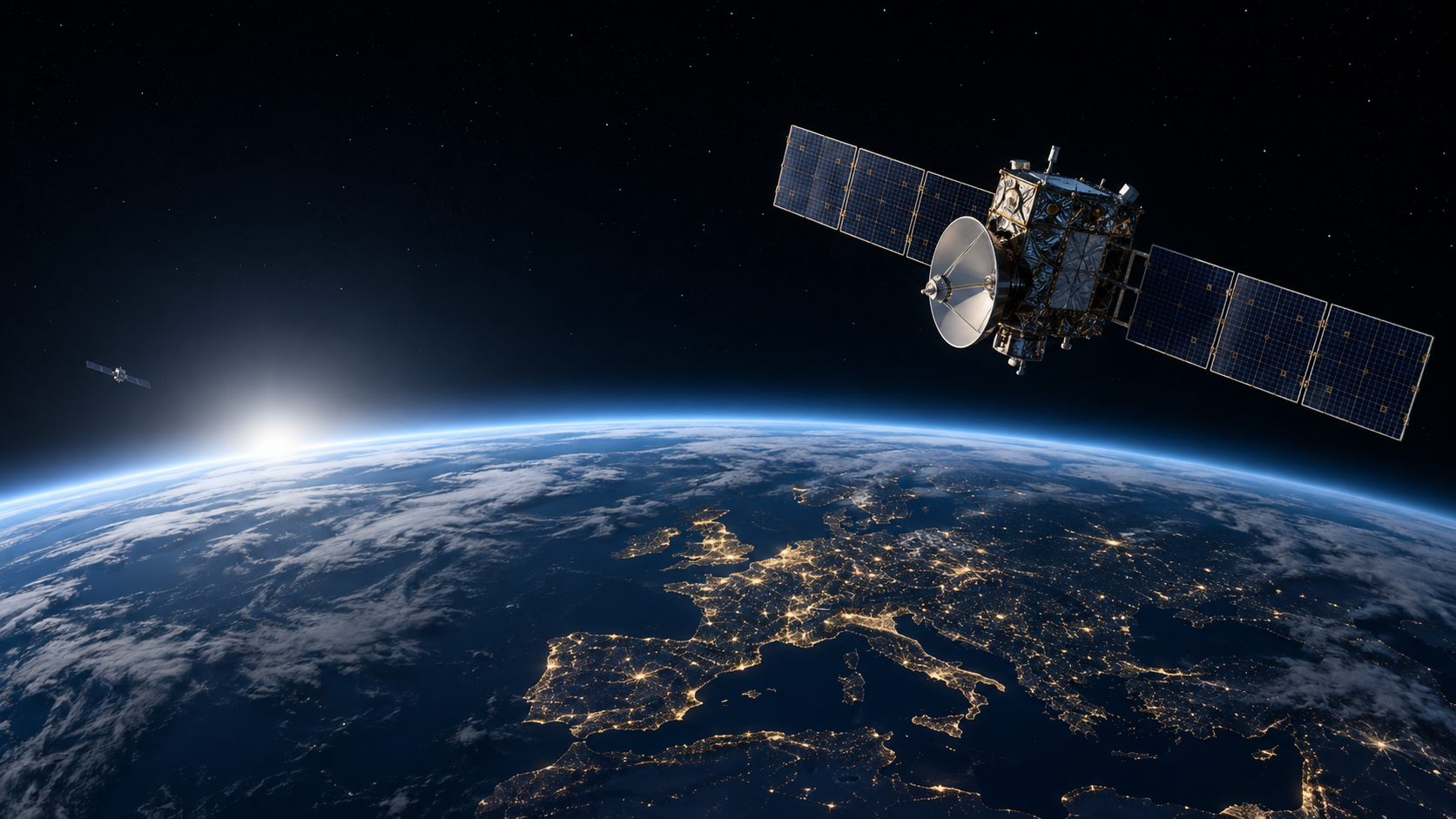
Satellites, transport, energy: Russian nuclear weapon in space? How vulnerable is the global economy really – How great is the danger from orbit? – Creative image on the topic, with AI: Xpert.Digital
Satellite failure: What consequences a nuclear detonation in orbit could have
What happens when satellite signals fail? The risks for the economy and everyday life
Satellite-based services are indispensable for many businesses and public services – from navigation and communication to precise timekeeping and Earth observation. The potential deployment of a Russian nuclear weapon in space therefore raises a serious question: How severely could the economy and daily life be affected if satellites were to fail? According to publicly available information from November 23, 2026, Western intelligence agencies and militaries consider a launch this year possible. However, such a launch has not been confirmed; nor has the independently verified possession of a deployable orbital nuclear weapon been proven.
The economic risk does not automatically lie in a total global outage. Rather, the crucial factors are which satellite services would be affected, how long the disruption would last, and whether independent backup solutions were available. Historical experience and current modeling studies show that a nuclear detonation in space could significantly impair satellites. At the same time, concrete damage cannot be reliably quantified without confirmed information about a weapon and its deployment scenario. However, one thing is clear: the more logistics, financial services, energy supply, and communication depend on satellite-based infrastructure, the more important robust backup systems become.
The digital economy considers itself crisis-proof – but its Achilles' heel extends all the way to space
The potential deployment of a Russian nuclear weapon in space would not only constitute a military escalation. It would shatter a fundamental economic assumption: that satellite-based communication, navigation, and Earth observation will remain permanently available. These services rely on an infrastructure whose importance extends far beyond the space industry. It supports transportation chains, agriculture, financial services, energy supply, and national security. Its disruption could therefore cause damage many times greater than the value of the affected satellites.
According to publicly available information as of November 23, 2026, Western intelligence agencies and militaries consider it possible that Russia could launch a nuclear-armed satellite this year. The system, designated Sputnik-S, is said to be fully constructed and has been stored in the greater Moscow area for some time. After launch, it could reportedly become operational within a short period. However, this does not confirm such a launch, nor does it confirm the independently verified possession of a deployable orbital nuclear weapon. This distinction is crucial: A serious warning describes a risk, but not yet an actual event.
Economically, the threat is nonetheless relevant. Companies and states don't need to wait for a proven attack to examine critical dependencies. However, it would be equally wrong to conclude that the digital economy is about to collapse based solely on an intelligence assessment. A sound analysis must distinguish between confirmed technical connections, plausible chains of damage, and remaining unanswered questions.
The central economic challenge lies less in the prospect of a sudden, global blackout than in the possibility of widespread, simultaneous disruptions. Modern economies can often weather individual outages. The situation becomes more difficult when multiple services are affected simultaneously and the planned contingency plans depend on the same underlying technology.
A serious warning situation is not yet proof of a weapon being ready for use
The available information describes a potential Russian capability and a possible timeframe. The German Armed Forces and the Federal Intelligence Service (BND) are said to have informed German government representatives and several NATO states about their assessments. Warning messages exchanged in early November reportedly indicated a possible launch within 60 days. This would make deployment as early as December 2026 conceivable. However, there is no publicly verifiable information available regarding the actual technical condition, the specific orbit, or the explosive power of such a system.
The political reactions also fail to provide conclusive clarification. The German Federal Ministry of Defense declined to comment further on the alleged concrete plans. The Russian embassy rejected the accusations, stating that it had no information regarding the described events. This neither proves the existence of the system nor its non-existence.
For an economic evaluation, this results in two distinct tasks. First, it is necessary to examine the potential impact of such a system. Second, it is essential to determine which precautionary measures would be appropriate given the unreliable quantifiability of the probability of occurrence.
An exact damage assessment would be unreliable at present. There is a lack of publicly available, reliable information about the weapon, its operational parameters, and the specific satellites at risk. Likewise, the available information does not allow for a reliable percentage probability of launch or detonation.
The appropriate perspective is therefore a conditional analysis: If a nuclear capability were stationed in orbit, which economic vulnerabilities would be particularly relevant? And which of these exist regardless of whether the current warning is confirmed?
Why satellites are economically more important than their purchase costs
The economic value of a satellite is not solely comprised of its development, manufacturing, launch, and operation. Crucially, it is the services and capabilities it enables on Earth through its data and signals that are achieved. A comparatively small component of a technical value chain can support processes with a significantly larger economic impact.
An industry estimate cited in United Nations documents valued the global space economy at approximately US$630 billion in 2023. A potential volume of US$1.8 trillion was projected for 2035. These figures are based on a specific market definition and growth assumptions. They do not represent the value of all satellites, nor the damage that would automatically result from their failure.
This distinction is crucial. Revenues from the space industry, satellite-based value creation, and actual economic output at risk of disruption are distinct categories. Equating them produces impressive but analytically unusable figures.
The extent of its use is illustrated by data on satellite navigation. Around 5.8 billion GNSS-enabled devices were reported to be in use worldwide in 2024. By 2034, this number could reach nearly ten billion. GNSS refers to global satellite navigation systems, which provide precise time information in addition to position and speed data. While the number of devices demonstrates the enormous prevalence of this technology, it doesn't indicate how long each individual device or its associated processes could continue operating without a satellite signal.
Economic vulnerability thus arises from a combination of reach and dependence. Many applications benefit from satellite services, but not all rely equally on their uninterrupted availability. Therefore, risk assessment depends not only on whether a company uses satellite data, but also on which business functions would fail without it.
An explosion in space has a different effect than an explosion on the ground
A nuclear detonation in space would not simply be an ordinary explosion in another location. For satellites, the effects of radiation and the potential creation of artificial radiation belts are particularly relevant. High-energy particles can be trapped by Earth's magnetic field and damage spacecraft during repeated passes. Therefore, the danger does not necessarily end with the immediate event.
The historical example is the American Starfish Prime experiment of 1962. A nuclear weapon with an explosive yield of approximately 1.4 megatons was detonated at an altitude of about 400 kilometers. The experiment caused electromagnetic interference in Hawaii and resulted in damage to several satellites. The artificially enhanced radiation environment also affected spacecraft beyond the immediate moment of the explosion.
However, this does not mean that a detonation today would automatically destroy all satellites. The effects depend on factors such as altitude, location, energy released, the affected orbits, and the resilience of the spacecraft. Therefore, different satellites could be affected very differently.
A distinction must also be made between satellite failure and direct damage to technical equipment on Earth. Communication loss caused by satellite failures involves a different transmission path than direct electromagnetic interference with ground-based systems. To lump both together under the blanket term "digital collapse" would obscure important differences.
A prolonged period of high radiation would be particularly problematic from an economic perspective. Simply replacing damaged satellites might not be enough. Newly launched systems could also be at risk. Regeneration would therefore not only be a question of money, but also of technical feasibility and timing.
Why low Earth orbit and navigation systems should not be equated
A precise risk analysis must differentiate between different areas of space. The current debate focuses particularly on satellites in low Earth orbit. Statements about very high failure rates often refer to specific model assumptions for these orbits and not to all satellites at every altitude.
This is crucial for economic assessment. Severe damage to low-flying satellites does not automatically lead to a similar failure of all global navigation, communication, and weather systems. Conversely, it would also be wrong to assume that higher-altitude systems are generally safe. The specific physical conditions would need to be examined to determine this.
A model study discussed in November 2026, but not yet peer-reviewed at that time, simulated very widespread failures in low Earth orbit under certain assumptions. In the scenario examined, the modeled percentage of failed satellites rose to approximately 98 percent within a week. This figure is not a prediction for Sputnik-S and is not a generally applicable damage rate. It belongs to a specific hypothetical scenario and depends on its assumptions.
The benefit of such calculations lies in making potential damage mechanisms visible. Their risk lies in reducing them to a spectacular percentage. Without the underlying conditions, a scientific scenario analysis can quickly become a supposed certainty.
For economic decisions, a different question is therefore more productive: Which services could fail under which conditions, how long could they be replaced, and which backup systems would actually be independent? Only this combination of orbital damage pattern and operational function allows for a reliable assessment.
What can actually be quantified regarding potential economic damage?
A British study on the failure of global satellite navigation systems provides a reliable estimate of the potential economic impact. It estimated the economic damage from a 24-hour GNSS outage at approximately £1.42 billion. For a seven-day disruption, the estimated damage was around £7.64 billion. Particularly large losses were attributed to emergency services, maritime traffic, and road transport, which together accounted for approximately 87.6 percent of the modeled damage from a one-week outage.
These figures illustrate the magnitude of potential dependencies. However, they are neither an estimate for a nuclear attack nor directly applicable to Germany. The study considers a specific country, specific applications, and defined failure assumptions. An event in orbit could affect other services, have different regional impacts, or develop over a longer period.
It is also noteworthy that the same study estimated the annual economic benefits of GNSS at approximately £13.62 billion. The comparison with the high short-term costs of outages initially seems surprising. This is explained by the fact that the benefits compared to a world without this technology are calculated differently than the damage caused by a sudden disruption in an economy already geared towards it.
An economy can develop alternative processes in the long term. However, in the event of an abrupt shutdown, the necessary time, equipment, and established procedures are lacking. Short-term disruption, emergency measures, and capacity bottlenecks can therefore be significantly more expensive than planned operations with less efficient technology.
A separate study would be necessary for Germany. A simple extrapolation based on population size or gross domestic product would ignore differences in industrial structure, transport networks, and technical safeguards. Therefore, a reliable figure for the total damage in Germany cannot be derived from the available data.
Germany should primarily assess the interconnectedness of its economy
For a German risk analysis, the number of satellite-dependent companies alone would not be decisive. Rather, it would be necessary to examine how disruptions propagate between industry, transport, energy, and services.
An industrial plant may be able to continue its immediate production without a satellite signal. However, if material deliveries are delayed, communication with a supplier fails, or important external data is missing, indirect limitations arise. The dependency then lies not in the machine itself, but in its economic environment.
The same problem arises when considering individual industries. A transport disruption doesn't just affect the transport sector. It can disrupt production, trade, and repair services. Conversely, not every delay necessarily leads to a production standstill. Inventory levels, alternative suppliers, and flexible processes can mitigate the consequences.
A meaningful German damage analysis would therefore need to differentiate between several time horizons. In the first few hours, short-term operational disruptions and the switch to alternative processes would be particularly relevant. After a few days, bottlenecks, backlogs, and additional costs would become more noticeable. With longer interruptions, investment decisions, contract amendments, and the reorganization of supply relationships would also come into play.
The economic significance of such a scenario therefore does not stem from a single spectacular figure. It lies in the potential overlap of many smaller and larger disruptions. It is precisely this overlap that makes the risk difficult to calculate and justifies an investigation that extends beyond individual company boundaries.
In logistics, a productivity shock is more likely than an immediate standstill
The British study shows that road and sea transport are among the most vulnerable sectors to a GNSS failure. This leads to an important economic distinction: the loss of digital support does not necessarily mean that vehicles can no longer move. However, it can significantly impair the efficiency, safety, and predictability of their use.
For logistics, a phased damage scenario would therefore be more plausible than the idea of an immediate, complete standstill. Initially, location information might be missing or become unreliable. Subsequently, scheduling, arrival forecasts, and coordination between individual transport segments would become more difficult. The longer the disruption lasts, the more pronounced the potential impact of deviations on downstream processes.
A distinction must be made between technology that is necessary and technology that enhances convenience. Some digital functions primarily save time and personnel. Others are a prerequisite for a specific automated process. A company needs to know which category its applications fall into.
The question of whether alternative procedures work in practice is particularly important. A theoretically available manual scheduling option is of little use if the necessary staff are lacking or the data is not available in a usable format. Similarly, an alternative communication channel can reach its limits if many companies resort to it simultaneously.
Economically, this would initially represent a productivity shock: The same transport output would require more time, personnel, and organizational effort. This could lead to higher costs and reduced capacity. The extent of this effect would depend largely on which services are actually affected and what operational reserves are available.
Hub for Security and Defense - Advice and Information


Hub for Security and Defense - Image: Xpert.Digital
The Security and Defence Hub offers expert advice and up-to-date information to effectively support companies and organizations in strengthening their role in European security and defence policy. Working closely with the SME Connect Defence Working Group, it particularly promotes small and medium-sized enterprises (SMEs) that wish to further develop their innovative capacity and competitiveness in the defence sector. As a central point of contact, the Hub thus creates a crucial bridge between SMEs and European defence strategy.
Related to this:
The importance of precise time information for businesses
Precise timekeeping is an often overlooked infrastructure service
Satellite navigation is typically associated in everyday life with maps, vehicles, and location tracking. In fact, global navigation systems also provide precise time information. Their economic significance therefore extends beyond visibly moving objects. Accordingly, the British study considers not only navigation, but positioning, navigation, and time tracking as interconnected infrastructure services.
For risk analysis, this means that a company cannot assess its dependency solely based on whether it uses navigation devices. It is equally relevant whether technical processes or external service providers use satellite-based time information.
A loss of signal would not automatically equate to an immediate loss of function. The crucial factor would be whether a system has an independent time source or sufficient bridging capability. The British analysis explicitly considers improvements in such bridging and resilience capabilities as a mitigating factor.
This distinction is economically significant. A backup solution doesn't need to function indefinitely to be valuable. Even additional hours or days can allow for controlled process adjustments, reduced workloads, or preparation for repairs.
At the same time, the mere existence of multiple devices is not sufficient protection. If they all require the same external time source, true independence is not achieved. The relevant metric is therefore not the number of installed components, but the duration for which operational functionality is maintained in the event of a failure of the common data source.
Power supply and communication require a sober assessment
The potential consequences for power supply and communication are among the most serious aspects of the threat. This is precisely why linguistic accuracy is necessary. Damage to numerous satellites does not automatically lead to a nationwide power outage in Germany or the complete collapse of all communication networks.
At least three transmission pathways must be distinguished: the loss of satellite-based services, disruptions to systems dependent on these services, and potential immediate electromagnetic effects of a detonation. Which of these effects will occur and how far they might extend cannot be reliably quantified without concrete technical parameters. The threat reports describe corresponding dangers but do not provide a reliable forecast of a specific damage scenario in Germany.
For economic preparedness, a function-oriented analysis is therefore more sensible than a blanket disaster assumption. Which communication channels are available independently of one another? Which processes can continue to operate locally? Where are there shared dependencies that have not yet been considered?
Backup systems deserve particular attention. A satellite-based communication link can provide protection against a regional terrestrial disruption. In contrast, a terrestrial alternative may be more valuable in the event of a large-scale orbital event. No single technology is the best fallback option under all circumstances.
The economic conclusion, therefore, is not to avoid satellite technology altogether. It is to avoid trying to cover different causes of failure with identical replacement solutions. Resilience arises from appropriate diversity, not from repeating the same technical architecture as often as possible.
The immediate material damage would only be the first cost component
A comprehensive damage assessment would require considering several cost categories separately. Replacing damaged satellites would only be the most visible part. Other factors to consider include potential operational disruptions, emergency organizational measures, lost revenue, and the modification of existing systems.
The aforementioned British GNSS estimates illustrate this difference. They assess the economic consequences of a service interruption, not the replacement value of lost spacecraft. Therefore, they can indicate significant damage without assuming a physical loss of the underlying satellites.
Another category to consider would be the cost of recovery. Even if sufficient capital were available, new systems would have to be developed or manufactured, launched, and put into operation. A continuing harmful radiation environment might necessitate additional technical modifications. Therefore, the duration of the disruption could potentially be more important than the sheer number of damaged satellites.
Longer-term adaptation costs should be considered separately. Companies could establish alternative communication channels, modify production processes, or maintain additional reserves. Such measures would reduce vulnerability but tie up resources that would otherwise be available for other investments.
Ultimately, a damage calculation should not record identical losses multiple times. Delayed transport, a resulting delivery delay, and the consequent loss of revenue can be interconnected. If these are indiscriminately added together, the total amount will be inflated. Data-driven analysis therefore also means identifying the limits of what can be added together.
Even the threat can change investment decisions
A nuclear system in orbit could have economic repercussions without ever being deployed. This would require companies, insurers, and investors to perceive the threat as credible and relevant to their business models.
Various reactions would then be conceivable. An operator could implement additional technical safeguards. An investor could factor greater uncertainty into their valuation. A customer could demand an independent replacement service. Such reactions would not be an inevitable consequence of the current reports, but rather possible pathways to a permanently altered perception of risk.
A particularly challenging scenario would be a damage event affecting many normally separate risks simultaneously. The usual assumption that losses can be distributed across numerous independent units would then be of limited use. Multiple satellites or different providers could be exposed to the same physical hazard.
This raises an additional question for the financing of new space projects: How resilient is the business model to large-scale disruptions that the operator cannot control? The answer could influence which projects receive funding and what safety requirements are imposed.
However, exaggeration would be inappropriate here as well. The current warning situation does not imply either concrete premium increases or actual changes in financing costs. What is economically relevant is the mechanism itself: a credibly heightened uncertainty can alter the conditions for future investments long before any physical damage occurs.
A nuclear space weapon would also be an attack on reliable rules
Article IV of the 1967 Outer Space Treaty prohibits placing objects carrying nuclear weapons or other weapons of mass destruction into Earth orbit or otherwise stationing such weapons in space. Any such deployment would therefore constitute a violation of this obligation, regardless of whether a detonation would occur later.
A distinction must be made between a nuclear-armed platform and the use of nuclear energy sources. The use of an energy source is not automatically equivalent to the deployment of a nuclear weapon. Likewise, the prohibition of orbital weapons of mass destruction does not imply a general prohibition of all military satellite use. The decisive factor is the specific prohibited armament.
Economically, such rules are more than just diplomatic formulations. Long-term investments require a minimum level of certainty. If companies have to assume that fundamental conditions for the use of space can be changed at any time by extreme threats of violence, planning becomes more difficult.
A proven breach of contract could therefore have repercussions beyond the immediate military situation. It would raise the question of how robust other rules for the secure use of shared infrastructure still are. The economic implications would lie in a potential increase in uncertainty, security costs, and political dependence.
Conversely, the existence of a treaty does not replace technical precautions. Legal norms can limit behavior and structure international responses, but they do not guarantee that a prohibited action will not occur. A viable strategy must therefore combine legal, diplomatic, and technical instruments.
The strategic logic is based on asymmetric dependency
A potential nuclear space weapon would not be an ordinary military precision instrument. Its economic significance would lie precisely in the fact that the consequences could be difficult to limit to individual adversaries or applications. A large-scale alteration of the radiation environment would not discriminate based on the nationality of a satellite.
This creates a strategic contradiction. Anyone using such a capability could also endanger their own systems as well as the infrastructure of allied or neutral states. The measure would therefore have significant repercussions.
However, this alone does not render a threat meaningless. From the perspective of a potential attacker, the decisive factor could be whether other states are relatively more dependent on the vulnerable services. A technologically advanced, tightly networked economy can achieve particularly large efficiency gains, but at the same time create significant dependencies.
This consideration is not a statement about a proven Russian operational plan. It describes the possible economic logic of a capability that threatens not only military objectives but also the functioning of adversary economic systems.
This also provides a basis for deterrence: if critical functions continue to operate even under significant disruptions, the potential blackmail value of such a threat decreases. Resilience is therefore not just civil disaster preparedness. It can also alter strategic incentives because it reduces the expected benefit of an attack.
Why Europe needs more than just satellites
One obvious response would be to build additional satellites and increase the number of available systems. This can be useful against individual failures. However, sheer numbers may not be sufficient against a common physical threat.
A European precautionary strategy should therefore place greater emphasis on the independence of different solutions. Different providers are helpful, provided they do not share the same critical failure path. Similarly, a domestic infrastructure can reduce political dependencies, but this does not automatically guarantee protection against large-scale radiation effects.
A crucial factor would be a combination of more resilient spacecraft, suitable terrestrial alternatives, independent timing and communication solutions, and proven operational fallback procedures. The economically appropriate mix would need to be assessed separately for each critical function.
One important argument in favor of investments that address multiple threats simultaneously is that British policy explicitly treats robust positioning, navigation, and timing services as a response to various risks, including space weather, cyberattacks, and physical attacks. Therefore, such a measure need not be justified solely by the rare scenario of a nuclear detonation.
The most economically sound safeguard would therefore not be the most expensive solution imaginable. It would be the one that, with reasonable effort, reduces several relevant vulnerabilities and demonstrably works in a crisis. For this, testing and clear performance requirements are more important than simply announcing new programs.
Companies need to test their functionality, not just their devices
For companies, effective preparedness doesn't begin with the question of whether to secure their own satellite contract. It begins with examining critical business processes. What information is needed? Where does it come from? Which service providers are involved? How long can the business function without this data?
Such an approach would differentiate between direct and indirect dependencies. A company cannot itself purchase space services and yet still rely on suppliers whose services are provided via satellite. Conversely, using a satellite service does not automatically mean that a failure would be existential.
A time-based assessment is crucial. Some interruptions are tolerable for minutes, others for days. Only by determining the maximum acceptable downtime can one derive the necessary level of protection. Without it, there is a risk of either spending unnecessarily or underestimating a critical vulnerability.
Similarly, contingency procedures should be tested under realistic conditions. An emergency plan is only reliable if the necessary data, responsibilities, access, and personnel skills are actually available. In the case of a large-scale incident, it should also be considered that external assistance might be needed simultaneously by many affected parties.
The consequence is not a rejection of digitalization. Rather, it is about safeguarding its efficiency gains against rare but consequential disruptions. A technologically advanced company should not only be efficient under normal circumstances, but also be able to continue operating in a controlled manner even with limited information access.
Precautionary measures must be economically justified, not driven by fear
Even serious risks do not justify every expenditure. An economically viable strategy must weigh the expected benefits of additional security against its costs. The problem is that the probability of a novel geopolitical extreme event occurring is almost impossible to quantify reliably.
Therefore, a seemingly precise calculation using arbitrarily chosen probabilities would be of little use. It is more sensible to examine whether a measure provides benefits across various plausible scenarios. An independent fallback system, for example, can help not only against an attack, but also against technical defects or other large-scale disruptions. British resilience policy explicitly follows such a cross-threat approach.
Furthermore, a distinction must be made between societal and operational perspectives. An individual company primarily considers its own costs and lost revenue. The consequences of its disruption for other businesses or public services can extend beyond this. This can give rise to a legitimate public interest in minimum standards and collective preparedness.
At the same time, government requirements should remain proportionate. Not every business needs the same level of protection as critical infrastructure. Uniform maximum requirements could generate high costs without correspondingly improving overall economic protection.
A sensible prioritization would therefore begin where a particularly large number of other processes depend on a single function and where a failure would be difficult to mitigate. This focus on actual system relevance would be more targeted than a blanket promotion of any and all security technology.
The key metric is the time until recovery
Public discourse often focuses on the number of satellites at risk and the potential extent of immediate damage. However, for businesses, another factor may be more important: How long will it take to restore a critical function to a sufficient level of quality?
A short outage can potentially be mitigated through reserves, overtime, or temporary restrictions. A longer interruption, however, can alter supply chains, production planning, and investment decisions. The damage does not necessarily increase proportionally with each additional hour.
British calculations for one-day and seven-day GNSS outages already demonstrate that specific time periods must be modeled separately. A reliable monthly value cannot be derived from a daily value simply by multiplication. Adaptive responses can limit damage, while depleted reserves can exacerbate it.
In the event of a nuclear incident in orbit, the question would arise as to whether replacement satellites could be operated safely under the altered environmental conditions. The historical example of artificial radiation belts and modern modeling make it clear why recovery should not be viewed solely as a production and launch task.
For companies and governments, a function-based restart concept would therefore be crucial. It would have to define the minimum capacity required first, which alternatives would suffice temporarily, and which capacities need to be replaced in the long term. This would allow preparedness measures to be aligned with verifiable results, rather than simply procuring additional technology.
The real lesson is: efficiency requires an independent fallback level
The warnings about Sputnik-S describe a serious threat, but one that has not been conclusively proven to the public. They confirm neither a successful launch nor independently verified possession of a deployable orbital nuclear weapon. A truly objective analysis must consistently adhere to this limitation.
Regardless of how the debate unfolds, it reveals a fundamental economic problem. Satellite-based services have become so successful that their availability is taken for granted in many applications. The more processes rely on this assumption, the more crucial the ability to continue operating smoothly when it fails becomes.
The right answer lies neither in alarmism nor in technical reassurance. A nuclear detonation in space would not be a reliably predictable global blackout. However, under unfavorable conditions, it could trigger an exceptionally far-reaching infrastructure crisis. The actual extent of the damage would depend on the services affected, the duration of the disruption, and the quality of available backup solutions.
Therefore, a clearly defined but consistent conclusion is economically convincing: Critical functions should not depend on a single common technical foundation. Where this dependency is unavoidable, its consequences must be known, assessed over time, and tested in practice.
The strength of a digital economy is not solely determined by its efficiency under ideal conditions. It is also demonstrated by its ability to bridge the gap caused by the loss of critical information without disrupting its core services. This very capability would determine whether a threat from orbit primarily results in high recovery costs or leads to long-lasting economic vulnerability.
Consulting - Planning - Implementation

Markus Becker
I would be happy to serve as your personal advisor.
Head of Business Development
Chairman SME Connect Defense Working Group
Consulting - Planning - Implementation
Konrad Wolfenstein
I would be happy to serve as your personal advisor.
You can contact me at wolfenstein∂xpert.digital or
Just call me on +49 7348 4088 965 .