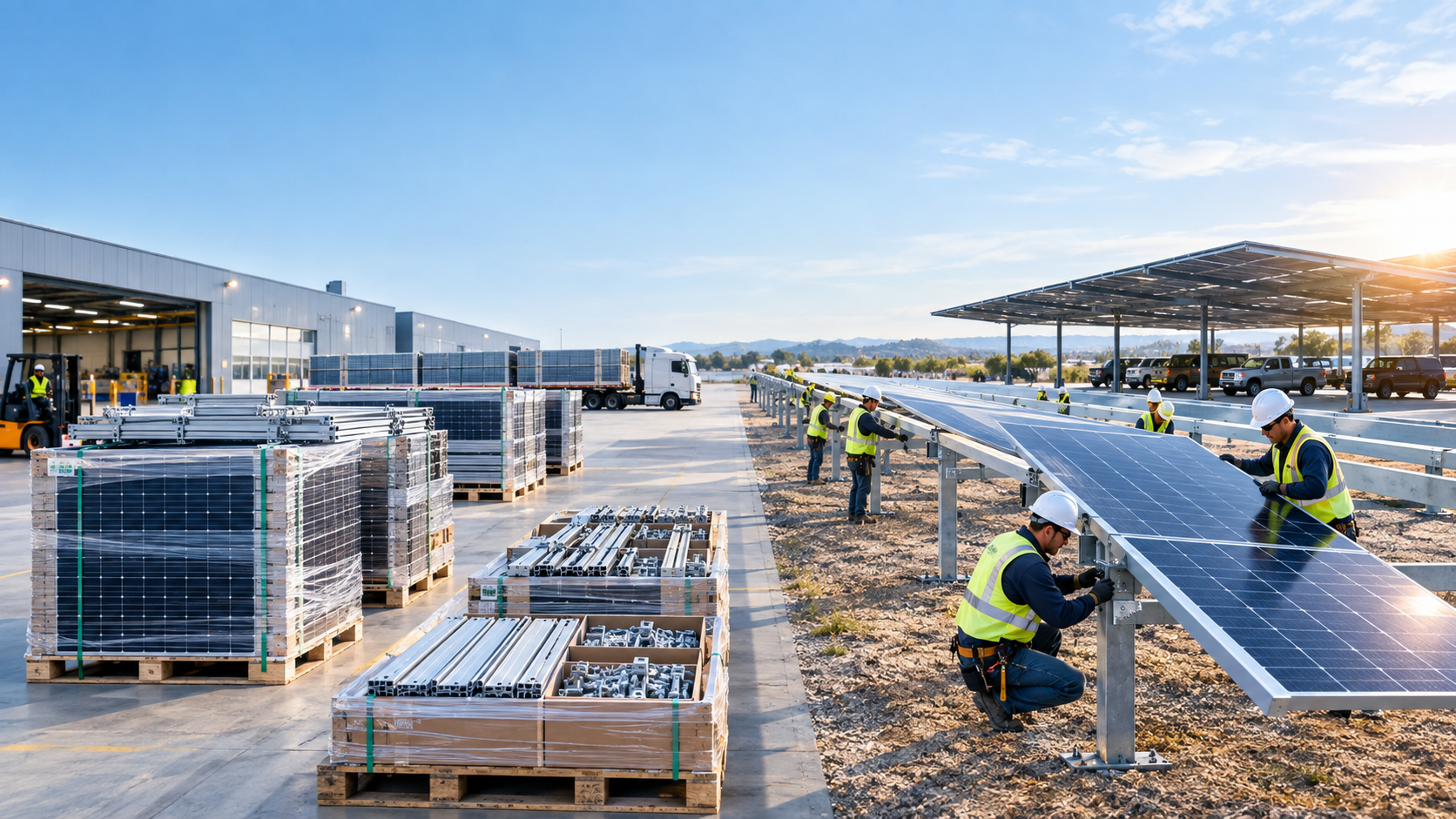
From solar rack to platform: How modular kits are revolutionizing the PV market – Creative image on the topic, with AI: Xpert.Digital
Hidden costs in solar projects: Why the pure price per watt is outdated
Revolution on the construction site? Why the solar industry needs a new "operating system"
The 43-gigawatt market: Why the US solar boom now urgently needs to be standardized
The global solar industry is growing at a breathtaking pace, yet on construction sites and in planning offices, a fragmented, piecemeal approach often prevails. Every project feels like a custom order: countless components must be coordinated, parts lists maintained manually, structural specifications individually verified, and supply chains re-orchestrated for every module and rail. For years, the industry's focus has been almost exclusively on reducing hardware costs—the price per watt for modules and mounting systems. But this hunt for the cheapest component is increasingly missing its mark. The real margin killers are now the so-called "soft costs" and process inefficiencies: complex engineering, a shortage of skilled workers, logistical friction, and rework on the construction site.
This is precisely where a promising new approach comes in, one that goes far beyond traditional component sales. The idea: modular, pre-configured solar system kits seamlessly integrated into a comprehensive deployment platform. Instead of selling individual parts, a standardized "operating system" for building photovoltaic systems is offered. The following article analyzes this strategic move – with a particular focus on the highly competitive but high-volume US market. It examines four specific installation systems (rooftop, carport, ground-mounted, and vertical PV) and demonstrates why market success depends not simply on the number of parts in the box, but on how measurably process costs can be reduced for installers and EPC companies.
The solar industry doesn't need more individual parts, but a better operating system for construction
The idea of combining modular, pre-configured solar system kits with a direct sales and platform approach deserves serious attention. Its economic core lies not in introducing yet another mounting system to an already saturated market. The model becomes truly compelling when it consolidates planning, procurement, logistics, and installation into a repeatable process. It is precisely at these interfaces that significant inefficiencies arise in solar projects: components must be selected and coordinated, parts lists adjusted, structural requirements verified, deliveries coordinated, installation teams trained, and deviations on-site resolved. A factory-designed, ready-to-install system with a small number of parts can eliminate some of this complexity from the project and transform it into a standardized product.
The economic value therefore lies less in the material itself than in the avoided process work. An EPC company or installer is not just buying modules, rails, posts, and connectors, but ideally shorter lead times, less planning effort, lower error rates, more predictable installations, and reduced inventory requirements. This shifts the focus of competition from who offers the cheapest individual component to who delivers the lowest overall cost per successfully installed watt. This perspective is crucial because, in the US, hardware costs represent only one part of the final price. Labor costs, sales, permitting, project management, financing, logistics, and general administration have at least as significant an impact on profitability.
The planned concentration of 70 to 80 percent of market development on the USA is fundamentally understandable. The market is large, regionally diverse, and structurally relevant despite political uncertainty. In 2025, approximately 43.2 gigawatts of new solar power capacity were installed in the United States. Solar energy thus once again represented the largest share of newly installed electricity generation capacity. At the same time, the overall volume declined compared to the exceptionally strong previous year, and the individual segments developed differently. The residential market shrank slightly, while the commercial segment grew. This very combination of high volume, margin pressure, a shortage of skilled workers, and regional fragmentation creates an environment in which standardization can be economically attractive. However, it does not guarantee market success. A system kit only becomes a strategic advantage if its benefits in the specific project are measurably greater than the costs of product commitment, conversion, and remaining local adjustments.
Four building systems with very different market logics
The current product range comprises four modular installation concepts: a residential roof system, a PV carport, a fixed-pitch ground-mounted system, and a vertical solar system. They all share the combination of photovoltaic modules with a MagicFrame interface, support structure, connection technology, and accessories. The commercial model uses complete kits at a uniform price per installed watt. Individual components are not priced separately, and the modules are delivered on factory-sealed pallets. This simplifies quoting and ordering but also limits customer flexibility.
The Residential Roof System is based on an installation unit consisting of two horizontally mounted modules with a total output of 0.88 kilowatts peak (kWp). A minimum order comprises 36 modules, comprising 18 installation units or 15.84 kilowatts peak (kWp). This minimum order is usually too large for a typical American household. Therefore, the product is less economically viable for end customers and more suited to installers, dealers, or platforms that can bundle multiple orders. The advantage lies in a standardized roof installation for tile, shingle, and metal roofs, although local roof geometries, fixing points, structural integrity, fire escape routes, and permitting requirements still need to be considered. Roof variations are particularly high in the residential building sector. The kit can simplify installation but cannot automatically replace the entire technical planning process.
The PV carport is designed as a unit with 15 vertically arranged modules, 8.93 kilowatts peak (kWp), and two parking spaces. The minimum order is five pallets, or 180 modules. This results in twelve installation units with 107.10 kilowatts peak (kWp) and 24 parking spaces. This product offers a different economic advantage than the roof system. It combines electricity generation with an additional structural function and can therefore be used by commercial enterprises, car dealerships, hotels, schools, municipalities, residential complexes, charging parks, and fleet depots. The watertight roof design increases its utility, although drainage, gutters, downpipes, and site drainage must be planned on-site. In conjunction with charging infrastructure and battery storage, the carport can become the visible centerpiece of an energy and mobility project. This leads to larger order values, longer sales cycles, and higher demands on structural engineering, foundations, electrical planning, and permitting.
The fixed-pitch ground-mounted system consists of modular two-post tables, each with 26 modules and a peak output of 15.47 kilowatts. The minimum order comprises three pallets with 108 modules. Of these, 104 modules are installed in four tables; four modules serve as a project reserve. The total installed capacity is 61.88 kilowatts peak. This format is well-suited for smaller commercial installations, farms, municipal projects, energy cooperatives, and decentralized sites that are too small for custom-designed large-scale systems but large enough for standard solutions. The variable tilt range of 5 to 45 degrees and the option of using different, site-specific foundations further expand its applicability. However, this also presents a trade-off: the greater the flexibility in tilt and foundation design, the more project-specific engineering becomes necessary. The economic challenge lies in combining a standardized core with clearly defined customization packages.
The vertical system uses two landscape-format modules with a combined output of 1.19 kilowatts peak per unit. The minimum order of 36 modules yields 18 units and 21.42 kilowatts peak. Vertical photovoltaics is not a mass-market product, but it can be compelling in certain applications: in agri-PV, along property lines, on narrow plots, as an energy fence, or where a broader feed-in period in the morning and evening is more valuable than maximum midday production. Marketing should openly acknowledge this niche nature. The system should not be presented as a universal replacement for traditional rooftop or ground-mounted systems. Rather, it is a differentiated offering for areas, land-use combinations, and generation profiles where conventional solutions reach their limits.
Standardization only sells if it demonstrates cost savings
The core customer benefit consists of five promised effects: reduced internal engineering effort, shorter project cycles, lower warehousing and logistics costs, reduced labor costs, and less waste. These advantages are plausible, but they must not remain mere general claims at market entry. EPCs and installers are not buying theoretical efficiency. They are buying verifiable results under real-world conditions. Therefore, every benefit must be translated into a measurable metric.
In engineering, the crucial factor is the actual number of working hours required between order placement and approved execution planning. A kit can standardize bill of materials creation, mechanical component selection, detailed design, and parts of the documentation. However, it does not replace the verification of wind zone, snow load, seismic category, soil conditions, roof condition, local building codes, or grid connection. The technical documentation cites reference values of 3,600 Pascals for snow and 2,400 Pascals for wind, but rightly points out that the specific design depends on the project and the responsible engineer. Therefore, the sales approach should not promise to completely eliminate engineering. A more credible statement is the industrialization of the recurring aspects of design and the limitation of local verification to clearly defined variables.
Lead time isn't just about on-site assembly. The crucial factor is the time from the initial order to commissioning. A ready-to-install kit can shorten procurement, order picking, and the construction process. However, permits, grid connection, financing, and inspections often remain the longer bottlenecks. Automated permitting processes like SolarAPP+ demonstrate that standardized, digitally verifiable system concepts offer significant time savings in suitable municipalities. This underscores the strategic opportunity: the greatest value is created when the physical kit is linked to standardized digital project data, documents, and audit trails. A box with fewer parts is useful. A kit that simultaneously structures planning, permitting, and ordering data is significantly more valuable.
In logistics, the advantages of full pallets should be considered in a nuanced way. Factory-sealed pallets reduce handling, sorting, shortages, and the risk of damage. Standardized deliveries can also decrease the number of suppliers and delivery dates. On the other hand, fixed pallet sizes can generate excess quantities for small or unusual projects. The open-space system partially addresses this with four spare modules. Other kits offer no project reserve, while the minimum order quantity may cover multiple construction sites. For regionally operating installers, this doesn't eliminate the burden of warehousing, but merely shifts it from many individual parts to a few larger kit inventories. The economic benefit depends on how well orders are consolidated, pallets are managed, and delivery dates are coordinated with construction sites.
When considering labor costs, a distinction must be made between reduced labor hours and lower qualification requirements. Fewer parts, repeatable work steps, and pre-assembled interfaces can increase productivity. At the same time, electrical work, fall protection, lifting operations, foundations, and quality control remain demanding. In the US, the shortage of qualified installers, electricians, technicians, and project managers is a structural problem. A system that reduces installation time and simplifies training therefore has real value. However, this value should be substantiated through time studies: required installer hours per kilowatt, number of work steps, tool changes, rework, damaged parts, safety incidents, and average crew size.
The cost per watt only tells half the story
Marketing based on a complete kit price per watt is attractive from a customer's perspective because it reduces complexity and makes offers more comparable. At the same time, the price per watt should not become the sole metric. An EPC company ultimately evaluates the total cost of the installed and commissioned system. This includes materials, transportation, crane or lifting equipment, foundations, electrical components, permits, local engineering, site risks, financing costs, and warranties. A kit may be more expensive to purchase than a self-assembled list of components and still be more economical if it sufficiently avoids indirect costs.
For cost calculations, a total installed cost (TOC) model is therefore recommended. In addition to the kit price, the customer should be able to see which cost items are included, reduced, unchanged, or explicitly excluded. For example, drainage and site drainage must be added locally for carports. For ground-mounted systems, the foundation is site-specific. For roof systems, roof inspection and local fastening design remain necessary. Without such transparency, there is a risk that a seemingly simple all-inclusive price will later be complicated by additional services. This damages trust and makes scaling more difficult.
The economic argument should be based on the installer's contribution margin. If a standardized kit reduces the number of planning hours required per project, allows a team to complete more installations per month, ties up less capital in inventory, and reduces the frequency of return trips due to missing parts, the margin improves even with an unchanged sales price. At the same time, faster completion can improve cash flow because progress payments, commissioning, and financing approvals are achieved sooner. Smaller installers, in particular, often suffer not from a lack of demand, but from project delays, working capital requirements, and inconsistent processes. In these cases, standardization can be more effective than a small discount on individual components.
A sound cost-benefit analysis should therefore distinguish at least three levels. The first level is the pure kit price per installed watt. The second level comprises the direct on-site costs, including labor, machinery, and local additions. The third level includes process costs and capital commitment, encompassing engineering, procurement, warehousing, rework, project management, and time to payment. Only the third level reveals whether the system is truly superior. Those who only compare the hardware price may underestimate the benefits. Those who attribute all promised savings solely to the kit overestimate them.
Not every installer is the right customer
The target group of solar EPCs and installers is too broad to be addressed with a single message. Large EPC companies often have their own engineering, procurement, and logistics processes. They can secure favorable framework agreements and may prefer open component architectures. For them, a closed kit is only attractive if it demonstrably reduces construction time, shifts risks, or opens up new project classes. Small installers, on the other hand, have fewer internal resources and benefit more from pre-configured solutions, but find it more difficult to manage minimum order quantities, inventory, and upfront financing.
The best entry point is likely regional installers and mid-sized EPCs that have sufficient project volume for pallet orders but don't yet operate a fully industrialized supply chain. These companies are particularly aware of the challenges posed by individual bills of materials, changing components, and a shortage of skilled workers. At the same time, they can make decisions more quickly than large national corporations. For roof systems, partners with recurring residential building contracts who can distribute 36 modules across multiple projects are a good fit. For carports and ground-mounted systems, companies with access to commercial real estate, municipalities, agriculture, fleets, and charging infrastructure are suitable.
Financing and distribution platforms represent a second, strategically interesting customer group. They often control access to the end customer but don't always have their own standardized technical implementation. A pre-configured kit can help them standardize offers, qualify installation partners, and base financing decisions on more stable cost and performance assumptions. The benefits increase when the kit is integrated with digital quote generation, document packages, installer assignment, and project status tracking. However, platforms are demanding partners. They require reliable delivery capabilities, clear warranty policies, data integration, attractive pricing, and sufficient geographic coverage. Furthermore, early dependence on a single large platform customer could weaken the manufacturer's margins and negotiating power.
Customer segmentation should be based primarily on process problems, not company size. Particularly attractive are companies with a high degree of product variety, recurring procurement errors, long planning times, limited inventory, small assembly teams, and sufficient sales to regularly order standard products. Less attractive are customers whose projects almost always require custom designs or who already have extremely efficient in-house solutions. A qualified sales team must identify these differences early on, instead of trying to force as many leads as possible into the same funnel.
New: Patent from the USA – install solar parks up to 30% cheaper and 40% faster and easier – with explanatory videos!

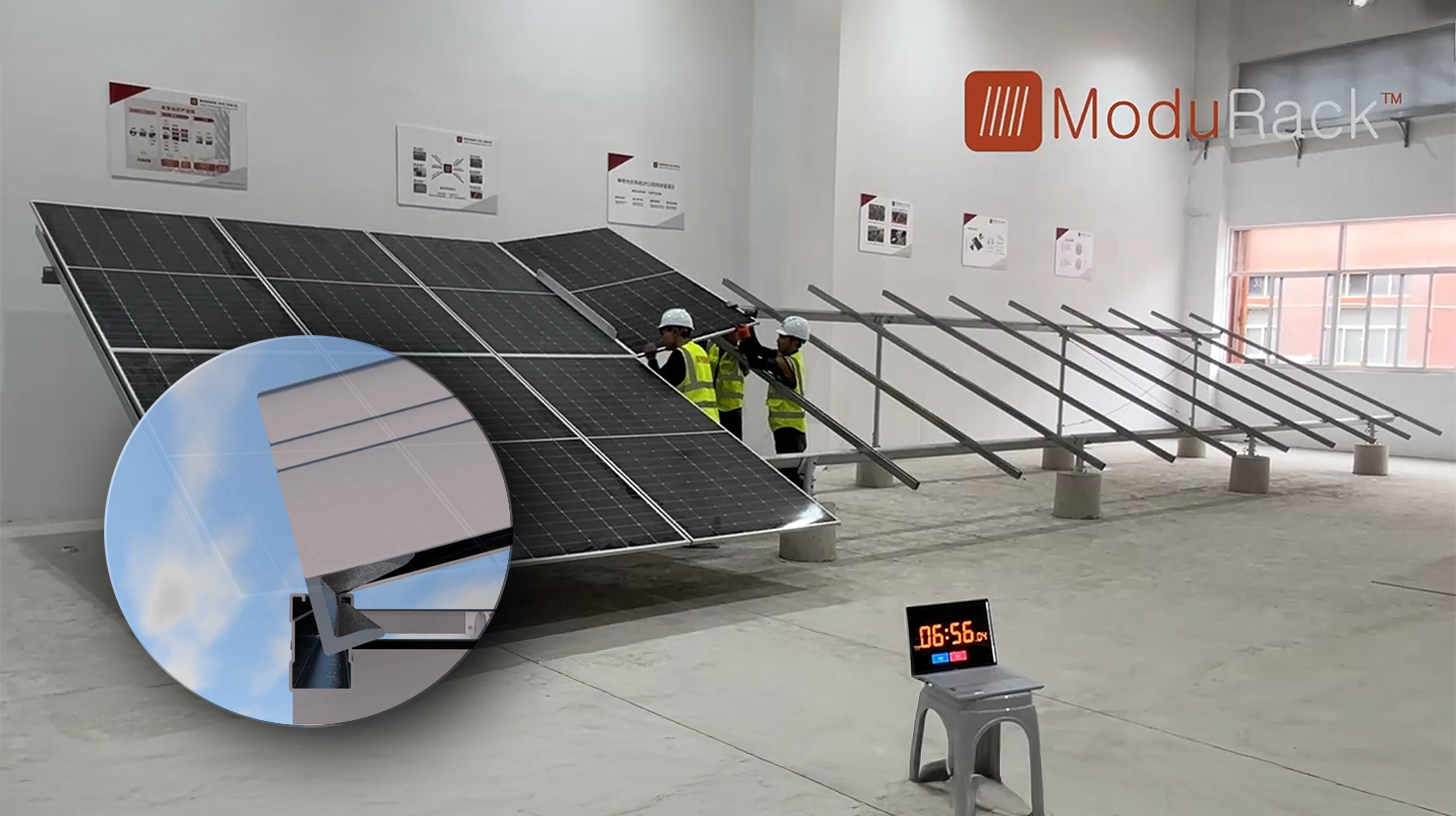
New: Patent from the USA – Install solar parks up to 30% cheaper and 40% faster and easier – with explanatory videos! - Image: Xpert.Digital
The core of this technological advancement is the deliberate departure from conventional clamp mounting, which has been the standard for decades. The new, more time- and cost-effective mounting system addresses this with a fundamentally different, more intelligent concept. Instead of clamping the modules at specific points, they are inserted into a continuous, specially shaped support rail and held securely in place. This design ensures that all forces – whether static loads from snow or dynamic loads from wind – are distributed evenly across the entire length of the module frame.
More information here:
The importance of pilot projects for market development
Carports and open spaces offer the strongest entry point
From an economic perspective, carports likely offer the greatest potential for differentiation. A roof-mounted system competes in a mature market with numerous established mounting and racking providers. A ground-mounted system, in turn, competes with cost-effective standard structures and, in larger projects, with tracker systems. A modular carport, on the other hand, combines energy generation, weather protection, charging infrastructure, and visible sustainability communication. Customers evaluate not only the solar yield but also the additional use of the parking space. This allows competition to be partially shifted away from the pure price per watt.
The minimum project, with 107.10 kilowatts peak and 24 parking spaces, is large enough to appeal to professional commercial clients, yet small enough to remain below the scale of traditional large-scale projects. It is suitable for standardized site types where layout, foundations, and charging infrastructure are repetitive. Clients with multiple similar properties are particularly attractive. A single carport is a construction project. Twenty largely identical carports for a hotel chain, a car dealership, a logistics provider, or a real estate portfolio become a scalable program. This is precisely where the Kit logic demonstrates its greatest value.
The fixed ground-mounted system is also well-suited for market entry because its table size of 15.47 kilowatts peak and minimum installation of 61.88 kilowatts peak allow for manageable projects. It can be used to address farms, smaller industrial sites, educational institutions, municipal utilities, and remote commercial locations. The four included spare modules are practical, as identical replacements may be more difficult to obtain later. However, from a marketing perspective, it should be clear that foundations, earthworks, cable routes, and grid connection can incur significant site-specific costs. A mechanically complete kit does not automatically constitute a complete power plant.
The Residential Roof System can be scaled later via installer programs, but requires particularly strong evidence regarding installation speed, roof compatibility, and regulatory acceptance. The vertical system is initially better suited as a targeted innovation line with selected pilot partners. Equal marketing of all four products would spread resources. Prioritization is advisable for the first twelve to eighteen months: carports and smaller open spaces as high-margin, reference-rich B2B offerings, the roof system as a volume-oriented partner solution, and the vertical system as a selective differentiation product.
Two new hires do not solve a market entry strategy
Filling positions for marketing and branding as well as sales is a sensible starting point, provided responsibilities are clearly separated yet closely integrated. The marketing function should not primarily produce advertising materials, but rather develop a robust positioning. It must explain what problem the kit solves, for which customer, under what conditions, and with what demonstrable economic results. This includes building technical trust, providing reference projects, installation videos, cost models, training materials, digital datasheets, and a consistent approach towards EPCs, platforms, financiers, and planners.
Sales shouldn't just sell modules or steel, but rather process improvements. This requires technical understanding and the ability to analyze an installer's workflows. A good initial meeting doesn't focus on price first, but rather on project volume, typical system sizes, planning hours, team performance, delivery issues, rework rates, inventory levels, and regional permitting requirements. From this information, a customer-specific business case is developed. Without this consulting expertise, the kit risks being treated by the purchasing department as just another interchangeable hardware package.
With a US market share of 70 to 80 percent, the organization should also develop regional expertise. The United States is not a homogeneous solar market. Building codes, snow loads, wind zones, seismic requirements, electricity tariffs, grid operators, permitting processes, labor costs, and financing vary considerably. A national market message can be developed centrally, but references, technical approvals, and sales partners must be established regionally. A phased market entry in a few states makes more economic sense than an early, nationwide presence.
When selecting the initial regions, installed megawatts alone should not be the sole consideration. More important factors include the target market segment, local permitting time, competition, logistics costs, the number of suitable installation partners, and the suitability of load assumptions. Carports could be particularly attractive in sunny states with high commercial activity and growing charging infrastructure. Rooftop systems require regions with an active residential housing market and suitable financing channels. Ground-mounted kits benefit from states with agricultural land, available space, and a market for smaller, decentralized systems. Such a selection process reduces travel costs, training requirements, and the number of technical variations.
Trust is built through certification and clear boundaries
The technical data sheets contain important information indicating that wind, snow, seismic activity, and local regulations must be verified on a project-specific basis. This caution is appropriate, but it must not be perceived in the market as an indication of incomplete product maturity. Customers need a clear boundary between the factory-validated standard and the locally verifiable design. The more precisely this boundary is documented, the lower the liability uncertainty and sales resistance will be.
For the US market, compliance of the mounting system with relevant standards is a crucial factor in building trust. UL 2703 covers, among other things, mechanical fastening, grounding, and equipotential bonding of photovoltaic mounting systems, as well as the suitability of specific combinations of modules and racking. A general statement that a component is certified is not always sufficient. It is essential that the specific combination, function, and application are covered. In addition, the National Electrical Code, local building codes, fire safety requirements, wind and snow load standards, and, where applicable, product-specific requirements for carports and canopies must be considered.
The MagicFrame interface can offer a significant system advantage by reducing assembly time, eliminating parts, and ensuring reproducible connections. However, this also creates a dependency on a specific module and frame configuration. While this is attractive from the manufacturer's perspective, it poses a risk from the customer's. Installers want to know if replacement modules will be available long-term, how a module change will affect certification and warranty, and whether alternative modules can be qualified. An open roadmap for compatible module variants can increase acceptance without compromising the system's logic.
The 25-year structural or module warranty also requires operational backing. Customers will inquire about the warranty provider, exclusions, corrosion classes, spare parts availability, response times, and claims processing. A long warranty is only as valuable as the financial and logistical capacity to fulfill it. Therefore, especially with a new supplier, it's not just the duration that matters, but also a clear warranty process with serial numbers, digital documentation, and defined spare parts packages.
The platform is the real strategic asset
The long-term vision of a deployment platform is more compelling than a pure kit business, provided it is built incrementally. A platform can connect quoting, technical configuration, financing, ordering, logistics, installer assignment, permitting, construction progress, acceptance, and warranty. This creates a digital process that not only sells products but also coordinates transactions and execution. This unlocks recurring revenue, better data, and stronger customer loyalty.
However, the development process shouldn't begin with extensive software development. First, the physical process must be stable. If bills of materials, scope of delivery, assembly times, exceptions, and responsibilities aren't yet standardized, a platform will merely digitize ambiguity. The correct sequence is therefore: standardized kits, successful pilot installations, documented workflows, repeatable partner qualification, and only then an increasingly automated platform.
In the first stage, a digital configurator suffices, mapping site type, system size, number of modules, number of kits, pallet requirements, installed capacity, and obvious exclusion criteria. The second stage adds automated quotes, technical documents, shipping status, and training records. The third stage integrates financing partners, installer capacity, permit data, and project status. Only in a later stage does a true marketplace emerge, where demand, financing, hardware, and execution are orchestrated.
The platform economy has a key advantage: with each completed project, a dataset grows detailing actual assembly times, regional surcharges, permits, errors, delivery times, and performance. This data can improve configuration and pricing. At the same time, a risk arises. EPCs might fear that their project data could be used to circumvent regulations or skim margins. Therefore, data protection, data sovereignty, and channel neutrality must be addressed early on. A platform will only gain liquidity if all participants trust that their role will not be devalued in the short term.
Financing can accelerate sales and mask risks
Targeting sales and financing platforms is strategically sound because many solar projects fail less due to technical shortcomings than due to a lack of capital, creditworthiness, and transaction costs. A standardized kit theoretically simplifies financing: costs, performance, scope of supply, and warranties become more comparable, and projects can be bundled into portfolios. Standardized assets are more attractive to financiers if their construction and operational risks are indeed lower.
This logic should be applied particularly to commercial carports and smaller open-field installations. Instead of simply offering hardware, a package can be developed comprising a pre-configured system, a qualified installer, yield forecast, warranty, insurance, and financing. The customer then receives a ready-to-invest solution instead of a list of components. This doesn't automatically shorten every decision-making process, but it can reduce the number of interfaces and increase comparability.
Financing, however, must not mask weak product profitability. Lower monthly payments due to long loan terms do nothing to change high overall costs. Similarly, dealer fees, interest markups, and complicated contract models can significantly increase the final price. Following the expiration or modification of key incentive programs, the US market is more sensitive to transparent profitability. The platform should therefore clearly display cash and financing options and not rely solely on seemingly low monthly costs.
Tax incentives remain relevant for commercial projects, but are tied to deadlines, project size, wage and training requirements, domestic value creation, and other conditions. These rules are subject to political change and can significantly shift demand over time. Therefore, the business model should not depend on a single funding provision. The strongest position is held by a kit that is competitive even without maximum funding due to lower construction and process costs.
The greatest risks lie outside the factory
The first risk is the assumption that a standardized product can largely eliminate local complexity. In reality, it only shifts some of the complexity to the factory. Site conditions, roofing, drainage, fire protection, utility connections, and permits remain local. If sales and marketing blur this boundary, change orders, delays, and liability claims arise. The solution is not a weaker value proposition, but a more precise one: a standardized core, defined interfaces, and transparent local additions.
The second risk is supplier and module dependency. The kits are designed for specific G-Star modules and the MagicFrame interface. This allows for optimization but increases dependence on availability, price, trade regulations, and long-term product continuity. Especially in the US market, tariffs, import restrictions, and requirements for foreign companies can disrupt supply chains. Therefore, a second qualified supplier or a clearly planned compatibility strategy is economically valuable.
The third risk is an overly broad portfolio with limited sales resources. Four systems address different buyers, applications, and decision-making processes. A roofer thinks differently than a carport developer or a farmer. If a single sales message is meant to cover all products, it will inevitably remain generic. Market launches should be conducted through clearly defined use cases, pilot customers, and sales materials.
The fourth risk is the channel structure. Simultaneous sales to platforms, EPCs, and installers can create conflicts. An installer will be reluctant to invest in training and market development if the same solution is being sold at lower prices through a platform or directly to their customer. Transparent pricing logic is needed, territory protection should only be granted upon proven performance, and clear rules should govern lead attribution, project registration, and service responsibility.
The fifth risk concerns the platform vision. Software can incur high development costs before enough transactions have been generated. Network effects arise not from the scope of functionality, but from repeated use. Therefore, every digital function should first solve a specific problem in the existing kit business. A configurator that halves the quote time is more valuable than a large marketplace without active buyers and installers.
Pilot projects must be conducted like economic experiments
For market entry, pilot projects should be planned not only as reference installations but also as controlled learning systems. Before starting, comparative data must be established: planning hours, number of order items, deliveries, assembly time, team size, tooling requirements, rework, waste, damage, safety observations, and time to acceptance. Upon completion, the kit is compared with a conventional solution of similar size. Only in this way can reliable evidence be obtained.
The initial pilot projects should deliberately cover different, yet manageable, conditions. For the carport system, a single commercial site and a customer with multiple locations would be suitable. For the ground-mounted system, a project with a simple foundation and clear grid connection should be chosen. For the roof system, an installer with recurring, similar roofs is more suitable than a project with an unusual geometry. The vertical system should be tested where its specific orientation offers a demonstrable added value.
Every pilot project must result in a standardized case study. This should not be a marketing narrative, but rather document the initial situation, the conventional alternative, actual times, costs, deviations, and lessons learned. Problems are also valuable if they demonstrate how the system was improved. Technical buyers trust a realistic presentation more than sweeping superlatives.
The most important key performance indicators (KPIs) for the first two years are not just revenue and delivered watts. More relevant are qualified pipeline, closing rate, time from initial contact to order, gross margin per kit, engineering hours per project, on-time and complete delivery, installation hours per kilowatt, complaint rate, repeat order rate, inventory turnover, and the percentage of projects with standardized documentation. For the platform, additional metrics will later include active installers, transactions per partner, digital quote rate, and time from configuration to order.
A focused market entry is stronger than a big launch
The most compelling strategy is to position the company first as a provider of an industrially standardized deployment process, rather than just another racking manufacturer. The product promise should be that pre-configured units make the path from factory to fully functional plant more predictable. This positioning must be substantiated through data, certifications, clear exclusions, and pilot projects.
In the first phase, the focus should be on the carport and the smaller open-space system. Both offer sufficient project value, visible differentiation, and good prerequisites for repeatable B2B applications. In parallel, the roof system can be validated with a small number of installation partners, who can distribute pallets across multiple orders. The vertical system should be developed selectively and application-oriented, rather than incurring high sales costs early on.
The new marketing and branding function should establish a business value model, a technical trust architecture, and segmented market messaging. Sales should acquire pilot customers whose processes can be measurably improved. Both functions require a shared dataset and the same key performance indicators (KPIs). Marketing shouldn't just generate leads, and sales shouldn't just report deals. The crucial factor is whether customers install the product faster, more cost-effectively, and more reliably, and subsequently reorder.
The deployment platform should emerge as a result of successful standardization, not as a replacement for it. If kits, data, partners, and financing logic work together reliably, it can become a scalable system with higher switching costs and recurring revenues. Then the company is no longer just selling hardware per watt. It's controlling part of the process that transforms demand into a built and financed solar power plant.
The clear outlook is therefore this: The approach is economically promising, but its success doesn't depend on the number of parts in the box. What matters is how much demonstrable complexity disappears for the customer. The USA offers a large but demanding market for this. Anyone offering only a mechanical kit there quickly finds themselves in price competition. However, anyone who combines product, engineering limitations, logistics, installer qualification, financing, and project data into a robust delivery model can transform a mounting system into a scalable infrastructure for decentralized solar projects.
Your partner for business development in the fields of photovoltaics and construction
From industrial rooftop PV to solar parks and larger solar parking lots
☑️ Our business language is English or German
☑️ NEW: Correspondence in your native language!

Konrad Wolfenstein
I and my team are happy to be available to you as your personal advisor.
You can contact me by filling out the contact form here wolfenstein@xpert.digital:or simply call me at +49 7348 4088 965. My email address is
I'm looking forward to our joint project.