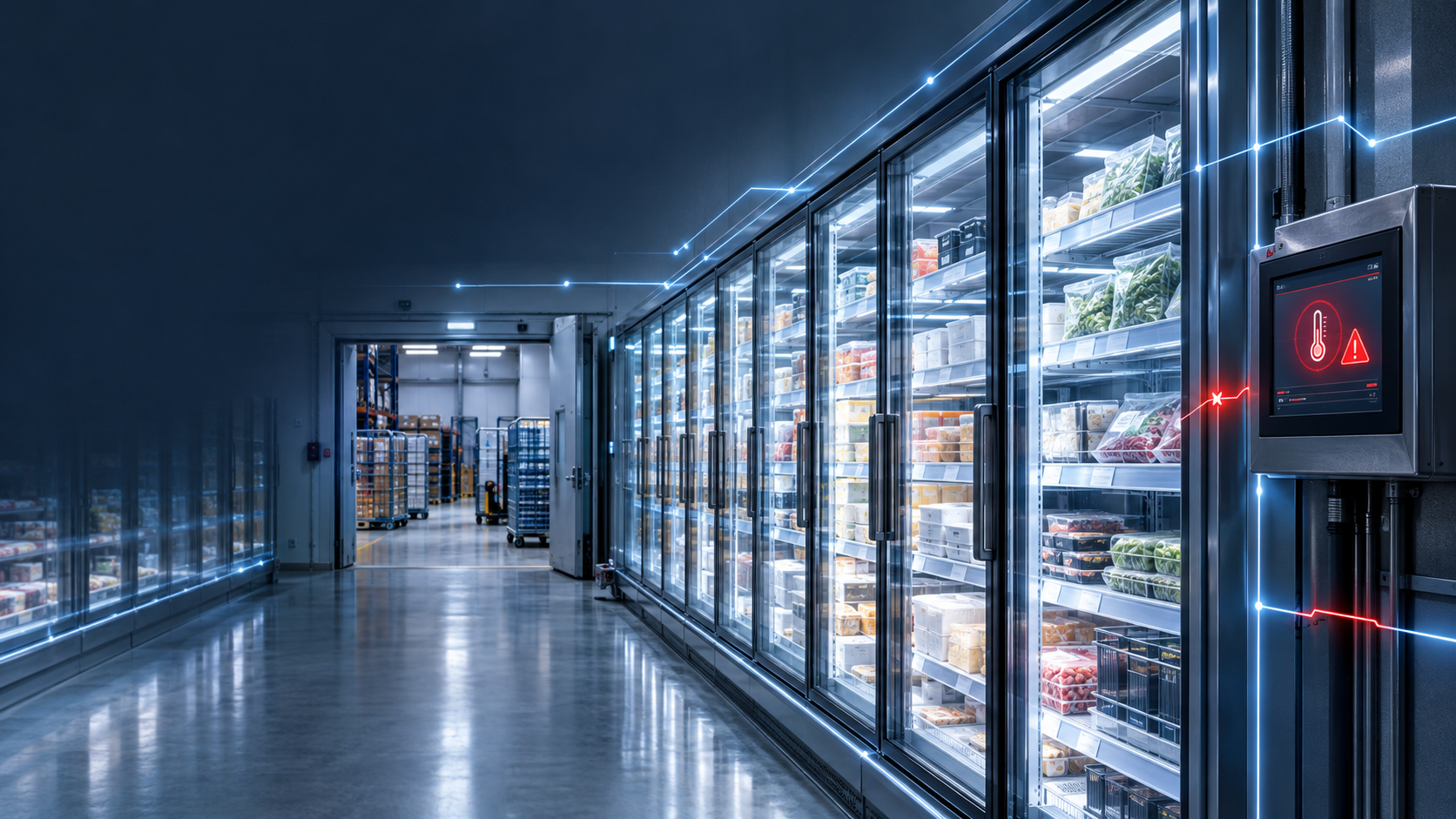
When hackers attack the cold chain: How digital failures endanger entire inventories – Creative image on the topic, with AI: Xpert.Digital
Refrigeration systems manipulated: Why cybersecurity is becoming a task for logistics
The underestimated weakness in the warehouse: When digital systems render goods unusable
How secure is the cold chain? Cyberattacks are putting pressure on Europe's supermarkets
Digital systems no longer just control inventory and the movement of goods. They can also determine whether food remains refrigerated – and thus retains its economic value. In early November 2026, supermarkets in Sweden, Belgium, and Luxembourg reported malfunctions in their refrigeration and freezing systems. In a supermarket in Sjöbo, Sweden, system settings were reportedly changed to 50 degrees Celsius; food had to be disposed of. The technical causes and the extent of the incidents were initially unclear. However, the reported impacts already demonstrate how closely cybersecurity, intralogistics, and security of supply are intertwined. If digital controls fail or are manipulated, not only can the operation of a system be affected, but goods that have already been produced, transported, and stored can also become unusable. Logistics must therefore do more than simply move goods quickly from point A to point B. It must ensure the conditions under which goods remain available, usable, and saleable.
When hackers control the cold chain: Why logistics is far more than just the movement of goods
The most expensive vulnerability in a warehouse can be a password
Logistics is often measured by how quickly goods leave a warehouse, how reliably shipments arrive, and how efficiently conveyor systems, order picking systems, or warehouse robots operate. While this perspective describes important tasks, it falls short. A supply chain doesn't generate its economic value simply by moving products. It must maintain their availability, quality, safety, and usability throughout all process steps. As soon as digital controls influence these conditions, data integrity, cybersecurity, and organizational responsiveness become integral components of logistics performance.
The direct connection between these problems and disruptions is demonstrated by the malfunctions in refrigeration and freezer systems at European supermarkets that came to light in early November 2026. In Sweden, ICA and Coop stores were affected. An ICA supermarket in Sjöbo, southern Sweden, reported that its systems had been tampered with and set to 50 degrees Celsius. Food had to be disposed of, and the store initially remained closed on Monday morning before resuming operations later. Similar problems were also reported in Belgium and Luxembourg. In Belgium, approximately 40 Delhaize stores were affected by an IT incident that disrupted their refrigeration systems.
The economic core of such events lies not only in technological failure. A digital intervention can devalue goods that have already been produced, transported, stored, and ready for sale within a limited timeframe. The entire preceding value chain then loses its purpose. Agricultural production, industrial processing, packaging, transport, and trade logistics have taken place, yet ultimately a usable product does not reach the customer.
This shifts the central question. It is no longer solely about how companies efficiently move goods through their networks. It also becomes crucial whether they control the conditions under which these goods retain their value.
What the refrigeration system incidents prove – and what remains unclear so far
A reliable analysis must differentiate between confirmed impacts, reports from individual stores, and still unresolved technical causes. Malfunctions in refrigeration and freezer systems at several retail locations have been confirmed. Some stores explicitly described these as hacker attacks. ICA initially stated that a limited number of branches were affected and supported the handling of the incident. Initial reports from Coop indicated six stores were affected; later reports increased the number to seven. This development demonstrates that the assessment may not be complete while an incident is ongoing.
Even the stated temperature of 50 degrees Celsius requires precise interpretation. A manipulated setpoint does not automatically equate to the actual air temperature reached in every refrigerated display case, and certainly not to the same temperature inside all food items. The temperature rise depends on factors such as the design of the unit, the ambient temperature, the stock level, and the duration of the outage. In the case of the market in Sjöbo, it was specifically reported that settings had been changed to 50 degrees. This does not necessarily mean that every affected product reached this temperature.
This distinction does not diminish the economic damage. Even significantly smaller temperature deviations can necessitate the inspection, blocking, or disposal of food products. Maintaining suitable storage and transport conditions is essential for frozen products; for flash-frozen foods, a product temperature of minus 18 degrees Celsius or below is generally the relevant reference point. However, the specific assessment of a deviation must be product-specific.
The full extent of the damage, the technical attack chain, and the identity of potential perpetrators remain unclear. Comparable disruptions in different countries do not prove a common attacker or an identical vulnerability. Similar incidents from French supermarkets were already reported in October. While repetition highlights the risk, it does not replace a technical investigation of each individual incident.
This results in a dual requirement for companies: they must act quickly enough to limit damage, and at the same time analyze carefully enough to avoid making incorrect security decisions based on preliminary assumptions.
The primary task of logistics is to maintain economic viability
A product can be in the right place and still be economically worthless. A pallet of frozen goods doesn't fulfill its purpose if it arrives on time, but its temperature history no longer permits safe use. Similarly, a spare part may be physically available but unusable due to incorrect identification. A fully stocked warehouse is no proof of delivery capability if inventory data, quality status, and the actual condition of the goods don't match.
This leads to a more comprehensive definition of logistical performance. Logistics not only organizes spatial and temporal availability, but also maintains the conditions under which a good can be used, processed, or sold. In the food trade, this includes, in particular, temperature control, traceable product conditions, and controlled releases. In other sectors, different parameters play the same role: humidity, vibration, purity, access authorization, or a clearly documented product identity.
Intralogistics is particularly relevant because physical movement and digital decision-making are closely intertwined. A warehouse management system determines which goods are stored, blocked, or shipped. A plant control system influences whether conveyor technology operates. A building automation system can modify environmental conditions. Such programmable systems are considered operational technology when they monitor or directly influence physical processes.
Economic responsibility therefore does not end with the mechanical functionality of a system. A conveyor belt can function perfectly and still transport the wrong goods to the wrong destination. A refrigeration system can be electrically powered and yet operate inappropriately. What is crucial is the reliability of the entire system, comprising technology, data, and decisions.
How digital networking creates efficiency while simultaneously distributing new risks
Networking logistics facilities offers clear economic benefits. Remote monitoring can identify technical problems earlier. Centrally available operational data facilitates comparisons between locations. Coordinated control systems can help to better align energy consumption, maintenance, and plant operation.
These advantages, however, arise from additional connections. A device previously operated locally becomes accessible remotely. A service provider gains access to multiple locations. A central platform consolidates status data and potentially also control rights. This changes not only the usability but also the distribution of failure risks.
A unified technical platform can, for example, reduce costs per location. At the same time, a shared vulnerability can affect multiple locations simultaneously. The benefits of standardization and the risk of a shared failure are thus two sides of the same architectural decision. It becomes economically problematic when the savings are explicitly calculated, but the additional dependency remains outside the investment calculation.
The incidents in the European food retail sector illustrate the importance of this question, without yet proving a specific technical cause. The fact that several companies are reporting similar effects warrants an investigation into common dependencies. However, it is not sufficient proof that the same component or service provider was actually responsible.
This leads to an important perspective for company management: Not every additional connection should be rejected. However, every connection that enables operational interventions must be evaluated with regard to authorization, monitoring, consequences of failure, and the possibility of regression.
Why a loss in goods on the balance sheet only shows part of the damage
The most visible damage caused by a refrigeration failure is the value of the discarded goods. While this figure is important, it doesn't fully reflect the economic burden. Additional costs include potential labor hours for clearing, cleaning, and documentation, disposal fees, technical repairs, extra transportation, and lost sales revenue.
It's important to distinguish between revenue and profit contribution. A lost sales day doesn't automatically mean the entire expected daily revenue is lost as profit. Some expenses associated with sales may be eliminated. Conversely, many costs remain even though the market isn't selling or is only selling to a limited extent. Therefore, for a transparent damage assessment, inventory write-offs, additional expenses, and lost contribution margins must be recorded separately.
A purely hypothetical model calculation illustrates the scale of the problem. Let's assume a store has to write off goods with a cost price of €80,000. Disposal, cleaning, technical support, and additional logistics cost a further €15,000. Due to the closure and limited product availability, the store loses €12,000 in contribution margin. Assuming these items do not overlap, the resulting direct cost is €107,000.
These figures do not describe any of the reported markets. They illustrate the calculation logic. A company that only records the value of goods would, in this example, overlook €27,000 in immediate costs. Long-term customer churn, additional administrative expenses, or subsequent changes to insurance terms would not yet be taken into account.
Equally important is avoiding double counting. If the loss of goods has already been recorded as an expense, the same amount must not be included again within a lump-sum loss of revenue. Especially in the case of complex business interruptions, a clear delimitation is crucial for the reliability of the financial analysis.
Perishable goods make time the decisive factor in damage
In many digital cases, it is generally possible to restore data from a backup or to resume a process later. With perishable goods, this flexibility is limited. Technical recovery cannot retroactively restore lost product quality.
This distinguishes cold chain logistics from processes that primarily generate processing delays. The relevant factor is not just the duration of the IT outage, but the time until the physical inventory is affected. The actual timeframe available depends on the product, packaging, initial temperature, equipment condition, and environment. Therefore, making blanket statements about a generally reliable bridging period would be misleading.
This allows for a clear structure to be derived for operational planning. First, it must be determined how quickly a deviation will be detected. Next, it is crucial to determine how much time is needed for assessment and the decision on countermeasures. This is followed by the actual implementation: technical stabilization, relocation, blocking, or disposal.
An organization can have high-capacity cold storage facilities and additional transport options and still react too late if a report has to go through several levels of responsibility first. Conversely, a quick decision is of little use if no suitable alternative capacities exist.
The economically relevant response time therefore encompasses the entire chain from the first detectable signal to the effective countermeasure. It cannot be measured solely by the speed of the IT department.
Why industrial engineering requires different protection concepts than office IT
Operational technology differs from traditional office applications primarily in its direct impact on the physical environment. A manipulated file can cause information damage. A manipulated system control can additionally alter machine movements, temperatures, or access points. Security measures must therefore consider not only confidentiality but also availability, reliability, and operational security.
It follows that safety concepts cannot simply be transferred unchanged from an office workplace to a refrigeration system or conveyor technology. Even a fundamentally sensible measure can create operational risks if implemented without an understanding of the system. An unplanned restart, a communication breakdown, or an untested change can disrupt a process.
Conversely, the desire for uninterrupted operation does not justify permanently uncontrolled access. A coordinated approach is required, in which changes are planned, technically reviewed, and aligned with operational requirements. The protection of operational systems must explicitly address their specific performance, reliability, and security requirements.
For intralogistics, this is a core organizational issue. Focusing solely on IT security can overlook physical consequences. Conversely, concentrating exclusively on plant availability can allow digital vulnerabilities to persist. Effective protection only emerges when both perspectives are integrated into a comprehensive risk assessment.
Separate networks limit damage, but do not solve every problem
Network segmentation means separating technical areas from one another and selectively restricting communication between them. Such separation can prevent a problem in one area from spreading unchecked to other systems. The crucial factor is determining which connections are actually necessary and which access is explicitly permitted.
For a retail or logistics site, for example, it makes sense not to treat customer Wi-Fi, office applications, point-of-sale systems, and operational equipment as equal participants in an open network. Similarly, maintenance access should not automatically grant comprehensive access rights to all connected systems.
However, isolation from the central corporate network is not a complete guarantee of security. In the Swedish incidents, it was reported that the affected cooling connections operated outside the central ICA infrastructure. A system can therefore be isolated from the main network and still remain accessible via a different connection.
The correct question to ask is therefore not simply whether two networks are separate. It is who can influence which function and through which channels. This includes local access, remote maintenance, manufacturer connections, and, where applicable, central management platforms.
The consequences of a loss of communication must also be considered. A protection concept should not result in a system losing its necessary local control as soon as a central connection is interrupted. Where technically feasible, secure continued local operation is a valuable complement to limiting external access.
Your intralogistics experts

Consulting, planning and implementation of complete solutions for high-bay warehouses and automated storage systems - Image: Xpert.Digital
More information here:
Identify and minimize digital risks in the cold chain
Independent measurement protects against the deceptive trust in advertisements
A control system is both a source of information and a means of intervention. This dual role can become problematic when the reliability of the system itself is in question. A display showing normal values is then not automatically sufficient proof of proper functioning.
For critical cooling processes, this leads to an important design principle: measurement, alarm systems, and controls should be organized in such a way that not every single fault disables all control options simultaneously. However, additional sensors only provide a real safety benefit if they do not have the same technical dependencies.
If two measurement systems share the same power supply, network connection, and administrative access, they can fail or be tampered with simultaneously. Therefore, the number of sensors alone says little about their actual resilience.
The alarm chain is equally crucial. A correctly identified deviation will not limit damage if the report goes unheeded at night or if no one has the authority to respond. The technical report must result in timely operational action.
A meaningful test criterion is therefore not just whether a sensor is functioning. The entire process should be examined: Do the systems detect the deviation, does the message reach a responsible person, does this person understand the urgency, and can they initiate effective action?
Remote maintenance is an economic advantage with power that needs to be controlled
Remote maintenance can save time and speed up technical support. This is a significant benefit, especially for geographically dispersed branches or logistics centers. The problem is not remote maintenance itself, but rather unclear or overly broad authorization.
From an economic perspective, maintenance access represents delegated intervention power. Those who use it can potentially change operating parameters, influence plant functions, or exchange configurations. The responsibility for this cannot be outsourced from the company simply through a service contract.
Therefore, a good design principle is to organize access rights in a person-specific, task-related, and traceable manner. Not every maintenance task requires the same permissions. Not every access needs to be permanently active. Particularly critical changes may justify additional permissions or a time limit on access.
The fundamental question is what authority is actually required for which task. This principle aligns with a multi-layered protection of operational systems, where technical separation, controlled communication, and clearly defined access points work together.
Companies should also distinguish between securing a connection and limiting its impact. Even a legitimately registered user or a compromised valid account should not be able to easily influence all locations. The greater the potential reach of an access point, the more carefully its use must be controlled.
The cold chain does not end at goods receipt or at the sales shelf
From a purely transport-oriented perspective, a delivery is considered successful if it arrives at its destination on time and undamaged. For temperature-controlled products, this is insufficient. Suitable conditions must be maintained even after unloading. Responsibility for the condition of the goods extends through storage, internal handling, and provision.
This transforms the supermarket itself into a logistics hub. Goods receipt, temporary storage, cold storage, restocking, and sales presentation form a cohesive process chain. A failure of the refrigeration system is not merely a building services issue, but a disruption to the availability and usability of the inventory.
This relationship is also relevant for automated warehouses. Higher movement speeds offer little economic benefit if the goods status and actual quality are not reliably correlated. An efficiently picked but incorrectly released shipment is not a good logistical performance.
The consequence is not that every technical function should be organizationally subordinated to logistics. Rather, the crucial point is to design the interfaces in such a way that no gap in responsibility arises. Temperature control, inventory status, fault reporting, and release must be interconnected, even if different departments remain responsible for them.
A local outage can put the entire supply chain under pressure
The immediate destruction of goods is only the first part of a potential chain reaction. As soon as a store can use its refrigeration equipment again, it will need replacement stock. If several locations are affected simultaneously, this creates a concentrated additional demand that was not anticipated in the regular planning.
In such a scenario, additional picking orders, short-notice route changes, and a higher demand for temperature-controlled transport capacity may arise. Centrally available stock may need to be redistributed. The decision as to which location is supplied first becomes a matter of network management.
It would be too simplistic to prioritize solely based on previous sales. The local supply situation, the availability of alternative stores, the product range, and the operational capacity of the respective market can also play a role.
The order of the restoration process is also important. A system that has been technically restarted should not be completely refilled immediately. Its stable operation must first be thoroughly assessed. Otherwise, there is a risk of exposing fresh goods to an unsafe environment again.
These considerations are not a description of already proven consequences of the European incidents. They illustrate the potential impact of a simultaneous failure of multiple sites in an interconnected supply system and what decisions should therefore be prepared.
Security investments require a calculation, not a gut feeling
Cybersecurity is often treated as an additional cost factor. However, for an economic evaluation, it is crucial to consider how the measure affects the expected risk of damage. This includes both the probability of an event and its potential severity.
A simplified, explicitly hypothetical calculation can illustrate this. Let's assume a company estimates the economic damage of a specific failure scenario at €500,000 and its annual probability of occurrence at eight percent. This results in a calculated annual expected loss of €40,000. If a package of measures were to reduce the probability to two percent, the remaining expected loss would be €10,000. The calculated risk reduction would amount to €30,000 per year.
These model values are not empirical data on the frequency of attacks on cooling systems. They merely illustrate how a decision can be structured. In practice, probabilities are often uncertain. Therefore, companies should consider several scenarios and examine how significantly the outcome changes under different assumptions.
Furthermore, average damage is not the only relevant factor. A rare event can jeopardize a company's liquidity or its ability to continue operating. A large loss of goods may have a different impact on a single market operator than on a diversified corporation.
A sound investment decision therefore combines expected values with limits of acceptability. Not every safety measure needs to be justified by a pinpoint forecast. However, it should be clear what risk it reduces, what residual risk remains, and what operational side effects arise.
Insurance can cover costs, but it cannot repair the cold chain
Insurance coverage and company pension schemes serve different purposes. Depending on the agreed scope, insurance can mitigate financial consequences. However, it neither restores spoiled goods nor automatically assumes responsibility for the operational restocking of a closed market.
For business planning, a separate approach is therefore advisable. First, the company must understand what physical and economic damages could occur. Then, it can be examined which of these are covered under the respective contractual terms.
Without reviewing a specific contract, it would be irresponsible to claim that a particular incident is insured or excluded. However, in practice, the distinction between loss of goods, business interruption, technical recovery, and additional expenses, as well as reliable documentation, are crucial.
Even with existing coverage, the liquidity issue remains. Periods can elapse between the incident, the investigation, and potential reimbursement, during which replacement goods, personnel, and service providers must be paid. Financing the resumption of operations is therefore a separate task of risk management.
The economically sensible order of operations is therefore not to replace protection with insurance. First, avoidable risks should be reduced, critical processes prepared, and remaining financial burdens consciously borne or insured.
Less food waste is also a result of secure digitization
The destruction of refrigerated goods not only causes a financial loss. The products represent resources already invested: agricultural land, water, energy, labor, packaging materials, and transportation. If the goods become unusable without being consumed, their intended purpose is lost, while the expenses incurred have already been incurred.
The scale of global food waste underscores the importance of the issue. In 2022, an estimated 1.05 billion tons of food waste was generated at the retail, food service, and household levels. This represented approximately 19 percent of the food available to consumers. This figure reflects the entire problem at these levels and not the portion caused by cyber incidents.
Individual attacks on refrigeration systems do not allow for a reliable global assessment of the contribution of cyber threats to food losses. Such a figure would be speculative. Nevertheless, the causal relationship is clear: when digital manipulation degrades storage conditions and necessitates the disposal of goods, cybersecurity becomes a factor in resource conservation.
For companies, this opens up a more meaningful link between sustainability and business management. Measures for more stable temperature control and faster response times can simultaneously reduce product losses, costs, and resource waste. The prerequisite, however, is that the impact is actually measured and not simply an additional digital system is purchased.
Clear responsibility is often more valuable than another screen
Technical transparency alone does not create the ability to act. A dashboard can display all temperatures and still remain ineffective if no one is clearly responsible for the response. Similarly, a person formally responsible can be practically powerless if they are not authorized to block access to equipment, relocate goods, or initiate additional transport.
A viable operating model must therefore consolidate responsibilities and authorities. Logistics assesses inventory, backup capacities, and replenishment. Engineering evaluates the condition of the equipment. IT managers examine digital access points and changes. Quality assurance assesses the status of goods and their release. Management makes decisions that trigger significant costs or operational disruptions.
These roles shouldn't be negotiated only during a nighttime disturbance. Prepared decision-making processes shorten the time between awareness and action. At the same time, they prevent unclear responsibilities from leading to hasty or contradictory interventions.
Not every organization needs a comprehensive crisis manual. A small location can operate with just a few clear rules. The crucial factor is that these rules are appropriate for the actual staffing levels and also function outside of normal working hours.
The quality of an organization is therefore less about the number of its documents outlining responsibilities than about whether someone is available at the crucial moment, can assess the situation, and is authorized to make the necessary decision.
What additional key performance indicators (KPIs) does a modern intralogistics system require?
Traditional key performance indicators (KPIs) such as throughput, picking performance, on-time delivery, and space utilization remain important. However, they are not sufficient to assess the resilience of a digitally controlled site.
Additionally, it is advisable to record the time until critical deviations are detected and the time until an effective response is implemented. Equally revealing is how long a site can continue to operate safely without central services and what proportion of critical systems are fully documented with regard to access and dependencies.
Further useful metrics arise from practical recovery capabilities. How up-to-date are the backed-up configurations? Has a return to normal operation actually been tested? What temperature-controlled backup capacity is available at short notice? How quickly can affected stock be clearly blocked and separated from released goods?
The metric should not be confused with the goal. A high percentage of documented systems is only valuable if the documentation is accurate and usable in the event of a malfunction. A test performed is of little value if its conditions were unrealistic or if identified weaknesses remain unresolved.
Therefore, combining performance and risk indicators makes sense. A location should not be judged solely on how efficiently it operates under ideal conditions, but also on how effectively it manages deviations.
Automation requires a manageable exception mode
The more a site is automated, the more important the question of its behavior outside of normal conditions becomes. A high degree of automation is not an end in itself. It only creates an economic advantage when productivity and reliability increase together.
For critical processes, it is therefore essential to determine early on which functions must be maintained in the event of a central system failure. This may include local temperature control, limited manual operation, safeguarded system parameters, or alternative communication channels. The specific design depends on the technology used and its safety requirements.
However, a manual backup process is only credible if it functions under realistic conditions. It is not enough to theoretically be able to revert to paper lists or local operation. What is needed are readily available documentation, trained personnel, and a traceable transition back to regular operations.
Emergency operations must not create new hazards. An improvised bypass of safety mechanisms can enable short-term activity while simultaneously compromising safety. Therefore, preparations must distinguish between sensible flexibility and uncontrolled improvisation.
Economically compelling automation does not eliminate all redundancy. It deliberately decides where additional safeguards are more cost-effective than the risk of a complete shutdown.
Technological progress must be measured by the degree of dependency it controls
The incidents at European refrigeration facilities highlight a fundamental shift. Digital systems no longer merely support physical logistics from the outside. They increasingly determine the conditions under which goods retain their value. Therefore, interference with a control system can economically devalue the movement of goods, even if no truck breaks down and no shelf is damaged.
This does not mean we should reject networking, central platforms, or automation. These technologies can offer significant advantages. The crucial question is whether companies manage their dependencies as well as their efficiency. A platform is not economically superior simply because it reduces operating costs. It must also be assessed based on the types of failures it can enable and how manageable their consequences are.
The clearly justified perspective is therefore: Logistics must be managed as a system to maintain availability and usability. Material flow, information quality, plant condition, cybersecurity, and response organization all belong within the same economic analysis.
Those who invest solely in faster movement risk overlooking the actual bottleneck. The greatest losses may not arise from slow transport of goods, but rather from unreliable storage conditions, status, or release procedures. Therefore, the high-performance intralogistics of the future is characterized not only by speed, but also by its mastery of the digital decisions upon which the physical value of its inventory depends.
Your global marketing and business development partner
☑️ Our business language is English or German
☑️ NEW: Correspondence in your native language!

Konrad Wolfenstein
I and my team are happy to be available to you as your personal advisor.
You can contact me by filling out the contact form here wolfenstein@xpert.digital:or simply call me at +49 7348 4088 965. My email address is
I'm looking forward to our joint project.