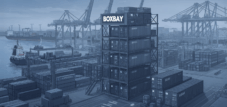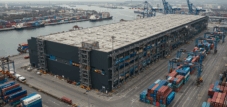
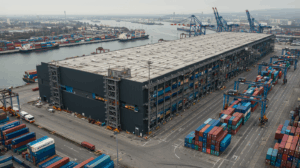
High-bay storage system for containers under construction, Jebel Ali Port, Dubai – Image: SMS group
Heavy-duty logistics – extreme automation: Innovative plant concepts for industrial giants
What is AMOVA and what role does the company play in the logistics industry?
AMOVA is a subsidiary of the SMS group and has many years of experience in building automated storage systems for heavy industry. The company, historically also known as SMS Logistiksysteme or SIEMAG, has been implementing innovative plant concepts for over 60 years. Its particular expertise lies in handling extremely heavy loads, especially steel and aluminum coils weighing several tons, up to 50 tons. This decades-long experience in 24/7 operation under harsh industrial conditions provides a perfect foundation for container logistics.
Related to this:

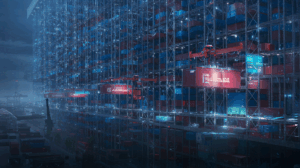
What technical characteristics distinguish High-Bay Storage Systems (HBS)?
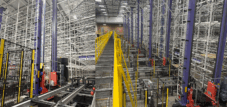
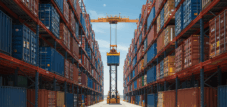
The core of AMOVA's HBS systems are highly robust, rail-mounted storage and retrieval machines known as Stacker Cranes. These are designed for a lifting capacity of up to 50 tons, which is crucial given that loaded 40-foot containers can weigh over 30 tons. The storage and retrieval machines move along rails in the storage aisles and can move containers both horizontally and vertically simultaneously, resulting in high throughput.
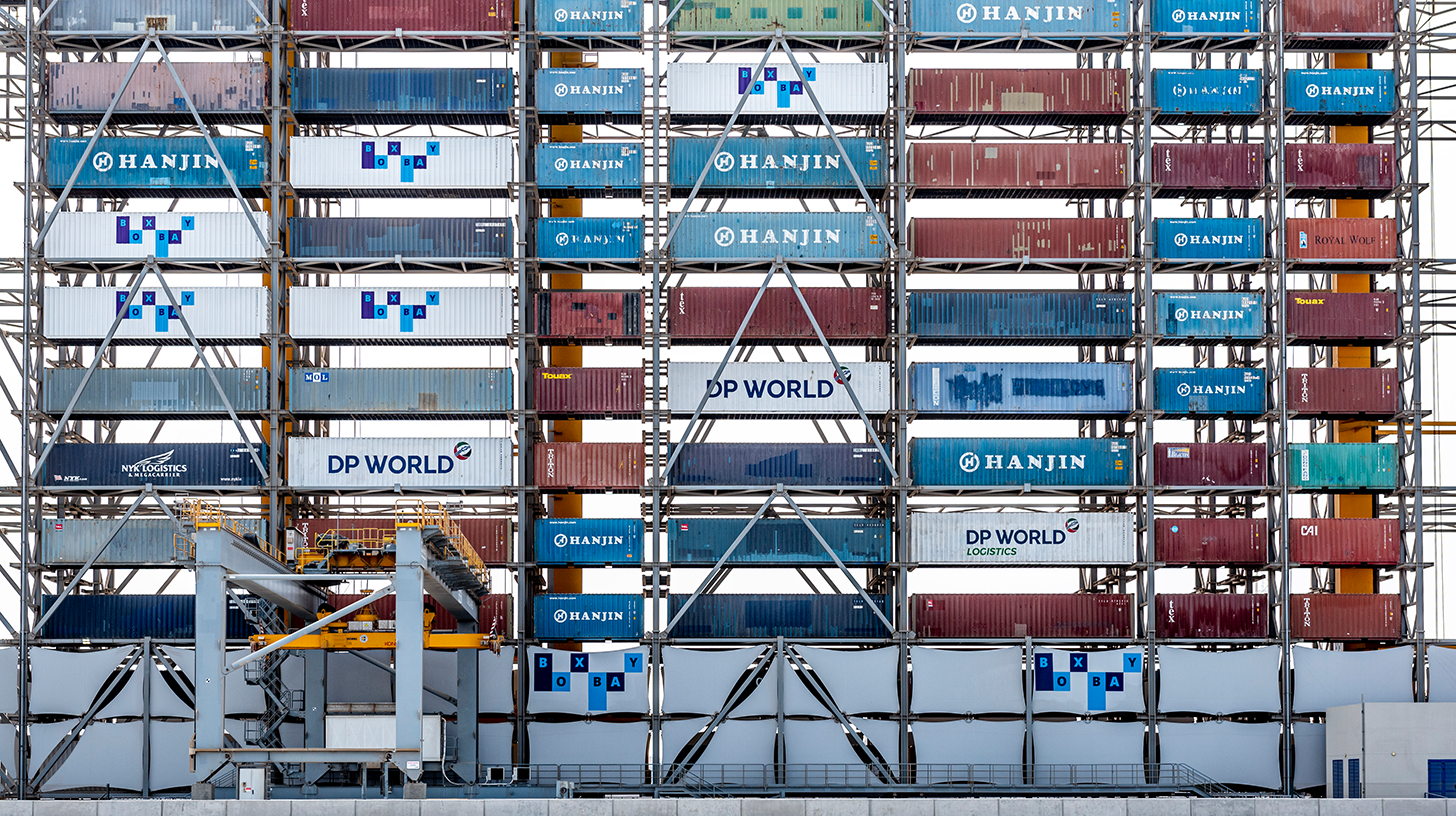
The system is designed to be fully modular and can be adapted for both large seaports and smaller inland industrial and logistics parks. A fundamental element of the HBS is a so-called "aisle," consisting of two racks with a rail system for the stacker cranes positioned between them. The HBS building can comprise multiple aisles and can even be expanded incrementally while the port remains operational.
How does the technical principle of rail-mounted storage and retrieval machines work?
Rail-guided storage and retrieval machines are aisle-bound, single-track vehicles used to handle goods in a high-bay warehouse. They move along three axes: the x-axis for the longitudinal direction of the aisle (drive unit), the y-axis for the vertical direction (lift unit), and the z-axis for the transverse direction of the aisle (load handling unit). Automated versions can handle containers with a positioning accuracy of up to +/- 50 mm, even if a 12-meter container weighs 40 tons and moves at speeds of 5 meters per second.
The unique feature of the AMOVA systems is that each container is placed in its own, permanently assigned shelf space. The automated storage and retrieval system travels directly to this space, retrieves the container, and transports it to the transfer point without moving any other containers. Every container is 100% directly accessible at all times, resulting in dramatically shorter handling times and predictable turnaround times.
What impressive capacity values do the HBS systems achieve?
AMOVA's theoretical capacity figure is impressive: with a high-density multi-aisle layout, a storage capacity of over 160,000 TEU per hectare per year can be achieved. This underscores the enormous density of their systems. The space efficiency of HBS systems results from two factors: vertical stacking and compact geometry. While traditional straddle carrier fields can typically only stack containers 3 to 4 layers high, and RTG cranes can manage 5 to 6 layers, HBS systems utilize heights of up to 11 layers.
The system offers more than three times the storage capacity on the same footprint compared to conventional solutions. Storage capacity on the same ground area is therefore at least doubled or tripled. Pairs of stationary racks at both ends of each HBS aisle provide an efficient interface to the waterside horizontal transport system.
What extensive practical experience has AMOVA gained?
AMOVA has implemented numerous high-bay warehouses in steel mills since 2006 and boasts a wealth of references worldwide. The company even holds the record for the world's largest high-bay warehouse for steel coils, with approximately 4,300 storage locations. An impressive example of the longevity of AMOVA technology can be seen at ElvalHalcor: the existing high-bay warehouse, supplied by AMOVA 20 years ago, is still fully operational. This is a testament to the high quality and durability of the systems.
The more than 45 references worldwide encompass fully automated systems with minimal footprint, maximum throughput, and no material damage. AMOVA develops turnkey, highly efficient warehouse concepts including transport and control technology as well as warehouse management software. This decades-long experience in 24/7 operation under harsh industrial conditions is a strong selling point for its application to container logistics.
What strategic market positions does AMOVA pursue?
AMOVA positions itself as a provider of customized HBS solutions that can be adapted to specific customer requirements. They operate as a flexible solutions provider, offering proven heavy-duty technology for a wider range of applications, including industrial and inland terminals. The company was the first in the world to successfully transfer its decades of expertise in high-bay warehouses for heavy loads to applications in container terminals.
The HBS system is highly modular and can be tailored to the needs of terminals at both brownfield and greenfield sites. Capacity and throughput are scalable through aisle length, number of lanes, and the number of stacker cranes per lane. This flexibility allows AMOVA to serve both large seaports and smaller regional terminals.
How does AMOVA differ strategically from BOXBAY?
Although both belong to the SMS group, AMOVA and BOXBAY pursue different, complementary strategies. BOXBAY is a standardized, highly scalable product primarily introduced to the global seaport market by its partner DP World. BOXBAY is an international joint venture between DP World and the SMS group, with the high-bay warehouse technology originally developed by the SMS group subsidiary AMOVA for 24-hour operation with metal coils weighing up to 50 tons.
In contrast, AMOVA operates more as a flexible solutions provider, offering its proven heavy-lift technology to various market segments. This can be seen as a dual strategy by the SMS group to cover different market segments. While BOXBAY focuses on the standardized seaport market, AMOVA, with its HBS systems, serves a broader range of applications and customized solutions.
What technical innovations characterize AMOVA storage and retrieval machines?
AMOVA's storage and retrieval machines feature a lifting mechanism equipped with a roller deck and can move containers simultaneously horizontally and vertically. This results in high storage and retrieval throughput combined with precise handling. AMOVA offers two versions: single-rail machines with the upper guide rail integrated into the warehouse steel structure, and dual-rail machines that are mounted independently of the racking system.
One advantage of dual-rail systems is their lower wheel load, as the vertical load is distributed across four wheels instead of two. These storage and retrieval machines offer various operating modes: in addition to fully automatic operation, semi-automatic or fully manual operation is also possible, as well as a special maintenance mode. Particular emphasis is placed on uncompromising operational reliability; therefore, they are very easy to maintain, which reduces maintenance times and increases availability.
Your intralogistics experts
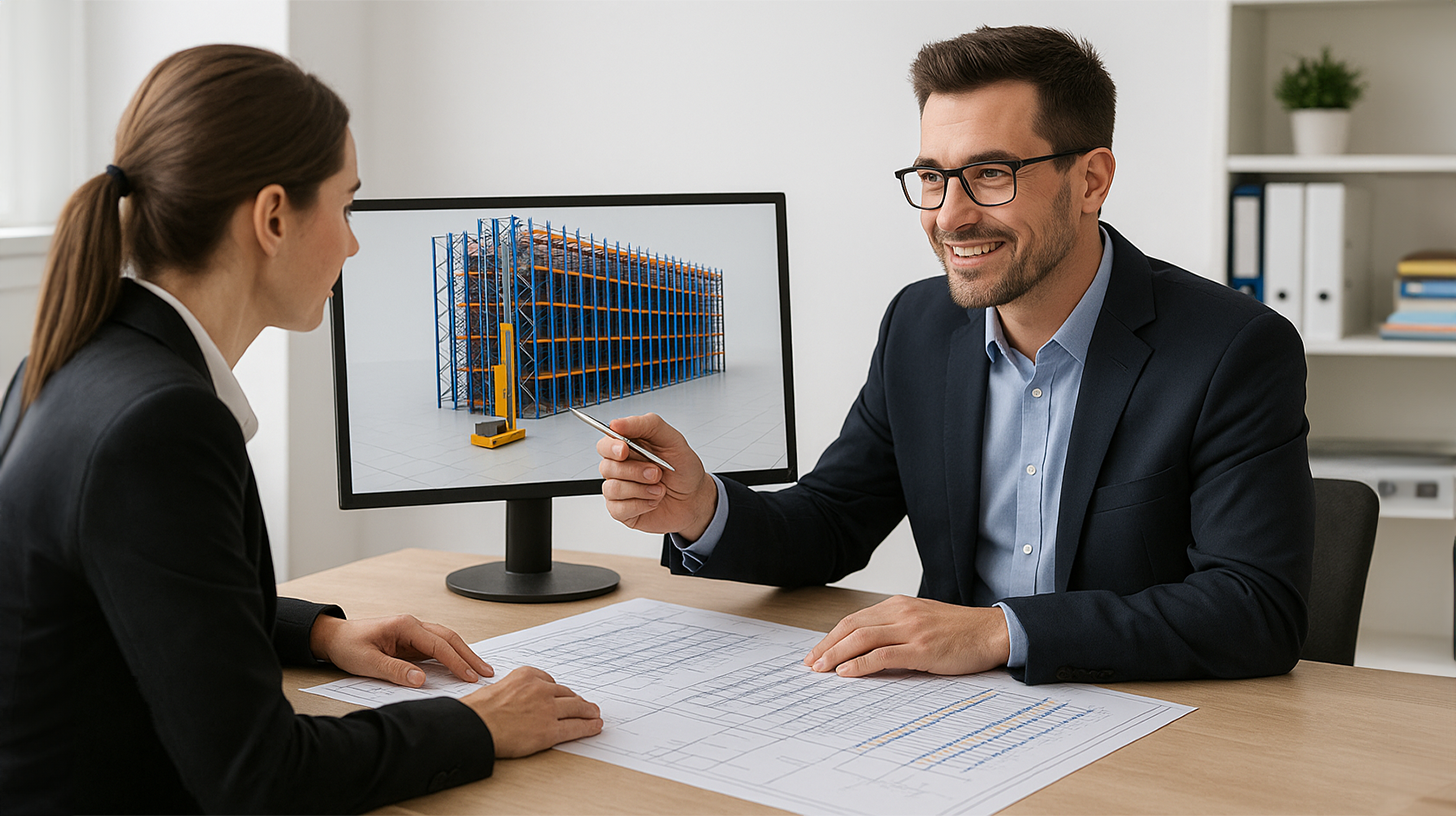
Consulting, planning and implementation of complete solutions for high-bay warehouses and automated storage systems - Image: Xpert.Digital
More information here:
More power, less effort: Container technology for modern ports
What systematic advantages do rail-bound systems offer?
Rail-based systems offer several systematic advantages for container logistics. They are predictable and reliable, designed for heavier loads, and available around the clock. Rail freight in general emits less than one-fifth of the greenhouse gases per ton transported and kilometer traveled compared to road transport. This is due not only to the propulsion system but also to the better ratio of transport volume to energy used for propulsion.
The safety aspects are also remarkable: The risk of an accident on the railway is approximately 40 times lower compared to the road. This results in a significantly lower failure rate of shipments. Furthermore, there is a lower risk of theft, as containers in high-bay warehouses are more difficult to access than those in open terminal areas.
Related to this:
What role do warehouse management systems play at AMOVA?
AMOVA develops its own warehouse management software, which offers numerous features in addition to material tracking and visualization. A particularly important feature is temperature tracking based on trend simulations, which is essential for material quality. AMOVA's WMS is an attractive and reliable solution for automated material flow control and warehouse management.
With UniWare, AMOVA offers a modular warehouse management system with ready-to-use modules for all standard processes. The system features pre-built interfaces to common systems and is designed to be needs-based thanks to its modular and freely configurable structure. UniWare is an integrated system that combines warehouse management, material flow control, plant visualization, and control technology into a single unit.
How does AMOVA contribute to sustainability and energy efficiency?
All container storage and retrieval movements are performed by stacker cranes, which move containers horizontally and vertically simultaneously while traveling. This results in high storage and retrieval throughput with optimal energy efficiency. AMOVA stacker cranes can be equipped with various functions that further increase energy efficiency and thus reduce operating costs.
The system's high level of sustainability is also evident in the enormous energy savings, as unproductive crane movements are completely eliminated. This simultaneously leads to less wear and tear on the equipment. The compact storage in automated systems reduces the space requirement by more than 50 percent compared to conventional systems, contributing to the optimal use of expensive port areas.
What forward-looking developments are shaping HBS technology?
AMOVA utilizes state-of-the-art simulation technology for throughput validation and optimization in facilities, as well as for the development and implementation of warehouse management strategies. The 3D simulation platform Visual Components is used to model equipment and create models of facilities and planned logistics concepts. Simulation studies serve to identify and implement improvement potential, thereby enabling throughput analysis and the optimization of performance limits.
The developed simulation and emulation models are used in various projects, ranging from high-bay warehouse aisles with multiple stacker cranes and pallet transport systems for steel coils to complex 7-aisle high-bay storage platforms. The goal is always throughput validation and maximization through logic optimization. This systematic approach ensures that each AMOVA system is optimally tailored to the specific requirements of the respective customer.
What practical application examples illustrate its capabilities?
An impressive example of the capabilities of AMOVA technology is the first fully automated high-bay warehouse for freight containers at Terminal 4 in Jebel Ali, Dubai. This disruptive technology is being implemented by BOXBAY, a joint venture between DP World and SMS group/AMOVA. The pilot project in Dubai has already successfully handled over 63,000 container movements, exceeding initial expectations.
The system in Dubai can handle 792 containers simultaneously and achieves a throughput of 19.3 movements per hour at each waterside transfer point. The test phase showed that BOXBAY is faster and more energy-efficient than initially expected. This experience is being directly incorporated into the further development of the AMOVA HBS systems and demonstrates the practical applicability of the technology under real port conditions.
How does AMOVA position itself in international competition?
AMOVA is the first company worldwide to successfully transfer its proven high-bay warehouse technology to container terminal applications. This pioneering role gives the company a significant competitive advantage, as the technology has already been tested for decades in demanding heavy-lift logistics. With over 70 years of experience in intralogistics, AMOVA possesses the necessary expertise to develop the best solution for diverse customer requirements.
The international market for container high-bay warehouses includes various suppliers, but AMOVA distinguishes itself through its proven expertise in heavy-duty applications. While other manufacturers have developed container-specific solutions, AMOVA can draw on a solid foundation of high-bay warehouse systems that have already proven themselves in extreme industrial environments. This experience in 24/7 operation under harsh conditions is a crucial factor for the reliability of the systems in port environments.
What integration into existing port infrastructures does AMOVA enable?
AMOVA's HBS system is designed for seamless integration into existing port infrastructure. An underground transport system connects the high-bay warehouse to the land-based truck interface. The pallet circulation system operates independently of the stacker crane movements and without impacting their performance. Key components include self-propelled pallets on rails and pallet transfer cars.
The flexible interfaces enable both waterside and landside loading. The system can be connected as a single- or multi-level system and achieves throughputs of up to 500 containers per hour. The direct connection of the ship-to-shore cranes allows for high throughput and scalable performance. At the same time, the dynamic allocation of berths is supported, keeping the quay area free for other uses.
What economic advantages do HBS systems offer?
AMOVA's HBS systems lead to massive space savings in expensive port areas and significantly reduced berthing times for container ships. This results in enormous cost savings for port operators. The system eliminates unproductive movements: Using the Busan terminal as an example, 350,000 unproductive movements per year are eliminated, improving truck handling time by 20 percent.
The systems' economic efficiency is also evident in their optimized use of space: with more than three times the storage capacity on the same footprint, port operators can make optimal use of their valuable land. As a complete package, the automated systems guarantee optimized dwell and throughput times, protection against material damage, reduced administrative and transport costs, and ease of handling and operation. These factors contribute significantly to improving the overall profitability of port terminals.
What technological future prospects does AMOVA offer?
AMOVA is continuously working on the further development of its HBS technology, utilizing state-of-the-art digital tools. The integration of artificial intelligence into warehouse management systems enables even more efficient optimization of container placement and movement. The development is moving towards fully autonomous systems that can operate with minimal human intervention.
The modular design of HBS systems allows for future expansions and modifications without interrupting operations. AMOVA continuously develops the system to meet the growing demands of container shipping. Expertise in heavy industry provides a solid foundation for integrating new technologies such as IoT, predictive maintenance, and advanced automation into next-generation HBS systems.

Xpert.Plus Warehouse Optimization - High-bay warehouses and pallet warehouses: Consulting and planning
We are here for you - Consulting - Planning - Implementation - Project Management
☑️ Our business language is English or German
☑️ NEW: Correspondence in your native language!

Konrad Wolfenstein
I and my team are happy to be available to you as your personal advisor.
You can contact me by filling out the contact form here wolfenstein@xpert.digital:or simply call me at +49 7348 4088 965. My email address is
I'm looking forward to our joint project.