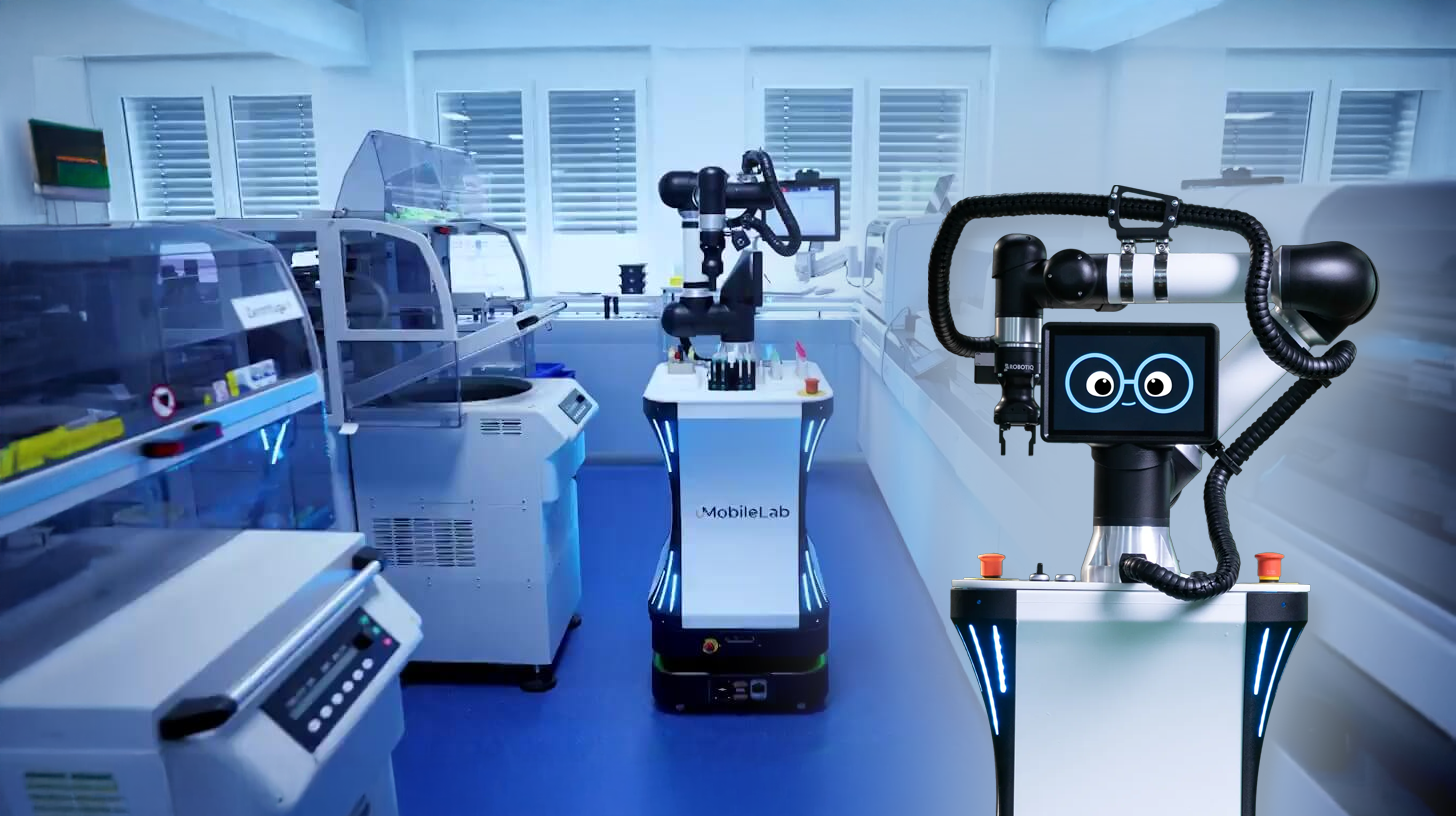
United Robotics Group: Promising and exciting new beginning as a healthcare specialist – Image: United Robotics Group
From failure to beacon of hope: A German robotics fairytale? How a new champion for healthcare rose from the ashes of URG
Skilled worker shortage in hospitals: Could these robots from Germany be the solution?
It's a story of failure and resurrection rarely seen in the German technology landscape: After the initially ambitious plans of the United Robotics Group (URG) ended in insolvency, the company is now relaunching under new leadership and with a radically changed focus. Instead of a broadly diversified attempt to create a European champion for all areas of service robotics, the new URG, led by experienced robotics expert Wassim Saeidi and former Siemens Healthineers manager Kerstin Wagner, is now concentrating entirely on the healthcare sector – the most demanding and, at the same time, most in need.
Driven by the vision of addressing the acute shortage of skilled workers with intelligent, AI-based assistants, the company is focusing on proven and market-ready products. At the heart of this relaunch is the mobile laboratory robot uLab Mobile, which already performs repetitive tasks in over 30 laboratories worldwide, relieving the burden on skilled personnel. Backed by solid, organic financing and a clear platform strategy, URG plans a gradual expansion from laboratory automation to logistics and cleaning in hospitals, culminating in direct patient support. With the humanoid robot uMe, announced for 2026, the vision of empathetic, technological support in everyday nursing care will become a reality – an honest solution to a real problem, Made in Germany.
What exactly is the United Robotics Group?
United Robotics Group (URG) is a German service robotics company headquartered in Stuhr near Bremen, specializing in AI-based robotics solutions for the healthcare sector. The company has had a turbulent history: founded in 2020 by Thomas Hähn as a European service robotics champion and financed by the RAG Foundation, the original URG filed for insolvency in February 2025. In the summer of 2025, Wassim Saeidi, who had been part of URG since 2019, acquired all patent, trademark, and content rights and now leads the company with a new focus, together with his co-CEO Kerstin Wagner.
Why did the original URG have to go bankrupt?
The insolvency of the original United Robotics Group resulted from a confluence of several critical factors. High development costs coupled with a lack of profitability placed a significant burden on the company. The ambitious plans for rapid growth and consolidation of various robotics divisions proved more expensive than initially anticipated. A decisive turning point was the abrupt cessation of funding by the RAG Foundation in the summer of 2024, which had previously acted as the main investor. The challenging market conditions in the German robotics industry, which experienced a ten percent decline in revenue in 2025, further exacerbated the already strained situation. The company's structure was also particularly problematic: while the French subsidiary Aldebaran handled the costly development, sales revenues flowed primarily to other business units, leaving insufficient funds available for research and development.
Who are Wassim Saeidi and Kerstin Wagner?
Wassim Saeidi is the founder and CEO of WS System GmbH, which he established in 2011 and which specializes in Industry 4.0 solutions. In 2019, he joined URG with his company and renamed it "United Robotics Health & Food GmbH." Saeidi brings extensive expertise in robotics and artificial intelligence, complemented by qualifications as a machine learning engineer. His motivation for acquiring the URG rights stemmed from his initial enthusiasm for the vision of combining robotics, AI, and humanity.
Kerstin Wagner joined URG's management team in January 2025 and was appointed Co-CEO and COO in September 2025. She brings nearly three decades of experience in the healthcare and diagnostics industry, including a leading position at Siemens Healthineers as Executive Vice President for Marketing and Commercial Operations. Among other things, Wagner was responsible for the market launch of Siemens Healthineers' flagship diagnostics platform in the EMEA region and is considered an expert in healthcare sector transformation.
Why is the new URG focusing on healthcare?
The strategic focus on healthcare is based on several compelling arguments. Healthcare represents the most demanding application area for service robotics – if robots function safely and reliably there, it will automatically convince other sectors such as airports, public institutions, and schools. Furthermore, URG already possessed the most robust and in-demand market-ready products in this field. The acute shortage of skilled workers in the German healthcare sector is further increasing demand: By 2035, German hospitals will be short at least 600,000 workers. Service robotics offers a concrete solution by taking over repetitive tasks and freeing up qualified personnel for actual patient care.
What makes the uLab Mobile so special?
The uLab Mobile is a mobile, collaborative robot specifically designed for laboratory automation. Its key feature is its seamless integration into existing laboratory environments without any programming required – thanks to close collaboration with laboratory equipment manufacturers, the robots are trained before delivery. Equipped with intelligent camera systems for object recognition, the robot can distinguish sample tubes based on cap color and perform product-specific tasks. Its AI-based software allows it to utilize "skills": it recognizes objects, locates gripping points, opens drawers, and plans work processes autonomously. These capabilities enable it to operate reliably even in unfamiliar environments. The mobile robot can work autonomously for approximately three hours and is particularly valuable for night shifts in clinical laboratories, where it can often handle the entire workload independently.
In which laboratories is the uLab Mobile used?
The uLab Mobile is currently in use in more than 30 laboratories worldwide. It is primarily used in clinical diagnostics, both in hospital labs and in private reference laboratories to which general practitioners send their samples. Large pharmaceutical companies also utilize the robot for their laboratory processes. Applications include sample handling, decapping and pipetting, loading and operating laboratory equipment such as centrifuges and analyzers, and performing reflex tests. The intelligent uGO software allows laboratory teams to set up and modify workflows within seconds using drag and drop.
What plans does URG have beyond laboratories?
The newly formed URG is pursuing a systematic expansion strategy, building on its successful laboratory operations. Initially, the company plans to become active in other hospital areas, such as catering, material transport, and cleaning. In the long term, URG aims to move from purely object handling to direct patient contact. The plan is to provide nursing support and patient assistance using the same robot platform, adapting only the grippers and workflows while maintaining the same underlying technology. This platform and family approach allows proven technology to be transferred cost-effectively to new applications.
What is the humanoid robot uMe?
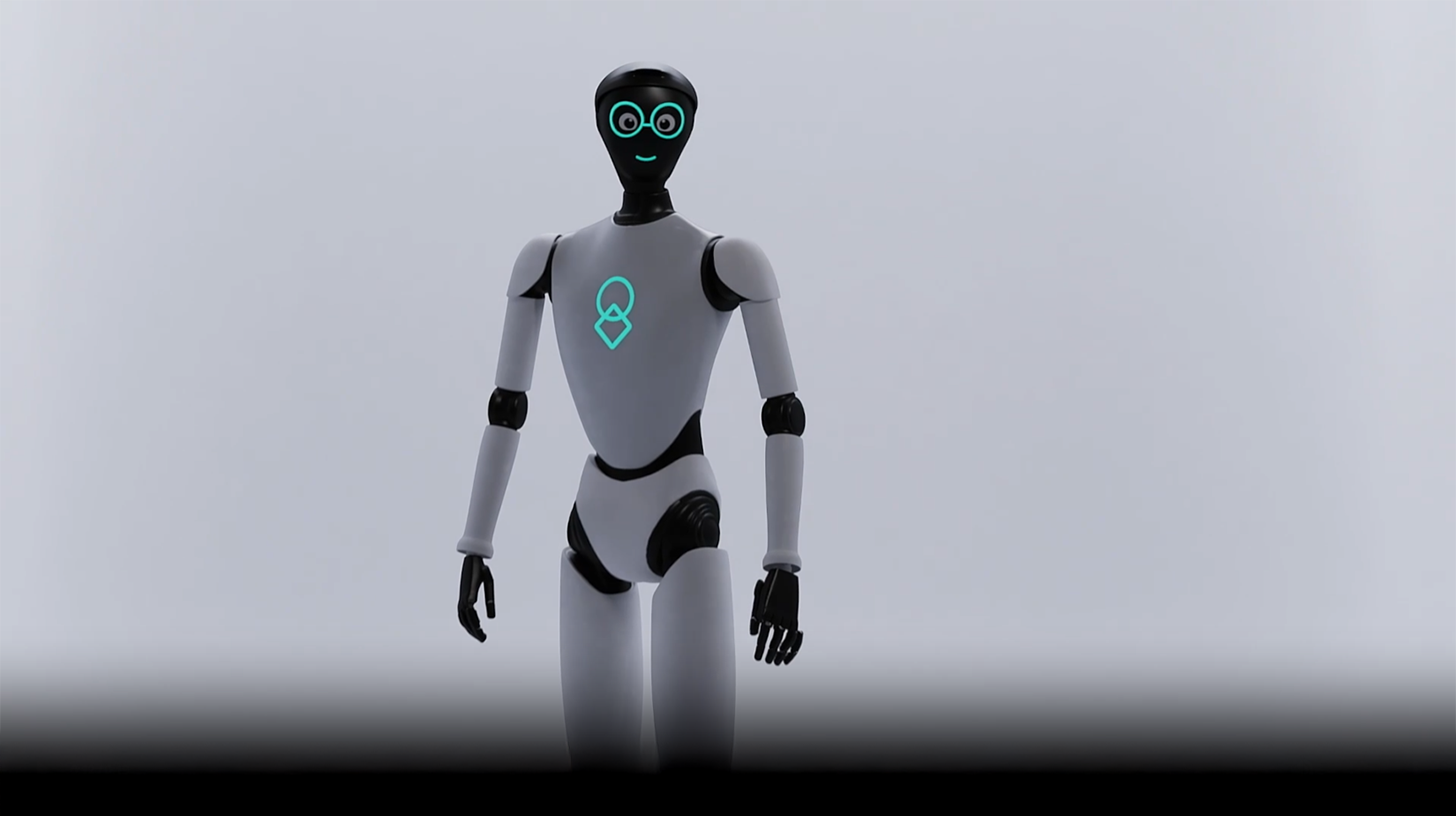
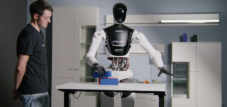
What is the humanoid robot uMe? – Image: United Robotics Group
The humanoid robot uMe represents the next major development step for URG and is scheduled to be presented at CES in Las Vegas in early 2026. Unlike many other providers who often only present visions, the uMe prototype is already running in URG's facilities and uses the same proven software platform as the uLab Mobile. Initially, uMe will handle the same use cases as the uLab Mobile: object recognition, grasping, and transport from point A to point B. The crucial difference lies in its ability to climb stairs and thus reach areas inaccessible to mobile robots. The primary goal is its use in elderly and care support, including in the home, where uMe is intended not only to provide simple assistance but also to interact empathetically with patients.
How is the new URG financed?
The new URG is currently fully self-financed and growing organically based on concrete, ready-to-use products that have already gained market acceptance. This self-financing is possible because the funds from the previous investor were used to develop solutions that are already marketable. Although the company is in discussions with investors, it is in a comfortable exploratory phase without time pressure. Partnerships are being explored for new ideas and faster growth, but the financial independence allows for strategic decisions to be made at a leisurely pace.
What is URG's vision for the next five years?
URG has set itself an ambitious goal: to become a leading European provider of service robotics – a unicorn with an international footprint. This vision is based on its successful product portfolio and consistent platform and family-oriented approach. The company aims to set trends by combining AI with real-world applications and bringing robotics to where people need it: hospitals, care facilities, and public spaces. Ethics remains a guiding principle – URG stands for technology that protects, relieves burdens, and improves lives. "Made in Germany" is intended to represent the highest quality and reliability.
Our EU and German expertise in business development, sales and marketing

Our EU and German expertise in business development, sales and marketing - Image: Xpert.Digital
Industry focus areas: B2B, digitalization (from AI to XR), mechanical engineering, logistics, renewable energies and industry
More information here:
A thematic hub offering insights and expertise:
- Knowledge platform covering global and regional economies, innovation and industry-specific trends
- A collection of analyses, insights, and background information from our key areas of focus
- A place for expertise and information on current developments in business and technology
- A hub for companies seeking information on markets, digitalization, and industry innovations
Made in Germany: How the new URG is rethinking healthcare robotics
How does the new URG differ from the original one?
The new URG differs fundamentally from its predecessor in its clear focus on healthcare, rather than the originally broad diversification strategy. While the original URG, under Thomas Hähn, attempted to create a European service robotics champion through rapid acquisitions and consolidation of various robotics divisions, the new URG concentrates on proven, market-ready products. The financing strategy has also fundamentally changed: instead of relying on large external investors like the RAG Foundation, the company finances itself organically from its own revenues. The new management structure, with Saeidi and Wagner, brings both technical expertise and in-depth healthcare know-how, enabling targeted market development.
What role does AI play in the URG robots?
Artificial intelligence is at the heart of URG's robotics technology, differentiating its products from simple automation solutions. The AI-based software enables the robots to work with "skills": they can independently recognize objects, find optimal gripping points, open drawers, and plan complex work steps autonomously. This intelligence allows the robots to operate reliably even in unfamiliar environments and adapt to changing conditions. The same AI platform runs on various robot types – from the uLab Mobile and the uClean cleaning robot to the uLog transport robot – creating synergies and reducing development costs. Saeidi himself, as a machine learning engineer, brings extensive AI expertise and ensures the continuous development of these intelligent functions.
Why is URG relying on humanoid robots despite recent disappointments in the industry?
URG addresses skepticism towards humanoid robots with a deliberately honest and realistic approach. While many companies raise exaggerated expectations that lead to disappointment, URG focuses on bringing honest products to market. The uMe is not intended to be a show project, but rather a practical solution to real-world challenges. The strategy is based on initially transferring proven functions from the uLab Mobile and then gradually expanding them. The focus is on senior and care support, where demographic change and the shortage of skilled workers are creating a genuine need. The empathetic interaction is intended to offer not just technical gimmicks, but real added value for users.
How is the market reacting to service robotics in healthcare?
The market for service robotics in healthcare is experiencing dynamic growth, driven by the acute shortage of skilled workers. The medical technology and healthcare sectors saw global growth of 36 percent in 2023. Global sales of service robots increased by almost 50 percent to 158,000 units. The potential is considered particularly significant in Germany: nursing staff spend 40 to 50 percent of their time on administrative tasks instead of with patients – this is precisely where robotics can make a difference. Demand is so high that Wagner speaks of "open doors" among healthcare customers. However, German healthcare institutions still lag behind in international comparison – Scandinavian countries are significantly further ahead in the use of robots as logistics providers.
What technical challenges does URG overcome?
URG addresses several critical technical challenges in service robotics. Seamless integration into existing workflows is achieved through close collaboration with laboratory equipment manufacturers, enabling robots to be trained even before delivery. URG meets healthcare safety requirements through comprehensive sensor technology and compliance with the EU Machinery Directive. Intelligent object recognition allows the robots to distinguish samples based on cap color and perform product-specific tasks. Remote maintenance and augmented reality support ensure minimal downtime. The modular software architecture allows proven skills to be transferred to different robot platforms, reducing development time and costs.
What does the platform and family concept of URG mean?
The platform and family concept forms the strategic foundation of the new URG and distinguishes it from single-product providers. At the heart of this strategy is a shared AI-based software platform that runs on various robot types – from the uLab Mobile and the uClean cleaning robot to the uLog transport robot and the future humanoid uMe. This approach makes it possible to transfer skills developed once, such as object recognition, grasp planning, or navigation, to different robots. For new applications, only grippers and workflows need to be adapted, while the underlying technology remains the same. This strategy reduces development costs, accelerates the market launch of new products, and creates synergies between the various robot solutions. Customers benefit from standardized operating concepts and reduced training requirements.
How does URG position itself in international competition?
URG consciously positions itself as a European alternative to Asian and American competitors with the quality promise of "Made in Germany." While many international providers focus on volume and low prices, URG concentrates on the highest quality, reliability, and safety. The combination of German mechanical engineering expertise, appealing design, and innovative AI software is intended to create its unique selling proposition. In the healthcare sector, where safety and reliability are critical, this quality-oriented approach can offer decisive competitive advantages. Furthermore, URG focuses on genuine practical applicability rather than marketing promises – while many competitors talk about visions, URG can already demonstrate functioning solutions in routine operation.
What role does ethics play in the URG strategy?
Ethics serves as a guiding principle for URG and distinguishes the company from purely technology-driven approaches. URG stands for technology that protects, relieves burdens, and improves lives, rather than replacing people. This philosophy is reflected in product development: robots are intended to free healthcare professionals from repetitive tasks, allowing them to focus on actual patient care. The empathetic interaction of the planned humanoid robot uMe is designed to create genuine added value for seniors and those requiring care, not merely represent a technological gimmick. This ethical stance is particularly important in the sensitive healthcare sector, where trust and human connection are paramount. URG sees itself as a partner to medical personnel, not as a competitor.
How is service robotics developing in Germany in general?
The German service robotics industry is undergoing a period of transformation, presenting both challenges and enormous growth opportunities. While the industry as a whole experienced a 10 percent decline in revenue in 2025, individual segments such as healthcare are showing strong growth. Although Germany is the fifth-largest market for industrial robotics worldwide, there is still room for improvement in the service robotics sector. The greatest growth areas lie beyond traditional industrial applications, particularly in healthcare, which saw global growth of 36 percent in 2023. Demographic change and the acute shortage of skilled workers are creating additional market opportunities: By 2035, half a million nursing staff will be needed. Collaborative robots and AI integration are considered key technologies for market development.
What happened to the famous robots Pepper and NAO?
The story of the humanoid robots Pepper and NAO is closely intertwined with the turmoil surrounding URG and illustrates the challenges facing the service robotics industry. Originally developed by the French company Aldebaran, both robots became icons of humanoid robotics. SoftBank acquired Aldebaran in 2012 but discontinued Pepper production in 2021. In 2022, URG, under Thomas Hähn, bought Aldebaran from SoftBank and attempted to revive the robots, but failed due to a lack of market acceptance. Following URG's insolvency, Aldebaran also filed for bankruptcy in February 2025. Finally, in July 2025, the Chinese Maxvision Technology Corporation acquired the technological assets and ownership rights of Pepper and NAO. Maxvision plans to continue production in China and leverage the French expertise. Aldebaran itself was permanently closed on June 2, 2025.
Related to this:

What lessons does the new URG draw from the history of its predecessor?
The new URG has learned fundamental lessons from its predecessor's failure and adjusted its strategy accordingly. Instead of the originally pursued broad diversification, the company now focuses on a clearly defined market: healthcare. The financing strategy has been radically changed – instead of relying on large external investors, growth is achieved organically from internal revenues. The new URG focuses on proven, market-ready products rather than ambitious development projects with uncertain outcomes. The focus is on genuine practicality and honest product promises, rather than marketing visions. The platform strategy reduces development risks through the reuse of proven technologies. This pragmatic approach aims to avoid the mistakes of the past and enable sustainable growth.
Your global marketing and business development partner
☑️ Our business language is English or German
☑️ NEW: Correspondence in your native language!

Konrad Wolfenstein
I and my team are happy to be available to you as your personal advisor.
You can contact me by filling out the contact form here wolfenstein@xpert.digital:or simply call me at +49 7348 4088 965. My email address is
I'm looking forward to our joint project.