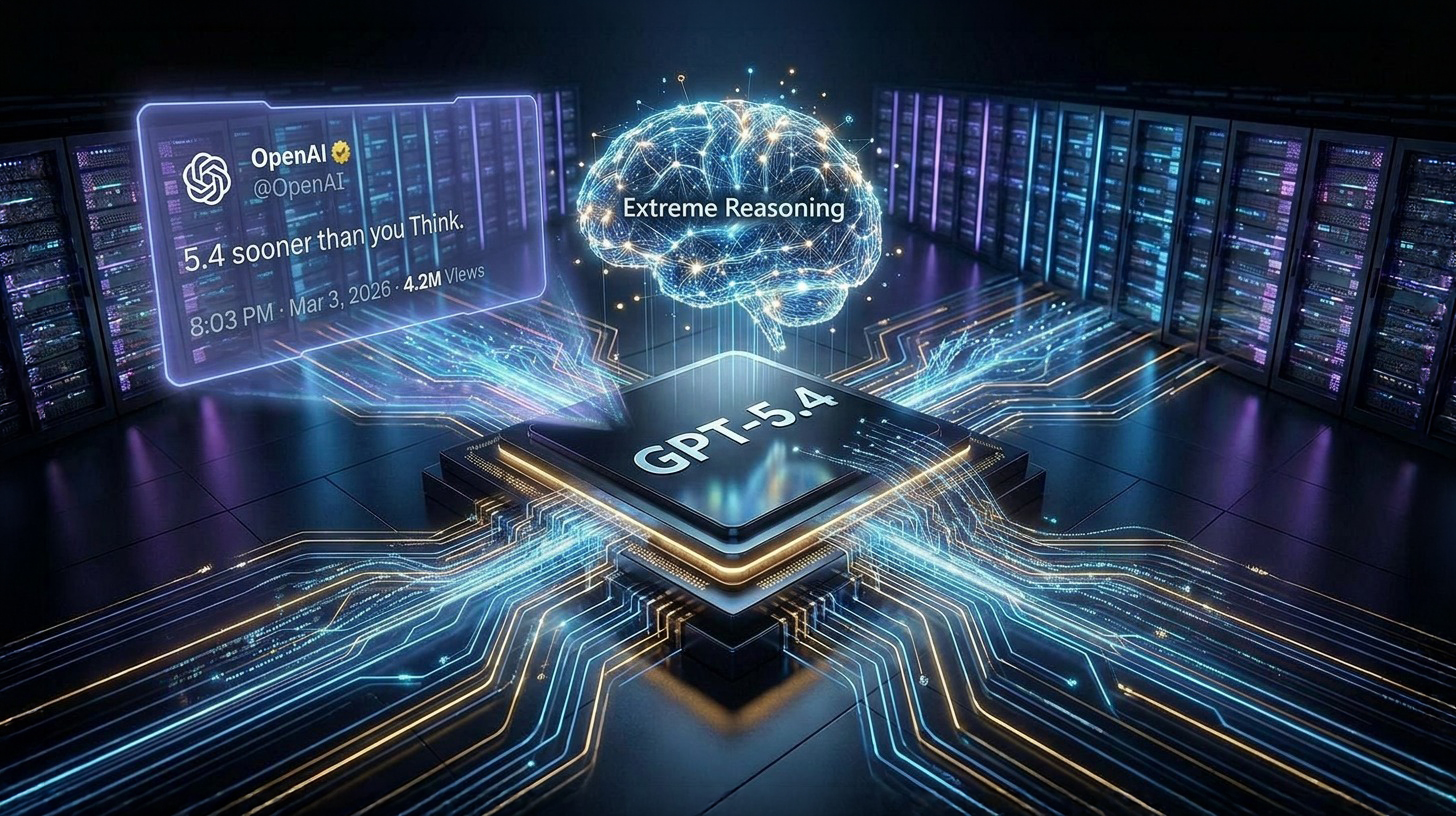
No sooner has GPT-5.3 launched than everyone is already talking about GPT-5.4: Extreme Reasoning & 2 Million Tokens – Image: Xpert.Digital
Quantum leap for OpenAI? The hidden AI giant: How OpenAI aims to outclass Google and Anthropic with GPT-5.4
Accidentally leaked: OpenAI's new mega-model GPT-5.4 is about to be released
A cryptic five-word tweet and hastily deleted code snippets on GitHub have sent shockwaves through the global tech world: OpenAI is apparently preparing to launch its next major language model – GPT-5.4. What might initially appear to be an inconspicuous, incremental update, upon closer inspection reveals itself to be a potential milestone in the fierce battle for AI supremacy. With groundbreaking features such as a computationally intensive "Extreme Reasoning" mode, a massive context window of up to two million tokens, and pixel-perfect image analysis, the company is arming itself to outmaneuver competitors like Google and Anthropic. But the accelerated release cycle comes at a price: While the models become increasingly autonomous and evolve into true agents, infrastructure costs are skyrocketing – and amidst controversial Pentagon deals, the ethical and economic viability of this rapid progress is increasingly coming into focus.
GPT-5.4: OpenAI's next quantum leap between Extreme Reasoning and the battle for AI supremacy
If five words on X are enough to send the entire AI industry into turmoil, then more than just a new model is at stake
It was a message of unparalleled brevity, yet it sent shockwaves through the entire artificial intelligence industry. On March 3, 2026, exactly one hour after OpenAI had released its new language model, GPT-5.3 Instant, to the general user base, a five-word post appeared on the company's official X channel, garnering three million views and 25,000 likes within hours: "5.4 sooner than you think." No image, no explanatory thread, no link to a blog post. Just five words and a conspicuously capitalized T that instantly set the speculation machine of the global developer and investor community in motion. What might at first glance appear to be a marketing-driven teaser, upon closer inspection, turns out to be the clearest public confirmation to date that OpenAI is preparing a model with GPT-5.4 that could fundamentally change the rules of the AI competition.
The tweet didn't appear in a vacuum. It followed a week in which three independent leaks from OpenAI's own Codex repository revealed the inner workings of the upcoming model before hastily deleting engineers could cover their tracks. And as the technology magazine The Information reported, citing a person familiar with the plans, GPT-5.4 will include an "Extreme" reasoning mode, allowing the model to utilize significantly more computing power than its predecessors when tackling complex problems. What initially sounds like an incremental update has the potential to reshape the power dynamics between OpenAI, Google, and Anthropic, further squeeze the cost structures of AI infrastructure, and raise the question of whether the business model behind these increasingly powerful models is sustainable in the long run.
Anatomy of an involuntary revelation
The story of GPT-5.4 didn't begin with a planned press release, but with a mistake that repeats itself with alarming regularity in the world of software development: An engineer wrote code that revealed more than it should have. On February 28, 2026, a pull request with the internal designation 13050 appeared in the publicly accessible Codex repository on GitHub. It contained a version check that explicitly referenced "GPT-5.4 or newer" as the minimum requirement for a new image processing feature. The community discovered the entry within a few hours. The line in question was hastily changed to "gpt-5.3-codex or newer," and the commit history was overwritten via force push, but by that time, screenshots were already circulating widely on X and Reddit.
The crucial point about this leak was that it wasn't a placeholder. The code implemented a specific functionality, namely the processing of full-resolution images, which technically only works with the capabilities of GPT-5.4. The engineer wrote the version check because the feature simply wouldn't run on older models. It was a functional reference, not a speculative one.
A few days later, on March 2nd, a second pull request, number 13212, followed, further clarifying the issue. An OpenAI developer with the username pash-openai added a fast-mode toggle function to the Codex terminal. Its description explicitly referenced "toggle Fast mode for GPT-5.4" and introduced a so-called ServiceTier enumeration with the variants Standard and Fast. This reference was also removed within hours, but the technical details had already been documented.
In parallel, an OpenAI employee named Tibo caused another unintended leak when he posted a screenshot of the model selection in the Codex application, showing GPT-5.4 as a selectable option alongside GPT-5.3 Codex. The post was quickly deleted, but the image had already gone viral. Finally, the developer nicdunz reported on X that an endpoint labeled "alpha-gpt-5.4" had temporarily appeared in a public API model list, consistent with OpenAI's usual practice of testing models in alpha endpoints before their official release.
Taken together, these four independent data points—two code commits, an employee screenshot, and an API endpoint—paint a picture that goes far beyond mere speculation. GPT-5.4 exists internally at OpenAI, is in advanced development, and is being actively prepared for production deployment.
The two-million-token promise and its limits
The most technically significant claim derived from the leaked code references concerns the context window. NxCode's analysis of the leaked commits suggests a context window of two million tokens, which would be five times the 400,000-token limit of the current GPT-5 flagship model and eight times the 256,000 tokens of the GPT-5.3 Codex. To put this into perspective, two million tokens are roughly equivalent to 5,000 printed pages—enough to process an entire codebase, a lengthy legal proceeding with all its supporting documents, or a multi-volume scientific paper in a single session.
However, an important distinction is necessary here. While the code leaks suggest two million tokens, The Information, citing a source familiar with the plans, reports a context window of one million tokens. This would still represent a doubling to quadrupling of its predecessor and would put OpenAI on par with Google's Gemini 2.5 Pro, which currently offers the largest commercially available context window with one million tokens. A careful review of sources reveals that the two-million figure stems from a single influencer post and is not directly confirmed by any of the four documented code leaks, whereas the one-million figure comes from an established technical publication.
Regardless of which number ultimately proves correct, the implication would be the same: OpenAI is closing one of its most glaring gaps with the competition. Google's Gemini models long offered a significantly larger contextual window than anything OpenAI had to offer, and Anthropic's Claude Opus 4.6, launched in early February 2026 with its own one-million-token window and support for parallel agent teams, further cemented this lead. A GPT 5.4 with one or even two million tokens would fundamentally shift this balance of power.
The practical applications of such a leap are manifold and extend far beyond academic benchmarks. Law firms could process entire case files in a single conversation window. Software development teams would be able to load entire codebases for analysis and multi-file refactoring without having to fragment the code. Research teams could feed in complete literature corpora for synthesis. The transition from hundreds of thousands to millions of tokens is not incremental; it fundamentally changes which tasks are even feasible in a single model interaction.
Extreme Reasoning: When AI takes more time to think
Besides the jump to the context window, the announced "Extreme" reasoning mode is the second defining feature of GPT-5.4. As The Information reports, this is a function that allows the model to dedicate significantly more computing power to difficult questions, thus enabling deeper cognitive analysis. According to available information, this mode is primarily aimed at researchers and not everyday users who expect quick answers.
The idea behind Extreme Reasoning mode builds on a trend that has been emerging since OpenAI introduced the o-series of reasoning models: the targeted shift of computational effort from the training phase to the inference phase. Instead of simply making a model more powerful through more extensive training, it is enabled to invest more time and computing resources in the actual answer generation. In the case of GPT-5.4, this means that the model can handle significantly higher computational demands for particularly complex scientific, mathematical, or technical problems, resulting in more precise and in-depth analyses.
The capital T in OpenAI's tweet has sparked widespread speculation in the community that GPT-5.4 will be a so-called Thinking-class model. OpenAI has already differentiated internally between various model classes: Thinking models for deep reasoning, Codex models for agent-based software development, and Instant models for everyday conversational use. The capital T would therefore have been a deliberate reference to the internal Thinking-Mode brand name. This interpretation is plausible, but remains unconfirmed.
The concrete implications of these enhanced reasoning capabilities for business users can be illustrated by specific scenarios. In pharmaceutical research, an extreme reasoning mode could significantly deepen the analysis of drug interactions. In financial analysis, complex derivative structures or macroeconomic models could be examined with a thoroughness that previously required multiple successive model interactions. In software development, bugs in nested systems could be identified, bugs that previously posed systematic difficulties for the model.
Pixel-precise image analysis: The end of compromises
A third technical breakthrough, documented by the leaked pull requests, concerns image processing. The code in PR 13050 adds a feature flag that directly and uncompressed passes original image data in PNG, JPEG, and WebP formats to the Responses API, controlled by a new API parameter, "detail: original". The minimum version requirement for this feature is 5.4, meaning it is a GPT 5.4-specific extension and cannot be backported to older versions.
Current GPT models compress uploaded images before processing, which reduces analysis quality for tasks requiring pixel-level precision. This includes medical imaging, satellite imagery, optical character recognition (OCR) in documents, the review of architectural plans and technical schematics, and quality control of design mockups and user interfaces. The ability to process full-resolution images would catapult GPT-5.4 into a range of professional application areas where previous models have reached their limits due to image compression.
For companies using AI-powered quality assurance in manufacturing, automated document processing in the legal or financial sectors, or image-based diagnostics in medicine, this would represent a leap forward of immediate practical benefit. It is no coincidence that OpenAI has explicitly tied this feature to GPT-5.4: Processing uncompressed, high-resolution images requires significantly more computing power and memory bandwidth, which increases the technical demands on the underlying model and infrastructure.
Setting the pace of the race: OpenAI's accelerated release frequency
One aspect that is at least as important as the technical specifications in the discussion surrounding GPT-5.4 concerns the speed at which OpenAI releases new model variants. Since the launch of GPT-5 on August 7, 2025, the company has released more variants within the GPT-5 series than during the entire GPT-4 era in a comparable timeframe.
The chronology illustrates the acceleration: GPT-5 was released in August 2025, GPT-5.1 followed in November 2025 after a three-month gap, GPT-5.2 arrived in December 2025 after only one month, GPT-5.3 Codex was released on February 5, 2026, GPT-5.3 Codex Spark followed a week later on February 13, and GPT-5.3 Instant launched on March 3, 2026. Should GPT-5.4 actually be released in March or April, the gap would shorten to about one month. Prediction markets on Manifold give the model a 55 percent probability of a release before April 2026 and a 74 percent probability before June.
According to The Information, this accelerated pace is a deliberate strategic decision. The more frequent model releases are intended to keep user expectations in check. The hype surrounding the GPT-5 launch had set the bar so high that it was virtually impossible to surpass, and OpenAI's user growth has recently fallen short of internal projections. By continuously delivering new, incremental improvements, rather than focusing on a single major release, the company can maintain industry attention without the risk of a disappointing single event.
However, this strategy also has a downside. Developers building on OpenAI's API are increasingly reporting a certain migration fatigue. The rapid succession of new model variants necessitates recurring evaluation cycles and adjustments to their own systems. For companies running AI applications in production environments, the question arises whether the effort of constant updates justifies the benefit of each incremental improvement.
A new dimension of digital transformation with 'Managed AI' (Artificial Intelligence) - Platform & B2B solution | Xpert Consulting

A new dimension of digital transformation with 'Managed AI' (Artificial Intelligence) – Platform & B2B solution | Xpert Consulting - Image: Xpert.Digital
Here you will learn how your company can implement customized AI solutions quickly, securely and without high entry barriers.
A managed AI platform is your all-inclusive, worry-free solution for artificial intelligence. Instead of dealing with complex technology, expensive infrastructure, and lengthy development processes, you receive a ready-made solution tailored to your needs from a specialized partner – often within just a few days.
The key advantages at a glance:
⚡ Rapid implementation: From idea to ready-to-use application in days, not months. We deliver practical solutions that create immediate added value.
🔒 Maximum data security: Your sensitive data stays with you. We guarantee secure and compliant processing without sharing data with third parties.
💸 No financial risk: You only pay for results. High upfront investments in hardware, software, or personnel are completely eliminated.
🎯 Focus on your core business: Concentrate on what you do best. We take care of the entire technical implementation, operation, and maintenance of your AI solution.
📈 Future-proof & scalable: Your AI grows with you. We ensure continuous optimization and scalability, and flexibly adapt the models to new requirements.
More information here:
AI race escalates: How GPT-5.4 aims to overshadow Google and Anthropic
The competitive landscape: Three corporations, one race, no clear winner
AI race escalates: How GPT-5.4 aims to overshadow Google and Anthropic
The announcement of GPT-5.4 comes at a time when competition among the three leading AI labs has reached an unprecedented level of intensity. On February 5, 2026, OpenAI and Anthropic released their respective new flagship models within an hour of each other, vividly illustrating the dynamics of this arms race. Anthropic unveiled Claude Opus 4.6, which offers improvements to long-context reasoning, a one-million-token context window, and support for parallel agent teams, allowing multiple AI agents to work simultaneously on programming and documentation tasks. OpenAI countered with GPT-5.3 Codex, optimized for agent-based programming and software development.
The results of independent comparative tests showed that neither model could claim a clear overall lead, with performance advantages varying depending on the application. Claude Opus 4.6 performed particularly well in professional reasoning, while GPT-5.3-Codex demonstrated advantages in autonomous software development. Meanwhile, Google's Gemini 2.5 Pro held the record for the most extensive context-based processing with its one-million-token context window and offered strong multimodal capabilities.
GPT-5.4 would be OpenAI's attempt to regain technological leadership on several fronts simultaneously: in the context window through the new one- or two-million-token limit, in reasoning through Extreme mode, and in image processing through pixel-precise analysis. Whether this succeeds depends largely on how quickly Google and Anthropic react with their own updates. The industry operates at a pace where technological advantages can be eroded within a matter of weeks.
For positioning in the enterprise market, another factor is relevant: According to industry analyses, Anthropic recently held a market share of 32 percent in the use of AI language models in the enterprise sector, a significant reversal of the situation two years ago when OpenAI still dominated with 50 percent. While OpenAI's focus on a consumer-oriented strategy via ChatGPT has given the company a massive user base, Anthropic has made considerable progress in the lucrative enterprise segment with its consistent focus on professional workflows and tools like Claude Code.
Pentagon, protest and crisis of confidence
The technical dimension of GPT-5.4 cannot be considered in isolation from the political and social context in which OpenAI currently operates. Just a few days before the announcement, OpenAI had signed a contract with the US Department of Defense to make its models available in classified networks, which triggered an immediate and strong backlash.
The backstory is telling: Anthropic had refused to grant the Pentagon unrestricted access to its technology, stipulating limitations on its use in mass surveillance and autonomous weapons systems. The Pentagon responded by classifying Anthropic as a supply chain risk and prohibiting the use of Claude throughout the government, prompting President Trump to order federal agencies to immediately cease using Anthropic technology. OpenAI seized the opportunity and announced its own agreement, which, according to the company, contains stronger security guarantees than any previous agreement for classified AI deployments.
The reaction was a storm of outrage. A movement formed under the hashtag #CancelChatGPT and via the platform quitgpt.org, mobilizing, according to its own figures, more than 1.5 million people through subscription cancellations, boycott calls on social media, and registrations on the campaign website. Claude temporarily overtook ChatGPT to become the most downloaded free app in the Apple App Store. Chalk graffiti attacking the Pentagon agreement appeared outside OpenAI's offices in San Francisco, while graffiti praising the refusal appeared outside Anthropic's offices.
Sam Altman admitted that the optics appeared "sloppy," and OpenAI published excerpts from the contract, which contained explicit prohibitions on mass domestic surveillance, fully autonomous weapons systems, and social credit schemes. An open letter signed by 796 Google and OpenAI employees warned that the US government was trying to "split the companies by instilling fear that each will back down.".
In this context, the accelerated release of GPT-5.4 takes on an additional strategic dimension. A technologically impressive model launch could serve as a counter-narrative to the crisis of confidence and shift public attention from the controversial Pentagon partnership to the company's innovative strength.
The economic equation: Between record revenues and record losses
OpenAI's financial situation is perhaps the most pressing factor influencing the valuation of GPT-5.4. The company finds itself in a paradoxical position: never before has a technology company grown so rapidly while simultaneously incurring such high losses.
Revenue reached an annualized $20 billion in 2025, a 233 percent increase over the $6 billion of the previous year and the $2 billion of 2023. Actual total revenue for 2025 was $13 billion, exceeding the company's own forecast of $10 billion, while expenses, at $8 billion, remained below the $9 billion target. However, costs are rising in parallel. Internal documents obtained by The Information project a loss of $14 billion for 2026, roughly three times the early estimates for 2025. For the period from 2023 to the end of 2028, OpenAI internally anticipates cumulative losses of $44 billion before expecting its first profit of $14 billion in 2029.
Gross margins are around 33 to 40 percent, significantly lower than those of traditional software companies, and are limited by variable computing costs. Inference costs, i.e., the costs of running the models in real time, reached $8.4 billion in 2025 and are projected to rise to $14.1 billion in 2026. While OpenAI has managed to reduce inference costs to below one dollar per million tokens, partly through the use of different hardware types, the sheer scale of usage is negating these efficiency gains.
To finance these expenditures, OpenAI closed the largest private funding round in history at the end of February 2026: $110 billion, led by Amazon with $50 billion, SoftBank and Nvidia with $30 billion each, at a pre-fund valuation of $730 billion and a post-fund valuation of $840 billion. Data center capacity tripled from 200 megawatts to 1.9 gigawatts, equivalent to the electricity consumption of approximately two million homes. For the period up to 2030, OpenAI is targeting total computing capacity expenditures of around $600 billion, down from an earlier estimate of $1.4 trillion, which was later revised as overly optimistic.
What GPT-5.4 means for infrastructure economics
A model with two million tokens of context and an extreme reasoning mode places significantly higher demands on computing infrastructure than its predecessors. The larger context window means that considerably more data must be processed by the model with each request, increasing storage requirements and processing time per request. The extreme reasoning mode, which according to reports enables processing times of several hours for individual tasks, multiplies the computational effort per request many times over compared to standard inference operation.
For OpenAI, this means a further exacerbation of the already strained relationship between revenue and infrastructure costs. Every new model requires more computing power. Every increase in computing power requires more capital. Every capital increase requires demonstrating a path to profitability, which shifts further into the future with each model generation. If revenues are around $20 billion and total costs are between $25 and $28 billion, this results in an implicit annual loss in the range of $5 to $8 billion.
The strategic answer to this dilemma is a two-pronged approach: On the one hand, OpenAI is investing heavily in its own hardware. The partnership with Broadcom to develop custom-built AI accelerators with a capacity of ten gigawatts, the Stargate data center project with SoftBank's SB Energy, and the agreement with Amazon to use Trainium chips are intended to reduce costs in the long term. On the other hand, OpenAI is increasingly differentiating its model offerings into different performance classes—Instant for everyday use, Thinking for deep reasoning, and Codex for agent-based programming—in order to allocate computing resources as needed and avoid having to use the full model capacity for every user request.
The introduction of a fast-mode toggle for GPT-5.4, as revealed in the leaked pull requests, suggests that OpenAI is also implementing such differentiation within individual models. Users could then choose between faster, more cost-effective queries and more in-depth, computationally intensive analyses, depending on their needs, thus enabling more efficient infrastructure utilization.
Agent-based AI: The real paradigm shift behind the numbers
Behind the impressive figures for context windows and token limits lies a paradigm shift that may be more crucial to the economic significance of GPT-5.4 than any single technical specification: the evolution towards agent-based AI. Reports on GPT-5.4 describe improvements that move the model towards "true agents" capable of autonomously performing multi-stage tasks.
The development line within the GPT-5 series illustrates this progression. GPT-5.2 excelled at single tasks. GPT-5.3 Codex optimized autonomous programming and terminal use, now boasting 1.5 million weekly active users. GPT-5.4 aims to offer broader autonomous capabilities across programming, research, and visual tasks. Improved memory capabilities across multi-stage processes and reduced error rates in complex tasks have been explicitly mentioned as features.
This development has significant implications for the enterprise market. According to Gartner analysts, by the end of 2026, approximately 70 percent of Fortune 500 companies could be using GPT 5.x agent architectures for core workflows, putting considerable pressure on traditional enterprise software vendors. More than half of all companies are already exploring the use of AI agents, with planned applications including administrative tasks, customer service, and content creation, but only 12 percent have moved beyond the experimental phase and into full deployment.
The investments of major technology companies in the underlying infrastructure reflect expectations for this market. Microsoft plans capital expenditures of $85 billion, Google $70 billion, Meta $65 billion, and Amazon $97 billion, totaling nearly $320 billion for computing infrastructure alone. These sums are not being spent on better chatbots, but rather on the foundation for autonomous workflows in which AI agents will take over tasks that previously required human intervention.
The question of trust: Security in the shadow of the race
The accelerated release frequency and increasing performance of the models raise a question that goes beyond the technical and economic dimensions: What about security? Demis Hassabis, the CEO of Google DeepMind, has publicly warned that competitive conditions and the pressure to outperform the competition can lead to hasty and dangerous decisions as the industry gets closer to superhuman AI.
GPT-5.3 Instant presented a mixed picture in this regard. The model achieved a 26.8 percent reduction in hallucination rates for web-based queries in critical fields such as medicine, law, and finance, and a 19.7 percent reduction when using only internal knowledge bases. At the same time, independent analyses showed that the model regressed in some security areas compared to its predecessor by allowing more potentially harmful content to pass through. The reduction in rejections, touted as an improvement in usability, appears to have lowered the threshold at which the model blocks queries.
For GPT-5.4 with its Extreme Reasoning mode, these security concerns are even more acute. A model capable of working autonomously on complex problems for hours on end must have robust mechanisms to prevent it from deviating from predefined constraints during these extended processing phases. The relaxation of security guardrails in the race for market share is not an abstract risk, as the recent Axios report illustrates, which shows that AI companies are increasingly loosening their security protocols to gain a competitive edge in innovation.
Outlook: The new normal of permanent disruption
GPT-5.4 is not an isolated product, but rather a symptom of an industry dynamic that is navigating uncharted territory in several respects. OpenAI's monthly release of increasingly powerful models, combined with the near-simultaneous updates from Google and Anthropic, creates a state of constant disruption where any technological advantage can be overcome within weeks.
For companies using AI technology, this means a fundamental shift in planning principles. Building applications based on a single model or vendor is becoming increasingly risky. Model-agnostic architectures that allow seamless switching between OpenAI, Anthropic, and Google are becoming a necessity. Evaluation cycles, which previously took place quarterly, must be shortened to monthly or even bi-weekly cycles.
At the same time, the evaluation logic for AI models is shifting. The question is no longer which model achieves the highest benchmark score, but rather which model delivers the most reliable results at the lowest cost in a specific use case. GPT-5.4, with its Extreme Reasoning mode, may be the best choice for cutting-edge scientific research, while for everyday business applications, the faster and more cost-effective GPT-5.3 Instant remains the more pragmatic option.
Prediction markets, which give GPT-5.4 a 55 percent probability of release before April and 74 percent before June, suggest that the wait will be short. Some observers even speculate a release date of May 4th, following the American date format as 5/4, which would fit with OpenAI's penchant for such cultural references. One thing is certain: GPT-5.4 is not speculation. It is code referenced in production. The question is not if, but when and to what exact extent it will deliver on the promises suggested by the leaked code.
What remains is an industry transforming at an unprecedented pace, driven by a race for technological supremacy that devours hundreds of billions of dollars annually and whose economic viability has yet to be proven. GPT-5.4 is the next chapter in this story, but certainly not the last.
Your global marketing and business development partner
☑️ Our business language is English or German
☑️ NEW: Correspondence in your native language!

Konrad Wolfenstein
I and my team are happy to be available to you as your personal advisor.
You can contact me by filling out the contact form here wolfenstein@xpert.digital:or simply call me at +49 7348 4088 965. My email address is
I'm looking forward to our joint project.
☑️ SME support in strategy, consulting, planning and implementation
☑️ Creation or realignment of the digital strategy and digitization
☑️ Expansion and optimization of international sales processes
☑️ Global & Digital B2B trading platforms
☑️ Pioneer Business Development / Marketing / PR / Trade Fairs
🎯🎯🎯 Benefit from Xpert.Digital's extensive, five-fold expertise in one comprehensive service package | BD, R&D, XR, PR & Digital Visibility Optimization

Benefit from Xpert.Digital's extensive, five-fold expertise in a comprehensive service package | R&D, XR, PR & Digital Visibility Optimization - Image: Xpert.Digital
Xpert.Digital possesses in-depth knowledge across various industries. This allows us to develop tailored strategies precisely aligned with the requirements and challenges of your specific market segment. By continuously analyzing market trends and monitoring industry developments, we can act proactively and offer innovative solutions. The combination of experience and expertise generates added value and provides our clients with a decisive competitive advantage.
More information here: