


Centralized control, global thinking, local action, strategic marketing – A concept for the future – Image: Xpert.Digital
Centralized control, global thinking, local action, strategic marketing – A concept for the future
As early as the beginning of the 2000s, I developed the concept of "centrally controlled, globally minded, locally minded, strategically marketed" to support companies in their strategic realignment in the context of emerging digitalization. Today, more than two decades later, this concept is more relevant than ever, as the challenges posed by globalization, technological innovations, and a constantly changing market environment continue to increase.
The relevance of the concept in today's world
The concept of "manage centrally, think globally, act locally, market strategically," which emerged in the early 2000s, is more relevant today than ever. Current studies show that many globally operating companies lack clearly defined strategies and goals in the area of digitalization. A major reason for this is the absence of individuals responsible for responding appropriately to constantly changing market conditions. This often leads to companies reacting too late to changes.
A 2021 survey by Hewlett Packard Enterprise revealed that 37% of executives and 65% of board members and managing directors stated that their company lacked a data strategy, not even as part of its IT strategy. This extends to marketing and, in particular, to global sales.
Furthermore, a study by LEK Consulting shows that companies worldwide are struggling to achieve their environmental, social, and governance (ESG) goals. Obstacles include disagreements within management and a lack of processes for establishing ESG programs.
These results underscore the importance of clearly defined strategies and responsibilities for success in a rapidly changing market environment. Their approach of centralized management, global thinking, local action, and strategic marketing provides a holistic framework for effectively addressing the challenges of digitalization.
The concept: "Control centrally, think globally, act locally, market strategically"
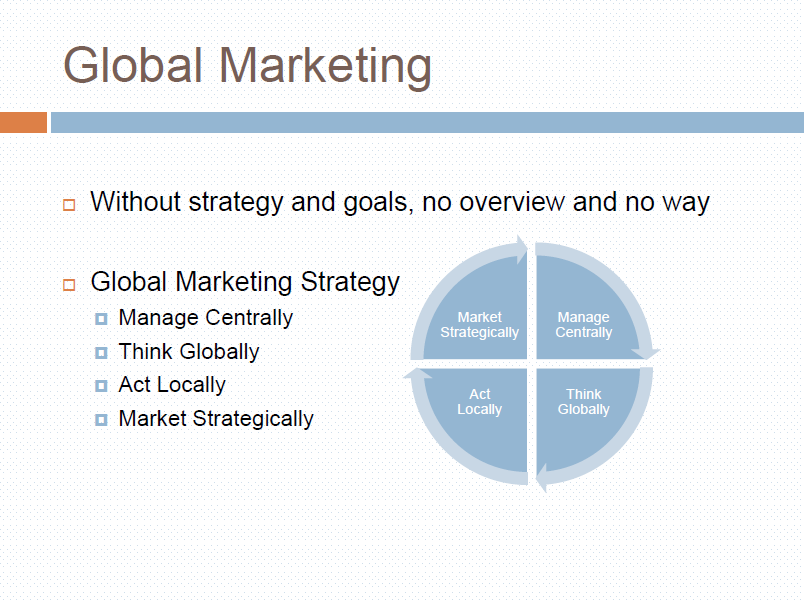
This concept offers a structured approach to successfully mastering the challenges and opportunities of globalization and digitalization. It combines four key elements:
- Centralized control: Clear and unified control of all company activities ensures consistency in the implementation of goals and strategies.
- Think globally: Understanding global trends and economic dynamics is essential to identify international market opportunities early on.
- Act locally: Adapting strategies to the specific needs and cultural conditions of local markets.
- Strategic marketing: Developing targeted marketing campaigns that take into account both global brand identity and local market requirements.
The central elements of the concept in detail
1. Central control
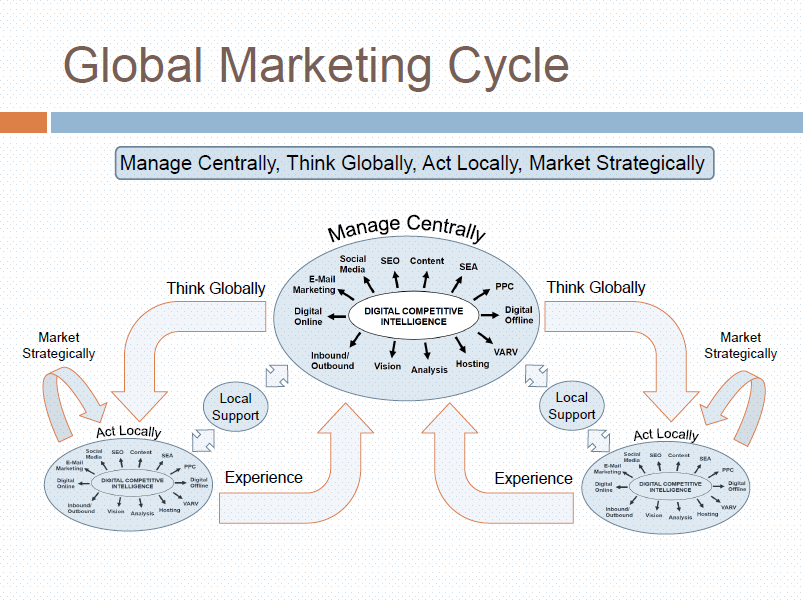
Centralized control ensures coherent and efficient decision-making. The advantages:
- Faster decision-making process, as information is pooled and decisions are made at a central level.
- Uniform implementation of corporate goals across different regions.
- Reduction of inconsistencies in communication and strategy.
2. Think globally
A global perspective is crucial for identifying future trends and potential market opportunities. This includes:
- Understanding of global economic developments and technological advances.
- Consideration of cultural differences that can affect international business relationships.
- Monitoring geopolitical changes to identify risks early and seize opportunities.
3. Act locally
Considering local characteristics is key to success in international markets. Successful companies adapt their strategies to the specific needs and preferences of local target groups by:
- Understanding and respecting cultural nuances.
- Take local consumption habits and legal frameworks into account.
- Develop products and services that meet the needs of local markets.
4. Market strategically
Effective marketing requires a balanced combination of global brand strategy and locally relevant implementation. This includes:
- Precise knowledge of the target group through data analysis and market research.
- Adapting messages and communication channels to the specific characteristics of each market.
- Development of integrated campaigns that take into account both global and local aspects.
The significance of the concept in the modern business world
Today's dynamic and complex business landscape makes a structured and flexible strategy like this essential.
challenges
- Lack of leadership responsibility: Many companies do not have clearly defined roles and responsibilities for developing and implementing strategies.
- Slow response to market changes: Delays in adapting to new market conditions can lead to missed opportunities.
In addition:
- Digital transformation: Many companies struggle to effectively integrate digital technologies and do not utilize the full potential of data analysis and automation.
- Competitive pressure: Global competition requires constant innovation and adaptation to new market conditions.
- Sustainability and ESG: Increasing pressure from consumers and governments to implement sustainable and socially responsible business practices.
Advantages of the concept
- Cultural sensitivity: Promotes trust and credibility of the brand in different markets.
- Regulatory compliance: Helps companies meet legal requirements in different regions.
- Agility and adaptability: Enables a rapid response to market changes and technological developments.
- Market proximity: Local operations ensure that products and services meet the needs of local customers.
- Effective communication: Strategic marketing makes it possible to convey the right message to the target group via the appropriate channels.
Successful implementation: Prerequisites and recommendations for action
The following factors are crucial for the successful implementation of the concept:
- Strong leadership: Leaders must set clear visions and take responsibility.
- Strategic foresight: Long-term planning and anticipation of future market trends are essential.
- Integration of market analyses: Detailed analyses of the target markets and their integration into the corporate strategy.
- Cultural change: Fostering a corporate culture that values openness, adaptability, and innovation.
- Technological investments: Use of modern technologies to support business processes and data analysis.
- Employee development: Training and further education to prepare employees for the demands of global markets.
Examples of measures:
- Establishment of central steering bodies to develop and monitor global strategies.
- Strengthen local teams that are responsible for implementing strategies in their markets.
- Introduce global communication platforms to promote knowledge exchange between regions.
Case study: Successful application of the concept
A multinational technology company successfully implemented this concept. Centralized management enabled the development of global product strategies, while local branches handled adaptation to regional markets. Strategic marketing combined global brand messages with locally relevant content, resulting in increased market share and improved customer loyalty.
Results:
- Increased sales in local markets through better-matched products and services.
- Improved brand perception through consistent yet locally adapted marketing campaigns.
- More efficient processes through centralized control and resource utilization.
A powerful method
The concept of "centrally controlled, globally minded, locally minded, and strategically marketed" is a powerful method for meeting the challenges of globalization and digitalization. Companies that successfully implement this strategy are not only better prepared for the risks but can also benefit from the numerous opportunities that arise in a constantly changing global economy. Through a balanced and flexible approach, they can achieve a sustainable competitive position and secure long-term success.
Key to success:
- Integration: Seamless connection between central guidelines and local implementation.
- Adaptability: Willingness to continuously review and adapt strategies.
- Customer focus: Constant alignment with the needs and expectations of customers, both globally and locally.
By implementing this concept, companies can not only meet the challenges of digitalization but also seize new opportunities. It enables them to remain agile, strengthen their global presence, and simultaneously delve deeply into local markets. This puts them in an ideal position for long-term success and sustainable growth.
Related to this: