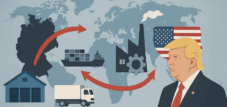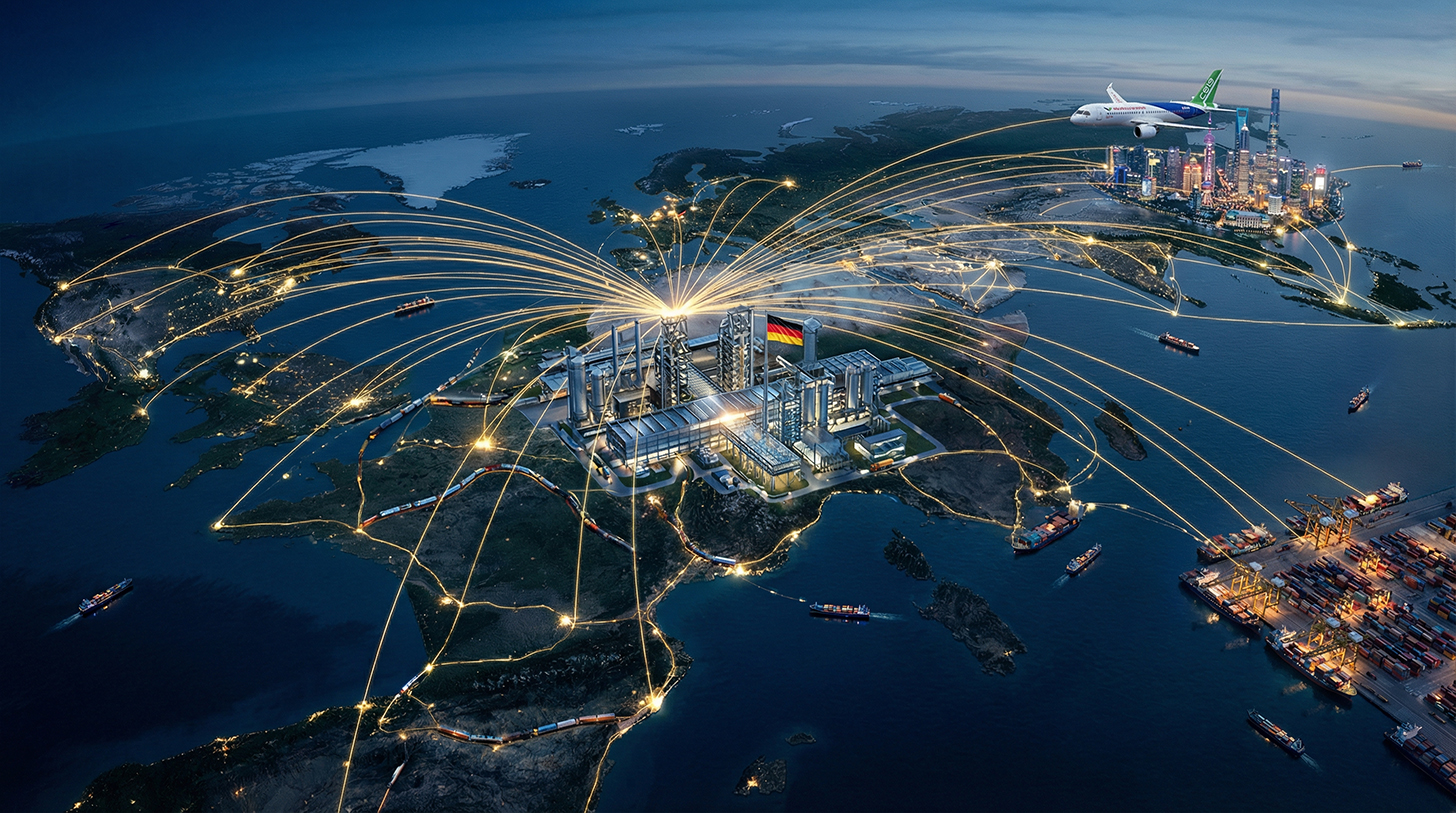
Global supply chains as a life insurance policy – Why Germany's strength lies in networking, not in isolation – Image: Xpert.Digital
The China myth is crumbling: Why Germany's true economic power lies in Europe
The hidden winners: Why German SMEs are much better prepared for the future than previously thought
The global economy is undergoing an unprecedented stress test. Tariffs, geopolitical tensions, and fierce competition from an increasingly self-sufficient economic power like China dominate the headlines. Amidst this turmoil, the call for economic decoupling is growing ever louder. But for an export nation like Germany, this path would be disastrous. The interconnectedness of German companies with the global economy is not a weakness, but rather the foundation of our prosperity. As current data and fascinating practical examples from the aviation industry demonstrate, interdependence in global trade is a strategic tool that also plays into the West's hands. Instead of panicked isolationism, what is needed now is intelligent diversification, technological sovereignty, and a strong SME sector that recognizes the innovative power of Asian markets as an opportunity. Anyone who now takes the chainsaw to global supply chains is sawing off the branch on which millions of German jobs rest.
Related to this:

Those who preach decoupling are sawing off the branch on which millions of jobs sit
Germany is a trading nation, and it is no mere platitude to say that the integration of German companies into the global economy forms the foundation of its prosperity. In the reporting year 2023, 59 percent of German companies with at least 50 employees were integrated into global value chains, totaling 34,641 out of 59,127 companies. Of these, 27,395 companies were involved in international trade in goods and 22,181 in international trade in services. Trade in goods takes place primarily between member states of the European Union, which underscores the importance of EU trade.
But this interconnectedness is under immense pressure. The BDI study from November 2025 paints an alarming picture: 92 percent of companies are experiencing higher resilience costs, and 68 percent are planning to relocate production abroad. Protectionism, tariffs, and geopolitical uncertainty are weighing on industry, and despite recognized risks, a comprehensive transformation is lacking. The supply chains and production processes of most companies are still insufficiently transformed, and not enough lessons have been learned from the Covid-19 pandemic.
The China Equation and its Resolution
In 2025, China once again became Germany's most important trading partner, overtaking the USA for the top spot. However, the balance is increasingly one-sided: Imports from China rose to €170.6 billion, an increase of 8.8 percent, while exports to China fell to €81.3 billion, a decrease of 9.7 percent. The trade surplus with China increased by €22.4 billion to €89.3 billion. German goods exports to China have plummeted by a quarter since 2022, and in the first three quarters of 2025, they were more than 12 percent lower than in the same period of the previous year.
The reasons for this are manifold. Chinese suppliers have caught up in key industries, and state subsidies and an undervalued yuan against the euro are noticeably worsening the sales prospects of German companies. Jürgen Matthes, a foreign trade expert at the German Economic Institute (IW), states that China is increasingly playing unfair games, thereby harming the German export sector by distorting competition with subsidies and an undervalued currency, and by exploiting barriers to domestic sales. Furthermore, German exports are declining because China is striving for greater self-sufficiency and is putting pressure on German companies to increasingly serve the Chinese market through local production and supply rather than exports.
Related to this:

The labor market outlook as a reality check
The impact on the German labor market can now be quantified. At the height of the Chinese export boom in 2021, around 1.1 million jobs depended directly or indirectly on final consumption in China. By 2025, this number had fallen by more than 400,000 to just under 700,000, a decline of approximately 40 percent. The share of jobs dependent on exports to China among all jobs in Germany fell from almost 2.5 percent in 2021 to an estimated 1.5 percent in 2025.
These figures allow for a sober assessment: Even at the height of the export boom, China was not a major driver of employment in Germany. However, this does not mean that the affected industries and regions are not feeling the decline acutely. Exports of motor vehicles and motor vehicle parts to the USA fell by 17.8 percent in 2025, although the United States remained the most important recipient of German exports. Overall, German exports still increased by 0.25 percent between January and September, with Poland, Switzerland, and Spain able to offset a large part of the decline.
The example of aviation shows how interdependence works
The LinkedIn post by Xiaolong Hu, Managing Partner of China-Team GmbH in Hanover and an experienced management consultant with many years of expertise in German-Chinese business, draws attention to an often overlooked detail of global economic interconnectedness: the Chinese aviation industry. Hu, who has worked as a management consultant for 17 years with project experience in Germany and China and possesses in-depth industry knowledge, including in the aviation sector, has been advocating for years that German SMEs recognize China's innovative strength as an opportunity.
The example of the COMAC C919, China's prestige project in aircraft manufacturing, illustrates the complexity of this relationship. The C919 was conceived as the first passenger aircraft entirely designed in China and received certification from the Civil Aviation Administration of China (CAAC) in 2022. Designed to carry 158 to 192 passengers, the aircraft has a range of up to 5,555 kilometers, placing it in direct competition with the Airbus A320 and Boeing 737.
But the apparent triumph of Chinese technology has a crucial Achilles' heel: the C919's production is heavily dependent on Western suppliers and manufacturing licenses. The landing gear system and air intake, including the air conditioning, come from the German company Liebherr, which established a joint venture with the Chinese firm Landing-Gear Advanced Manufacturing in Changsha for the development and production of the landing gear. The CFM LEAP-1C engines are from a joint venture between GE Aerospace and the French company Safran. While the fuselage, wings, and tail of the C919 are of Chinese manufacture, the core flight systems, avionics, and engines are produced by American or European suppliers.
Our EU and German expertise in business development, sales and marketing

Our EU and German expertise in business development, sales and marketing - Image: Xpert.Digital
Industry focus areas: B2B, digitalization (from AI to XR), mechanical engineering, logistics, renewable energies and industry
More information here:
A thematic hub offering insights and expertise:
- Knowledge platform covering global and regional economies, innovation and industry-specific trends
- A collection of analyses, insights, and background information from our key areas of focus
- A place for expertise and information on current developments in business and technology
- A hub for companies seeking information on markets, digitalization, and industry innovations
The unsung champions: Why small and medium-sized enterprises (SMEs) are better able to cope with the globalization crisis
Technological dependence as strategic capital
The vulnerability of this arrangement became painfully clear in 2025. In May, Washington halted export licenses for key components, including the LEAP-1C engines and parts from Parker and Honeywell. Production of the C919 came to a standstill. It wasn't until July that US authorities lifted the restrictions. The consequence was dramatic: instead of the originally targeted 75 deliveries, COMAC was only able to deliver around 25 C919s to customers in 2025, a reduction of two-thirds.
This example illustrates two things. First, China's technological dependence on Western suppliers remains significant in strategic industrial sectors. The C919 cannot fly without parts from Europe. Second, this dependence is not a one-sided risk, but rather a two-way power dynamic. For Liebherr, GE, and Safran, participation in the C919 program means billions in revenue and access to by far the fastest-growing aviation market in the world.
It cannot be assumed that the foreign companies contributed their best technology to adequately protect themselves. China is working intensively on its own engines, but technological independence in aviation is still many years away. Although Comac has built up engine stockpiles for about two years, in the long term the project remains dependent on foreign suppliers.
Related to this:
Diversification instead of derisking is the best approach
The lesson from these developments is not that German companies should withdraw from global supply chains. On the contrary: the companies that are best navigating the current turbulence are those that are actively diversifying. Half of the companies intend to further diversify their procurement in the future through multisourcing in order to achieve greater independence and increased resilience. Geographic diversification strategies such as nearshoring in Europe, local and regional sourcing, friendshoring, and reshoring back to Europe are gaining in importance.
Due to increased protectionism and new tariffs, companies are planning to relocate their production even more extensively than two years ago, with the main target regions being the USA, Eastern Europe, and again parts of Asia. Significantly more than in 2023, not only production but also pre-assembly and final assembly are being relocated, and even central corporate functions as well as research and development are increasingly moving elsewhere.
At the same time, Europe remains the anchor of stability. Trading partners in Europe now account for almost 70 percent of German exports. The growing importance of intra-European trade relations shows that diversification is already taking place, albeit less spectacularly than the media debate surrounding China and the USA suggests.
US tariff policy as a catalyst for reorganization
US trade policy under President Trump has plunged transatlantic economic relations into a new era of uncertainty. Tariffs of up to 50 percent are specifically targeting key sectors of the German export economy, such as the automotive and mechanical engineering industries. This creates a strategic dilemma for Germany's heavily export-oriented economy: How can it retain its most important non-European market without losing its competitiveness under the burden of tariffs? (Note: The period has been changed to a correct question mark here.)
Many German companies are reacting pragmatically: they are investing more heavily in production sites in the USA to circumvent tariffs, while simultaneously investing in more cost-effective locations in Eastern Europe to secure margins. This dual strategy is expensive in the short term, but vital for long-term survival. However, safe havens have diminished, making clear cost-benefit analyses necessary for risk reduction.
Digital early warning systems and AI-supported planning
The technological answer to the increased complexity of global supply chains lies in digitalization. Companies should strategically implement digital early warning systems and AI-supported planning to increase resilience. IT infrastructure and data quality must be improved as a basis for using AI in the supply chain, and cybersecurity must be expanded as part of the supply chain strategy.
Thinking in terms of crisis scenarios is no longer the exception, but an integral part of daily decision-making. Comprehensive monitoring and risk assessment in the supply chain are necessary to react more quickly to the impact of new tariffs and other disruptions. Strategic partnerships and collaborations are just as important for making production capacities more flexible as further digitalization and automation in cost-intensive locations like Germany.
The underestimated strength of German companies
However, there is no reason to panic. Many German companies are still making good money in Germany; industrial profits rose significantly faster than wages in 2023, and German stock indices are at record highs. The relocation of production abroad is not in itself an indication of a weak business location, as the example of the major automotive companies shows. These companies have secured car production in Germany precisely by diversifying their supply networks and developing foreign markets through local production facilities.
What Germany needs, however, is an industrial strategy that specifically addresses the pressing problems. Blanket energy price subsidies or general tax breaks are the wrong approach. The reduction of trade barriers within the EU single market must be accelerated in order to better utilize Europe's potential.
The middle class as the secret champion of globalization
Germany's small and medium-sized enterprises (SMEs), those companies with 50 to 500 employees that form the backbone of the German economy, are paradoxically often better equipped for the current situation than large corporations. SMEs are more flexible in their decision-making structures, often have deeper and more personal relationships with their international partners, and can react more quickly to changing conditions. Of the companies involved in international trade in 2023, almost half purchased raw materials for further processing from abroad, and another 40 percent sourced intermediate products.
The work of consultants like Xiaolong Hu, whose China-Team GmbH in Hanover specifically helps medium-sized companies develop their China strategy and gain insights into China's innovative strength and dynamism, highlights an important aspect: The relationship between German SMEs and Asian markets is not a one-way street. Previously, entrepreneurs went to China to sell products. Today, they can gather a wealth of inspiration there for innovations, new products, and the development of their own company, even in their home market.
The future lies in intelligent networking
The message is clear: Strong German companies with global supply chains are not the problem, but the solution for securing jobs and value creation in Germany. Unbundling global value chains would not strengthen, but rather weaken Germany's position as a business location. The right strategy is to intelligently manage interconnectedness, diversify dependencies, and defend Germany's leading technological position in critical areas.
The C919 example clearly demonstrates that technological sovereignty is not a one-way street. As long as Western companies master key technologies that China cannot replace in the short term, their negotiating position remains strong. Maintaining this position, however, requires massive investments in research and development, in training skilled workers, and in modernizing domestic production infrastructure. Those who advocate decoupling are sawing off the branch on which millions of jobs depend. Those who cultivate intelligent networking are building a branch that will withstand even the next storm.
Your global marketing and business development partner
☑️ Our business language is English or German
☑️ NEW: Correspondence in your native language!

Konrad Wolfenstein
I and my team are happy to be available to you as your personal advisor.
You can contact me by filling out the contact form here wolfenstein@xpert.digital:or simply call me at +49 7348 4088 965. My email address is
I'm looking forward to our joint project.
☑️ SME support in strategy, consulting, planning and implementation
☑️ Creation or realignment of the digital strategy and digitization
☑️ Expansion and optimization of international sales processes
☑️ Global & Digital B2B trading platforms
☑️ Pioneer Business Development / Marketing / PR / Trade Fairs
🎯🎯🎯 Benefit from Xpert.Digital's extensive, five-fold expertise in one comprehensive service package | BD, R&D, XR, PR & Digital Visibility Optimization
Benefit from Xpert.Digital's extensive, five-fold expertise in a comprehensive service package | R&D, XR, PR & Digital Visibility Optimization - Image: Xpert.Digital
Xpert.Digital possesses in-depth knowledge across various industries. This allows us to develop tailored strategies precisely aligned with the requirements and challenges of your specific market segment. By continuously analyzing market trends and monitoring industry developments, we can act proactively and offer innovative solutions. The combination of experience and expertise generates added value and provides our clients with a decisive competitive advantage.
More information here: