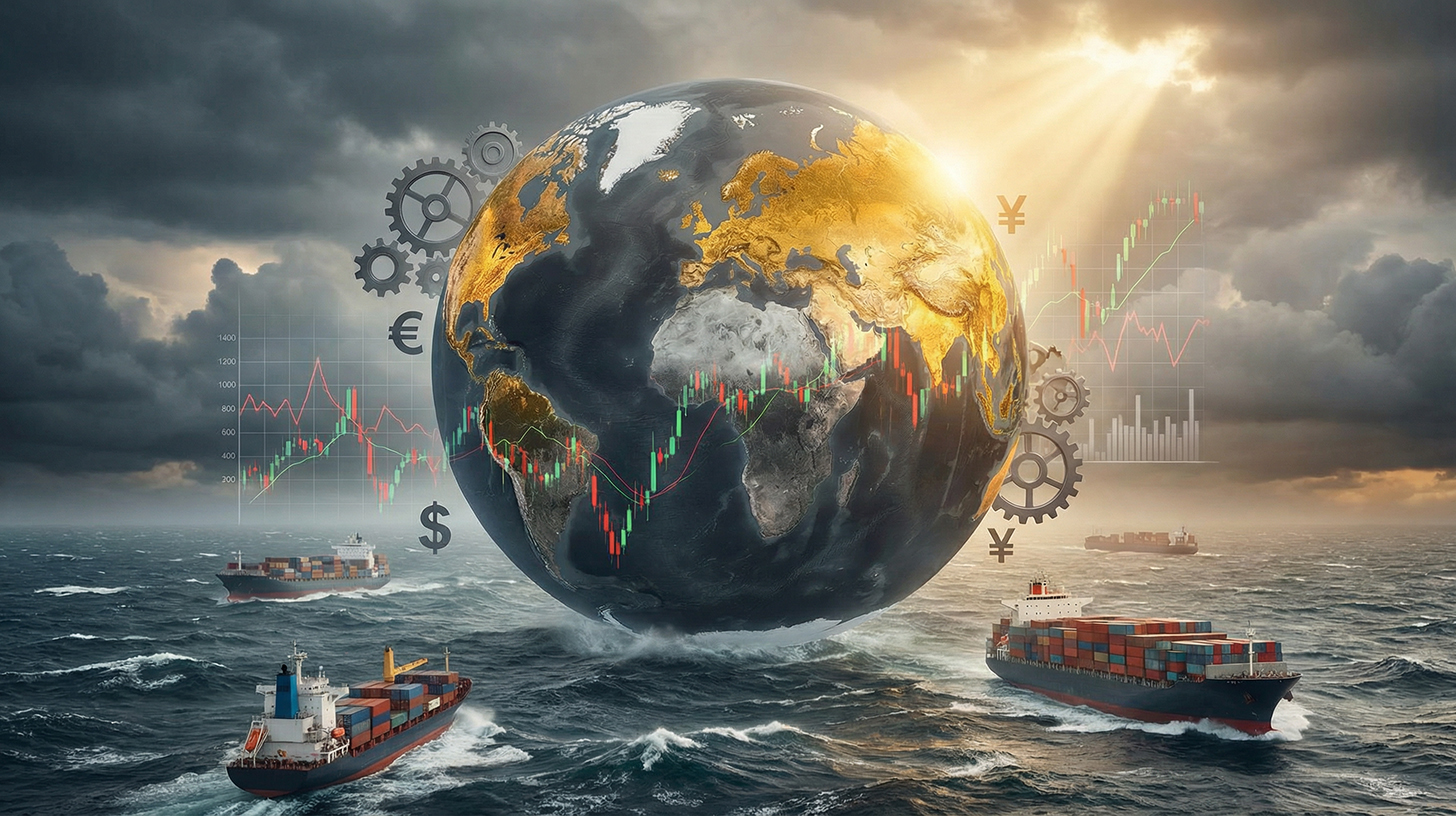
Is the global economy on the verge of collapse? The low point has not yet been reached, but the downturn remains manageable if policymakers do not fail – Image: Xpert.Digital
The world at a crossroads: Between tenacious resilience and the harbingers of a new crisis
IMF sounds the alarm: The invisible risks to the global economy in 2026
In the spring of 2026, the global economy resembles a powder keg with the fuse already lit. While markets demonstrate remarkable resilience thanks to an unprecedented AI boom and increasingly loose monetary policy, this apparent calm is deceptive. In reality, the delayed shockwaves of an unprecedented global trade war, the persistent structural weakness of European industry, and a highly dangerous geopolitical escalation in the Middle East threaten to finally shatter the already fragile balance. Are international supply chains and financial markets robust enough to withstand these extreme stress tests, or are we on the verge of an uncontrolled collapse? This in-depth analysis illuminates the greatest downside risks of 2026 and reveals why the anticipated economic trough is far from being reached.
Despite the trade war: How artificial intelligence can now prevent the global recession
In the spring of 2026, the global economy will be navigating a field of tension that is almost unprecedented in its complexity. On the one hand, there is a remarkable resilience that has repeatedly silenced the pessimists of recent years. On the other hand, downside risks are accumulating in a way that is worrying even seasoned economists. The International Monetary Fund forecasts global growth of 3.3 percent for 2026, revising its October forecast upward by 0.2 percentage points. But behind this reassuring-sounding figure lie tectonic shifts that are shaking the foundations of the international economic order.
The bill for the trade war
The year 2025 was turbulent, marked by Donald Trump's unpredictable trade policies. The Liberation Day announced in April 2025 triggered massive uncertainty, and many economists feared higher inflation rates and an economic slowdown, even a recession. They were wrong, at least in the short term. The global economy once again proved its resilience, growing by 3.2 to 3.3 percent in 2025. But the price has merely been postponed, not eliminated.
The average US tariff has risen from 2.5 percent to 17.9 percent since Trump's return to the White House in January 2025, the highest rate since 1934, according to calculations by Yale University's Budget Lab. Global trade in goods and services is expected to slow from 2 percent in 2025 to just 0.6 percent in 2026 due to the delayed effects of this trade war—a decline of roughly two-thirds. Only in 2027 is a slight recovery projected, with growth expected to reach 1.8 percent.
2025 was characterized by advance deliveries and American stockpiling, shifts in trade flows, and significant investments in artificial intelligence. This supported global trade. However, the consequences of the trade war are likely to follow in 2026, with a significant decline in growth. The UN Economic Commission confirms this assessment: Global economic growth will be significantly lower at 2.7 percent, well below the pre-pandemic average of 3.2 percent, with the prospect that the global economy could enter a permanently slower growth trajectory.
The major economic blocs under pressure
Despite its own tariff policies, the United States remains the fastest-growing economy among the G7 nations. The IMF forecasts growth of 2.4 percent for 2026, following an estimated 2.2 percent in the previous year. AI investments and technological innovation serve as an important buffer for growth. Nevertheless, growth rates are below average compared to historical averages and fall short of the US economy's potential. In 2026, the tariffs are expected to gradually impact consumer prices and dampen consumption, mitigated by lower interest rates and further fiscal stimulus.
China faces a significantly more complex challenge. The IMF forecasts growth of 4.5 percent for 2026, supported by tariff reductions on Chinese goods and efforts to redirect exports to Southeast Asia and Europe. However, the housing crisis persists, the government's anti-involution campaign is accelerating the consolidation of overcapacity sectors such as steel, cement, and solar panels, and the contribution of net exports to GDP is expected to decline. For Russia, the IMF anticipates only very weak growth of 0.8 percent, as the war-related special effects of arms production and state-stimulated consumption fade, and sanctions and labor shortages increasingly dampen investment and productivity.
The eurozone is barely moving forward. The IMF forecasts growth of 1.3 percent, with Germany, at 1.1 percent, remaining below the average. Spain stands out as a positive outlier with a forecast of 2.3 percent. Germany is suffering from structural obstacles that are slowing exports and industrial production, although higher military spending and public investment are acting as moderate countermeasures.
Our global industry and economic expertise in business development, sales and marketing

Our global industry and economic expertise in business development, sales and marketing - Image: Xpert.Digital
Industry focus areas: B2B, digitalization (from AI to XR), mechanical engineering, logistics, renewable energies and industry
More information here:
A thematic hub offering insights and expertise:
- Knowledge platform covering global and regional economies, innovation and industry-specific trends
- A collection of analyses, insights, and background information from our key areas of focus
- A place for expertise and information on current developments in business and technology
- A hub for companies seeking information on markets, digitalization, and industry innovations
Has the bottom been reached? Why the answer to the most important economic question is so complicated
The risk map of 2026
The World Economic Forum's Global Risks Report 2026 identifies geoeconomic confrontation as the greatest global risk. Economic risks are increasing most sharply in the short term, with both the threat of recession and the risk of inflation rising eight places compared to the previous year. Fears about the disruptive effects of artificial intelligence are also growing, while environmental risks are becoming less urgent in the short term, though they do not disappear entirely.
Munich Re warns in its Economic Outlook 2026 that, overall, downside risks outweigh potential scenarios of better-than-expected performance. Geopolitical risks and abrupt US policy decisions with consequences for the economy and international trade could negatively impact global economic development. Furthermore, sharp rises in stock markets have heightened concerns that a potential overvaluation of technology stocks in the wake of the AI boom could lead to financial market crashes.
Allianz Trade identifies four specific downside risks: further tariff escalation, a de-dollarization shock in US monetary policy with a probability of 35 percent, a sovereign debt crisis with a probability of 20 percent that could restrict fiscal policy in France, Italy, the UK and the US, and a further increase in geopolitical tensions, particularly in the event of a conflict between NATO and Russia, an escalation in the Middle East and an open conflict between China and Taiwan.
The new war and its economic consequences
The US-Israeli attacks on Iran, which began on February 28, 2026, have opened up an entirely new dimension of geopolitical uncertainty. Iran's retaliatory attacks on the Gulf states are striking at the nerve centers of global oil trade and international finance. For metropolises like Doha, Dubai, and Manama, even limited attacks on hotels, airports, and industrial areas are a catastrophe that threatens their reputation, built up over decades, as safe business and tourism hubs. The price of oil is already reacting with significant fluctuations, and financial markets are under pressure.
This conflict strikes the global economy at a moment of vulnerability. The US economy was just beginning to recover from the fallout of its own trade war. Europe is grappling with stagnation and military spending. China is struggling with a housing crisis and overcapacity. The escalation in the Middle East adds another variable to an already fragile equation, the full extent of which is not yet clear.
The paradoxical role of artificial intelligence
Paradoxically, the AI boom is proving to be a stabilizing factor. The IMF explicitly attributes its upward revision of its global growth forecast to investments in new technologies such as artificial intelligence. The global economy has shaken off the trade and tariff disruptions of 2025, thanks in part to the technology boom. But risks lurk here as well. At an ACCA event, renowned economist Kenneth Rogoff warned that the enormous uncertainty is not reflected in the financial markets. He predicted a major stock market crash sometime in the next three years, but conceded that the market could still rise significantly before the crash.
Has the lowest point been reached?
The question of whether the low point of global economic development has been reached cannot be answered with a simple yes or no. The data paints a nuanced picture. On the positive side are the resilience of the global economy despite extreme pressures, the loose monetary policy in most major economies, and the AI-driven investment boom. On the negative side are the dramatic slowdown in world trade, escalating geopolitical conflicts, high levels of public debt, and the latent threat of a correction in overvalued technology markets.
The most likely scenario is one that ACCA Chief Economist Jonathan Ashworth describes as steady but fragile growth. The global economy will grow by just over three percent, supported by loose monetary policy, fiscal stimulus, and the AI boom. But it is a fragile environment in which heightened geopolitical tensions, trade fragmentation, rising public debt, and highly valued financial markets make the global economy vulnerable to shocks. Industrialized nations are facing their lowest growth rates since 2008. The bottom has not yet been reached, but an uncontrolled collapse is also not the most likely scenario. The global economy is in a fragile equilibrium that can be disrupted at any time by any of the numerous geopolitical flashpoints. The next few months will be crucial, particularly the development of the conflict with Iran, the outcome of the US tariff dispute before the Supreme Court, and the ability of central banks to navigate between fighting inflation and supporting growth.
Your global marketing and business development partner
☑️ Our business language is English or German
☑️ NEW: Correspondence in your native language!

Konrad Wolfenstein
I and my team are happy to be available to you as your personal advisor.
You can contact me by filling out the contact form here wolfenstein@xpert.digital:or simply call me at +49 7348 4088 965. My email address is
I'm looking forward to our joint project.
☑️ SME support in strategy, consulting, planning and implementation
☑️ Creation or realignment of the digital strategy and digitization
☑️ Expansion and optimization of international sales processes
☑️ Global & Digital B2B trading platforms
☑️ Pioneer Business Development / Marketing / PR / Trade Fairs
🎯🎯🎯 Benefit from Xpert.Digital's extensive, five-fold expertise in one comprehensive service package | BD, R&D, XR, PR & Digital Visibility Optimization
Benefit from Xpert.Digital's extensive, five-fold expertise in a comprehensive service package | R&D, XR, PR & Digital Visibility Optimization - Image: Xpert.Digital
Xpert.Digital possesses in-depth knowledge across various industries. This allows us to develop tailored strategies precisely aligned with the requirements and challenges of your specific market segment. By continuously analyzing market trends and monitoring industry developments, we can act proactively and offer innovative solutions. The combination of experience and expertise generates added value and provides our clients with a decisive competitive advantage.
More information here: