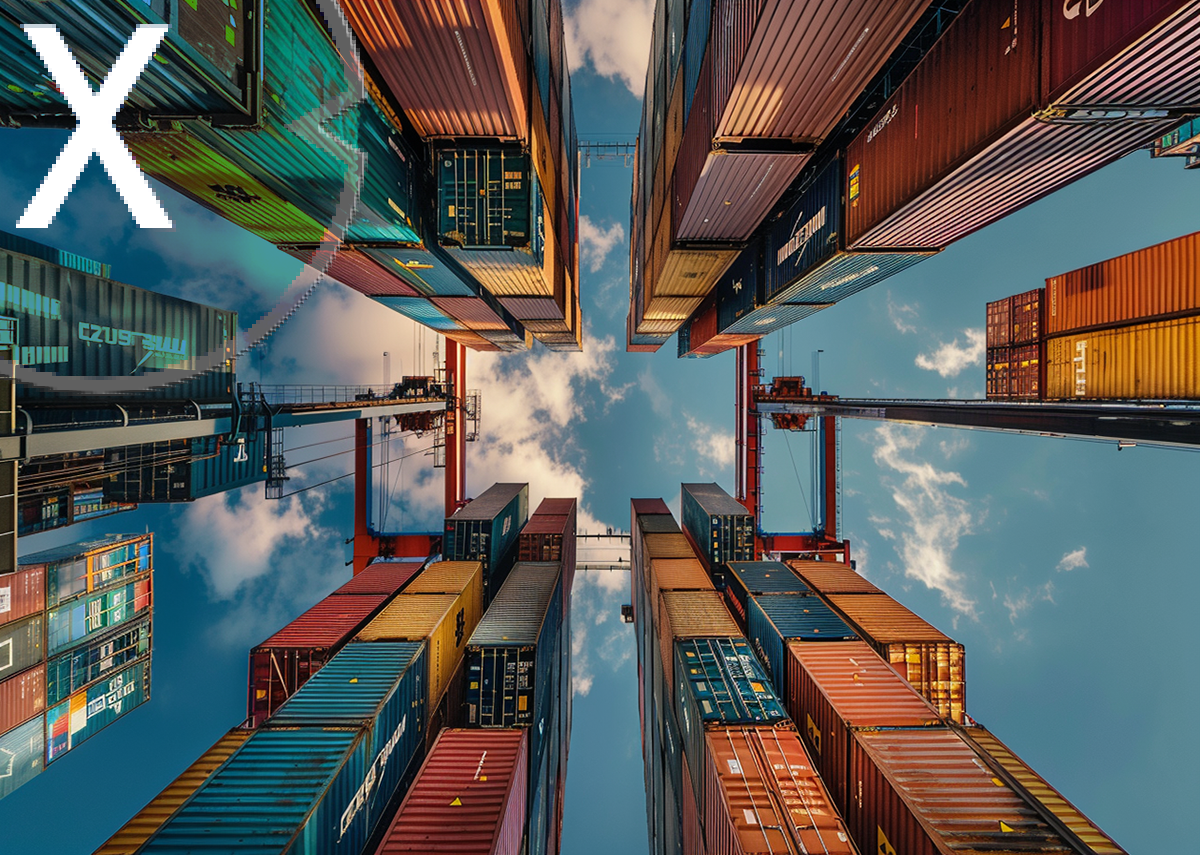
Digitalization is the infrastructure for the global economy and exports at the same time – Image: Xpert.Digital
🌐🔄 Political missteps and the opportunities of digitalization for SMEs
🔎 Current situation in Germany
Political missteps, often driven by ideologies, are areas where small and medium-sized enterprises (SMEs) have limited opportunities to exert influence. However, one sector that offers these companies wide open doors and enormous opportunities is digitalization. In this respect, Germany currently ranks in the middle of the pack in Europe, which also leaves room for improvement and further development.
Related to this:
🚀 Digitalization as an economic engine
Digitalization is far more than a buzzword; it is the infrastructure and foundation of global economic success and also plays a central role in exports. For SMEs, this opens up a field with immense untapped potential. By strategically using and developing digital opportunities, these companies can not only keep pace but also strengthen their market position and even develop and expand competitive advantages.
🔍 Germany as an export nation and digitalization
Let's start with the current situation: Germany is traditionally known as an export nation, but in terms of digitalization, it occupies a middle position in a European comparison. This shows that there is a need for action in the area of digital innovation and structures. Digitalization should be understood as an essential component of corporate strategy, as it has the potential to revolutionize business models and open up new markets.
🏭 SMEs as drivers of innovation
SMEs make up the majority of German companies and are often described as the 'engine of innovation' in the economy. They are generally faster and more flexible than large corporations and can therefore adapt more quickly to new technologies. However, they also face particular challenges: limited resources, less specialization in IT and digitalization, and a tendency towards less market power compared to large players.
Related to this:
💡 Digitalization as an opportunity for SMEs
Digitalization offers SMEs the opportunity to meet these challenges. Tools for increasing productivity, market research and customer acquisition, as well as platforms for exchanging information with other companies and for better visibility in international markets are just a few examples of the potential of digitalization.
🌐 Optimizing internal processes
Another benefit of digitalization lies in the optimization of internal processes. Cloud solutions enable SMEs to securely store data and access it from anywhere. Communication tools promote collaboration within teams and with external partners, even across national borders. Intelligent software can help automate processes, increase efficiency, and reduce costs.
🏭 Technologies in production
In the production sector, for example, Industry 4.0 technologies can be used to make manufacturing processes smarter and more flexible. By linking physical and digital systems, production processes can be optimized in real time and adapted to changing market demands.
📈 Digital customer access and marketing
Another key aspect is customer access. Digitalization enables SMEs to enter online markets and make their products and services accessible to a wider audience. They can use digital channels to interact with customers, conduct personalized marketing, and improve the buyer experience.
🔒 IT security for SMEs
Information technology security is of crucial importance because SMEs are increasingly becoming targets of cyberattacks. Robust IT security protects not only company data but also customer trust.
💼 Rethinking and investing in digital skills
However, digitalization also requires a change of mindset for SMEs. It is important that they are prepared to adapt their business models and invest in digital skills. This includes both technological infrastructure and the further training of employees.
📚 Further education and qualification
Continuing education and training of the workforce are essential to ensure competitiveness. Employees must learn to handle new technologies and use them effectively in their work processes.
💡 Strategic importance of digitalization
The commitment to digitalization is not merely a reaction to competition, but should be understood as a strategic goal for securing future viability and opening up new markets. SMEs that adopt digital technologies early on can enjoy first-mover advantages and thus maintain and expand their market position.
🏡 SMEs in rural regions
Furthermore, SMEs play a key role in rural regions. Through digitalization, they can create jobs and contribute to strengthening the regional economy. They can help reduce the digital divide between urban and rural areas and thus contribute to balanced economic growth.
🤝 Collaboration for digital transformation
Close cooperation between policymakers, educational institutions, and business associations is necessary to improve the framework for the digital transformation of SMEs. This involves creating an innovation-friendly climate with appropriate funding programs to support SMEs in their digitalization efforts.
🔍 Opportunity of Digitalization
While the challenges of digitalization and global integration for SMEs are significant, the opportunities far outweigh them. Targeted and strategically sound digitalization enables SMEs to tap into new market potential, better meet customer needs, and remain competitive in the long term. It is these small and medium-sized enterprises that, through their innovative strength and flexibility, can shape and drive the economy – and are thus a crucial engine for economic growth in Germany and Europe.
📣 Similar topics
- 🚀 Digitalization opportunities for SMEs: How they can master digital transformation
- 🌐 SMEs as an “engine of innovation”: The central role of digitalization
- 🔧 Germany in the digital middle ground: Action needed regarding digital innovations
- 🛠️ Challenges and potential: SMEs and digitalization options
- ☁️ Cloud technology and international networking: Digital added value for SMEs
- 🏭 Industry 4.0: A revolution in manufacturing for German SMEs
- 🛍️ Conquering online marketplaces: Digital customer access for SMEs
- 🔒 IT security: An investment in the future of SMEs
- 🎓 Strengthening skills: Further training as the key to digital competence
- 🏡 SMEs in rural regions: Digitalization as a growth engine
#️⃣ Hashtags: #DigitalizationSMEs #InnovationEngine #Industry40 #ITSecurity #DigitalEducation
🎯🎯🎯 Benefit from Xpert.Digital's extensive, five-fold expertise in one comprehensive service package | BD, R&D, XR, PR & Digital Visibility Optimization


Benefit from Xpert.Digital's extensive, five-fold expertise in a comprehensive service package | R&D, XR, PR & Digital Visibility Optimization - Image: Xpert.Digital
Xpert.Digital possesses in-depth knowledge across various industries. This allows us to develop tailored strategies precisely aligned with the requirements and challenges of your specific market segment. By continuously analyzing market trends and monitoring industry developments, we can act proactively and offer innovative solutions. The combination of experience and expertise generates added value and provides our clients with a decisive competitive advantage.
More information here:
🔍 Digitalization is fundamentally reshaping the foundations of the European economy and society
📈📊 Level of digitalization in EU countries according to the DESI index 2022
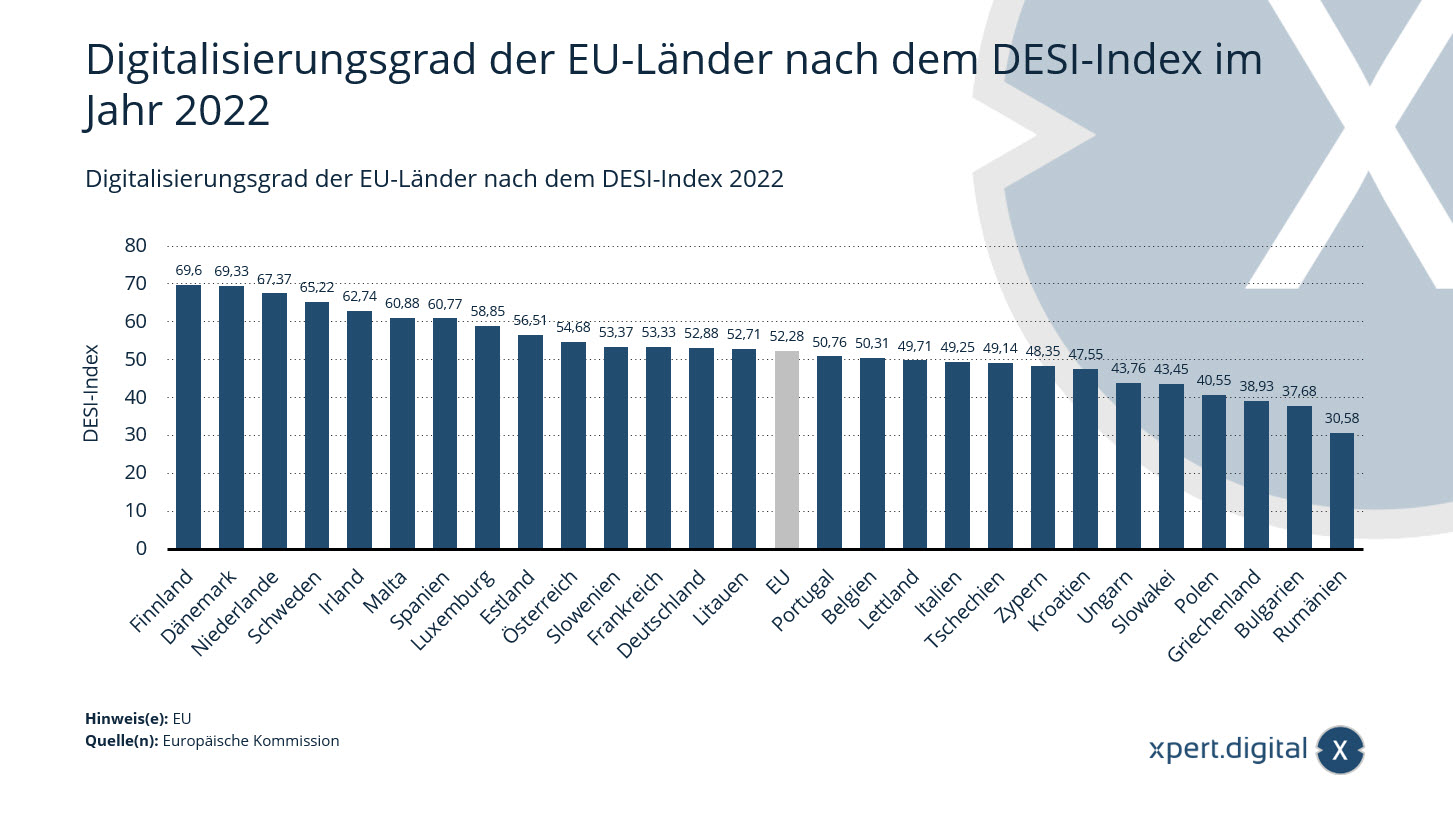
Level of digitalization in EU countries according to the DESI index 2022 – Image: Xpert.Digital
⚙️ The five dimensions of the DESI index
What this means for Germany becomes particularly clear when looking at the DESI index – a European Commission tool that annually measures and compares the digital progress of member states. In 2022, Germany achieved an index score of 52.9, placing it in the middle of the EU rankings. Leading countries like Finland and Denmark, however, demonstrate the high level of achievement that is already attainable.
🌐 Connectivity in Germany
The core of the DESI index consists of five dimensions: connectivity, digital skills, internet use by individuals, integration of digital technology by businesses, and digital public services. These areas are essential for mapping and evaluating the transformation processes in a modern society. Germany shows both strengths and weaknesses in these categories.
💡 Digital skills
Connectivity in Germany has made remarkable progress. Over 65 million people use the internet, and nearly 90 percent of households have a broadband connection. However, the speed and availability of broadband, as well as the expansion of the ultra-fast fiber optic network and 5G technology, present a major challenge. International comparisons indicate that there is a significant need to catch up in these areas.
👩🎓 Society and Education in the Digital Age
Digital skills are another pillar of the digital society. Germany is investing in the digital education and training of its population. Schools are being equipped with digital devices and curricula are being adapted to prepare children and young people for a digital future. But studies also show room for improvement here – both in the practical application of digital skills and in lifelong learning.
🌐 Internet usage of the population
The picture is quite positive regarding internet usage by private individuals, as a large proportion of the German population is actively online. Nevertheless, wider use of e-government services or e-health services could further improve quality of life and simplify processes.
🏭 Business digitalization
When it comes to integrating digital technology, companies are both leaders and laggards. Large corporations and startups are often already well-digitized, but small and medium-sized enterprises (SMEs) in particular are lagging behind. This is especially critical, as these companies form the backbone of the German economy.
🏛️ Digital services of the public sector
Germany is making progress with digital public services. The introduction of digital administration and services such as electronic records management and digital government processes is advancing. However, there is still a long way to go before a comprehensive and user-friendly system is available nationwide.
♻️ Opportunities and risks of digitalization
However, it's crucial not to overlook the fact that digitalization presents both opportunities and challenges. From an economic perspective, it holds the potential for innovation, competitiveness, and ecological sustainability. Digital services make mobility more flexible, and the climate benefits from intelligent energy efficiency solutions. Education can be enriched and made more accessible through digital media and methods.
🚧 Career change and cybersecurity
However, digital transformation is not without its drawbacks. The automation and digitization of work processes threaten traditional jobs and pose existential challenges for certain professions. This necessitates a society that is prepared for professional change and provides the necessary support for retraining and further education.
🔒 The importance of cybersecurity in the digital age
Another crucial aspect of the digital age is cybersecurity. With increasing connectivity, the risk of cyberattacks also rises. Germany, like many other countries, must continue to invest in this area to protect critical infrastructure and guarantee the privacy of its citizens.
🛣️ Future prospects of digital transformation in Germany
Germany has already laid many foundations on its path to a digital future, but significant steps remain. Politicians, businesses, and every individual are called upon to actively shape this transformation. Digitalization should not be viewed merely as a technical process, but as a comprehensive societal development that heralds a new era. The future will show how quickly and successfully Germany will overcome these challenges.
📣 Similar topics
- 1️⃣ 🌐 GERMANY IN DIGITAL TRANSFORMATION: Challenges & Opportunities
- 2️⃣ 📶 DESI-INDEX: An EU comparison of digital connectivity
- 3️⃣ 🎓 INVESTMENT IN THE FUTURE: Germany's path to digital competence
- 4️⃣ 🏡 BROADBAND & FIBER OPTIC EXPANSION: Germany's infrastructure in EU comparison
- 5️⃣ 💡 INNOVATION THROUGH DIGITALIZATION: New opportunities for Germany's economy
- 6️⃣ 📚 EDUCATION IN THE DIGITAL AGE: Adapting curricula and equipment in schools
- 7️⃣ 👥 INDIVIDUAL INTERNET USAGE: Online Behavior in Germany
- 8️⃣ 🏢 SMEs AND DIGITAL TRANSFORMATION: Challenges for the backbone of the German economy
- 9️⃣ 📱 PUBLIC SERVICES: The progress of digital administration in Germany
- 🔟 🛡️ CYBERSECURITY: The key to protection in digital Germany
#️⃣ Hashtags: #Digitalization #DigitalGermany #DESIIndex #DigitalEducation #DigitalInfrastructure
📈📊 Learn more ➡️ Figures: Digitalization level of EU countries according to the DESI index 2022
With an index score of 52.9, Germany ranked in the middle of the pack among EU countries in the 2022 European comparison of the digital economy and society. The Scandinavian countries of Finland and Denmark led the rankings. The European Commission publishes the Digital Economy and Society Index (DESI) annually, which tracks the progress of member states in five key areas
Level of digitalization in EU countries according to the DESI index
- Finland – 69.60
- Denmark – 69.33
- Netherlands – 67.37
- Sweden – 65.22
- Ireland – 62.74
- Malta – 60.88
- Spain – 60.77
- Luxembourg – 58.85
- Estonia – 56.51
- Austria – 54.68
- Slovenia – 53.37
- France – 53.33
- Germany – 52.88
- Lithuania – 52.71
- EU – 52.28
- Portugal – 50.76
- Belgium – 50.31
- Latvia – 49.71
- Italy – 49.25
- Czech Republic – 49.14
- Cyprus – 48.35
- Croatia – 47.55
- Hungary – 43.76
- Slovakia – 43.45
- Poland – 40.55
- Greece – 38.93
- Bulgaria – 37.68
- Romania – 30.58
🌐 The digital age and Europe's economy 🛠️
📈📊 Level of digitalization in EU countries according to the Digital Economy and Society Index (DESI)
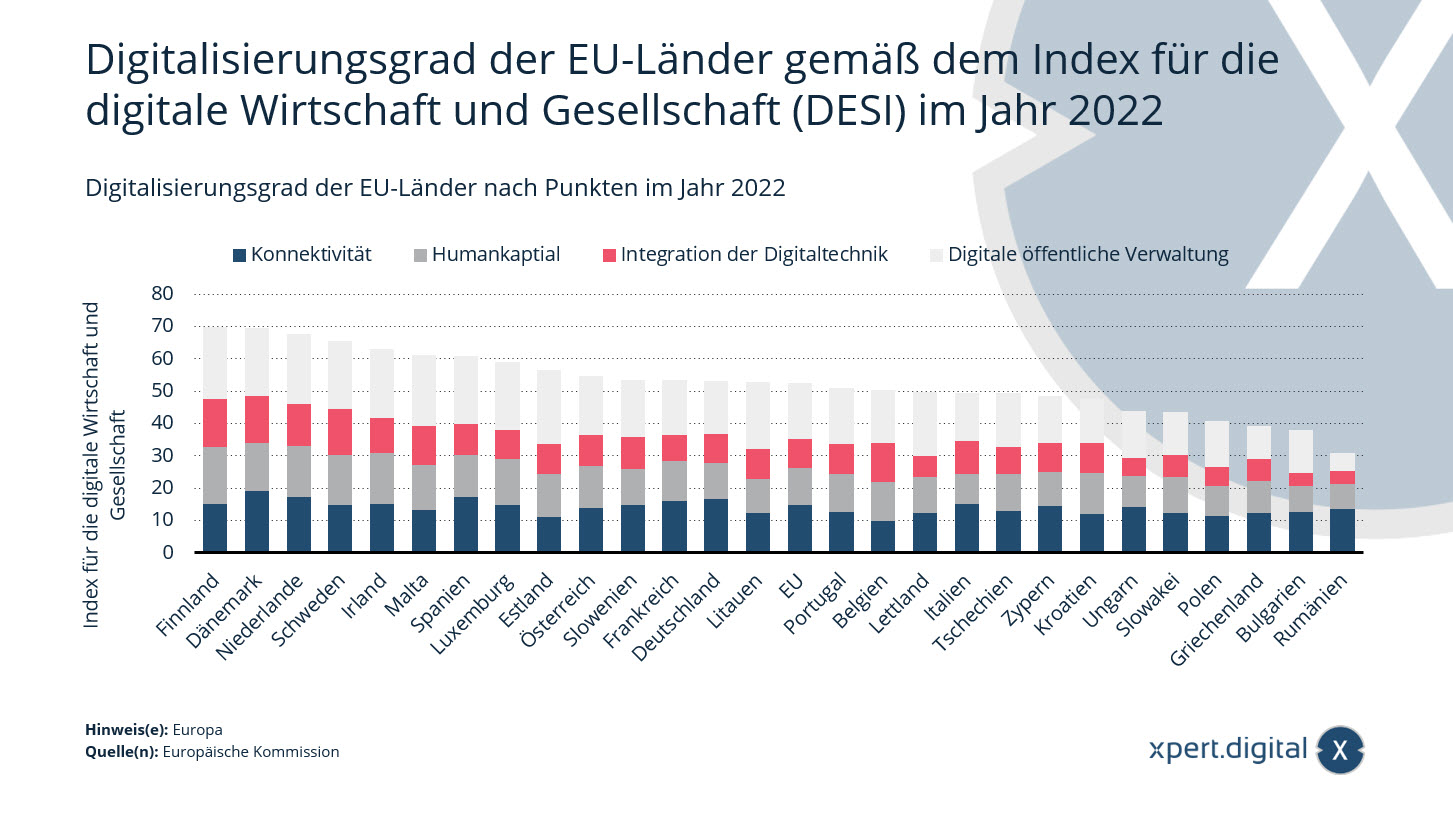
Level of digitalization in EU countries according to the Digital Economy and Society Index (DESI) – Image: Xpert.Digital
🌐 The Digital Age and the European Union
The digital age is increasingly shaping European societies and their economies, although the degree of digitalization varies from country to country. The European Union, as an association of member states with the aim of creating an ever closer union, is intensively engaged with digital development and transformation in order to improve the competitiveness and quality of life of its citizens.
🔍 Digital Economy and Society Index (DESI)
One of the key instruments for measuring and comparing digital progress is the Digital Economy and Society Index (DESI), an index that aggregates important indicators of Europe's digital performance. The DESI provides insights into the overall development of EU member states across five key dimensions: connectivity, human capital, integration of digital technology, digital public services, and internet use by individuals and businesses.
📊 DESI ranking and Germany
In 2022, the DESI revealed the varying levels of digital preparedness among EU countries. Germany, for example, achieved 52.9 points that year, placing it 13th in the European comparison. This position highlights the country's progress in digital transformation, but also indicates that there is still considerable room for improvement, particularly compared to leading Scandinavian nations such as Finland and Denmark.
💡 Digital pioneers Scandinavia
The Scandinavian countries, often seen as beacons of digitalization in Europe, are characterized by a combination of high investments in digital infrastructure, a strong focus on information technology education, and the deep integration of digital services into public administration. Their top rankings in the DESI reflect the success of these approaches.
🔎 Detailed look at DESI
📡 Connectivity
Connectivity, as the first dimension, measures the extent and quality of broadband infrastructure. This dimension is of paramount importance for optical broadband connections and 5G networks, as high-performance connectivity is the backbone of digital activities and a prerequisite for a modern digital economy.
🧠 Human capital
The human capital dimension focuses on digital skills and the availability of IT professionals. While Germany has made progress in this area, the shortage of skilled IT workers remains a significant challenge that needs to be addressed. A direct comparison with the Nordic countries, in particular, highlights the considerable potential for improvement in education and training within the digital sector.
🛠️ Integration of digital technology
The integration of digital technology assesses how companies adopt and utilize new digital technologies. The digital transformation of the economy is crucial for growth and innovation. Germany demonstrates strengths in this area, placing it in the middle of the pack, but with the prospect that more consistent digitalization could further increase the efficiency and innovative capacity of German companies.
🏛️ Digital public services
Digital public services are the fourth main dimension of DESI. This dimension examines how digital technologies are integrated into the public sector and contribute to more effective and user-friendly administrative processes. Countries like Estonia have provided exemplary models of how consistent digitalization can make public administration more efficient and citizen-oriented.
🌐 Internet usage
Finally, there is internet usage, which shows the extent to which people use digital content and are active online. Germany shows widespread usage, but the intensity and diversity of online activities could certainly be increased compared to other European countries.
🚀 Germany's measures and strategies
So what must Germany do to catch up in comparison to other European countries? A key starting point is education and training. It's not enough to simply expand the infrastructure; at the same time, people must be empowered to use and shape it effectively. Government initiatives and educational programs that promote digital skills from primary school onwards and enable lifelong learning are crucial for achieving a better ranking on the DESI in the future.
💰 Investments and infrastructure
Furthermore, it is of central importance for Germany to strengthen the structure and scale of investments in digital innovations. Progress is particularly needed in the area of digital infrastructure, such as the expansion of fiber optic and 5G networks, to ensure that digital services can be offered nationwide and in high quality.
🏢 Support for SMEs
In the business sector, particular focus should be placed on supporting small and medium-sized enterprises (SMEs). These form the backbone of the German economy, and their digitalization is crucial for increasing productivity and maintaining international competitiveness.
📜 Digital Administrative Services
German administration should also further digitize and simplify its processes in the area of digital public services in order to accelerate and facilitate access for citizens.
🔧 Implementation of a digital strategy
A visionary digital strategy that unites all these aspects and defines concrete, measurable goals is key for Germany to rise in international comparison and to assume a leading role in the digital economy and society of Europe.
🔮 DESI – A valuable guide
The progress and challenges identified by the DESI provide valuable guidance. It highlights where measures have been successful and where urgent action is needed, thus offering a basis for targeted policy management in an increasingly digital world. Digital transformation is no longer a fringe issue – it is a central pillar of any future-oriented society and economy. It will therefore be interesting to see how Germany's position in the DESI ranking develops in the coming years and what steps are taken to shape and improve the country's digital landscape.
📣 Similar topics
- 🌐 The Dynamics of Digital: Europe's Path to Digital Excellence
- 📊 DESI 2022: A look at Germany's digital challenges
- 🏆 Scandinavian pioneers: Lessons in digitalization
- 💻 Germany and IT: Ways to overcome the skills shortage
- 🛰️ Connectivity as a foundation: Europe's broadband and 5G rollout
- 🏭 Digital transformation in the economy: Germany's position and potential
- 📲 E-Government: Best Practices for Digitizing Public Administration
- 🕹️ Internet usage in a European comparison: Where does Germany stand?
- 🎓 Education as a digital driving force: The future of education strategies
- 📡 Strengthening Germany digitally: Investments and innovations as the key
#️⃣ Hashtags: #Digitalization #DESI2022 #DigitalCompetence #EuropeanUnion #EducationStrategy
📈📊 Learn more ➡️ Figures: Digitalization level of EU countries by points in 2022
The Digital Economy and Society Index (DESI) is a composite index that combines relevant indicators of Europe's digital performance and tracks the development of EU member states across five main dimensions. The overall DESI index is calculated as a weighted average of the four main dimensions: 1. Connectivity, 2. Human Capital, 3. Digital Technology Integration, and 4. Digital Public Services.
Germany ranked 13th in the 2022 European comparison of the digital economy and society, achieving a total score of 52.9 points. The Scandinavian countries of Finland and Denmark led the rankings. The European Commission publishes the Digital Economy and Society Index (DESI) annually, which tracks the progress of member states in five key areas: connectivity, digital skills, internet use by individuals, integration of digital technology by businesses, and digital public services.
Connectivity
- Finland – 15.14
- Denmark – 19.27
- Netherlands – 17.53
- Sweden – 15.06
- Ireland – 15.38
- Malta – 13.25
- Spain – 17.43
- Luxembourg – 14.83
- Estonia – 11.11
- Austria – 14.11
- Slovenia – 14.97
- France – 16.05
- Germany – 16.83
- Lithuania – 12.34
- EU – 14.98
- Portugal – 12.90
- Belgium – 9.96
- Latvia – 12.52
- Italy – 15.31
- Czech Republic – 13.17
- Cyprus – 14.69
- Croatia – 12.01
- Hungary – 14.40
- Slovakia – 12.46
- Poland – 11.63
- Greece – 12.39
- Bulgaria – 12.68
- Romania – 13.81
Human capital
- Finland – 17.85
- Denmark – 14.80
- Netherlands – 15.78
- Sweden – 15.49
- Ireland – 15.66
- Malta – 14.15
- Spain – 12.83
- Luxembourg – 14.44
- Estonia – 13.49
- Austria – 12.74
- Slovenia – 11.06
- France – 12.47
- Germany – 11.24
- Lithuania – 10.61
- EU – 11.44
- Portugal – 11.49
- Belgium – 12.17
- Latvia – 11.03
- Italy – 9.14
- Czech Republic – 11.40
- Cyprus – 10.44
- Croatia – 12.96
- Hungary – 9.61
- Slovakia – 11.03
- Poland – 9.26
- Greece – 10.03
- Bulgaria – 8.15
- Romania – 7.73
Integration of digital technology
- Finland – 14.77
- Denmark – 14.50
- Netherlands – 13.02
- Sweden – 14.06
- Ireland – 10.83
- Malta – 12.03
- Spain – 9.63
- Luxembourg – 8.74
- Estonia – 9.12
- Austria – 9.79
- Slovenia – 9.96
- France – 7.98
- Germany – 8.96
- Lithuania – 9.31
- EU – 9.02
- Portugal – 9.40
- Belgium – 12
- Latvia – 6.46
- Italy – 10.19
- Czech Republic – 8.46
- Cyprus – 8.84
- Croatia – 9.18
- Hungary – 5.40
- Slovakia – 6.96
- Poland – 5.72
- Greece – 6.66
- Bulgaria – 3.88
- Romania – 3.79
Digital public administration
- Finland – 21.84
- Denmark – 20.77
- Netherlands – 21.05
- Sweden – 20.61
- Ireland – 20.86
- Malta – 21.45
- Spain – 20.88
- Luxembourg – 20.84
- Estonia – 22.79
- Austria – 18.03
- Slovenia – 17.37
- France – 16.84
- Germany – 15.85
- Lithuania – 20.45
- EU – 16.84
- Portugal – 16.98
- Belgium – 16.19
- Latvia – 19.70
- Italy – 14.62
- Czech Republic – 16.11
- Cyprus – 14.38
- Croatia – 13.39
- Hungary – 14.35
- Slovakia – 13
- Poland – 13.94
- Greece – 9.85
- Bulgaria – 12.97

We are here for you - Consulting - Planning - Implementation - Project Management
☑️ Smart City & Factory: Industry expert for energy-efficient 5G buildings and halls, as well as consulting and installation of solar systems
☑️ Xpert.Plus - Logistics consulting and logistics optimization
☑️ Industry expert, here with his own Xpert.Digital industry hub with over 1,500 specialist articles

Konrad Wolfenstein
I would be happy to serve as your personal advisor.
You can contact me by filling out the contact form below or simply call me on +49 7348 4088 965 .
I'm looking forward to our joint project.
Write to me


Xpert.Digital - Konrad Wolfenstein
Xpert.Digital is a hub for industry focusing on digitalization, mechanical engineering, logistics/intralogistics and photovoltaics.
With our 360° Business Development solution, we support renowned companies from new business to after-sales.
Market intelligence, smarketing, marketing automation, content development, PR, mail campaigns, personalized social media and lead nurturing are part of our digital tools.
You can find more information at: www.xpert.digital - www.xpert.solar - www.xpert.plus
Keep in touch