
Germany's fighter jet turnaround: Why Sweden is suddenly becoming a key option
Xpert Pre-Release

Available in 27 languages 📢
Prefer Xpert.Digital on GoogleⓘPublished on: October 24, 2026 / Updated on: October 24, 2026 – Author: Konrad Wolfenstein
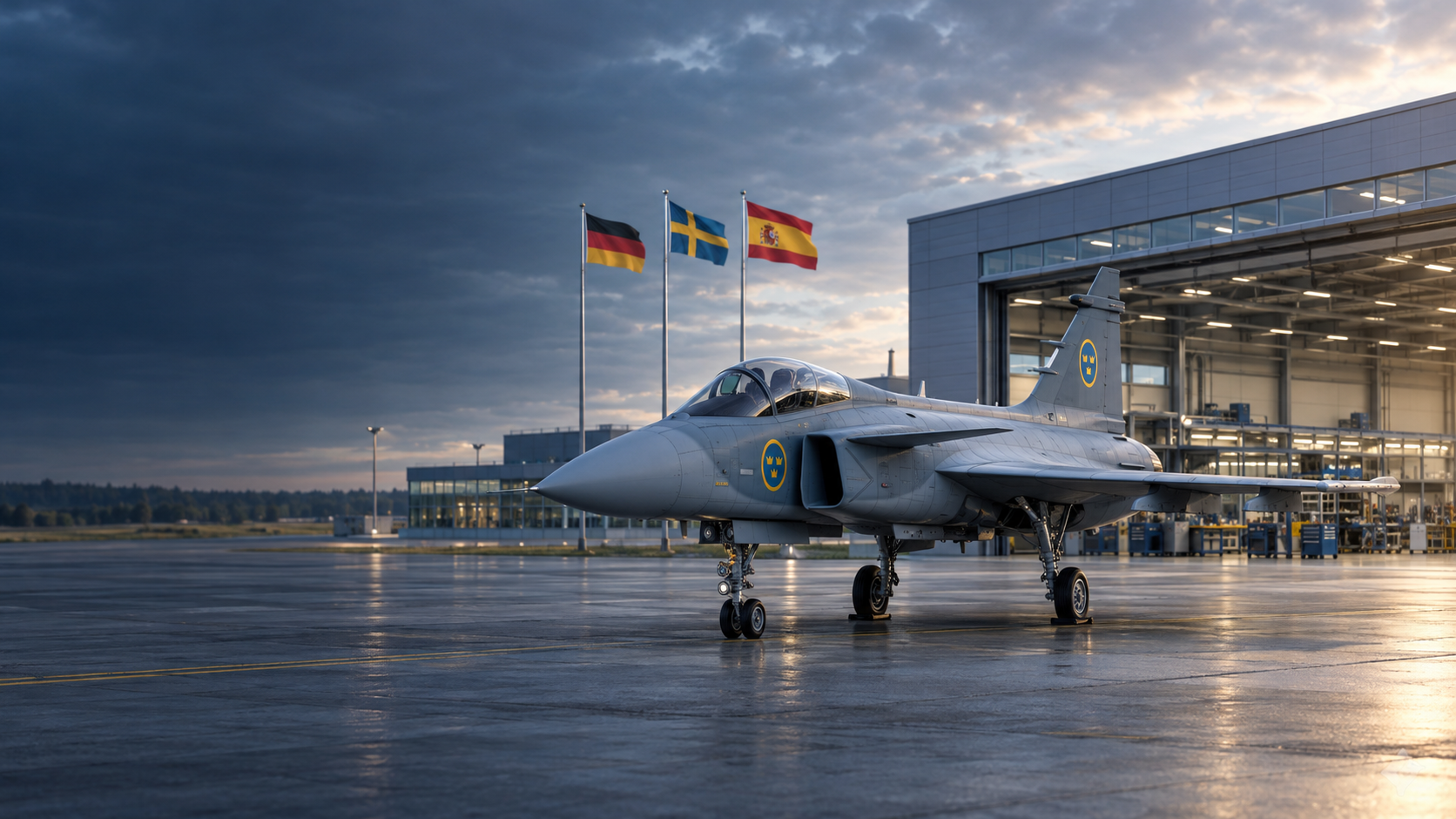
Germany's fighter jet turnaround: Why Sweden is suddenly becoming a key option – Creative image on the topic, with AI: Xpert.Digital
New billions for Europe's fighter jet – but this question will determine its success
Gripen as a model, GCAP as an alternative: Germany's difficult jet decision
Fighter jet plan with Sweden and Spain: Opportunity for Germany or next billion-euro risk?
Germany faces a pivotal decision regarding its future fighter jet. A collaboration with Sweden and Spain is gaining traction compared to a potential entry into the British-Italian-Japanese GCAP development program. However, no new partnership has yet been finalized. Key questions regarding financing, military requirements, industrial participation, and access to crucial technologies also remain unresolved.
The potential restart promises better coordination of partner interests and could strengthen Europe's technological independence. However, a new alliance is not automatically cheaper or simpler than the existing Franco-German project. To prevent the mistakes of the past from being repeated, clear decision-making rights, a common technological goal, and binding rules for development and further development are needed from the outset.
The Swedish Gripen E is not the same as Germany's future fighter jet. It could serve as a technological foundation or interim step, but the design of a new system would remain open. Therefore, the crucial factor is not solely which country or company is involved: Germany must clarify what level of military capability is financially sustainable in the long term – and whether it can actually utilize and further develop the necessary technologies independently.
Billions spent on new jets – but Europe's biggest problem isn't in the cockpit
A new direction is emerging for Germany's future fighter jet: Cooperation with Sweden and Spain is gaining traction compared to joining the British-Italian-Japanese GCAP development program, but this is not yet official government policy. There are several economic arguments in favor of this reorientation, provided it does not repeat the mistakes of the previous Franco-German project: unclear decision-making powers, competing industrial interests, and requirements that are politically aligned but technically diverge.
The crucial question, therefore, is not which country presents the most attractive fighter jet. It is about which partnership will create financially viable military capabilities over decades and secure reliable access to key technologies for Germany. A dedicated European development project can reduce strategic dependencies. However, it could also open a new, costly path whose industrial returns become apparent sooner than its military benefits.
A direction, not a decision
The situation as it stood on October 24, 2026, requires a clear distinction: Within the German Ministry of Defense, a new partnership with Sweden and Spain is being assessed as an advantageous alternative to GCAP; however, there is no final political decision or confirmed approval of this recommendation from the Minister of Defense. Similarly, the discussed cooperation between Airbus and Saab is not equivalent to an already agreed-upon development program.
This differentiation is economically crucial. Between a preferred strategic direction and a viable industrial program lie decisions about financing, technical requirements, ownership rights, and responsibility for the overall system. As long as these fundamentals are lacking, neither reliable unit prices nor a dependable German financing share can be determined. Therefore, a new alliance can currently be meaningfully assessed according to its industrial logic, not according to supposedly fixed total costs.
The Swedish Gripen E plays a role in these considerations as a possible technological stepping stone to a future new aircraft. This does not imply a German decision to purchase this model, nor does it mean that a Gripen will simply be enlarged or renamed. Anyone who equates the existing aircraft with the future German fighter jet is confusing a potential technological starting point with the outcome of an ongoing development process.
The break with France
The basic situation has already changed: Germany and France have not pursued the joint development of the manned combat aircraft within the existing framework since June 2026. However, the overarching approach of a networked European air combat system will continue. Therefore, the end of the joint aircraft project does not mean the end of all cooperation within the Future Combat Air System (FCAS).
This distinction is more than a linguistic subtlety. A new fighter jet is a platform. FCAS, on the other hand, describes a larger network in which aircraft, unmanned systems, sensors, and digital command and control structures are intended to work together. Without the shared platform, individual technologies and networking functions can still be further developed. This creates the possibility of later integrating nationally or otherwise jointly developed aircraft into a larger European system network.
Economically, the reorganization can be understood as an attempt to continue cooperation where common interests exist and to disentangle it where differing goals permanently impede progress. This can be more efficient than a politically imposed comprehensive package. However, it entails additional integration risks: If the aircraft and network architecture are developed separately, interfaces, safety requirements, and technical responsibilities must be aligned particularly early on. The organizational disentanglement must not be paid for by subsequent technical fragmentation.
Differing needs increase the cost of togetherness
The difficulties of the existing aircraft project involved both industrial management and differing military requirements. France's need for a carrier-capable aircraft suitable for its national nuclear deterrent does not fully align with the German requirements. Although Germany participates in NATO's nuclear sharing arrangement, this does not automatically mean it must meet the same design requirements as a French carrier jet.
An aircraft intended to fulfill additional operational roles requires more than just additional equipment. These additional requirements can influence its structure, weight, dimensions, development testing, and maintenance concepts. The economic benefits of joint development diminish if the partners use the same program name but actually require different aircraft. The supposed savings in development costs can then be partially lost due to adjustments and more complex production processes.
The potential alliance with Sweden and Spain appears particularly interesting from a German perspective because their military positions are considered more compatible. However, this assessment is a working hypothesis and not yet proof of an agreed-upon set of requirements. A viable restart would first have to define the core requirements. National add-ons should not subsequently alter these core requirements so significantly that the same problems reappear under different flags.
The economic appeal of Sweden
Sweden contributes Saab, a manufacturer that developed its own fighter jet system, the Gripen, and whose current E version is geared towards electronic warfare, networked sensors, and a scalable software architecture. This doesn't automatically make the country the ideal partner. However, it does create a concrete industrial foundation that goes beyond mere financial participation.
Of particular interest is the potential link between limited resources and disciplined system design. For Germany, a partnership would be valuable if it consistently prioritized military requirements according to benefit and cost. Not every technically achievable peak performance needs to be included in the initial design. A system can be economically superior if it is available more quickly, easier to further develop, and sufficiently efficient in operation.
Sweden is also already working on concepts and demonstrators for future manned and unmanned air combat systems; key technical areas include system integration, autonomy, signature reduction, propulsion, and digital development. The current phase of work is planned for 2026 to 2028, with possible extensions in 2029 and 2030. Such preliminary work can facilitate a start. However, it does not replace a complete development plan or proof that German, Swedish, and Spanish ideas can lead to a joint product.
Spain is not a supporting actor
In the proposed restructuring, Spain is envisioned as the third state partner, while Airbus and Saab will form the key industrial links. Airbus already connects the German and Spanish sides through European fighter jet manufacturing; Germany and Spain, along with Italy and the UK, are among the Eurofighter partner countries.
Economically, a third partner initially expands the potential financing and demand base. Developing a modern fighter jet involves significant upfront investments that do not increase proportionally with each additional aircraft. The more aircraft built on a shared technical platform, the more broadly these upfront investments can be distributed. Furthermore, there are potential advantages in spare parts, training, and joint development.
At the same time, Spain should not be viewed merely as an additional financial contributor. A viable three-way partnership requires a clearly defined industrial role for all participants. If a state contributes to the costs but is permanently marginalized when it comes to crucial technical expertise, a political imbalance arises. The economically productive solution, therefore, does not lie in an arbitrary equal distribution of all tasks, but rather in a clear combination of specialization, fair participation, and shared access to relevant systemic knowledge.
GCAP remains a serious alternative
The Global Combat Air Programme is supported by the UK, Italy, and Japan and aims to put its future combat aircraft into service by 2035. Industrial leadership lies with the joint venture Edgewing, in which BAE Systems, Leonardo, and Japan's JAIEC each hold approximately one-third of the shares. The target date represents a program intention and does not guarantee operational readiness.
For Germany, joining an existing program would have a fundamental advantage: Already organized structures and ongoing development could reduce the effort required for a complete restart. At the same time, the question arises as to what degree of influence a partner joining later would actually have. Financial participation, manufacturing shares, and responsibility for the technical architecture are not the same thing.
German reservations relate in particular to the suitability of the requirements and the prospect of a sufficiently strong industrial role. However, this does not objectively lead to the conclusion that GCAP is technically unsuitable or fundamentally controlled by a single company. A reliable assessment would depend on the specific participation rights offered. An entry with substantial co-determination could be economically attractive; an entry as a predominantly paying user would be a different decision from an industrial policy perspective. Conversely, a new alliance would not be an improvement if it promises more formal participation but generates significantly higher risks.
Gripen as a bridge, not an endpoint
The Gripen E is a single-engine fighter jet with a maximum takeoff weight of 16.5 tons, ten external hardpoints, and a GE F414G engine. These characteristics describe an existing system, not the already defined design of a future German aircraft. Its potential significance lies primarily in making technologies and development principles available during the creation of a later platform.
Such a bridging function can offer several economic advantages. Sensors, electronic protection systems, and software can potentially be tested earlier than a completely new aircraft would be available. Errors then don't only become apparent at the most expensive development stage. Furthermore, engineering teams can gain experience with integration and change processes before the next platform reaches its final design.
The boundaries must remain clear. A new aircraft with significantly different requirements for range, low detectability, electrical power, or payload cannot be derived from an existing model simply by adding software. Even adopting proven components can trigger new integration efforts. The economically sound approach is therefore to selectively reuse existing technology without allowing it to dictate the entire future system architecture. Reusing existing technology is a tool for risk reduction, not a substitute for an honest assessment of development needs.
Software determines the modifiability
A key feature of the Gripen-E architecture is the separation of mission functions and flight-critical software. This is intended to facilitate further development of operational functions without requiring the entire flight-critical area to be reworked for every change. However, this does not result in a blanket exemption from safety testing or certification requirements.
The economic core of this architecture lies in the costs of later modifications. A fighter jet is not developed solely for the threat situation of its first year of service. New sensor data, modified communication methods, and additional equipment can necessitate further adjustments over the course of its service life. If each change affects numerous other system components, the effort and time required increase. A clear technical separation can limit such ripple effects.
For Germany, therefore, the aircraft's performance at launch would not be the only decisive factor. Equally important would be how quickly and at what cost it could subsequently be adapted. Access to software, development tools, and interfaces should be considered an integral part of its military usability. A formally jointly developed aircraft offers only limited freedom of action if significant modifications remain practically dependent on the approval of a single partner.
Existing collaborations lower entry barriers
Airbus and Saab already have a concrete technical partnership for the electronic warfare capabilities of the German Eurofighter. The integration of the Arexis system is planned for 15 aircraft; Saab and its AI partner Helsing are collaborating on this project. Arexis is designed, among other things, to help detect, locate, and identify radar emitters in complex electromagnetic environments.
This collaboration doesn't yet prove that the two companies could efficiently develop a complete fighter jet together. However, it does provide experience with interfaces, safety requirements, and the integration of hardware and software. Such practical experience is economically valuable because it can reduce some of the uncertainty surrounding the collaboration. A partnership then doesn't begin solely with political declarations of intent.
Electronic warfare, in particular, illustrates why the value of a modern air combat system lies not solely in the aircraft fuselage. Sensors, signal processing, and rapid adaptation to changing threats can be key performance characteristics. For German companies, this opens up the possibility of shaping crucial functions without having to manufacture every component nationally. A viable industrial approach should therefore prioritize control over functionally important capabilities over achieving the most complete geographical distribution of assembly.
Billions in volume without a reliable price tag
The financial dimensions are considerable, but the publicly discussed scale of the existing FCAS project cannot be adopted as a fixed cost framework for a new German-Swedish-Spanish alliance. Neither its final scope of services, nor fleet size, development time, and cost sharing have yet been definitively determined. Under these circumstances, a precise total sum would be falsely precise.
For economic analysis, several cost categories must be separated: research and development, testing, series production, infrastructure, training, ongoing operation, maintenance, and subsequent modernizations. Additionally, a distinction must be made between figures presented in current prices and those in future years. Over long periods, these two representations can differ significantly, even if the technical performance remains unchanged.
Even supposed unit prices are of limited help. The price of a single aircraft is not automatically comparable to the average cost of a complete capability package. If one figure includes simulators, spare parts, and training, while another only includes the aircraft, a misleading comparison arises. A sound decision therefore requires consistent cost definitions. Politically inconvenient ranges are more informative than a single figure whose accuracy is achieved only by omitting significant costs.
Hub for Security and Defense - Advice and Information

Hub for Security and Defense - Image: Xpert.Digital
The Security and Defence Hub offers expert advice and up-to-date information to effectively support companies and organizations in strengthening their role in European security and defence policy. Working closely with the SME Connect Defence Working Group, it particularly promotes small and medium-sized enterprises (SMEs) that wish to further develop their innovative capacity and competitiveness in the defence sector. As a central point of contact, the Hub thus creates a crucial bridge between SMEs and European defence strategy.
Related to this:
Eurofighter and F-35: The challenges facing the German Air Force
The state can finance more
Germany's regular defense budget for 2026 amounts to €82.69 billion; an additional €25.51 billion comes from the special Bundeswehr fund. This brings the total available for the Bundeswehr to more than €108 billion. An increase to approximately €152 billion is projected by 2029; this figure is a projection and not a figure that has already been realized annually.
Greater financial flexibility changes the possibilities, but it doesn't eliminate the scarcity. A long-term fighter jet project competes within defense spending with personnel, ammunition, air defense, infrastructure, and other systems. The higher its future payment obligations, the less flexibly the budget can respond to new threats. The crucial constraint, therefore, is not only current solvency, but the overall sustainable financing of the armed forces.
Furthermore, there is a time constraint: development programs require reliable funding over many years, while political priorities and economic conditions can change. A generous short-term budget does not guarantee long-term planning security. A more economically sound financing model would consider technical milestones, realistic reserves, and anticipated future operating costs together. A project that appears financially viable only through persistently optimistic assumptions is not sound, even in a period of increasing defense spending.
Europe's demand is growing rapidly
Defense spending by the 27 EU member states reached approximately €418 billion in 2025, or 2.2 percent of their economic output. Around €454 billion, or 2.4 percent, is expected for 2026; these figures are given in constant 2025 prices. European defense investments amounted to approximately €134 billion in 2025 and are projected to rise to around €163 billion in 2026.
These figures show that a German fighter jet project would be embedded in a rapidly growing European market. However, they say little about how many aircraft of a specific new type are actually needed. Rising overall expenditures are spread across numerous military tasks. Therefore, reliable sales planning must not treat all additional defense resources as potential demand for a single platform.
At the same time, in 2025 only about €17 billion, or 4 percent, of European defense spending was allocated to research and development; around €20 billion is expected for 2026. The contrast between high demand for readily available equipment and the need for long-term development is thus clear. A new fighter jet program could strengthen European technological expertise. However, it would have to be designed in such a way that it does not tie up already scarce development resources without creating a credible prospect of practical application.
Industrial strength requires appropriate scale
The German aerospace industry generated revenue of approximately €62 billion in fiscal year 2025 and employed around 130,000 people. Of this, €13.5 billion in revenue was attributable to military aviation. The military sector recorded revenue growth of approximately 35 percent compared to the previous year.
These figures illustrate the sector's industrial policy significance, but should not be confused with the immediate effect of a single fighter jet project. Industry revenue does not equate to additional economic output. Existing employment is not synonymous with newly created jobs. And a company can be involved in several programs simultaneously, so employment effects cannot simply be added together.
For Germany as a business location, it is crucial which demanding activities are permanently maintained or developed. Research, system design, integration, testing, and independent further development create different capabilities than manufacturing limited to specific work steps. The economic policy benchmark should therefore not be to generate as much publicly funded revenue as possible domestically. It should be to secure, with a reasonable investment of resources, productive capabilities that are militarily required and will remain technologically relevant in the long term.
The Eurofighter buys time
The Eurofighter is scheduled to remain in service with the German Air Force until the 2060s. Delivery of a further 20 aircraft is planned between 2031 and 2034. The new fighter jet would therefore not immediately and completely replace an existing fleet, but rather enter a longer period of overlapping systems.
This transition phase is economically significant. It allows for the gradual introduction of new technologies, avoiding the concentration of every risk on a single replacement date. At the same time, costs arise from operating different systems in parallel. Training, spare parts supply, and technical infrastructure must be compatible throughout the entire transition period. A seemingly inexpensive new platform can become costly if it creates a particularly lengthy or complex parallel structure.
Further developing existing Eurofighters can therefore be more than just a stopgap measure. Improvements in sensors and electronic warfare can enhance capabilities while the next platform is still under development. However, this should not be used as a pretext to postpone decisions about future requirements indefinitely. The existing time buffer has value when used for technical risk reduction. It loses this value when it merely allows for further years of institutional indecisiveness.
F-35 complements the European question
Germany will initially receive 35 F-35As; the first aircraft was delivered on September 18, 2026, and full delivery is scheduled for 2029. The first aircraft will initially be used for training in the USA, while preparations for deployment at Büchel Air Base begin in 2027. Their intended tasks include taking over nuclear sharing from the Tornado.
Short-term military availability and long-term European development capability are therefore not identical decisions. An existing foreign platform can provide certain capabilities sooner than a new European program could. A European development project also aims to preserve technical expertise and its own design capabilities for decades. Both approaches can complement each other, but together they result in a more demanding fleet and cost structure.
The infrastructure illustrates the scale of the investment, which goes far beyond the aircraft price: Around two billion euros have been invested in the modifications at Büchel Air Base. This doesn't imply a universally applicable infrastructure fee for other aircraft. However, it demonstrates why the economic evaluation of a platform must always consider its ground-based requirements. Hangars, secure IT systems, maintenance procedures, and training are not secondary costs, but rather prerequisites for transforming a delivered aircraft into a usable capability.
Availability beats fleet size alone
The US F-35 fleet achieved a 44 percent capability to execute at least one planned mission in fiscal year 2025; in 2021, this figure was 67 percent. The capability to execute all planned missions decreased from 38 to 25 percent during the same period. These figures pertain to the US fleet under investigation and should not be used as a forecast for Germany's future F-35 availability.
This example nevertheless highlights a general evaluation issue. The nominal number of aircraft is not identical to the actual operational capacity available in an emergency. Spare parts, maintenance capacity, technical specifications, and a sufficient number of qualified personnel must all work together. Therefore, an economic comparison should not only consider the cost per delivered aircraft, but also the operational capacity that can be maintained over a longer period.
For a new European platform, this would be a crucial lesson: maintainability and servicing must be part of the system design from the outset. A design whose theoretical peak performance can only be achieved with disproportionately expensive maintenance can be disappointing in practical operation. Conversely, a higher availability rate should not be used in isolation as proof of greater military capability. Availability, protection, armament, and mission spectrum must be evaluated together. The right benchmark is not the biggest promise, but a comprehensible relationship between effectiveness and sustained effort.
Participation must become technically effective
German industry explicitly links any potential new collaboration to the demand for a substantial and equal role in development, manufacturing, and operation. This demand is economically understandable, but requires precise interpretation. A stake in a company alone does not determine who is authorized to approve technical changes or what data a partner can access.
Of particular importance are responsibility for the overall architecture, the rights to newly developed technologies, and access to information for maintenance and further development. This also includes the handling of existing knowledge within the participating companies. A fair partnership must distinguish between protecting existing corporate expertise and the shared right to use newly funded results. Without this distinction, future conflicts can be inherent from the very start of the program.
The economically sound solution is neither a complete mutual disclosure of all trade secrets nor a structure in which one partner has only limited access. What is needed is a clearly defined shared knowledge space. Germany must be able to operate and further develop its own aircraft effectively even if individual political or economic interests diverge. This is precisely where the practical value of strategic capability lies: not in a national label, but in secure technological capabilities.
Sovereignty does not end with the manufacturer
The Gripen E uses the GE F414G engine from a US manufacturer. Therefore, a European airframe does not automatically mean an exclusively European supply chain. The technical starting point of a collaboration must be distinguished from its eventual target state.
Assessing dependencies requires more than simply considering the nationality of the parent company. The crucial factor is identifying which components, information, or support services would be particularly difficult to replace in the event of a disruption. A component with a low price may be strategically more important than an expensive but easily replaceable assembly. Therefore, sovereignty should be evaluated based on critical functions and realistic alternative solutions.
Complete self-sufficiency, however, would also not be a convincing economic model. It can lead to additional development costs, reduce economies of scale, and make access to high-performance technology more difficult. A more appropriate strategy would be a tiered approach: European or jointly controlled solutions for particularly critical capabilities, reliable international supply chains for less sensitive components, and robust contingency plans for disruptions. The question is not whether dependencies exist at all. It is whether their risks are understood, mitigated, and acceptable in relation to the benefits.
Economies of scale require political discipline
Europe's defense industry continues to suffer from fragmented markets, small production runs, and insufficiently coordinated national requirements. Increased spending does not automatically solve these problems; additional demand, coupled with limited capacity, can also trigger higher prices. A new fighter jet project must therefore achieve more than simply consolidating existing national interests into yet another organization.
The most important prerequisite for economies of scale would be a stable, common technical standard over a longer period. If each partner country develops its own variants, the number of individual components that can be used jointly decreases. Joint training and maintenance also become more difficult. A larger nominal fleet may then offer fewer economic advantages than a smaller, but more standardized series.
Equally important is timing. If national demand is spread over very different periods, production interruptions or low annual capacity utilization can occur. Under such conditions, companies can only invest to a limited extent in efficient processes and additional capacity. Realistic quantity and timing planning is therefore an essential part of industrial productivity. It must not be based solely on optimistic export assumptions. Exports can strengthen a program, but they should not be the prerequisite for ensuring that already committed national capabilities remain financially viable.
Growth is not automatic
Increased defense spending can boost demand, employment, and investment in the short term; however, international studies have found that, on average, this overall economic boost is not unlimited. The impact depends, among other things, on domestic production levels, how the spending is financed, and whether additional capacity is created. Therefore, it is not possible to reliably derive a specific growth effect from a new German fighter jet.
For the German economy, technological development would be particularly valuable if it expanded existing expertise and created new productive opportunities. Connections to digital development processes, materials, sensor technology, or safety-critical software are conceivable. However, such spillover effects should not be automatically considered a guaranteed additional benefit. Military secrecy, specific requirements, and limited civilian market opportunities can hinder their utilization.
Furthermore, qualified specialists, production space, and capital also compete with other sectors. An additional job in military aviation must be assessed differently from a macroeconomic perspective if it utilizes a previously unused resource, compared to simply exacerbating a bottleneck in another promising sector. The primary purpose of the expenditure therefore remains security. Industrial policy and economic benefits are potential additional returns, but they are no substitute for demonstrating military expediency and economic viability.
The architecture must remain adaptable
A future air combat system is intended to combine manned aircraft with unmanned platforms and a secure digital network. The Swedish preliminary work also explicitly includes manned and unmanned system concepts. Therefore, economic planning should not be limited solely to the development of a single, particularly high-performance aircraft.
A distributed architecture can enable the delegation of different tasks to systems of varying cost. However, it also creates its own requirements for communication, security, testing, and the interaction of individual components. Therefore, unmanned platforms are not automatically inexpensive simply because they lack a cockpit. The crucial factors are the capabilities they require and how reliably they interact with the rest of the system under realistic conditions.
For Germany, a phased approach would be more sensible than committing to a single, distant promise of completeness. Initially, clearly defined partial capabilities could be tested and subsequently expanded based on reliable results. The architecture would need to remain open enough to accommodate technological advances, yet stable enough to avoid constant reinvention. Economic discipline in this context means not denying uncertainty, but rather structuring investments in such a way that insights can lead to timely changes.
The benchmark for the restart
A German-Swedish-Spanish partnership has a comprehensible industrial logic: it could combine existing Airbus structures with Saab's fighter jet expertise and create a new common starting point. However, the advantage over GCAP would not be proven simply by the free choice of partners. It would have to be demonstrated through a coordinated understanding of requirements, effective decision-making rights, and a credible relationship between costs, time, and performance.
Before entering into a long-term partnership, several questions should be answered: What capabilities are actually needed jointly? Which technical risks have already been tested? Who has the authority to make binding decisions in case of conflicts? What data and modification rights does each partner have? How can it be prevented that national special requests subsequently increase the cost of the shared core components? And how can the air force remain effective if the new platform is available later than expected?
The move towards Sweden is therefore neither an industrial policy breakthrough nor necessarily the next multi-billion-euro dead end. It is a serious option, the quality of which depends on its specific design. For Germany, the most economically viable fighter jet would not be the one with the greatest national symbolic value. It would be a financially feasible, scalable, and genuinely available system that reliably fulfills military tasks and whose crucial technologies remain usable even under difficult political circumstances.
Consulting - Planning - Implementation
Markus Becker
I would be happy to serve as your personal advisor.
Head of Business Development
Chairman SME Connect Defense Working Group
Consulting - Planning - Implementation
Konrad Wolfenstein
I would be happy to serve as your personal advisor.
You can contact me at wolfenstein∂xpert.digital or
Just call me on +49 7348 4088 965 .