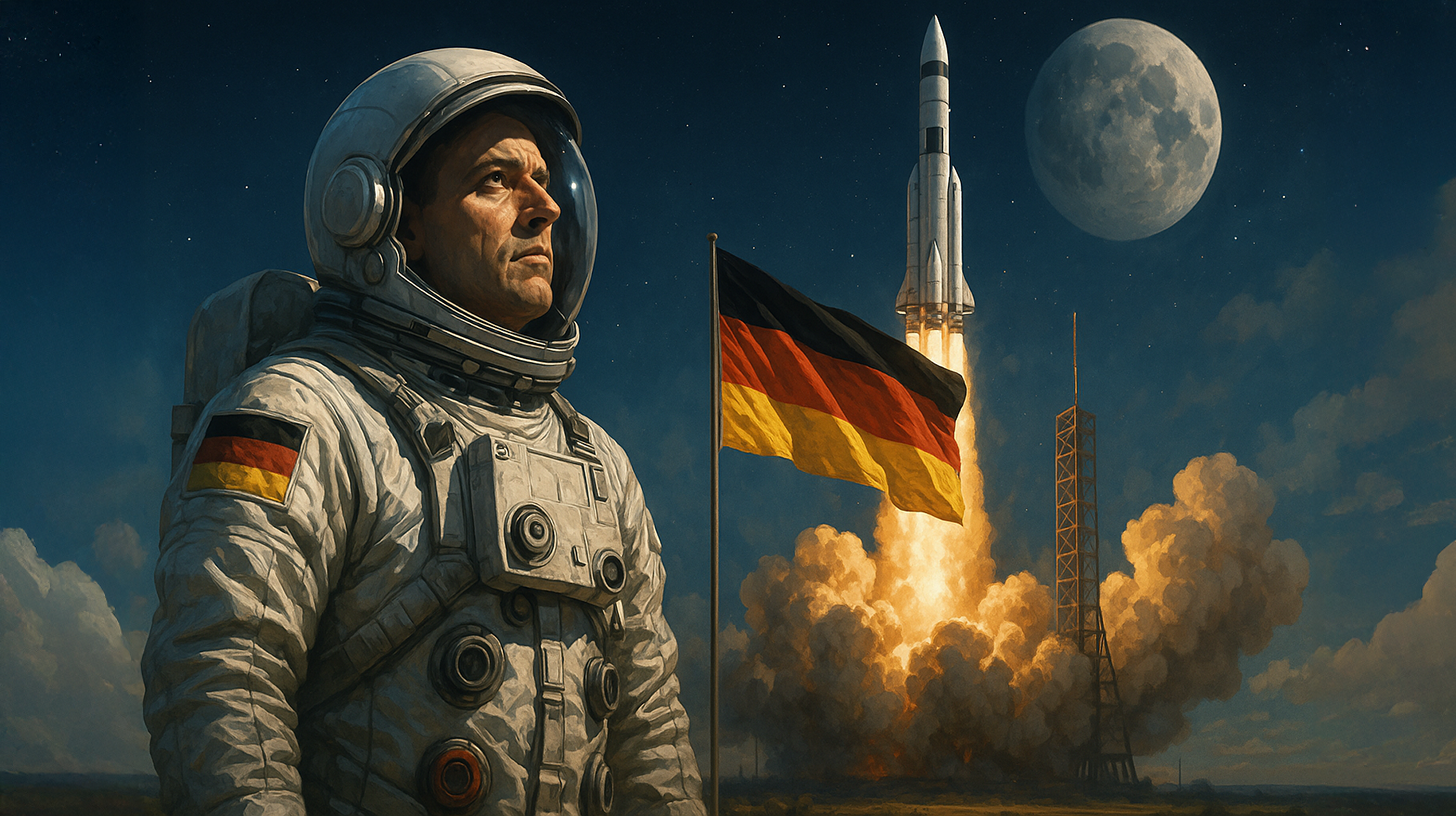
35 billion bet: How Germany now wants to catch up with the USA and China in space – Germany's leap to becoming a new space power – Image: Xpert.Digital
Germany's leap into space – How an underestimated industry is becoming a strategic key industry
Long underestimated, now vital for survival – nothing works without them: Why your life would collapse immediately without satellites
Few people realize how deeply space travel is already embedded in our everyday lives. From car navigation and instant bank transfers to evening video streaming – our modern lives hang by a thread of invisible infrastructure floating thousands of kilometers above our heads. But while we've grown accustomed to this convenience, a dramatic transformation is taking place in orbit. Space travel has evolved from a prestigious scientific project into a key strategic industry, whose global market is projected to reach an incredible €2 trillion by 2040.
In this new race, Europe risks being crushed between the superpowers, the USA and China, which are expanding their dominance with gigantic investments and tens of thousands of satellites. The German government has recognized the signs of the times: with a historic investment of 35 billion euros, Germany intends to reduce its dependence and establish its own robust security architecture in space. For space is no longer just an economic arena, but also a potential battleground where hostile satellites can spy on, disrupt, or even destroy our systems.
This new era is no longer driven solely by government agencies, but by a dynamic "New Space Economy." Visionaries like Elon Musk have revolutionized costs with reusable rockets and paved the way for hundreds of startups. In Germany, young companies like Isar Aerospace and Rocket Factory Augsburg are also competing, vying for a place in the fiercely competitive rocket manufacturing market.
This article sheds light on the profound transformation of a long-underestimated industry. It explains why Germany is suddenly investing billions in space, what concrete dangers posed by space debris and cyberattacks, and which fascinating visions—from mining on the moon to asteroid mining—could shape the future. It is the story of a technological breakthrough where nothing less than Germany's strategic sovereignty, security, and prosperity in the 21st century is at stake.
Strategic shift in the skies: Why space is becoming the new arena of power
Space exploration is undergoing a fundamental transformation. What was once considered a prestige project for a few nations is evolving into a key strategic industry of the 21st century. Experts predict a 10 percent growth rate for the global space industry in the coming years – a rate that traditional industries can only dream of. But while the global market for space-based infrastructure and services is set to quadruple from nearly €500 billion to €2 trillion by 2040, Europe risks falling behind.
The German government has recognized the signs. With Defense Minister Boris Pistorius's announcement of a total of €35 billion for space projects and a space security architecture by 2030, the topic of space travel in Germany has reached a political level previously only seen in Italy, France, Japan, and the USA. Walther Pelzer, a member of the board of the German Aerospace Center (DLR), is beaming with pride: The new federal government has raised space travel to a level that finally gives due recognition to the strategic importance of this industry.
It's no longer just about scientific discoveries or the fascination of the cosmos. Space travel has become critical infrastructure. A satellite failure could have fatal consequences in modern life – from mobile phone outages and plane crashes to failed bank transfers. During a single speech at a space congress, 39 Chinese and Russian reconnaissance satellites flew over the conference grounds – a symbol of a new era in which conflicts are fought not only on Earth, but also in space.
This article illuminates the multifaceted dimensions of an industry that long remained in the shadows but is now becoming an indispensable foundation for security, the economy, and technological progress. From its historical roots and current developments to its challenges and future visions, the following analysis paints a picture of an industry undergoing a transformation.
From state monopoly to start-up race: A brief history of space travel
The history of space exploration begins with the Sputnik shock of 1957. The Soviet Union's launch of the first artificial satellite not only triggered a technological race between the superpowers but also laid the foundation for international cooperation in space. As early as 1958, European scientists such as Pierre Auger and Edoardo Amaldi met to discuss the establishment of a joint Western European space agency. Europe recognized early on that national projects could not compete with the superpowers.
The founding of ESRO and ELDO in 1962 marked the first attempt at coordinated European space exploration. While ESRO successfully launched seven satellites between 1967 and 1972, ELDO, with its Europa rocket, became a fiasco – none of its eleven launch attempts were successful. Only the merger of the two organizations to form ESA on May 30, 1975, brought about a change. With the development of the Ariane rocket, which has been flying since 1979, the Europeans achieved a breakthrough, creating one of the most important satellite launch vehicles in the world.
For decades, space exploration remained the domain of government agencies. High development costs, technological complexity, and political interests left little room for private players. This era ended with the founding of SpaceX in 2002. Elon Musk's vision of commercializing space travel and drastically reducing costs revolutionized the industry. With reusable rockets, SpaceX succeeded in reducing launch costs many times over, thus paving the way for the New Space Economy.
This new era is characterized by private investment, shorter innovation cycles, and a multitude of new business models. Hundreds of startups are entering the market, ranging from rocket manufacturers and satellite operators to providers of space-based services. Germany is also participating in this new competition. Three companies – Isar Aerospace, Rocket Factory Augsburg, and HyImpulse – are developing their own launch vehicles and have received a total of €25 million in funding from the DLR's microlauncher competition.
The transformation is remarkable. While it took Jeff Bezos 20 years to successfully launch Blue Origin, German startups have come a long way despite setbacks – such as the explosion of the Rocket Factory Augsburg in Scotland in 2024. The combination of government funding and private investment is creating an ecosystem that could make Europe competitive again.
The technological foundation: The crucial components of space infrastructure
Modern space travel rests on several technological pillars, the interplay of which is what enables its diverse applications. The first and most obvious component is launch vehicles. For decades, heavy rockets like the Ariane dominated the market. However, the New Space Economy has demonstrated that flexible, smaller launch systems offer significant advantages for transporting small and medium-sized satellites. German startups are pursuing different approaches: Isar Aerospace is developing the Spectrum rocket with an engine based on proven technology. Rocket Factory Augsburg uses the Helix engine, which is based on Ukrainian turbopump technology. HyImpulse is taking a unique approach with hybrid engines that burn solid paraffin with liquid oxygen.
The second pillar consists of the satellites themselves. While in the past individual satellites weighing several tons remained in orbit for decades, today constellations of hundreds or thousands of smaller satellites increasingly dominate. SpaceX already operates over 8,500 satellites with Starlink and has applied for permits for a total of over 40,000. These megaconstellations enable global internet coverage with low latency, but also present new challenges.
The third component is ground infrastructure. Without ground stations, control centers, and data processing capabilities, satellites are worthless. Germany has a central facility for controlling European satellites: the ESA Control Centre in Darmstadt. The newly established Cyber Security Operations Center in Darmstadt protects 28 satellites, ground stations, and control systems from cyberattacks – a sign that the vulnerability of space-based infrastructure has been recognized.
The fourth pillar is Space Situational Awareness. Mapping all flying objects in the sky, as offered by the Ariane Group, makes it possible to monitor satellite movements, detect disturbances, and issue warnings of threats. AI models constantly analyze orbital movements and issue alerts. Previously, Germany used incomplete mapping data from the USA. European systems would allow Europe to become more sovereign in this crucial area.
The fifth dimension is the dual-use nature of the technology. Earth observation satellites, which provide high-resolution images for agriculture or disaster relief, can also be used for military reconnaissance. Communication satellites, which bring broadband internet to remote regions, are also crucial for controlling drones and networking troops in the field. This merging of civilian and military uses is characteristic of modern spaceflight and raises complex ethical and legal questions.
Europe's dilemma in orbit: The fight for strategic autonomy
The current state of European spaceflight is characterized by a paradox. On the one hand, Europe possesses highly developed technology and excellent engineering expertise. Germany alone operates just over 80 of its own satellites and invests around €2.5 billion annually in spaceflight. On the other hand, Europe lags significantly behind in global competition. The European market share is currently only 17 percent, while the USA invests approximately €72 billion and China €18 billion annually. The USA operates over 10,000 satellites, and China around 900.
These figures illustrate the strategic challenge. To increase its European market share from the current 17 percent to 25 percent, Germany alone would have to increase its investments by €93 billion by 2040. Total European investments would need to rise by €412 billion. This investment gap is not merely a matter of national prestige, but also affects Europe's strategic autonomy in an economic and security system increasingly dependent on space infrastructure.
This dependence is particularly evident in the defense sector. Currently, two Intelsat satellites, which the German Armed Forces also use, are being tracked by two Russian reconnaissance satellites. NATO Secretary General Mark Rutte warns of Russian plans to place nuclear weapons in space to attack satellites. Russia and China have rapidly expanded their space warfare capabilities in recent years. They can jam, blind, manipulate, or kinetically destroy satellites.
Germany's response to these threats is comprehensive. The announced 35 billion euros will be invested in a robust infrastructure of satellite constellations, ground stations, secure launch capabilities, and services. Specifically, plans include hardening systems against jamming and attacks, improving situational awareness through radar, telescopes, and sentinel satellites, creating redundancies through multiple networked satellite constellations, and ensuring secure transport capabilities into space. Germany is relying on a mix of small launch vehicles for flexible launches and, in the medium term, also European heavy-lift launch vehicles.
Civilian uses are equally important. Space-based services are now indispensable for telecommunications, navigation, weather forecasting, disaster relief, and environmental monitoring. The European Earth observation program Copernicus continuously provides data for monitoring sea ice, icebergs, glaciers, land subsidence, and oil spills. The Galileo satellite navigation system enables precise positioning independent of the American GPS. This sovereignty in critical areas is invaluable but requires continuous investment and technological innovation.
Our EU and German expertise in business development, sales and marketing


Our EU and German expertise in business development, sales and marketing - Image: Xpert.Digital
Industry focus areas: B2B, digitalization (from AI to XR), mechanical engineering, logistics, renewable energies and industry
More information here:
A thematic hub offering insights and expertise:
- Knowledge platform covering global and regional economies, innovation and industry-specific trends
- A collection of analyses, insights, and background information from our key areas of focus
- A place for expertise and information on current developments in business and technology
- A hub for companies seeking information on markets, digitalization, and industry innovations
Germany's opportunity in space: Invest or fall behind?
Practical test in space: How space technology is changing war, the economy and everyday life
The practical significance of spaceflight is most clearly demonstrated in concrete applications. The war in Ukraine has impressively demonstrated the strategic role of space-based systems. The Ukrainian armed forces rely on the internet provided by Starlink and use it to control their drones. Fast and flexible satellite communication has successfully thwarted Russian electronic jamming. According to Elon Musk, all attempts to hack or disrupt Starlink have failed. Systems like Starlink will be indispensable in future wars – and the US has a significant advantage in this area.
The military application goes even further. Ariane Group's Space Domain Awareness enables the complete mapping of all flying objects in the sky. It allows users to see which satellites are flying where, whether they are being tracked or jammed by other satellites, and whether there are any unusual maneuvers. AI models constantly analyze these movements and issue warnings. This capability is essential for the German Armed Forces and other armed forces that need to protect their own systems and detect potential threats early on.
In the civilian sector, space exploration is revolutionizing numerous industries. Agriculture uses satellite-based precision methods to optimize irrigation and fertilization. Logistics companies are entirely dependent on satellite navigation. The financial industry requires highly accurate time signals from satellites to synchronize transactions. Insurance companies use Earth observation data for risk assessment. The energy sector monitors pipelines and power lines from space. All these applications have become so commonplace that their reliance on space infrastructure is often overlooked.
Commercial applications are developing rapidly. The German company OroraTech has developed a platform that aggregates external and proprietary satellite data into advanced algorithms for wildfire detection. Decision-makers receive real-time information about fires, saving lives and minimizing damage. The Munich-based company The Exploration Company is developing its Nyx spacecraft, a reusable transport vehicle intended to deliver cargo to the ISS or other destinations in low Earth orbit starting in 2028. With a payload capacity of 3,000 kilograms, Nyx is expected to transport more than comparable systems – and at 25 to 50 percent lower costs.
Earth observation has become a multi-billion dollar market. Geopolitical uncertainties have massively increased the demand for geodata and satellite imagery. Government agencies use it for everything from analyzing weather patterns and agriculture to monitoring changes and movements along international borders. In the first quarter of 2024, funding for space startups surged from $2.9 billion to $6.5 billion. Investments in geodata surpassed satellite communications for the first time, demonstrating the growing demand for such data.
The overcrowded skies: Risks and downsides of the new space age
Despite all the enthusiasm for space travel, the significant problems and controversies must not be overlooked. The most pressing problem is space debris. It is estimated that around 130 million objects classified as junk are already orbiting the Earth. Approximately 40,000 of these are larger than one meter and can be tracked by ground-based radar stations. However, the majority of these objects are too small to be detected – and yet still dangerous. At speeds exceeding 30,000 kilometers per hour, even the smallest particles possess destructive power.
The Kessler Syndrome, named after NASA scientist Donald Kessler, describes a catastrophic chain reaction: If the density of space debris becomes so high that collisions increase exponentially, this could render parts of Earth's orbit unusable for space travel. Every collision creates additional space debris and increases the risk of further collisions. The International Space Station already has to perform evasive maneuvers regularly. German astronaut Matthias Maurer recounted one of his most dangerous experiences in space, when space debris hurtled toward the space station.
The megaconstellations exacerbate the problem. SpaceX already operates over 8,500 Starlink satellites. China is planning two comparable projects, Guowang and Spacesail, with a total of 27,000 satellites. The number of objects in orbit is growing exponentially. While modern satellites have a limited lifespan of about five years and then burn up in the atmosphere, the sheer number dramatically increases the risk of collisions. Researchers are sounding the alarm that the more than 7,000 Starlink satellites may not behave as intended and could hinder space exploration.
The second major controversy concerns cybersecurity. Satellites are highly vulnerable to cyberattacks. The German Federal Office for Information Security (BSI) emphasizes that space infrastructure represents a single point of failure where enormous damage can be inflicted with relatively little effort. Satellites are used for an average of 15 years, and many older models from the early 2000s are still in operation, having not been designed with security by design from the outset. These legacy systems typically use older software that cannot be easily patched. Hardware vulnerabilities can present an attack surface throughout a satellite's entire lifespan.
At the 2022 Black Hat security conference, it was demonstrated that manipulated software code could be executed on Starlink terminals using equipment costing just $25. Although Starlink responded, the example illustrates a general vulnerability. The increasing number of satellites and market participants, not all of whom have convincing IT security practices, exacerbates the problem. Cost is a factor – more IT security features drive up development costs, which is why compromises are sometimes made.
The third controversy concerns the militarization of space. The 1967 Outer Space Treaty prohibits the deployment of weapons of mass destruction in space and calls for peaceful use. However, the lines between civilian and military use are becoming increasingly blurred. The dual-use nature of modern satellite technology makes a clear distinction impossible. China and Russia are rapidly expanding their space warfare capabilities. Germany also plans to develop offensive capabilities in space to maintain its defense capabilities. This development raises fundamental questions: Can space truly remain a space of peace, or will it become the next battlefield?
The fourth controversy is ethical in nature. Can the use of immense resources for space missions be justified, or should these resources be better used for more pressing problems on Earth? Space tourism, where flights cost hundreds of thousands to millions of dollars, intensifies this question. Will space tourism provide new impetus and unlock financial resources, or will it merely contribute to commercialization while urgent problems on Earth remain unresolved?
Gold Rush in Space: Humanity's Next Major Goals in Space
The future of space travel is shaped by several major trends. The first is the return to the moon. NASA's Artemis program envisions landing humans back on the moon within this decade. This time, the first woman will be among them. Germany plays a central role: The European Service Module (ESM), largely built in Germany, is essential for the Orion spacecraft. It houses the main engine, provides power, regulates climate and temperature, and stores fuel, oxygen, and water supplies for the crew. Without Germany, the USA would not be able to travel to the moon.
The lunar missions are more than symbolic acts. Starting in 2032, NASA plans to test mining on the moon. Initially, the focus will be on extracting oxygen and water, and later potentially iron and rare earth elements. Developing resources on the moon is key to reducing costs and fostering a circular economy. Water can be purified for drinking, serves as protection against space radiation, and can be split into oxygen and hydrogen – the basis for rocket fuel. Launching from the moon is far more efficient than from Earth due to its lower gravity.
The second major trend is asteroid mining. The US company AstroForge is already planning a mission to asteroid 2022 OB5, a metal-rich M-class asteroid, for 2025. Besides iron and nickel, such asteroids can contain valuable platinum group metals. The asteroid Psyche, which a NASA spacecraft is currently targeting, could be worth 10 trillion dollars from its iron content alone – more than the entire global economy. Although commercial mining may still be decades away, the technological foundations are being laid now.
The third trend is commercial space tourism. Virgin Galactic has been offering regular flights for around $450,000 since 2023. Blue Origin has been conducting tourist suborbital flights since 2021. In September 2021, SpaceX took four space tourists into space for three days with Inspiration 4, reaching an altitude of 580 kilometers. In September 2024, the altitude was increased to 1,400 kilometers – a new record for space tourism. NASA opened the ISS to tourists in 2022, with a stay costing $55 million per person. Looking ahead, Elon Musk even envisions tourist flights to Mars and settlements on the Red Planet.
The fourth trend is international competition, particularly with China. China is pursuing a comprehensive space strategy with clear goals and massive investments. In the last five years, China has made impressive progress: demonstrating refueling in space, testing a fractional orbital bombardment system, launching a crewed space station, and collecting samples from the far side of the moon—an achievement the US has not yet reached. China plans to conduct the first crewed lunar landing by 2030 at the latest, putting pressure on the US.
China is also investing in space-based solar energy, which could beam electricity from orbit to Earth. Should China scale up this capability and export the resulting energy, it could gain control over global power grids, similar to OPEC's control over oil. This strategic dimension makes it clear that space exploration is far more than technological innovation—it is an instrument of geopolitical power.
Beyond the horizon: Germany's fate in space
Space exploration is at a historic turning point. What was long considered a niche sector is developing into a key strategic industry of the 21st century. Projected growth rates of ten percent annually and the quadrupling of the global market to €2 trillion by 2040 illustrate its enormous economic potential. But the significance of space exploration extends far beyond economic indicators. It touches upon fundamental questions of security, sovereignty, technological progress, and ultimately, Europe's position in an increasingly multipolar world order.
Germany and Europe have recognized the signs, but their response is still too hesitant. The announced 35 billion euros by 2030 are an important step, but they are insufficient to close the gap with the US and China. To increase Europe's market share from 17 to 25 percent, Germany alone would need an additional 93 billion euros by 2040. These investments must be accompanied by structural reforms: faster approval processes, more venture capital for startups, closer integration of research and industry, and a clear commitment to the strategic importance of space exploration.
The technological challenges are considerable. While Germany boasts excellent engineering and established companies like OHB and Airbus Defence and Space, as well as promising startups such as Isar Aerospace and Rocket Factory Augsburg, there is a significant gap compared to SpaceX, which dominates orbit with over 8,500 Starlink satellites and has revolutionized launch costs. The reusable rockets that SpaceX has perfected are the main reason for America's leading position in space launches. China is rapidly catching up in this area.
The downsides must not be ignored. Space debris threatens the long-term usability of orbit. The cyber vulnerability of space-based systems poses a significant security risk. The increasing militarization of space contradicts the original ideals of the Outer Space Treaty. And the ethical questions surrounding the prioritization of investments in light of pressing problems on Earth remain unanswered. Sustainable space development requires international regulation, technological solutions for debris removal, and critical reflection on goals and means.
Nevertheless, the opportunities outweigh the risks. Space travel is no longer a distant dream of the future, but an integral part of our everyday lives. Without satellites, telecommunications, navigation, weather forecasting, disaster relief, and numerous economic sectors would collapse. Our dependence on space-based services will continue to increase. Whoever possesses technological sovereignty in this field secures strategic capability. Whoever falls behind will become dependent on other powers.
Germany and Europe face a choice: Will they invest massively in this future technology now and create the necessary structural conditions for a competitive space industry? Or will they leave this strategically crucial field to the USA and China? The next few years will show whether Europe has the courage and vision to treat space travel for what it is – not an overlooked industry, but the foundation for security, prosperity, and sovereignty in the 21st century. The stars are aligned, but time is running out.
Your global marketing and business development partner
☑️ Our business language is English or German
☑️ NEW: Correspondence in your native language!

Konrad Wolfenstein
I and my team are happy to be available to you as your personal advisor.
You can contact me by filling out the contact form here wolfenstein@xpert.digital:or simply call me at +49 7348 4088 965. My email address is
I'm looking forward to our joint project.
☑️ SME support in strategy, consulting, planning and implementation
☑️ Creation or realignment of the digital strategy and digitization
☑️ Expansion and optimization of international sales processes
☑️ Global & Digital B2B trading platforms
☑️ Pioneer Business Development / Marketing / PR / Trade Fairs
🎯🎯🎯 Benefit from Xpert.Digital's extensive, five-fold expertise in one comprehensive service package | BD, R&D, XR, PR & Digital Visibility Optimization

Benefit from Xpert.Digital's extensive, five-fold expertise in a comprehensive service package | R&D, XR, PR & Digital Visibility Optimization - Image: Xpert.Digital
Xpert.Digital possesses in-depth knowledge across various industries. This allows us to develop tailored strategies precisely aligned with the requirements and challenges of your specific market segment. By continuously analyzing market trends and monitoring industry developments, we can act proactively and offer innovative solutions. The combination of experience and expertise generates added value and provides our clients with a decisive competitive advantage.
More information here: