
A milestone for municipal digitalization – This ‘operating system’ is now making German municipalities more efficient! – Image: Xpert.Digital
No surveillance, just efficiency: Saving millions, reducing CO2 emissions – The innovative system that has already impressed 25 cities
Smart Cities on the Rise: 25 Cities in Record Time – The Operating System That Is Changing Germany
The Cologne-based startup dataMatters is achieving remarkable success with its innovative operating system for smart cities. Within just a few weeks of its official launch, 25 German cities have already implemented the technology, which optimizes urban infrastructure through innovative sensor technology and AI-supported analysis. The system's rapid adoption points to a fundamental shift in municipal administration, where data-driven decision-making is becoming the new standard.
Related to this:

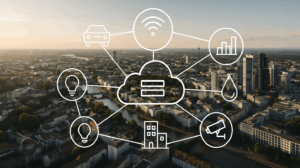
The development of dataMatters: From university spin-off to smart city pioneer
The story of dataMatters begins at RWTH Aachen University, where Dr. Daniel Trauth founded the company and later relocated it to Cologne. Originally launched in 2018 as senseering GmbH and renamed dataMatters in 2024, the company specializes in the practical application of artificial intelligence in the real economy. The founder pursues a deliberately down-to-earth approach: "We work in the real economy and are a real company that grows without venture capital, thanks to satisfied customers, instead of trying to get rich through the speculative poker game of the financial world," explains Dr. Trauth.
Unlike many AI startups that focus on generative AI for text, image, and video generation, dataMatters focuses on connecting AI with real-world infrastructure – from smart cities and smart factories to smart buildings. This approach has earned the company numerous awards, including the RWTH Spin-off Award 2019. Dr. Trauth now even advises the United Nations on smart city concepts as Co-Chairman of the "Real-World AI Forum" at the global think tank Diplomatic Council.
urbanOS: The digital operating system for modern cities
In early May 2025, dataMatters presented urbanOS, which it claims is the world's first dedicated operating system for smart cities. Similar to a computer or smartphone operating system, urbanOS organizes digital processes, but is specifically designed for the "smartification" of urban infrastructures – from traffic management and waste management to energy supply and public safety.
Technical architecture and functionality
The system is based on a multi-layered model with five interlocking levels:
- Sensors: A network of sensors collects real-time data on various urban aspects
- Connectivity: The collected data is transmitted to a municipal data space
- AI analytics: Artificial intelligence is used to analyze the data and create forecasts
- Visualization: The so-called urbanCockpit presents analyses and forecasts for decision-makers
- Automation: Optimized services for citizens and administration are being implemented
A key feature is the integrated app store, through which municipal utilities and private companies can offer their services. This modular structure makes urbanOS highly scalable and suitable for cities of all sizes – from small towns and medium-sized cities to megacities.
Application areas and success stories
The system offers diverse application possibilities, and municipal bodies are free to decide in which areas they wish to begin. Among the most popular applications are:
Intelligent waste management
A prime example of practical application is smart waste bins equipped with fill-level sensors. These transmit data to a central location, where waste disposal logistics are optimized. Pilot projects have shown that this has reduced costs by approximately 20 percent and the carbon footprint by around 30 percent. The company even commissioned an animated explainer video in pixel art style to clearly illustrate this complex technology.
Optimized public transport
Cameras on buses and trains allow for precise tracking of seat and standing room occupancy on specific routes and at specific times. Based on this data, AI can develop recommendations for optimizing public transport, taking into account events such as city festivals, football matches, and cultural events. "Citizens experience buses and trains running at precisely the right frequency, and the city operator benefits from more targeted staffing and cost optimization," explains Dr. Trauth.
Other areas of application
The spectrum ranges from parking management and monitoring of environmental parameters such as air quality, particulate matter, and CO2 to early warning systems for anomalies like extreme weather or burst pipes. In Dormagen, for example, sensors on streetlights record pollution and pedestrian traffic, which supports urban planning and environmental protection.
The urbanOS pilot program: Easy entry for municipalities
A particular advantage of the system lies in its cost-effective implementation model. Municipalities only need to install and commission the sensors on site. The data space, AI logic, and urbanCockpit can be provided by dataMatters, thus keeping the necessary initial investments low.
As part of a nine-month pilot program, interested municipalities receive, among other things, 50 ready-to-use sensors, access to urbanOS's data space and artificial intelligence, as well as an urbanCockpit tailored to their needs, featuring dashboards for various applications. "Most applicants are surprised at how straightforward and cost-effective it is to launch a test project," reports Dr. Trauth.
Current implementations
Since the beginning of June 2025, 25 cities in Germany have been connected to the "digital town hall" via sensors. These include Aachen, Auweiler, Bad Honnef, Coesfeld, Dormagen, Dülmen, Essen, Euskirchen, Frechen, Grevenbroich, Heiligenstedt, Hürth, Krefeld, Leverkusen, Lüdinghausen, Mönchengladbach, Munich, Nuremberg, Siegen, Singen, Solingen, St. Augustin, Weinheim, Widdersdorf, and Willich. According to international reports, the system is also being piloted in cities in Belgium, France, and the Netherlands.
Related to this:


Data protection and security in an urban context
In an era of increasing digitalization, data protection plays a central role. "Municipalities want a smart city – but not a surveillance city," emphasizes Dr. Trauth. The company therefore places great importance on adhering to strict data protection and security standards. No personal data is collected, and all operations take place exclusively in data centers located in Germany.
Future prospects and global significance
Rapid urbanization poses major challenges for cities worldwide. According to United Nations estimates, around 60 percent of the world's population will live in metropolitan areas by 2030. The associated problems can only be solved with smart infrastructure and artificial intelligence.
With the global smart city market expected to reach a volume of $4 trillion by 2030, dataMatters is strategically positioning itself in a promising sector. In particular, the markets for smart buildings ($100 billion), smart factories ($300 billion), and smart cities ($600 billion) offer enormous growth potential.
The digital transformation of urban space
The urbanOS system from dataMatters marks a significant advancement in the digital transformation of cities. By combining sensors, data analysis, and artificial intelligence, municipal processes are made more efficient, sustainable, and citizen-friendly.
“Many decision-makers only realize during the test phase the enormous advantages of not only seeing the current situation, which is impressive enough in itself, but also AI-based forecasts of what will happen in the city in the coming weeks and months,” explains Dr. Trauth. This transparency and foresight enables municipalities to act proactively rather than reactively and to use their resources optimally.
With the steady expansion of connected cities and the continuous development of the technology, urbanOS could make a significant contribution to overcoming urban challenges and set the standard for future smart city solutions.
Related to this:
Your global marketing and business development partner
☑️ Our business language is English or German
☑️ NEW: Correspondence in your native language!

Konrad Wolfenstein
I and my team are happy to be available to you as your personal advisor.
You can contact me by filling out the contact form here wolfenstein@xpert.digital:or simply call me at +49 7348 4088 965. My email address is
I'm looking forward to our joint project.