GEO and AEO: The evolution of SEO to AI-powered search engine optimization in the age of artificial intelligence – Image: Xpert.Digital
The future of search: Why SEO is no longer enough
Beyond SEO: Strategies for the next generation of search
With the rapid development of AI technologies and the changing search behavior of users, the digital landscape has fundamentally transformed. Traditional search engine optimization (SEO) is increasingly being complemented by new approaches such as Answer Engine Optimization (AEO) and Generative Engine Optimization (GEO). These new strategies respond to the changed way people search for information today – whether via voice assistants or AI-powered search engines.
Fundamentals of traditional search engine optimization (SEO)
Search engine optimization, or SEO for short, encompasses all technical and content-related measures aimed at improving a website's visibility in organic search results. SEO primarily focuses on optimizing for traditional search engines like Google, Bing, and Yahoo, and due to their market dominance, it is often referred to as "Google optimization.".
Traditional SEO comprises three main processes:
- Crawling: Search engines use bots to discover content by following links on the web
- Indexing: The found content is processed and stored in a database
- Ranking: When a search query is entered, relevant content is retrieved and ranked according to various factors
The main goal of SEO is to improve organic rankings in order to generate more website traffic and thereby achieve goals such as increased sales, higher brand awareness, or greater reach.
Traditional SEO strategies
SEO focuses on several key elements:
- Keywords and metadata for content relevance
- Technical optimizations for improved crawlability and performance
- Backlinks to increase authority
- User signals such as click-through rate and dwell time
Answer Engine Optimization (AEO): Optimization for direct answers
AEO stands for Answer Engine Optimization and represents an evolution of traditional SEO. This strategy has gained importance in recent years due to the rise of voice-activated search queries and devices like Alexa, Google Home, and Siri.
What is AEO?
AEO is an optimization approach that designs content to appear as direct answers to user queries in search engines and AI-powered platforms. Unlike traditional SEO, which focuses on website visits, AEO concentrates on ensuring content is displayed in features such as featured snippets, voice search results, or as direct answers.
Core principles of AEO
AEO is based on several key strategies:
- Structured data: Schema markup makes content easier for search engines to interpret
- User intent: Content is tailored to the user's intent, whether for general information or short answers
- Precision and clarity: Answers are direct, concise, and easy to understand
- Question-and-answer format: Content is structured to directly answer frequently asked questions
Meaning of AEO
AEO is gaining increasing relevance, as studies show that around 45% of Americans use voice search as the starting point for their shopping journey. With the rising use of voice assistants and the fact that approximately 60% of Google searches result in "zero clicks" (users get their answers directly from the snippets), AEO is becoming ever more important.
Generative Engine Optimization (GEO): Optimization for AI search engines
GEO (Generative Engine Optimization) is an innovative approach that aims to optimize content for generative AI models that not only link to websites but deliver complete, synthetically generated answers.
What is GEO?
GEO describes the optimization of web content specifically for AI-powered search engines such as SearchGPT, Perplexity, Microsoft Copilot, or Google Gemini. These systems analyze content in real time and provide context-related answers, often with source citations. The goal of GEO is to ensure that your content is preferentially cited or paraphrased.
GEO-Strategies
GEO uses various techniques for optimization:
- Contextual understanding: AI models analyze content for natural language and user intent, rather than just keywords
- Structured, trustworthy content: GEO ensures that content is semantically accessible, technically structured, and maximally trustworthy
- Authority and depth: GEO promotes comprehensive, authoritative content that is considered a reliable source for AI models
- Natural language: Content is written in natural, NLP-friendly language
Why GEO is important
The growing popularity of AI-powered search engines is fundamentally changing the rules of digital visibility. For example, since December 2024, ChatGPT's real-time online search has been available for all versions, significantly increasing the importance of GEO. With the integration of AI into search engines like Google SGE (Search Generative Experience), the SEO world is facing a fundamental transformation in 2025.
SEO, AEO and GEO in direct comparison
To better understand the differences between these three approaches, here is a direct comparison:
Goals and Focus
- SEO: Aims for higher rankings in organic search results to drive traffic to the website
- AEO: Focused on providing direct answers to user questions in featured snippets and voice search
- GEO: Aims for the consideration and correct citation of content in AI-generated answers
Target platforms
- SEO: Traditional search engines like Google, Bing, Yahoo
- AEO: Voice Assistants, Featured Snippets, Voice Search
- GEO: AI-powered generative search engines such as ChatGPT, Google SGE, Perplexity, Copilot
Optimization methods
- SEO: Keywords, backlinks, technical optimization, user signals
- AEO: Structured data, FAQ format, semantic optimization
- GEO: Context understanding, trustworthy content, natural language, structuring for AI extraction
Content strategy
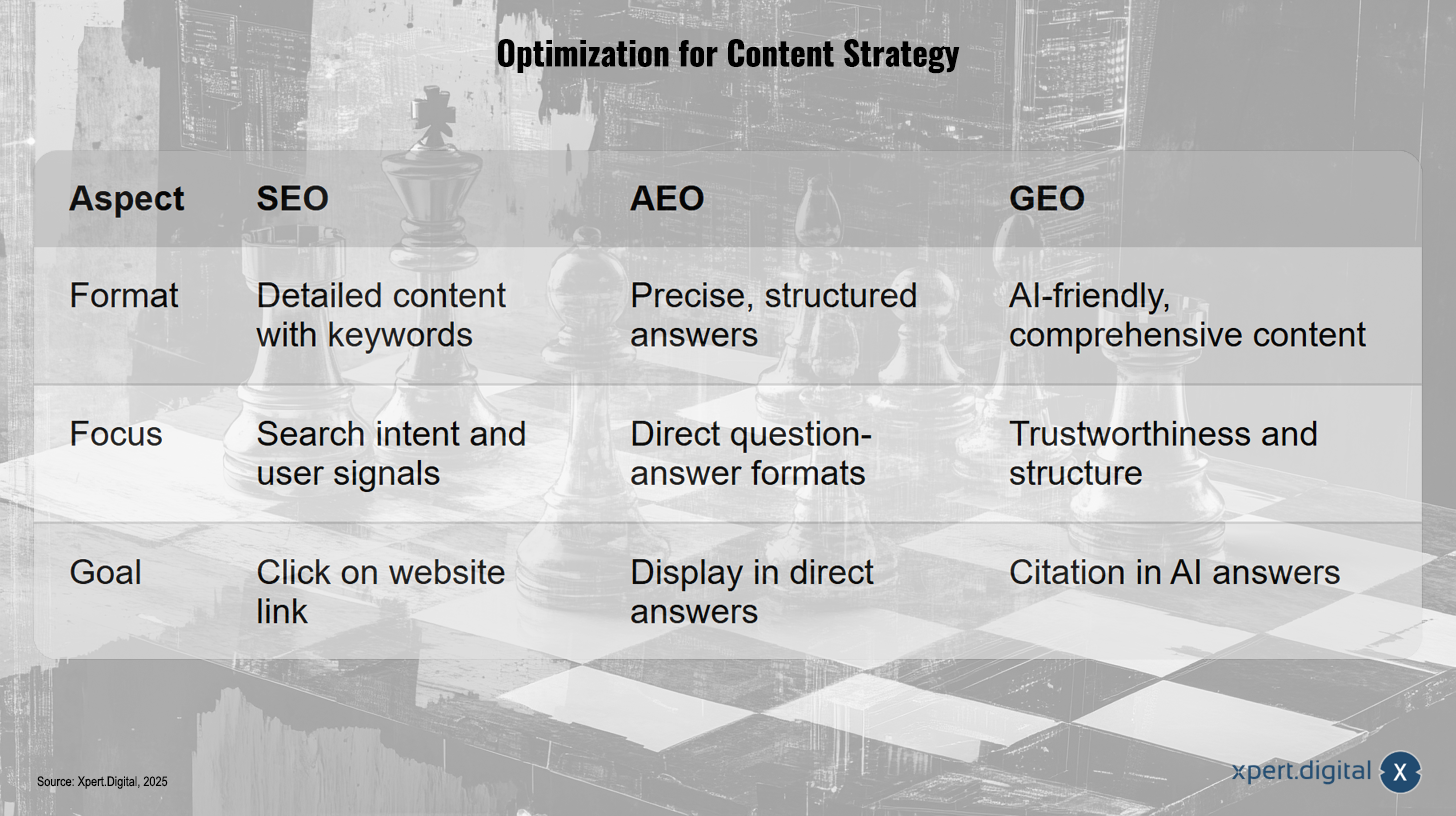
Content strategy – Image: Xpert.Digital
Content strategy can be viewed from three different perspectives: SEO, AEO, and GEO. SEO focuses on detailed content with keywords that address search intent and user signals to generate clicks on the website link. AEO, on the other hand, concentrates on precise, structured answers and direct question-and-answer formats, with the goal of appearing in direct responses. GEO relies on AI-friendly, comprehensive content that prioritizes trustworthiness and structure, with the aim of being cited in AI responses.
The integrated strategy: SEO + AEO + GEO
The modern strategy is not "SEO vs. AEO vs. GEO", but rather "SEO + AEO + GEO". Each of these approaches has its own relevance and application, and together they form a comprehensive digital presence.
Common basis: Quality content
All three strategies share a common foundation: high-quality content. Comprehensive content serves both traditional ranking purposes and as extraction material for AI. The EEAT principles (Expertise, Experience, Authority, and Trustworthiness) are important for all three approaches.
Practical implementation of an integrated strategy
An effective integrated strategy includes:
- Structuring content: Clear headings (H2, H3) improve both readability for SEO and extraction points for AI systems
- FAQ sections: Fulfill the potential for featured snippets while providing direct answers that AI can reference
- Structured data: Improve SEO through rich results and simultaneously make information more analyzable for AI systems
- Focus on natural language: Including natural language questions that are relevant to both AEO and GEO
The future of search optimization
The search landscape is undergoing a fundamental transformation, driven by AI technologies and changing user behavior. SEO, AEO, and GEO are not competing but complementary strategies that together ensure a comprehensive online presence.
In the future, the importance of AEO and GEO is expected to increase further as more and more people use voice assistants and AI-powered search engines. Nevertheless, traditional SEO will continue to play a vital role, as billions of people will still search for information in the conventional way.
For businesses and content creators, this means they should pursue an integrated approach that considers all three strategies to remain visible in the evolving digital landscape. The future of search optimization lies not in choosing between SEO, AEO, or GEO, but in skillfully combining all three approaches to create a comprehensive digital presence.
Related to this:
Your global marketing and business development partner
☑️ Our business language is English or German
☑️ NEW: Correspondence in your native language!

Konrad Wolfenstein
I and my team are happy to be available to you as your personal advisor.
You can contact me by filling out the contact form here wolfenstein@xpert.digital:or simply call me at +49 7348 4088 965. My email address is
I'm looking forward to our joint project.