


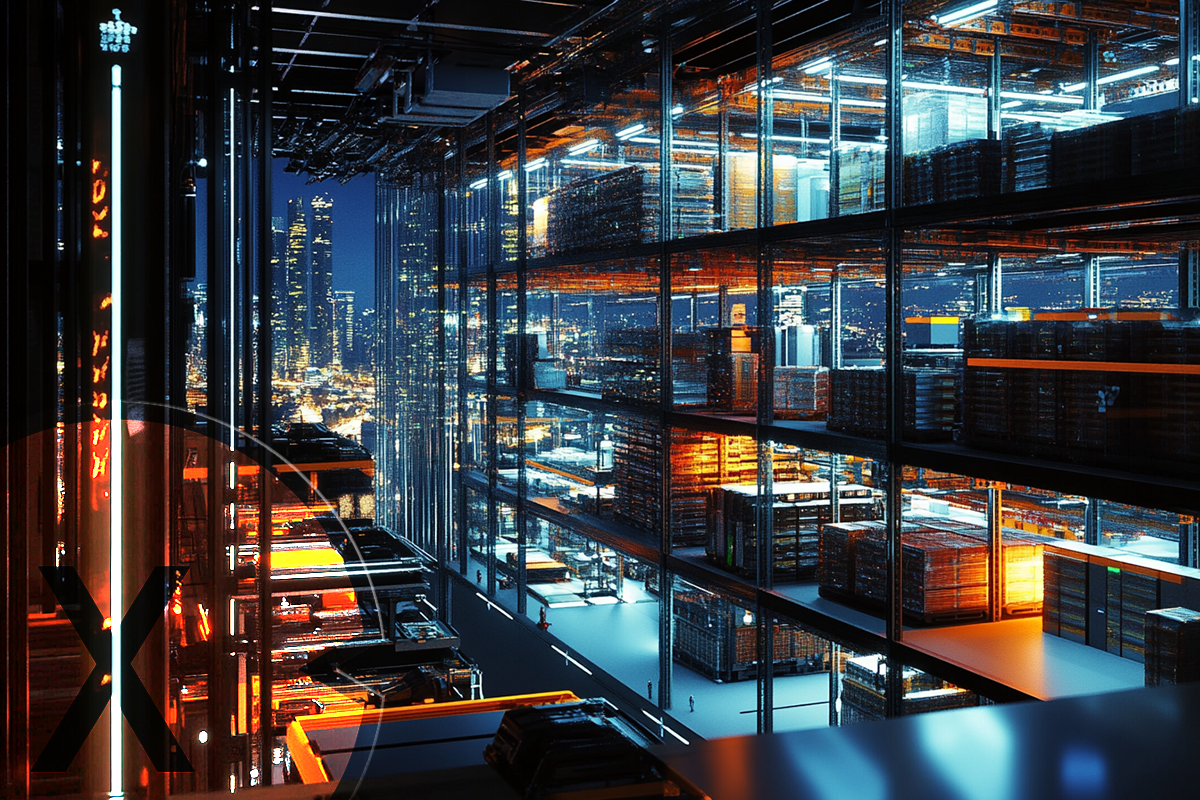
Nearshoring and buffer storage – For logistics optimization and cost reduction – For smart city and smart factory solutions – Image: Xpert.Digital
The future of logistics: Strategies for a stable and ecological supply chain
Nearshoring and buffer storage: Paths to more sustainable logistics
The rapidly changing world of logistics is becoming an increasingly essential factor for the success of modern companies. Global supply chains have come under increasing pressure in recent years, whether due to geopolitical tensions, the pandemic, or new environmental standards. Companies today face the challenge of making their logistics structures future-proof, cost-efficient, and sustainable. Two key strategies that are gaining importance in this context are nearshoring and buffer storage, particularly in conjunction with innovative approaches such as smart cities and smart factories. This approach not only enables improved adaptability to external disruptions but also promotes more sustainable and efficient value creation.
The need for new logistics strategies in a dynamic world
Traditionally, many companies have relied on offshoring to take advantage of cost-effective production locations. In recent decades, it has been common practice to relocate production facilities to distant countries like China or India to benefit from lower labor costs and large production capacities. However, this strategy has significant drawbacks, particularly regarding flexibility and responsiveness to market changes or global crises. Longer supply chains and higher transportation costs create increasing risks that can ultimately jeopardize reliability and cost stability.
Related to this:
Nearshoring: Relocating production closer to the market
One of the most promising answers to these challenges is the concept of nearshoring, where production facilities are located geographically close to sales markets. The advantage is obvious: Shorter transport routes not only reduce delivery times but also dependence on international freight routes, which are increasingly affected by geopolitical conflicts and environmental regulations. At the same time, CO₂ emissions decrease due to reduced transport costs, helping companies achieve their sustainability goals. This is a particularly important aspect in Europe, as regulatory requirements for companies' carbon footprints are becoming increasingly stringent.
Another strength of nearshoring lies in the increased agility of supply chains. Companies can react more quickly to changes in demand and adjust their production volumes without being burdened by long delivery times and costly transportation. In industries characterized by short product lifecycles and high innovation pressure, such as electronics or automotive, nearshoring can be a decisive competitive advantage.
Buffer storage: Resilience and flexibility through optimized warehousing
In addition to nearshoring, buffer warehouses are gaining importance as an essential component of modern logistics strategies. A buffer warehouse is an additional warehouse established near production or sales markets to absorb supply fluctuations. By setting up such warehouses, companies can make their supply chains more resilient to disruptions caused, for example, by natural disasters, political tensions, or sudden spikes in demand.
A well-organized buffer warehouse enables companies to manage their inventory more flexibly and efficiently. Modern technologies, such as big data and predictive analytics, play a crucial role in this. Data-driven forecasts allow companies to accurately predict when and in what quantity products will be needed, thereby optimizing inventory management. This not only reduces the costs associated with excess inventory but also minimizes the risk of supply bottlenecks that could disrupt production.
Related to this:
The role of smart cities and smart factories in future-oriented logistics
The concepts of the Smart City and the Smart Factory are closely linked to modern logistics strategies such as nearshoring and buffer storage. A Smart City utilizes digital technologies to improve infrastructure and urban life, which is also crucial for logistics. Intelligent traffic management systems and automated delivery processes can increase the efficiency and sustainability of logistics in urban centers. Deliveries can be planned more precisely, traffic congestion avoided, and the CO₂ balance improved through shorter routes and optimized transport logistics.
Smart factories, on the other hand, rely on automation and digitalization within production facilities. The use of Internet of Things (IoT) technologies, artificial intelligence, and robotic process automation (RPA) enables more responsive and efficient production. In a smart factory, all production processes can be monitored and optimized in real time, which in turn creates the basis for seamless just-in-time production. Nearshoring and buffer storage fit perfectly into this framework, as they ensure the smart factory's supply of the necessary materials and components.
Seamlessly integrating smart factories with buffer storage and nearshoring structures significantly increases the efficiency of the entire value chain. Short-term production adjustments to market fluctuations become possible without production downtime or unnecessary storage costs.
An overview of the advantages of nearshoring and buffer storage for smart cities and smart factories
The implementation of nearshoring and buffer storage offers numerous advantages for companies that rely on smart city and smart factory solutions:
1. Cost reduction
Shorter transport routes and optimized warehousing can significantly reduce logistics costs. This contributes to profitability and competitiveness.
2. Sustainability
Reducing transport distances lowers CO₂ emissions, which is becoming increasingly important in times of ESG (Environmental, Social, and Governance) requirements. Companies can more easily achieve their sustainability goals and thus make a positive contribution to environmental protection.
3. Increased resilience
Proximity to markets and the availability of buffer stocks make companies more resilient against unforeseen events, such as natural disasters, geopolitical crises, or supply chain disruptions.
4. Agility and flexibility
Nearshoring enables faster adaptation to fluctuations in demand and market changes. In combination with smart factory technologies, production can be aligned with the current market situation in real time.
5. Improved security of supply
Buffer stocks provide additional security for the supply chain. Even in the event of unexpected delays, production can continue without bottlenecks.
6. Innovation promotion
Proximity to markets and integration into a networked smart factory environment provide an excellent foundation for innovation processes. Companies can react more quickly to new technologies and market trends, thereby strengthening their market position.
Challenges in implementation and how they can be overcome
Despite its numerous advantages, implementing nearshoring and buffer storage also presents challenges. A key aspect is the high initial investment required to relocate production sites and build up warehouse capacity. Companies must initially invest capital in new locations, technologies, and training. However, in the long run, these costs are recouped through the benefits of a more flexible and efficient logistics structure.
Another obstacle can be the shortage of skilled workers, particularly in the areas of automation and digitalization. Here, it is essential for companies to invest in the further training of their employees and to enter into strategic partnerships with educational institutions. This helps to build the necessary skills and secure access to qualified personnel.
How nearshoring and buffer storage will sustainably change logistics
Increasing digitalization and the trend towards localizing production facilities will fundamentally change logistics in the coming years. Nearshoring and buffer storage form the foundation of a resilient and flexible supply chain capable of responding to changing market conditions and promoting sustainable business practices.
With the ongoing development of technologies such as IoT, Big Data, and Artificial Intelligence, the efficiency of logistics processes will continue to increase. Combined with Smart City and Smart Factory approaches, this will not only reduce costs but also minimize environmental impact. These technologies enable companies to achieve a high degree of transparency and control over their entire supply chain, which is invaluable in a dynamic and globalized world.
Nearshoring and buffer storage are key components of a modern logistics strategy that addresses the challenges and opportunities of digitalization and globalization. Companies that adopt these strategies early on and skillfully integrate them into their value chain benefit from increased resilience, sustainability, and flexibility. This allows them not only to enhance their competitiveness in the global market but also to make a valuable contribution to more sustainable development. By using nearshoring and buffer storage, companies can shorten supply chains, improving both their responsiveness to market changes and the efficiency of their inventory management. This leads to a reduction in transport distances and associated emissions, which has a positive impact on their environmental footprint.
Furthermore, nearshoring enables closer collaboration with geographically close suppliers and customers, fostering innovation and adaptation to local market needs. Integrating these strategies can also facilitate the use of technologies such as artificial intelligence and automation, thereby further optimizing processes and utilizing resources more efficiently.
Related to this: