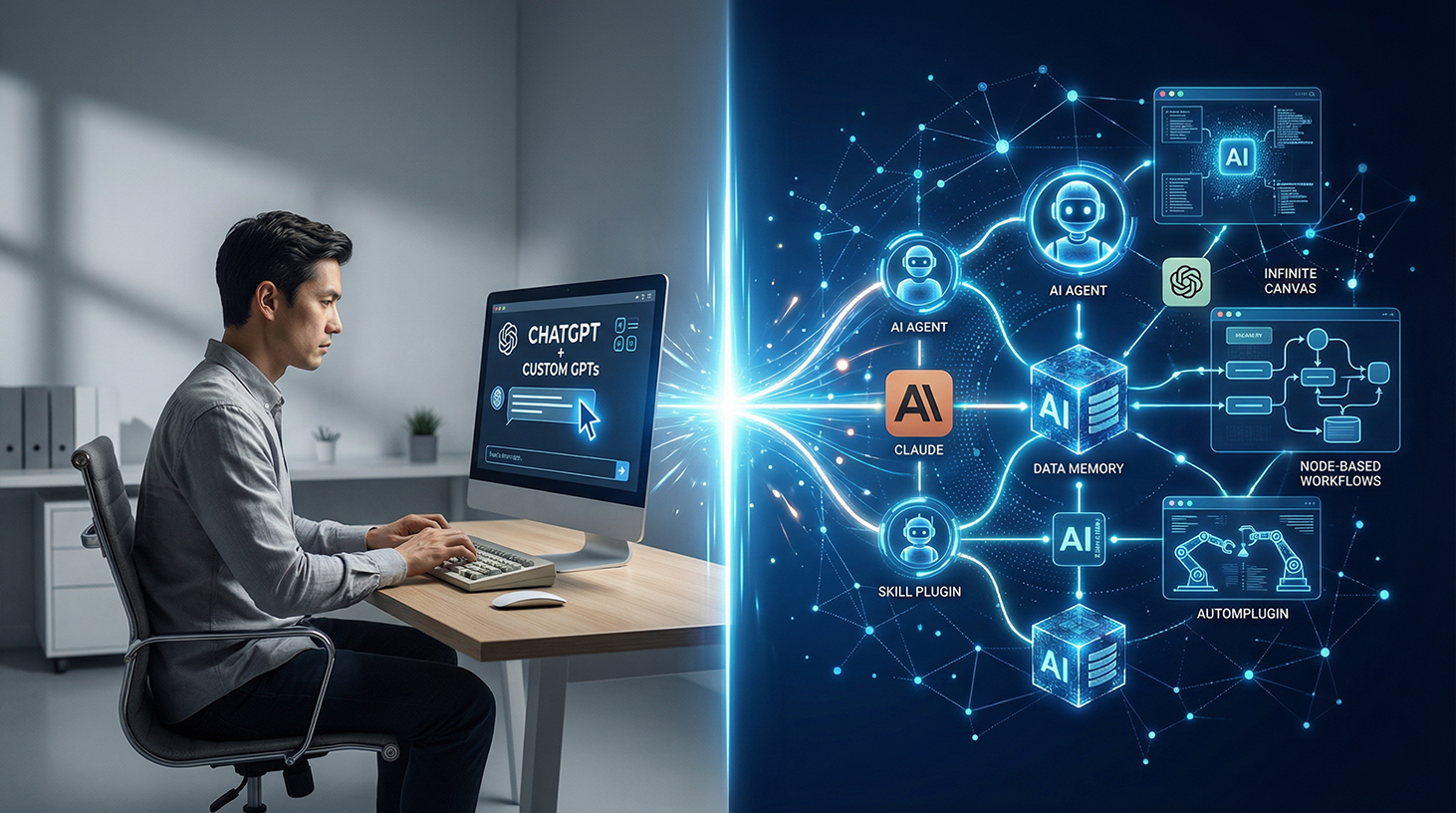
From tool to co-thinker: Why we are using AI completely wrong (and what will change in 2026) – Image: Xpert.Digital
800,000 jobs in transition: Who will benefit from the new AI trend in 2026 – and who will lose out?
The end of the input field era: How autonomous AI agents are now revolutionizing entire departments
AI with memory: This seemingly insignificant step will change our entire working world in 2026
Two years after ChatGPT's breakthrough, we stand before an invisible but fundamental turning point. Until now, we have treated artificial intelligence like a highly sophisticated calculator: we type in a question, wait for the answer, copy the result, and start from scratch next time. But this model of the isolated, reactive tool—which still dominated the working world in 2025—is long outdated. In 2026, the biggest paradigm shift since the invention of the internet will take place: the evolution of AI from a mere tool to a thinking, agentive system.
Technologies such as persistent memory, modular skills, and autonomous "agentic AI" are transforming digital assistants into proactive employees. They understand the company context, independently manage processes across various programs, and make decisions in fractions of a second. This development is far more than a technological update; it represents a watershed in the economy. Studies predict a value creation potential of up to €440 billion for Germany and a massive structural transformation of the labor market that will change hundreds of thousands of jobs. The following analysis examines why companies and employees who still view AI as a mere "input-output tool" are falling behind—and how to successfully transition to the age of systems AI.
Related to this:

AI 2026: From tool to thinking system – An economic analysis of the biggest paradigm shift since the Internet
We are still using the most powerful technology since industrialization like a glorified calculator – and in doing so, we are wasting trillions in value creation potential.
The end of the input field era: Why 2025 is already history
Anyone who worked with an AI chatbot in 2025 will be familiar with the ritual: open a window, formulate a task, copy the answer, close the window, and continue working in the next program. For each new session, the AI begins without any knowledge of the person sitting opposite it. No context. No continuity. No memory. This model of the isolated, reactive tool has shaped the majority of AI adoption since 2022 – and its basic logic still reflects what the majority of users and companies worldwide practice. The paradox is that the technology itself has since evolved fundamentally. The problem isn't with AI; the problem is the mindset with which we approach it.
The accompanying infographic condenses this idea into a productively provocative formula: In 2025, AI was a tool operated by humans. In 2026, AI is a system that works with humans. This semantic difference is far more than a marketing promise—it describes a fundamental reorganization of human-machine interaction, one that will have significant economic, labor market, and societal consequences. This analysis delves into the reasons for this transformation, places it within its macroeconomic context, and examines its concrete implications for companies, employees, and economic policy.
The six faces of the old paradigm: What 2025 really was
To understand where AI is headed, it's worth taking an honest look back at its state in 2025. The infographic in the appendix identifies six domains in which AI has already been used productively – and at the same time shows the structural limitations that characterized this use.
In the realm of AI chatbots—especially ChatGPT and its custom GPTs—productive use primarily meant manual effort. Users had to manually select the appropriate model for each specific task, rebuild contexts from session to session, and could never run multiple GPT instances simultaneously. The assistant was intelligent, but forgetful and insular. For presentations and documents, tools like Gamma allowed for impressive automated results, but each new document had to be completely manually populated, structured, and adapted—contextual knowledge from previous projects went unused. In image and video generation with Midjourney, intensive prompt engineering was the price of any reasonably accurate output. Each image required a quasi-separate creative restart; consistency across project contexts was structurally almost impossible. While automation tools like Zapier and n8n represented a serious approach to process automation, they required significant technical setup knowledge and necessitated the completely manual construction of each workflow. While Microsoft Copilot could efficiently process Office documents, the system remained contextually limited and its performance was regularly disappointing when dealing with truly complex, multi-stage tasks.
The common thread running through these six tool categories is that each operates on the principle of isolated, individual calls. The user must take action, provide knowledge, and manually share results. The AI reacts—it doesn't act. It doesn't store, it doesn't anticipate, it doesn't coordinate. This architecture isn't the result of technological limitations. It's the result of a mindset that conceives of AI as a productivity tool, not as an infrastructure component of a system based on the division of labor.
Memory as an economic production factor: What memory really means in AI
Perhaps the most underestimated step in AI evolution is the introduction of persistent memory functions. Anthropic's Claude received a memory function in August 2025 that can retrieve past conversations at the user's explicit request and integrate them into new work contexts. At first glance, this sounds like a convenient little feature. Economically speaking, however, it is revolutionary.
In modern knowledge work, knowledge is the decisive production factor. What distinguishes an experienced employee from a newcomer is not primarily intelligence – it is accumulated context: knowledge of the company's language, customer preferences, and the substantive history of ongoing projects. An AI system without memory is structurally like a highly qualified consultant who receives a new briefing for every conversation. The time spent on this constant rebriefing adds up considerably in real-world practice. Claude's memory function takes a different approach than OpenAI's ChatGPT, which automatically builds a user profile: Claude only accesses past conversations when the user explicitly requests it and does not create a permanent profile without consent. In March 2026, Anthropic went a step further and offered a free memory import, allowing users to transfer their entire ChatGPT-built context to Claude.
The economic logic behind this is clear: A system that knows its user's preferences, ongoing projects, and individual work style amortizes its investment significantly faster than a system that starts from scratch every day. For companies with intensive knowledge work—consulting firms, law firms, creative agencies, research departments—this difference represents the gap between marginal benefits and genuine transformative impact. It's no coincidence that Anthropic initially rolled out the memory function for Enterprise and Team subscriptions: The economic value of persistent AI continuity is most directly measurable in these subscriptions.
Specialization through modular intelligence: The principle of skills and plugins
Besides memory, the second structural innovation of 2025/2026 is the introduction of modular, reusable skill packages. Anthropic referred to this innovation for Claude as Agent Skills. The basic idea is technically elegant and economically significant: Instead of repeatedly instructing Claude from scratch on how to handle a specific task—such as processing complex PDFs, adhering to a particular brand style, or analyzing financial reports according to a defined scheme—these expertise packages are created once as so-called Skills. Claude loads them automatically as needed and can use multiple Skills in combination.
What makes Claude's skill architecture unique is its cross-platform portability: Once created, a skill works in the Claude web application, the Claude desktop program, Claude Code, and via the API. This makes skills true infrastructure components – comparable to libraries in software development or standardized process manuals in traditional companies. In parallel, Anthropic Claude Cowork introduced plugins that transform Claude into an expert tailored to specific professional fields: sales, legal, finance, customer service – each area with its own plugin bundle of skills, commands, and tool connections.
The measurable results of early implementations are remarkable. In the financial sector, one company reported a fivefold acceleration in review processes, coupled with an increase in data accuracy from 75 to over 90 percent. Norway's sovereign wealth fund NBIM and the insurance group AIG are among the documented users who achieved significant productivity gains through Anthropic's modular skill architecture. These figures illustrate what economists call the economies of scale of knowledge: The investment in the one-time development of a high-quality skill pays off across all future use cases—a principle that corresponds to the establishment of specialized production lines in traditional manufacturing.
Creative Infrastructure: When Visual Workflows Become Capital
An often underestimated sector of AI transformation is the creative economy. Here, Freepik Spaces, the node-based canvas system launched in November 2025, demonstrates how the tool-to-system principle is implemented in practice. Where in 2025 every visual production task—generating an image, editing it, upscaling it, deriving a video—required a separate tool and separate manual intervention, Freepik Spaces enables the construction of reusable, automated workflows on a single collaborative workspace.
The economic dimension of this approach lies in the capitalization of workflow intelligence. A company that has configured its entire creative production process—from prompt creation and image generation to upscaling and video derivation—as a reusable Freepik space possesses a production asset. This space can be shared, collaboratively refined, applied to new projects, and used consistently across the team. This represents a fundamentally different relationship to creative AI than that of the individual prompt engineer who starts their creative work from scratch every day. In parallel, platforms like Krea, ImagineArt, and Runway are pursuing similar canvas-based workflow approaches, signaling the emergence of an industry standard for professional AI-driven creative production.
Agentic AI: The quantum leap from assistant to autonomous actor
The term that will dominate the corporate IT landscape like no other in 2026 is Agentic AI – agentic artificial intelligence. This refers to AI systems that do not wait for a human command to execute a single task, but instead independently pursue multi-stage goals, switching between different software systems, accessing external services, and making decisions autonomously within defined parameters.
The Lenovo CIO Playbook 2026, based on the assessments of 800 IT and business decision-makers in Europe and the Middle East, states unequivocally: Agentic AI will replace Generative AI as the top priority for CIOs in 2026. 65 percent of companies plan to scale agentic AI into their business processes within the next twelve months. European CIOs expect an average return on investment of $2.78 per dollar invested in AI infrastructure. German companies are nearly identical, with an expectation of $2.75 per dollar invested.
The consequences for business organization are profound. Gartner describes multi-agent systems and physical AI as key strategic trends for 2026. Practical examples: A maintenance agent communicates autonomously with a planning agent, who in turn communicates with a procurement agent – the entire service process is orchestrated without a human having to manually initiate each step. Customer support requests are handled completely without human intervention. Marketing budgets are reallocated in real time based on performance data. Contracts are drafted and automatically forwarded for electronic signature. What was still a pilot project and proof of concept in 2025 will be in series production by 2026.
Of course, it would be misleading to describe this development without considering its structural limitations. Gartner simultaneously predicts that around 40 percent of all agent-based AI projects will be discontinued by 2027. The reason lies less in technological shortcomings than in insufficient organizational preparation: a lack of governance concepts, unclear responsibilities, and poor data quality. While 47 percent of companies in Germany are already actively using AI, only 27 percent have a comprehensive governance concept. This represents a strategic gap that could prove costly in the medium term.
A new dimension of digital transformation with 'Managed AI' (Artificial Intelligence) - Platform & B2B solution | Xpert Consulting

A new dimension of digital transformation with 'Managed AI' (Artificial Intelligence) – Platform & B2B solution | Xpert Consulting - Image: Xpert.Digital
Here you will learn how your company can implement customized AI solutions quickly, securely and without high entry barriers.
A managed AI platform is your all-inclusive, worry-free solution for artificial intelligence. Instead of dealing with complex technology, expensive infrastructure, and lengthy development processes, you receive a ready-made solution tailored to your needs from a specialized partner – often within just a few days.
The key advantages at a glance:
⚡ Rapid implementation: From idea to ready-to-use application in days, not months. We deliver practical solutions that create immediate added value.
🔒 Maximum data security: Your sensitive data stays with you. We guarantee secure and compliant processing without sharing data with third parties.
💸 No financial risk: You only pay for results. High upfront investments in hardware, software, or personnel are completely eliminated.
🎯 Focus on your core business: Concentrate on what you do best. We take care of the entire technical implementation, operation, and maintenance of your AI solution.
📈 Future-proof & scalable: Your AI grows with you. We ensure continuous optimization and scalability, and flexibly adapt the models to new requirements.
More information here:
The AI operating system is coming: What will really change the world of work after ChatGPT?
Perplexity Computer and Claude Code: When AI Takes Over the Keyboard
Two recent developments deserve special attention because they elevate human-machine interaction to a new level of abstraction. The "Perplexity Computer" mentioned in the infographic represents a new category of AI interface: less technical, faster to implement, and directly controllable from natural language. While automation platforms like n8n require significant technical expertise, this approach targets the vast majority of knowledge workers who are not developers but still want to benefit from AI-powered process automation. For more complex scenarios requiring actual programming logic, n8n or Zapier are still recommended as complementary tools.
Claude Code represents the more technically sophisticated option. As a tool for software-savvy users and development teams, it offers direct file access, an understanding of project contexts beyond individual documents, and significantly higher performance for complex coding tasks than conventional chatbot interfaces. Claude Code's economic relevance lies in accelerating the software development process: The IBM study from October 2025, based on a survey of 3,500 executives in ten countries, identifies software development and IT as the area with the greatest AI-related productivity gains in Germany, ahead of customer service and account management. 62 percent of German companies have already reported significant productivity increases through the use of AI.
Related to this:
The macroeconomic dimension: What's at stake
The overall economic significance of the AI paradigm shift is difficult to overstate. An expansion of Google's "Digital Factor" study, published in February 2026—arguably the most comprehensive analysis of this topic for the German economy—estimates the value creation potential achievable through generative AI in Germany at approximately €440 billion by 2034. Of this, €330 billion is attributable to productivity gains in companies and public administration, and a further €110 billion to new innovation potential unlocked by AI through the acceleration of research and development. The German Economic Institute (IW) calculated, based on similar data, that up to €4.5 trillion in additional value creation could be generated cumulatively over 15 years if AI is widely and consistently deployed in Germany. Globally, McKinsey estimates the AI potential at up to US$13 trillion in additional global economic output by 2030.
These figures provide a context that makes the tool-to-system approach appear less like a matter of technological preference and more like a strategic decision with considerable economic leverage. The IW report commissioned by the DIHK (Association of German Chambers of Industry and Commerce) models average annual economic growth of 0.8 percentage points higher than the status quo for the AI scenario. For an economy the size of Germany, which has been struggling with structural growth weaknesses for years, this is a significant difference. The productivity findings of the PwC study from 2025 reinforce this picture: In the sectors most affected by AI, productivity growth has quadrupled since the widespread adoption of generative AI in 2022.
The current adoption rate does not yet fully reflect this potential. According to the Workday blog, around 11 to 13 percent of German companies were using AI productively in 2023; by 2025, this figure is expected to rise to over 40 percent, and even to 42 percent in the manufacturing sector. The ifo Institute confirms this upward trend, reporting an AI adoption rate of over 40 percent among German companies by summer 2025, compared to 27 percent the previous year. However, the crucial question is not how many companies are using AI tools, but rather how many have actually transitioned to the systems paradigm. Here, it becomes clear that the vast majority of companies are still operating in a reactive mode of tool deployment – and thus missing out on the structurally transformative value creation effects.
The labor market under systemic conditions: Who benefits, who loses?
The question of the labor market effects of the AI paradigm shift is the most pressing societal issue. The available studies paint a nuanced picture that confirms neither the naive hope for pure job gains nor the apocalyptic thesis of job destruction. In their joint study, the Federal Institute for Vocational Education and Training (BIBB), the Institute for Employment Research (IAB), and the GWS project that around 800,000 jobs could be lost to AI in Germany within the next 15 years – while at the same time around 800,000 new jobs are created. On balance, this amounts to a zero-sum game in terms of absolute employment figures. However, behind this aggregate figure lies a massive structural transformation.
AI could automate over two-thirds of the tasks associated with roughly 37 percent of all jobs in Germany. This primarily affects routine tasks in offices, administration, and standardized manufacturing processes. According to GWS modeling, around 1.6 million jobs will be affected by AI-induced structural change in the long term, either being created or lost. Experts warn of regional disruptions, particularly in eastern Germany, where manufacturing jobs and supplier companies account for an above-average share of employment. The Federal Statistical Office reported a total of around 46 million employed persons in Germany for 2025 – a slight decrease compared to the previous year, marking the first end to years of job growth. This stagnation cannot be attributed solely to AI, but it can certainly be seen as a harbinger of structural change.
The transition from AI tool to AI system intensifies this dynamic in a specific way that is often overlooked in public debate: While tool AI primarily accelerates individual tasks, thus tending to free up higher-value work, agentic AI can handle entire process chains without human intervention. This is not the same thing. A clerk who works faster with the help of an AI tool remains in the value chain. An agentic AI system that handles all the processing independently completely replaces the position. Indeed's Jobs & Hiring Outlook Report 2026 identifies 2026 as the year of widespread structural change in the German labor market, with AI skills becoming a basic requirement far beyond the tech sector, now encompassing HR, marketing, and finance departments.
The distribution of gains and losses is by no means random. PwC data shows that employees who actively integrate AI into their work become more productive and earn higher salaries, while the number of jobs initially increases precisely in the most automatable sectors – because AI opens up new markets and business models that, in turn, require people for higher-value tasks. The decisive variable for individual job market opportunities is therefore no longer the industry, but the willingness and ability to actively shape AI systems instead of passively enduring them.
Automation infrastructure as a strategic asset: n8n, Zapier and the new business administration
The tool-to-system perspective is also changing the evaluation logic for automation infrastructure in companies. Platforms like n8n and Zapier were considered technical aids for individual workflow optimization in 2025. In the systems paradigm, they become strategic infrastructure components through which AI agents are coordinated.
n8n, modeled as a fair-code platform for technical teams, achieved a valuation of $1.5 billion by mid-2025 – a clear indicator of investor confidence in the growing economic relevance of automation infrastructure. The platform allows for self-hosted operating models with complete data sovereignty, which represents a significant compliance advantage for German companies given GDPR requirements. Zapier, on the other hand, positions itself as a cloud-native AI orchestration platform that requires no in-house infrastructure maintenance, thus lowering the barrier to entry for mid-sized companies.
The economically relevant question in this context is not which platform offers the better features, but rather how quickly companies can transition from the tool-driven logic of ad-hoc zaps to the system-driven logic of integrated agent orchestration. A company that views its n8n workflows as strategic capital, regularly refines them, and connects them with AI agents creates a competitive advantage that laggards will struggle to catch up with. Automation expertise thus becomes a production factor similar to brand knowledge or customer data – difficult to imitate over time and a significant value driver.
Governance as a blind spot: The strategic gap in the German AI ecosystem
A sober economic analysis of the AI transformation cannot ignore the structural weaknesses of its adoption in Germany. Despite significant progress in adoption rates, a dangerous gap exists between the use of AI tools and the strategically sound operation of AI systems. Only 27 percent of companies in Europe and the Middle East – and the situation in Germany is not fundamentally different – have a comprehensive AI governance concept.
In this context, governance means more than compliance checklists. It's about who in the company is responsible for AI decisions, how the quality of AI expenditures is verified, how data pipelines are secured, and how errors by autonomous agents are handled. Without these foundations, agentic AI systems regularly fail not because of the technology itself, but because of organizational friction. Gartner's prediction that around 40 percent of all agentic AI projects will be discontinued by 2027 is, in this light, less a testament to technological immaturity than an indicator of the governance gap that pervades many companies.
Added to this is the question of digital infrastructure. The IW report commissioned by the DIHK (Association of German Chambers of Industry and Commerce) makes it clear that broadband infrastructure, data center capacities, and available AI specialists are the crucial prerequisites for productive AI effects. Germany has structural deficits in this area that cannot be remedied by corporate initiative alone. The shortage of skilled workers is measurable: In 2023, unfilled positions in Germany corresponded to an economic loss of around 1.3 percent of GDP – approximately 339 billion US dollars in unrealized economic output. AI can partially close this gap in the medium term, but initially requires highly qualified specialists for implementation and operation. At the end of 2025, there were more than 900 AI startups in Germany – a significant increase compared to the previous year – which demonstrates the growing ecosystem and the demand for AI expertise.
The AI operating system as the next stage of development: What comes after the agents?
When tools become systems and systems become infrastructure, another stage of evolution is on the horizon: AI as the company's operating system. This term, which is increasingly circulating in strategy circles, describes an architecture in which AI does not take over individual tasks or automate individual processes, but rather coordinates the entire business logic – from procurement and production to sales and customer service.
Specifically, as analysts from Gartner and IFS describe, this means the emergence of hybrid workforces in which human employees and AI agents collaborate as equal team members. Maintenance agents communicate with planning agents, procurement agents coordinate with logistics agents, and humans retain strategic control, define goals, and monitor quality—but they are no longer the operational bottleneck in the execution chain. According to current best practices, companies that consistently implement this architecture achieve savings of 8 to 12 percent in the first twelve months in energy-intensive industries solely through AI-based energy management systems.
Mechanical engineering, a traditional strength of German industry, is developing Manufacturing-as-a-Service offerings in this context, where production, maintenance, and data analysis merge into an integrated service package. AI platforms are becoming scalable machine intelligence for companies that cannot or do not want to build their own data science department. Supply chains are being transformed into living systems by combining predictive models with satellite imagery, reacting to events before they become visible in traditional reporting cycles. This is no longer science fiction – it is the state of the art for early adopters in 2026.
Related to this:


Anyone still managing tools today is missing the next level
The infographic that inspired this article succinctly summarizes its conclusion: In 2025, AI was a tool to be used. In 2026, AI will be a system that collaborates. The economic analysis confirms and expands upon this thesis on several levels.
First, the shift from tool to system is not a linear upgrade, but a paradigm shift requiring different organizational logics, investment priorities, and skills. Companies that equate AI adoption with tool acquisition will fail to realize the transformative productivity effects. Second, the economic stakes are enormous. Value creation potentials linked to the adoption of the systems paradigm, not the mere use of tools, have been identified as ranging from €440 billion (Germany, by 2034) to US$13 trillion (global, by 2030). Third, the labor market will undergo structural reorganization, not collapse—but this restructuring will be faster and more profound than many companies and employees are prepared for. Fourth, the companies that manage the transition consistently—with thoughtful governance, a clear infrastructure strategy, and an understanding of AI as a system component rather than a mere tool—will define the competitive landscape over the next five to ten years.
The crucial question is not whether AI will become a system. It already is. The crucial question is which companies and economies will be among those that actively shaped this transformation at the end of this decade – and which managed it until it was too late.
Consulting - Planning - Implementation

Konrad Wolfenstein
I would be happy to serve as your personal advisor.
You can contact me at wolfenstein∂xpert.digital or
Just call me on +49 7348 4088 965 .