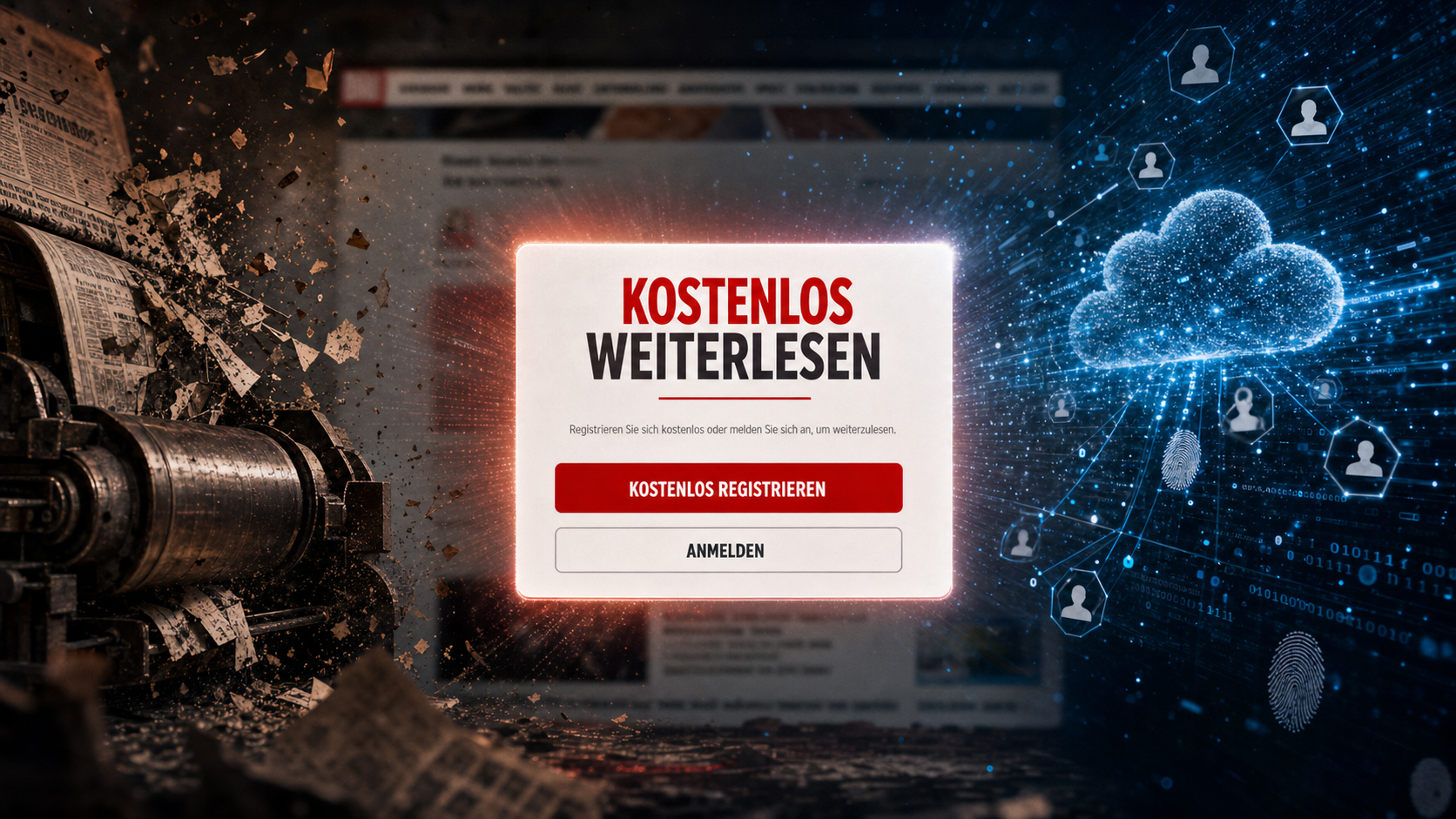
The real reason for the new login requirement at Bild.de – From newspaper to data platform: “Continue reading for free now!” – Image: Xpert.Digital
Google is pulling the plug: Why Bild.de urgently needs your email address now
The end of the people's newspaper: What the radical change in strategy at Bild means for millions of readers
Historic low for print: How Axel Springer is secretly restructuring the Bild system
Anyone visiting Bild.de today is quickly stopped by a seemingly harmless banner: "Continue reading for free now!" But behind this simple request to register lies far more than just a new marketing trick – it's the unmistakable symptom of a historic upheaval in the media landscape. The once unchallenged power of mass-market, advertising-funded free information is crumbling. Driven by the dramatic decline in print circulation, the gradual demise of third-party cookies, and the massive existential threat posed by AI-powered search engines (like Google's "AI Overviews"), Europe's largest tabloid is forced to radically reinvent its business model. The anonymous people's newspaper for everyone is becoming a data-driven platform where users no longer pay with money, but with their identity. The following analysis shows why the end of the free mass press is inevitable, how publishers are countering this with first-party data and multi-million-dollar AI deals, and what this fundamental change means for democratic information provision in Germany.
Bild.de in a pincer movement: When millions of reach are no longer enough – Why the end of free mass press is closer than expected
The banner as a symptom: What “Read on for free now!” really means
Anyone visiting Bild.de today is increasingly confronted with a banner that, in its apparent innocence, conceals a fundamental strategic realignment: "Continue reading for free now!" – this sounds like an offer, but is actually a requirement. Users are asked to register, create an account, and provide personal data. Access remains free, but is no longer anonymous. What initially appears to be a new marketing tactic is, in fact, the visible surface of a profound structural transformation that has swept through the entire digital publishing industry and is simply particularly evident at Bild.de – after all, for decades Bild was the prime example of unfettered tabloid journalism for everyone.
Axel Springer's transition to a registration model was not a spontaneous reaction to a short-term trend, but rather a response to a complex problem that has been intensifying for years: the structural decline of the advertising-financed mass-reach model, which is losing substance due to the rise of AI-driven search, the diminishing importance of third-party cookies, and the increasing competition for user attention from platforms like TikTok, YouTube, and ChatGPT. What was once considered the indestructible foundation of the digital media economy—traffic from Google, programmatic advertising, free content for everyone—is proving to be fragile.
From twelve million to less than one million: The decline of the printed Bild
To understand the dramatic nature of the current situation, it's worth looking at the historical development of the Bild brand. In its heyday, the tabloid newspaper was among the highest-circulation daily newspapers in the world, and its social reach was virtually unparalleled. German chancellors are said to have both feared and loved Bild. For a long time in Germany, tabloid journalism and mass culture were synonymous with the term "Bild.".
But the figures tell a different story today. The print circulation of Bild/BZ Germany in the fourth quarter of 2024 was around 990,000 copies – a historic low. In the fourth quarter of 2016, it had been more than twice as high. The reach of the print edition fell from nearly 12.8 million readers per issue in 2012 to around 6.37 million readers in 2024. Bild am Sonntag alone lost more than two-thirds of its reach between 2004 and 2024 – from over 11.2 million to around 4.1 million readers. In a direct comparison of the first half of 2025, Bild lost a further 13.5 percent of its circulation, which corresponds to a loss of more than 100,000 copies.
This decline is not a phenomenon specific to Bild, but rather part of a broader societal trend: German daily newspapers have been steadily losing their print readership for years. While around 33.7 million Germans still get their news from newspapers daily, tabloids are disproportionately affected. Single-copy sales at newsstands – once Bild's core business model – are collapsing along with the changing nature of morning information habits. Today, those who want to know what's happening in the world no longer go to a newsstand, but instead open an app or ask an AI.
The digital counterweight: Deceptive reach
Axel Springer's official counter-narrative to the decline of print reads impressively: In the first quarter of 2026, Bild's digital offerings reached 640 million visits per month, according to the publisher. Media Impact, Axel Springer's marketing unit, reports 25.30 million monthly unique users and 5.66 million daily unique users for Bild.de. The publisher is celebrating a 15 percent year-on-year growth in digital revenue and describes November 2025 as the strongest month for digital marketing in Bild's history. Based on these figures, everything seems to be going well.
But behind these figures lies a structural problem that isn't addressed so openly in official press releases: Digital reach alone is no guarantee of economic stability. For many years, the business model of most advertising-funded news portals was based on the simple formula: more traffic equals more advertising revenue. This equation no longer holds true. Programmatic advertising, the largely automated trading of digital advertising space, has put massive pressure on cost-per-thousand (CPM) rates. At the same time, advertising revenue is flowing towards Google, Meta, and Amazon, which, as so-called walled gardens, can offer significantly more precise audience targeting options—namely, based on user data that they themselves possess.
This is precisely the motive behind the "Continue reading for free now!" banner: Bild.de wants to build up first-party data. Without registration, a user is largely anonymous to the publisher – a blind spot in a data-driven world where personalization determines advertising value. With registration, however, the publisher knows the user's age, gender, email address, and ideally, their usage patterns across all platforms. This data has become the true capital of the digital media world.
The end of third-party cookies as a system break
To understand the strategic importance of mandatory registration, one must understand the background to the demise of third-party cookies. For years, tracking users across different websites—enabled by so-called third-party cookies—was the technical foundation of the programmatic advertising industry. Advertisers could track users, create interest profiles, and deliver personalized ads without publishers themselves collecting and storing user data. This was convenient, questionable from a data protection perspective, and worked primarily because regulation lagged behind.
With the tightening of European data protection regulations (GDPR), political pressure on Google to abolish third-party cookies in Chrome, and the increasing use of ad-blocking technologies, this model has been disintegrating ever since. What remains is first-party data – that is, information that a user shares directly with a provider. Publishers who own their own database retain negotiating power with advertisers. Publishers without their own database become interchangeable reach providers who cannot compete in the price war with global platforms.
For Bild.de, this means specifically: The registration wall is not a paywall in the traditional sense, but rather a so-called consent-and-registration model. Users don't pay with money, but with data – often without being fully aware of it. Access to the information remains formally free. The price is anonymity. From a business perspective, this is a smart move: The publisher can maintain its reach promise to advertisers while simultaneously increasing the quality of advertising through better targeting.
AI is fundamentally changing the information market
Bild.de's registration strategy cannot be considered in isolation from the overarching AI transformation of the information industry. Since Google introduced its AI Overviews in Germany in March 2025, reliable data on their impact on the reach of news portals has become available for the first time. The figures are alarming.
Traffic losses of up to 79 percent for certain news queries have been documented. When an AI summary appears on the search results page, the click-through rate on external links drops from around 15 percent to only about 8 percent. Clicks within the AI overviews themselves are extremely rare, at around 1 percent. The number of so-called zero-click searches—where a user asks a question and the search engine answers it directly without clicking an external link—is now almost 69 percent for news topics. This means that almost seven out of ten information queries are answered by Google itself, without the user even visiting a news website.
A study by Digital Content Next (DCN), which analyzed data from 19 major US publishers, revealed that traffic originating from Google searches plummeted by an average of 10 percent in just eight weeks. The New York Times saw its share of organic search traffic drop from 44 percent three years ago to 36.5 percent in April 2025. German publishers report similar findings: According to the BDZV and Retresco AI Maturity Report 2025, 43 percent of media companies are already experiencing a decline in organic Google traffic.
The implications for a mass medium like Bild.de, which has historically relied heavily on search engine traffic, are obvious: the foundation upon which its free, ad-supported mass-market model rested is crumbling. Every percentage point of traffic lost from organic search translates directly into a loss of advertising revenue. The fact that Bild.de, according to its marketing unit Media Impact, points out that 75 percent of its digital visitors arrive via direct links – without a prior Google click – is not a side note in this context, but rather the central strategic message: they want to become less dependent on Google.
Google's dual role: partner and threat
The relationship between news publishers and Google reveals a structural ambivalence that is characteristic of the entire industry. For many years, Google was the most important source of reach for digital publishers. The search engine giant sent users links that led to news content—and thus traffic that was converted into advertising revenue. Publishers accepted that Google profited from their content by featuring it in search results. This was an implicit exchange: reach in exchange for content usage.
With the introduction of AI Overviews and AI Mode, this equation has shifted in a one-sided way. Google now answers user questions itself – based on journalistic content for which it neither pays nor consistently links. Publishers complain that Google uses their content for AI answers without paying adequate compensation. In September 2025, the Alliance of Media and Digital Industries filed a complaint with the German Federal Network Agency. The Independent Publishers Alliance appealed to the European Commission. In the US, Penske Media Corporation (Rolling Stone, Billboard) sued Google. The accusation: Google is abusing its dominant market position to place its own AI summaries at the top of search results and disadvantage the original content providers.
Axel Springer is attempting to escape this dilemma by taking a different approach: proactive cooperation with AI companies instead of confrontation. In December 2023, the publisher signed a multi-year licensing agreement with OpenAI, which generates tens of millions of euros annually for Axel Springer. OpenAI is permitted to access all Axel Springer content, including articles behind paywalls from Bild, Welt, Politico, and Business Insider, and use it for training language models and for ChatGPT responses. In addition, Axel Springer entered into a cooperation agreement with Microsoft in 2024, which includes content partnerships as well as a cloud migration to Microsoft Azure.
This licensing strategy is both pragmatic and strategic: it secures revenue from a new channel that can at least partially compensate for the lost search engine revenue. At the same time, Axel Springer positions its own brands as reputable sources within AI systems – an advantage in an information world where source citations in ChatGPT and similar systems increasingly signify new visibility.
🎯🎯🎯 Data-driven B2B industry hub as a quasi-in-house solution


The quasi-in-house solution: How Xpert.Digital closes operational gaps in B2B marketing and sales – Smart Content-Driven Business - Image: Xpert.Digital
Xpert.Digital is a data-driven B2B industry hub led by Konrad Wolfenstein . The company acts as an external, quasi-in-house solution for industrial partners, closing operational gaps in marketing, content, and sales – without requiring additional resources on the client side.
More information here:
Personalization instead of mass production: The new currency behind Bild.de
BILDplus and the subscription model: Growth with limits

Bild.de in a pincer movement: When millions of reach are no longer enough – Why the end of free mass media is closer than expected – Image: Xpert.Digital
Alongside its advertising strategy, Axel Springer has been consistently pursuing the development of a subscription model since 2013. BILDplus launched in June 2013 as a freemium model, with certain content behind a paywall, while the majority of content remained free. After six months, BILDplus had gained 152,500 subscribers – a then-celebrated entry into the digital subscription market. By comparison, The Times in Great Britain had only acquired 0.8 percent of its unique users as subscribers after six months, and Bild 1.1 percent.
Growth continued. In November 2023, BILDplus surpassed the 700,000 subscriber mark. In 2024, Bild increased its digital subscriptions by approximately 11 percent to 724,000. The official goal for 2026 was one million digital subscriptions and a reach of 20 million daily visits. According to Bild, it has exceeded its visit target – with 640 million visits per month in the first quarter of 2026, the monthly figure alone exceeds the previous daily target thirtyfold. It remains unclear whether the one million subscription mark has been reached; comparable current IVW reports were not publicly available at the time of publication.
The paid content market in Germany continues to grow overall: Revenues from paid content for German consumer media rose by 15 percent in 2025 to around €1.66 billion. For the first time, national newspapers are generating more than half of their digital revenue via paywalls. However, Bild faces a specific dilemma that other brands like Welt, FAZ, or Süddeutsche Zeitung do not have in this form: Bild has always been the newspaper for everyone – explicitly not a quality paper for a paying, educated elite, but a tabloid with an emotional mass appeal. The willingness to pay of Bild's typical core target group is structurally lower than that of subscribers to Die Zeit or Der Spiegel.
The strategic shift to "Digital Only": Cost-cutting measures as a liberating move
In February 2023, Axel Springer announced a far-reaching future strategy for Bild and Welt, aiming for complete digitization. CEO Mathias Döpfner explicitly stated the goal as "Digital Only," but acknowledged that the complete transition would take several more years as long as print remained profitable. As part of this strategy, a drastic restructuring of the regional organization was announced that same year: the number of regional editions was reduced from 18 to 12, and several locations were closed. Positions such as editor-in-chief, page editor, proofreader, and photo editor were eliminated.
The job cuts are directly related to the use of AI: Axel Springer communicated internally that the company had to part ways with colleagues whose tasks could be replaced by AI and automated processes. AI can be used in the layout of the print edition, a task previously handled by a managing editor. AI can automatically rewrite, summarize, and optimize texts from agencies for SEO. AI can add captions to images, set metadata, and adapt articles for different channels. What this means for journalistic quality and ultimately for democratic access to information is a question that goes far beyond mere business optimization.
The BDZV AI Maturity Report 2025 shows that 96 percent of all German newsrooms are now working with AI. More than twice as many newsrooms as last year primarily want to reduce costs – 57 percent in 2025 compared to 24 percent in 2024. At the same time, 91 percent of respondents state that the actual benefits of AI remain difficult to measure. The media industry has discovered AI as a lever for efficiency, but is still far from building new and sustainable revenue models with it.
Personalization as the new currency: data instead of mass
The true strategic logic behind the registration model becomes clear when one considers Bild.de not as a newspaper, but as a data platform. From this perspective, journalistic content is not a product to be sold, but rather a lure that attracts users to the platform. The real value creation takes place behind the scenes: through the collection of first-party data, which enables precise targeting for advertisers.
Specifically, this means that anyone who registers at Bild.de allows the publisher to create a personalized user profile – including interests, usage times, topic preferences, time spent on each article, and interaction behavior. In a post-cookie world, this data is what publishers use to differentiate themselves in the market. The marketing agency Media Impact is already advertising a "guaranteed home reach" of 21 million monthly users in its advertising interface. Behind this figure lies the idea of a verified, addressable audience – far more valuable than anonymous page impressions.
According to a BDZV report, AI-powered personalization is considered the most promising lever for the future: 58 percent of the media companies surveyed consider AI-powered personalization particularly relevant. Axel Springer is already implementing this: The AI assistant "Hey_" on Bild.de has reportedly answered around 150 million questions. This interactive user experience generates engagement, increases dwell time, and—crucially—generates further behavioral data that refines the profile of the registered user.
The trap of reach inflation: When 640 million visits lie
A critical examination of officially communicated reach figures leads to an uncomfortable question: What exactly is being measured? The figure of 640 million visits per month sounds impressive. But not all visits are created equal. A user who accesses a page, reads a headline, and leaves immediately is counted the same as an engaged reader who reads an entire article and comments on it. The distinction between bounce rate, time on site, and engaged time, familiar from the Anglo-Saxon publishing market, plays a subordinate role in the public communication of reach figures in Germany.
In February 2025, Bild.de recorded approximately 179.6 million worldwide visits, according to Statista – a decrease of 4.9 percent compared to the previous month. The discrepancy with the internally reported 640 million visits is explained, among other things, by different measurement methods (IVW vs. internal analytics), the inclusion of app usage, video platforms, social media interactions, and potentially automated access. Ultimately, what counts remains a methodological question – and a marketing strategy decision.
The truly relevant question is: How many of these users have an active account, are identifiable, and willing to return regularly? This is where the registration model begins to reveal its true value. Axel Springer's strategy of communicating a target of over 600 million visits while simultaneously pointing to 80 percent direct entries sends a clear message: They are trying to transform themselves from a passive reach medium into an actively used platform with a loyal readership.
What happens to the democratic function of tabloid journalism
Beyond the realm of business administration, a question arises that has dimensions in media ethics and democratic theory: What does it mean for the information supply of a society when Germany's most widely read tabloid newspaper places its content behind a registration model?
Historically, Bild was the medium that reached broad segments of the population who didn't read other national newspapers. Bild didn't reach the educated elite who read Die Zeit or the Frankfurter Allgemeine Zeitung, but rather people with less formal, institutional media exposure – blue-collar workers, pensioners, people in economically disadvantaged regions who had little time to delve into complex political analyses. This is politically ambivalent: tabloid journalism can simplify, sensationalize, and manipulate. But it can also make information accessible that would otherwise go unnoticed.
When this target group is confronted with a registration form – even if access remains formally free – new barriers to entry arise. Digital apprehension, a lack of familiarity with online registration, data privacy concerns, or simply a lack of interest in an account can lead to the loss of precisely those users who previously relied on Bild as their sole source of information. The loss of these readers not only exacerbates the publisher's reach problem but also narrows the public information space.
In a study published in 2025, the North Rhine-Westphalia Media Authority pointed out that the growing influence of algorithmically driven platforms and the structural decline of journalistic-editorial media are jeopardizing media diversity. When large platforms pool reach and advertising revenue without contributing to the financing of journalistic content, a market failure occurs with societal costs that extend far beyond the financial losses of individual publishers.
Industry strategies compared: Who does what?
Bild.de is not the only media outlet grappling with these challenges. The industry's responses vary considerably. Some publishers, like the New York Times, have consistently relied on paid content, thereby establishing a financially stable, direct reader-driven financing model. The Süddeutsche Zeitung, Die Zeit, and Der Spiegel have also expanded their subscriber base in Germany. A clearly defined target audience is happy to pay for these quality publications' in-depth reporting, analysis, and investigative journalism.
Regional publishers are facing particularly tough competition: Approximately 19 percent of the revenue of regional daily newspapers comes from premium subscriptions or other paywall models – the rest from e-paper and print. Local quality journalism, which cannot be replaced by Google and AI, is considered one of the few stable anchors in an otherwise turbulent market. The Media Network Bavaria report also points out that Focus Online generates over 70 percent of its page views through direct access – and is therefore largely independent of Google traffic.
Bild.de pursues a hybrid strategy: reach for advertising-financed revenue, registration for first-party data and personalization, subscriptions (BILDplus) for direct reader financing, AI licenses (OpenAI, Microsoft) for new revenue streams, and its own AI products (Hey_, BILD Play) for user retention and new business models. This diversification is understandable – but also an indication that no single model can sustain success on its own.
The Dilemma of the Tabloid in the AI Age
Perhaps the most fundamental contradiction that Bild.de will have to grapple with in the coming years is this: The medium grew large through simplification, emotionalization, and mass appeal. In an AI-driven world where facts, summaries, and gossip are delivered instantly and free of charge by language models, precisely this type of content loses its distinguishing value.
What AI cannot do—and what has barely been mentioned in the debate so far—is genuine investigative journalism, local research, exclusive sources, and journalistic analysis of complex events. This presents an opportunity for media outlets willing to invest in these core strengths. Axel Springer recognized this theoretically: Döpfner emphasized in 2023 that journalistic creation must become central to their work, while production becomes increasingly technologically supported and automated. The question is whether this ambition can actually be realized at Bild—a media outlet known for sensational headlines, lurid exclusive stories, and political campaigns—without losing its core audience or fading into journalistic irrelevance.
An industry that doesn't yet know how the story ends
The media industry is undergoing a transformation process of unprecedented speed and depth. No other business model based on attention and information is as directly affected by the structural disruption caused by AI as traditional journalism. And no other medium in Germany is as symbolic of this change as Bild – because Bild has always represented the pinnacle of mass appeal.
The banner "Continue reading for free now!" on Bild.de is not a sign of weakness. It is the visible symbol of a profound strategic repositioning intended to transform the paper from a free, mass-market tabloid into a personalized data platform with journalism as its content vehicle. Whether this transformation succeeds depends on several factors: the core audience's willingness to pay and their data loyalty, the ability to remain visible as a relevant source in the AI world, the speed at which new revenue models from licensing deals and proprietary AI products scale, and ultimately, the ability to maintain journalistic credibility – one of the few assets that AI cannot replicate.
What can be said with certainty, however, is that Bild's model as a free, public-spirited newspaper for everyone is structurally at its end. The era of advertising-funded mass information, which rested on naive trust in the stability of Google traffic and cookie-based advertising, is drawing to a close. What's coming is more fragmented, more nuanced, more data-driven – and possibly less inclusive than what came before. This isn't a tragedy specific to Bild. This is the situation of an entire industry that doesn't yet know how the story will end.
Your global marketing and business development partner
☑️ Our business language is English or German
☑️ NEW: Correspondence in your native language!

Konrad Wolfenstein
I and my team are happy to be available to you as your personal advisor.
You can contact me by filling out the contact form here wolfenstein@xpert.digital:or simply call me at +49 7348 4088 965. My email address is
I'm looking forward to our joint project.
☑️ SME support in strategy, consulting, planning and implementation
☑️ Creation or realignment of the digital strategy and digitization
☑️ Expansion and optimization of international sales processes
☑️ Global & Digital B2B trading platforms
☑️ Pioneer Business Development / Marketing / PR / Trade Fairs
📈🚀 From visibility to trust 👀🤝 Your scalable path with Xpert.Digital


From visibility to trust: Your scalable path with Xpert.Digital - Image: Xpert.Digital
In industrial B2B, sustainable business relationships rarely emerge overnight. They develop step by step – through visibility, professional relevance, recurring touchpoints, and growing trust. Xpert.Digital's 4-stage model addresses precisely this: It offers a structured path that begins with a manageable entry point and can evolve into deeper collaboration in business development if needed.
Instead of relying on loud marketing promises, this model puts the relationship at the forefront. Companies start with clearly defined, easily calculable measures and then decide, based on their own experience, how far they want to expand the collaboration. A key factor for this undisturbed trust-building process: The platform completely avoids annoying advertising ads, so the editorial focus remains solely on the companies' expertise.
More information here: