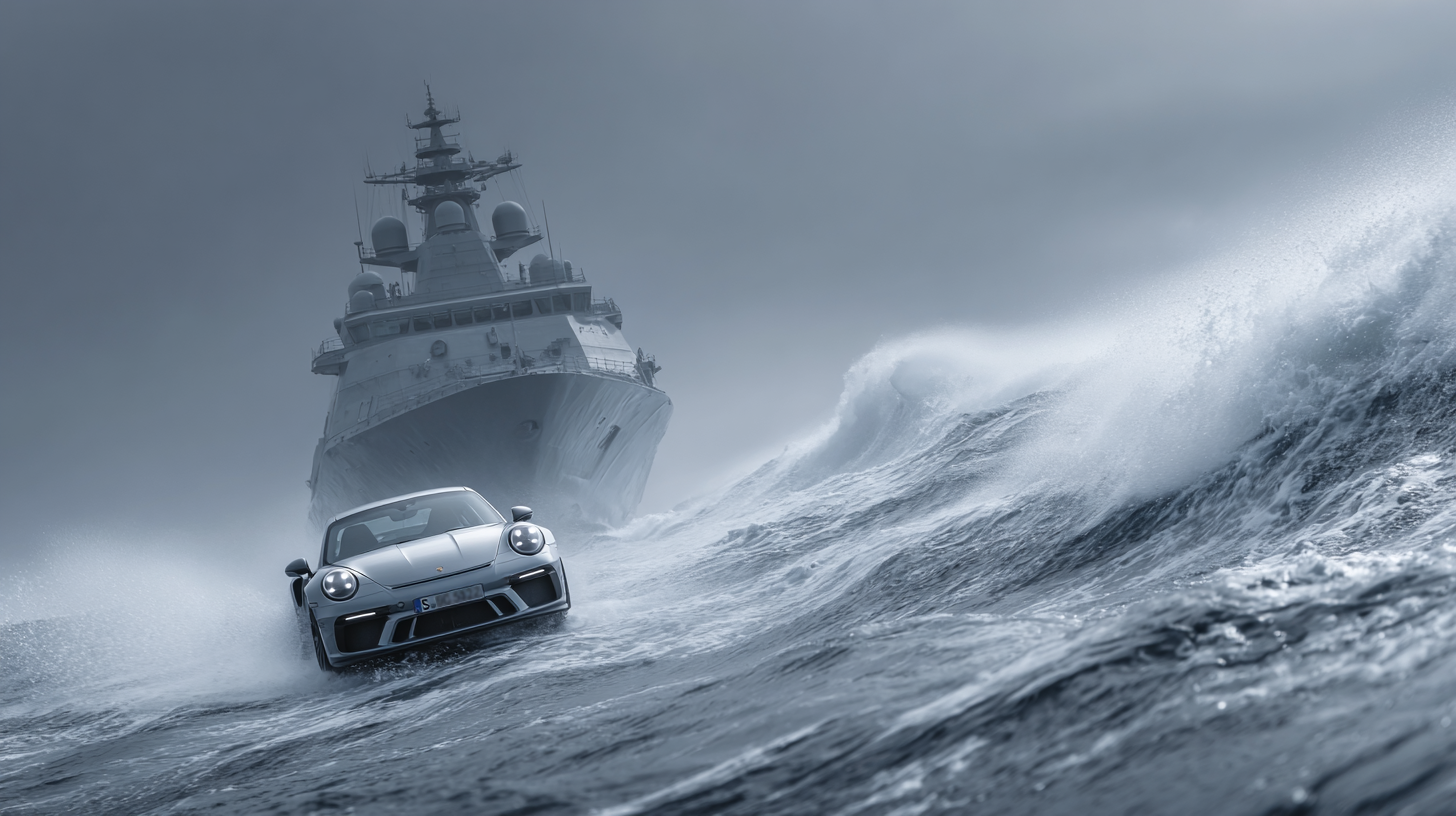
Frigate construction | Is Porsche saving the navy? Why the sports car manufacturer is now supposed to solve the frigate debacle – Image: Xpert.Digital
The F126 billion-dollar boondoggle: Is the biggest naval project of all time in danger of being scrapped?
Stuttgart instead of the North Sea: How “sports car DNA” is supposed to bring order to the digital chaos in frigate construction
It sounds like an April Fool's joke, but it's a bitter industrial policy reality: A luxury sports car manufacturer is supposed to prevent the German Navy's most important armaments project from running aground. The F126 frigate, planned as the Bundeswehr's most modern warship, is in deep crisis – and Porsche Consulting, of all companies, is supposed to correct its course.
The scenario is not without a certain irony: While Stuttgart is meticulously fine-tuning the perfect panel gaps, the collaboration between Dutch designers and German shipyards in the multi-billion-euro F126 project is threatening to collapse over digital design. With a contract volume of around six billion euros, not only is an enormous amount of taxpayers' money at stake, but also the operational readiness of the German navy for the next decade.
But why is the Ministry of Defense bringing car manufacturers on board? Is this a brilliant move to break down entrenched manufacturing mindsets, or the final admission of failure by a state procurement bureaucracy that has lost its core competencies?
This analysis looks beyond the headlines. We examine why the digital interface between the Netherlands and Germany is faltering, why Porsche Consulting already made history at the Meyer shipyard, and which three scenarios are now crucial for the future of the German Navy. It's a story about industrial culture wars, lost national sovereignty, and the question of whether warships can truly be saved by mass production.
When Stuttgart sports car DNA meets maritime reality: lifeline or declaration of bankruptcy?
The news caused a stir in the press, extending far beyond the trade pages: Porsche Consulting, a subsidiary of the Stuttgart-based sports car manufacturer, is to examine and potentially rescue the German Navy's faltering prestige project, the F126 frigate (formerly MKS 180). What at first glance sounds like a bizarre anecdote – car manufacturers advising shipbuilders – reveals, upon closer inspection, the profound structural crisis of the German defense procurement system.
This analysis sheds light on the economic background, the operational logic behind the selection of Porsche, and the systemic deficiencies that made this step necessary in the first place. It's not just about a ship; it's about Germany's industrial sovereignty and the question of whether lean management methods from the automotive industry can handle the complex realities of naval shipbuilding.
How to build a ship like a sports car: The secret of the Meyer shipyard
Porsche Consulting is a management consultancy and a wholly owned subsidiary of Porsche AG, founded in 1994. It specializes in operational excellence, lean management, and the industrialization of complex production and development processes in industrial companies, including those in the automotive, mechanical engineering, aerospace, and shipbuilding sectors. The consultants are primarily engaged when companies want to shorten construction times, increase productivity, and standardize and streamline processes.
The Meyer Werft shipyard in Papenburg is one of the world's leading shipyards in cruise ship construction, building extremely complex vessels with up to 15 million individual parts, manufactured in a high degree of variation and under enormous time pressure. Especially since the 2000s, the shipyard has faced the challenge of delivering increasingly larger and more technically sophisticated cruise ships economically and on schedule, while simultaneously modernizing its own organization.
The collaboration between Porsche Consulting and the Meyer Werft shipyard began in the late 2000s and continued as a long-term partnership for several years. The impetus was the desire of the shipyard management, particularly the family-owned businesses in the executive ranks, to significantly shorten the construction times of the cruise ships, increase productivity, and reorganize internal processes based on the model of the automotive industry.
Specifically, Meyer, under the guidance of Porsche Consulting, implemented professional process management, a streamlined order processing system, and a more takt-based production logic. In production, the ships were consistently divided into sections and blocks, which flow into the building dock according to a herringbone pattern and are assembled there modularly, allowing for parallel processes and reducing downtime.
A key objective was to reduce dock time, i.e., the time a ship occupies the building dock and thus ties up capital. Between approximately 2009 and 2013, this occupancy time was successfully reduced from around nine to about six months, despite increasing ship sizes. This was highlighted by the trade press and industry analyses as a measurable success of the cooperation.
In addition to pure process optimization, the development and design organization was also adapted so that design and engineering could be completed earlier and thus be able to handle the new, more fast-paced manufacturing processes. This was complemented by continuous improvement programs, an internal academy, and training formats that enabled employees to permanently adopt the new process logic.
1. The Billion Dollar Graveyard: Anatomy of a Stagnation
The F126 project is not just any armaments project. With an initial contract volume of around six billion euros for an initial four ships (plus an option for two more), it is the largest naval procurement project of the German Armed Forces since 1945. Expectations were enormous: a "jack-of-all-trades" design, modularly adaptable for worldwide deployments, from anti-piracy operations to high-intensity combat.
But the reality in 2026 is sobering. Officially, the first ship was supposed to be delivered in 2028. However, current forecasts predict a delay of "at least three to four years"—meaning it will hardly be commissioned before 2031 or 2032.
The root of the problem: cutting edges instead of welding
Unlike previous debacles (such as the F125 Baden-Württemberg class, which struggled with listing and software errors), the F126's current problem lies even before physical production, in the so-called "detailed design." The prime contractor, the Dutch Damen Schelde Naval Shipbuilding (DSNS), and the German subcontractor NVL (Naval Vessels Lürssen, formerly Blohm+Voss) are unable to find common technological ground.
The core problem is digital in nature: the synchronization of the design software (based on Dassault systems) between the Dutch architects and the German shipyards that are supposed to manufacture the segments is not working smoothly. Modern shipbuilding no longer uses paper plans, but rather digital twins. If the interfaces are not compatible, no steel can be cut. Construction progress is effectively frozen.
The economic consequences are disastrous: Since payments in the arms industry are usually tied to milestones, no money is flowing to Damen. The Dutch company has already had to be propped up by a bridge loan from the Dutch government (approximately €270 million) to secure its liquidity. A domino effect is looming, which will also force German suppliers into short-time work.
2. Process alchemy: Why a car manufacturer in particular?
The critical question being asked by taxpayers and experts alike is: What qualifies a manufacturer of luxury sports cars to save highly complex warships? Is this a triumph of marketing or a rational decision?
The answer lies in the past – more precisely in Papenburg at the Meyer shipyard. Far from Zuffenhausen, Porsche Consulting has made a name for itself there as a "hardcore industrializer".
The "rhythm" in dry dock
Shipbuilding was traditionally a craft. Each ship was unique, built in a "construction site" fashion. Porsche Consulting implemented principles at the Meyer shipyard that have been standard in the automotive industry since Toyota, but were considered impossible in shipbuilding:
- Modularization and section construction: Ships are almost fully equipped in huge blocks (sections) before they come into the dock.
- Flow production: Even if the ship does not move on a conveyor belt, the work packages move in a strict rhythm.
- Reduction of berthing time: These measures enabled the docking time at the Meyer shipyard to be reduced from nine to six months – a massive gain in capital efficiency.
The logic behind commissioning the F126 project isn't that Porsche engineers understand the radar system (that's what Thales is for), but rather that they understand how to translate complexity into industrial processes. If the F126's problem is that Dutch designs don't "flow" into German manufacturing processes, then that's precisely the kind of supply chain engineering Porsche specializes in. It's about industrializing the unique product.
However, this reveals a danger: A cruise ship is primarily a floating hotel (steel + cabins). A frigate is a floating weapon system with an extremely high system density in a very confined space. The transferability of the "Meyer methodology" to warship construction is by no means guaranteed. In naval shipbuilding, changes in one area (e.g., heavier radar) often lead to cascading effects throughout the entire ship design (stability, power supply) that cannot simply be "clocked away.".
Hub for Security and Defense - Advice and Information

Hub for Security and Defense - Image: Xpert.Digital
The Security and Defence Hub offers expert advice and up-to-date information to effectively support companies and organizations in strengthening their role in European security and defence policy. Working closely with the SME Connect Defence Working Group, it particularly promotes small and medium-sized enterprises (SMEs) that wish to further develop their innovative capacity and competitiveness in the defence sector. As a central point of contact, the Hub thus creates a crucial bridge between SMEs and European defence strategy.
Related to this:
Open-heart surgery: Can Porsche still save the sinking ship of the German Armed Forces?
3. The state's admission of failure: The "advisor republic"
However logical the commissioning may seem from an operational standpoint, the judgment it delivers on the state procurement organization is devastating. The awarding of the contract to Porsche Consulting is a symptom of a profound erosion of state competence.
The Federal Office of Bundeswehr Equipment, Information Technology and In-Service Support (BAAINBw) in Koblenz theoretically has thousands of employees. Why does an agency whose sole purpose is the procurement of armaments need external assistance to assess the status of an armaments project?
Principal-agent failure
From an economic perspective, this is a classic principal-agent problem, exacerbated by the decline in technical expertise:
The principal (the state) has, over the years, reduced engineering positions and replaced them with administrative lawyers. It can no longer independently verify the technical validity of the agent's (Damen's) statements. If Damen says, "The IT problem is almost solved," and the subcontractor NVL says, "The data is unusable," the BAAINBw lacks the internal capacity to look "under the hood" and determine the truth.
Porsche Consulting is acting here as a "verifying third party." This, however, is a damning indictment. In previous decades, the German Navy had its own design offices that could compete on equal footing with shipyards. Today, the state pays dearly for this level playing field – a trend that began under Ursula von der Leyen (keyword: "McKinsey army") and continues under Boris Pistorius despite reform efforts.
The "lobbying question" needs to be considered in a nuanced way. It's unlikely that Porsche Consulting secured the contract through classic backroom deals. Rather, the company benefits from its positioning as a "neutral industrial auditor." The major strategy consultancies (McKinsey, BCG) are often too far removed from steel construction; technical inspectors like TÜV or DNV are too focused on compliance. Porsche occupies the niche of "operational excellence." Nevertheless, the fact that the state needs private assistance for its core task—equipping its armed forces—demonstrates that the "balanced budget" of the past has also left behind an intellectual stagnation in government offices.
4. Strategic dissonance: Dutch leadership, German execution
Another often overlooked aspect of the F126 crisis is the geopolitical and industrial policy flaw in the contract's design. The 2020 decision to award the contract to the Dutch Damen shipyard (and not to the German consortium led by TKMS/Lürssen) was unprecedented. It marked the first time a surface combat ship for the German Navy had been ordered from a shipyard outside the EU.
Economically, this was justifiable at the time: Damen offered the lower price and the seemingly better concept. However, the reality of implementation reveals the high transaction costs of cross-border arms projects
Cultural clash: The pragmatic, often informal Dutch shipbuilding culture ("We solve the problem when it arises") clashes with the German, over-regulated procurement bureaucracy and the attention to detail of German shipyards ("We need an approved drawing first").
Conflicting interests: Damen, as the general contractor, wants to achieve a profit margin. NVL (Lürssen), as a subcontractor, feels demoted to a mere "extended workbench" and has little incentive to rectify the flaws of the Dutch design at its own expense.
In this minefield, Porsche Consulting not only has to optimize processes, but also, in effect, provide diplomatic mediation between two industrial cultures that are blocking each other.
5. Scenario analysis: What the “Porsche report” could trigger
The Porsche Consulting report, once published, will have political implications. From an economic perspective, three scenarios are possible:
Scenario A: The “Turnaround” (Probability: 30%)
Porsche identifies clear bottlenecks in data exchange. A task force mode is established, in which engineers from Damen and NVL physically meet in the same room (war room) instead of exchanging emails. Costs increase moderately, and the delay is limited to two years.
Economic assessment: The "sunk cost" scenario. They continue because they have already invested too much.
Scenario B: The “emergency brake” / contract termination (probability: 40%)
The report concludes that the IT architectures are incompatible and that Damen underestimated the complexity of German building regulations. The contract is terminated ("Termination for Default").
As a result, a German consortium (NVL/TKMS) takes over. The design would likely need to be adapted to German standards, which would take years. Alternatively, an existing off-the-shelf design (e.g., MEKO A200) could be purchased to quickly close the capability gap. This would spell the end of the dream of the "high-tech F126 ship," but would preserve its operational readiness.
Scenario C: The “Bad Bank” solution (probability: 30%)
The state is pumping in massive amounts of money to solve the integration problems (“cost-plus” contracts) and accepts that the F126 will cost more like 9 or 10 billion instead of 6 billion.
Economic assessment: The worst outcome for the taxpayer, but politically often the path of least resistance to avoid admitting failure.
Germany's most expensive lesson: How misguided cost-cutting sank a billion-euro project
The involvement of Porsche Consulting is a last-ditch attempt to save a project that is threatening to collapse under its own complexity. It is not a simple consulting assignment, but rather open-heart surgery on the German security architecture.
That a car manufacturer is needed to explain to shipbuilders how to manage processes is a humiliation for the maritime industry – but perhaps a salutary one. The real lesson, however, lies not in the shipyard halls, but in Berlin and Koblenz: those who cut corners on their own project management expertise will ultimately pay many times more in consulting fees and delay costs. The F126 threatens to become the most expensive lesson in the history of the German Armed Forces – with or without the Porsche logo on the project report.
Consulting - Planning - Implementation

Markus Becker
I would be happy to serve as your personal advisor.
Head of Business Development
Chairman SME Connect Defense Working Group
Consulting - Planning - Implementation
Konrad Wolfenstein
I would be happy to serve as your personal advisor.
You can contact me at wolfenstein∂xpert.digital or
Just call me on +49 7348 4088 965 .
Your dual-use logistics experts

Dual-use logistics experts - Image: Xpert.Digital
The global economy is currently undergoing a fundamental transformation, a watershed moment that is shaking the foundations of global logistics. The era of hyper-globalization, characterized by the relentless pursuit of maximum efficiency and the "just-in-time" principle, is giving way to a new reality. This new reality is marked by profound structural breaks, geopolitical power shifts, and increasing fragmentation of economic policy. The once taken-for-granted predictability of international markets and supply chains is dissolving and being replaced by a period of growing uncertainty.
Related to this:
Our EU and German expertise in business development, sales and marketing

Our EU and German expertise in business development, sales and marketing - Image: Xpert.Digital
Industry focus areas: B2B, digitalization (from AI to XR), mechanical engineering, logistics, renewable energies and industry
More information here:
A thematic hub offering insights and expertise:
- Knowledge platform covering global and regional economies, innovation and industry-specific trends
- A collection of analyses, insights, and background information from our key areas of focus
- A place for expertise and information on current developments in business and technology
- A hub for companies seeking information on markets, digitalization, and industry innovations