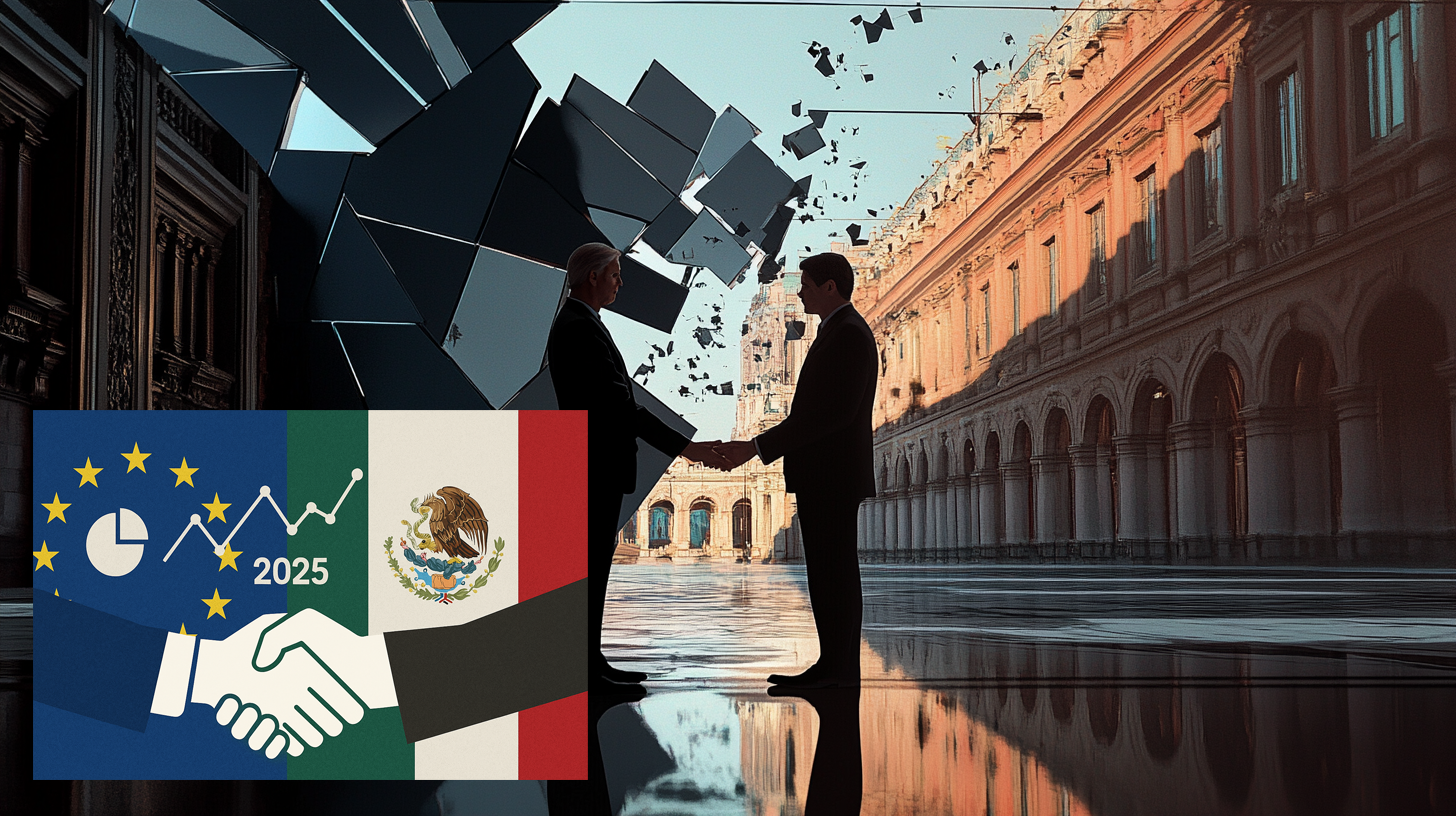
The modernized free trade agreement between the EU and Mexico: A comprehensive analysis of the 2025 agreement – Image: Xpert.Digital
EU and Mexico: New global agreement strengthens economic partnership
Milestone in trade relations: EU and Mexico deepen cooperation
In January 2025, a significant milestone in international trade relations was reached: the European Union and Mexico concluded a modernized Global Trade Agreement after several years of negotiations. This agreement represents a comprehensive update of the previous agreement from 2000 and establishes a new framework for the economic, political, and cooperative relationship between the two partners. The agreement is particularly important against the backdrop of increasing trade tensions in North America and reflects the desire of both sides to deepen and diversify their economic relations.
Historical context and negotiation process
Negotiations to modernize the EU-Mexico Global Trade Agreement officially began in May 2016. The modernization process had become necessary because the original agreement from 2000 no longer met the current requirements of international trade and did not adequately cover new issues such as the digital economy, sustainability, and investment protection.
Although an agreement in principle on trade aspects was reached as early as April 2018, the conclusion of the agreement was delayed for various reasons. Among the most contentious issues were investment protection and the recognition of traditional EU food and beverages in Mexico. A senior Commission official also stated that the conclusion of the agreement had been stalled by Mexico's plans to amend its constitution in favor of the state-owned electricity company. This would have led to the renegotiation of key elements of the agreement.
After intensive discussions, these obstacles were overcome, and on January 17, 2025, both sides announced the successful conclusion of the negotiations. The agreement is now undergoing legal review and must subsequently be ratified by both sides.
Key elements of the modernized agreement
Reduction of trade barriers and tariffs
A key aspect of the modernized agreement is the elimination of tariffs on almost all goods between the EU and Mexico. Particularly significant is the abolition of high tariffs of up to 100% on key EU agricultural and food exports. This will especially benefit European exporters of products such as cheese, poultry, pork, pasta, apples, jams, chocolate, and wine.
For many cheeses previously subject to tariffs exceeding 20%, Mexico will grant preferential access. Quotas have been agreed upon for milk powder, which will increase annually: 30,000 tons upon the agreement's entry into force, rising to 50,000 tons after five years. Virtually all pork products can be traded duty-free, and the high tariffs on chocolate products (previously up to 30%) and pasta (previously up to 20%) will be eliminated.
Protection of geographical indications
A significant achievement for the EU is the expansion of protection for geographical indications. The agreement protects a total of 568 geographical indications for regionally typical European food and beverage products on the Mexican market. This represents a substantial improvement for producers of high-quality, traditional European products and protects them from imitation.
Services and public procurement
The modernized agreement offers new opportunities for service exports in sectors such as financial services, transportation, e-commerce, and telecommunications. European financial institutions gain expanded access to the growing Mexican market with simplified licensing procedures and reduced regulatory barriers.
Another important step forward is equal access for EU companies to Mexican government contracts. This will allow European companies to participate in a wider range of public tenders issued by the Mexican federal government, including unprecedented access to the Mexican state level. Mexico will align its rules on transparency and non-discrimination with those of the World Trade Organization's Government Procurement Agreement.
Sustainability and social standards
The agreement contains a comprehensive chapter on trade and sustainable development, which establishes legally binding commitments in the areas of workers' rights, environmental protection, climate change, and responsible business practices. It is noteworthy that this chapter is subject to a special dispute settlement procedure, which ensures the effective implementation of these provisions.
Both parties have committed to implementing the Paris Climate Agreement and will cooperate on climate protection initiatives. The agreement includes provisions for the sustainable management of forests, fisheries, and biodiversity, as well as measures to promote renewable energy and clean technologies.
Investment protection and anti-corruption measures
The agreement is the first EU agreement to include investment protection provisions with a Latin American country. It establishes a reformed investment court system and safeguards the rights of the EU and its member states to regulate in the public interest. Furthermore, provisions for combating corruption and measures against bribery and money laundering were agreed upon.
Digital Commerce and Innovation
A dedicated chapter on digital commerce removes barriers to online trade, introduces rules to enable businesses to operate securely online, and protects online consumers. The agreement strengthens intellectual property protection and establishes a framework for data privacy while facilitating cross-border data flows, which are essential for modern business operations.
Economic importance and trade volume
The economic importance of the agreement is underscored by the impressive trade figures. Trade in goods between the EU and Mexico reached €82 billion in 2023, while trade in services between the two countries amounted to €22 billion in 2022. EU exports to Mexico totaled €53 billion in 2023, while Mexican exports to the EU amounted to €29 billion.
Mexico is the EU's second-largest trading partner in Latin America after Brazil. Around 42,000 EU companies export to Mexico, and EU exports have increased by an impressive 302% since the original EU-Mexico agreement came into force. EU investment stocks in Mexico amounted to €195 billion in 2022.
The modernized agreement is expected to lead to a further intensification of trade. The EU's agricultural and food sector, in particular, is likely to benefit from the agreement, as Mexico is a net importer of EU agricultural products. Furthermore, growth opportunities are anticipated in sectors such as pharmaceuticals, e-commerce, and renewable energy.
Geopolitical context and strategic importance
Reaction to US policy and trade tensions
The strategic importance of the EU-Mexico trade agreement has been further enhanced by recent developments in trade relations between the US and Mexico. In January 2025, US President Donald Trump announced tariffs of 25 percent on imports from Mexico. These were originally scheduled to take effect on February 1, 2025, but following discussions with Canada and Mexico, they were postponed by one month to April 2.
This tariff policy poses a serious challenge to the Mexican economy, as the US has been Mexico's most important trading partner since 2023 – even ahead of China. Last year, Mexico exported $506 billion worth of goods to the US. The US tariffs could push Mexico into recession this year.
In this context, the EU-Mexico agreement gains additional significance as part of a diversification strategy for Mexico and as a way to reduce dependence on the US market. The agreement could help mitigate the negative effects of US tariffs and open up alternative export markets.
Strengthening supply chains and resource security
Another strategic goal of the agreement is to strengthen supply chains and secure access to critical raw materials. The agreement aims to guarantee a secure supply of materials essential for the green and digital transitions. It improves market access and non-discrimination in raw materials, eliminates export restrictions, and prohibits export monopolies and unjustified government intervention in pricing.
These provisions are particularly important in the context of global efforts towards a more sustainable economy and the growing demand for critical raw materials for renewable energy and digital technologies.
Impact on European and German companies
Opportunities for EU exporters
The modernized agreement opens up new business opportunities for European companies in Mexico. By reducing tariffs and non-tariff trade barriers and creating a level playing field, EU exporters can expand their presence in the Mexican market. Sectors such as agriculture and food, manufacturing and engineering, e-commerce and digital services, pharmaceuticals, and healthcare are expected to particularly benefit.
Of particular relevance for German companies
The agreement is of particular importance to German companies. According to the German Bundesbank, German corporations have invested between 15 and 20 billion US dollars in Mexico since the turn of the millennium, making Mexico the second most important recipient of German direct investment in Latin America after Brazil.
In Mexico, around 2,100 companies with German capital operate, providing approximately 300,000 jobs. Besides DAX-listed companies, many specialized medium-sized businesses are active in the country, operating in sectors such as pharmaceuticals, chemicals, electrical engineering, mechanical engineering, and logistics. The automotive industry, with major corporations like VW, Audi, Mercedes, and BMW, as well as numerous suppliers, is particularly important.
The current US tariffs are hitting these companies hard, especially those exporting from Mexico to the US. Johannes Hauser, Managing Director of the German-Mexican Chamber of Industry and Commerce, describes the situation as a "hard blow," since nearly 50 percent of vehicles produced in Mexico, particularly those manufactured in Germany, are destined for the US. In this context, the EU-Mexico agreement offers an important alternative and complement to the North American market.
Advantages for small and medium-sized enterprises
The agreement contains specific provisions to support small and medium-sized enterprises (SMEs), including a dedicated SME chapter that provides resources and information to help smaller businesses navigate the requirements of international trade. It also establishes mechanisms for regulatory cooperation to reduce duplicate testing and certification requirements, which often place a burden on smaller companies.
Simplified standards and procedures, as well as reduced export restrictions, are intended to particularly benefit SMEs from the agreement and give them easier access to the Mexican market.
Need for cooperation: Success factors for the implementation of the new EU-Mexico agreement
Ratification process and implementation
The modernized agreement is still subject to legal review and ratification by both sides. The official documents are expected to be published online in the coming days. The ratification process can take varying amounts of time depending on the political situation in the EU and Mexico, and the agreement can only enter into force or be provisionally applied once this process is complete.
The implementation of the agreement will require effective cooperation between the authorities on both sides to ensure that the agreed rules and standards are respected and that the potential benefits can be fully realized.
Economic and political risks
Despite the positive outlook, risks and challenges remain. Global economic uncertainty, particularly regarding US trade policy and potential retaliatory measures, could diminish the anticipated benefits of the agreement. The impact of US tariffs on the Mexican economy could trigger a recession, potentially reducing purchasing power and demand for EU products.
Furthermore, the implementation of certain aspects of the agreement, particularly with regard to sustainability and labor rights, could encounter practical obstacles and require continuous monitoring and adaptation.
EU-Mexico agreement: New impetus for transatlantic trade relations
The modernized free trade agreement between the EU and Mexico represents a significant step forward in bilateral economic relations. It updates and expands upon the existing agreement from 2000 and establishes a comprehensive framework for trade and cooperation in the 21st century.
The agreement comes at a strategically important time, as it allows both parties to strengthen and diversify their economic relations, particularly given the increasing trade tensions with the US. For European, and especially German, companies, it offers new opportunities and could help mitigate the negative impact of US tariff policies on their business activities in Mexico.
The removal of trade barriers, the protection of geographical indications, the improvement of access to service markets and public procurement, and the strengthening of rules on sustainability and investment protection are important achievements that should contribute to more intensive and fairer trade between the EU and Mexico.
The successful implementation of the agreement will depend on various factors, including the ratification process, economic development in both regions, and the ability of businesses to capitalize on the new opportunities. Given current geopolitical challenges, the agreement is not only economically but also politically significant, underscoring both sides' commitment to open trade and multilateral cooperation in an increasingly fragmented global economy.
Related to this:
Your global marketing and business development partner
☑️ Our business language is English or German
☑️ NEW: Correspondence in your native language!

Konrad Wolfenstein
I and my team are happy to be available to you as your personal advisor.
You can contact me by filling out the contact form here wolfenstein@xpert.digital:or simply call me at +49 7348 4088 965. My email address is
I'm looking forward to our joint project.